Common Mistakes in SSC Preparation
SSC preparation looks simple from the outside, but it becomes challenging when students actually start studying. The syllabus seems familiar, the subjects look manageable, and many candidates believe that regular study alone is enough. But in reality, many SSC aspirants fail not because they are weak, but because they make repeated preparation mistakes.
Whether a student is preparing for SSC CGL, CHSL, MTS, GD, CPO, JE, Stenographer or Selection Post, the basic preparation errors are often the same: unclear target, weak basics, no revision, random study material, poor mock analysis and lack of consistency.
At Career Wave, we always tell students that success in SSC is not only about studying more. It is about studying correctly. A student who avoids common mistakes can improve faster, save time and score better in the final exam.
This blog explains the most common mistakes in SSC preparation and how to avoid them.
Why Do SSC Aspirants Make Mistakes?
Most beginners start SSC preparation without proper guidance. They watch random videos, buy multiple books, join multiple test series and follow different strategies every week. This creates confusion.
SSC exams are competitive. Every mark matters. A small mistake repeated daily can become a big reason for failure.
Common reasons behind mistakes are:
• Lack of syllabus clarity
• No fixed exam target
• Poor time management
• Weak revision habit
• Overdependence on shortcuts
• Ignoring mock analysis
• Studying from too many sources
• Not understanding exam pattern
• Low accuracy
• No consistency
The good part is that these mistakes can be corrected with the right strategy.
Mistake 1: Starting Without a Clear Exam Target
Many students start SSC preparation without deciding which exam they want to target.
They say:
“I will prepare for all SSC exams together.”
This sounds practical, but it usually creates confusion.
SSC CGL, CHSL, MTS, GD, CPO, JE and Stenographer have different patterns, eligibility, difficulty levels and selection processes. Some exams are graduation-level, some are 12th-level, some require physical fitness, and some require technical or skill-based preparation.
Why This is a Mistake
Without a clear target:
• Study plan becomes weak
• Mock test strategy becomes unclear
• Syllabus coverage becomes random
• Time is wasted on irrelevant topics
• Motivation decreases
Correct Approach
Choose one main exam and one backup exam.
Examples:
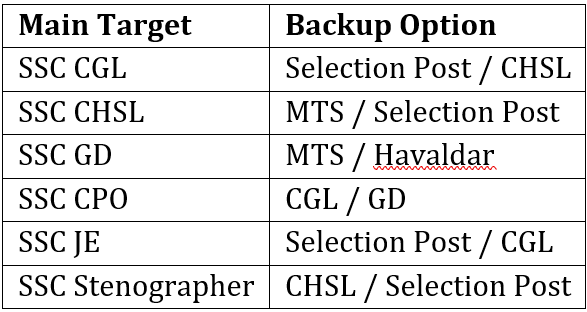
At Career Wave, we advise students to first check qualification, age limit, job preference and exam pattern before choosing the main target.

Mistake 2: Not Understanding the Syllabus Properly
Many students start studying without reading the official syllabus. They follow books or videos blindly and end up studying unnecessary topics.
Why This is a Mistake
If you do not know the syllabus:
• You may miss important topics
• You may waste time on low-value topics
• Revision becomes unorganized
• Mock test performance remains unstable
Correct Approach
Before starting preparation, write down the syllabus of your target exam.
For most SSC exams, common subjects are:
• Quantitative Aptitude
• Reasoning
• English
• General Awareness
Some exams may also include:
• Computer Knowledge
• Typing Test
• Skill Test
• Physical Test
• Technical Subject
• Translation or Essay
Keep the syllabus visible in your study area. It keeps your preparation focused.

Mistake 3: Ignoring the Exam Pattern
Syllabus tells what to study. Exam pattern tells how the exam will test you.
Many students know the subjects but do not understand:
• Number of questions
• Total marks
• Time limit
• Negative marking
• Sectional weightage
• Qualifying sections
• Skill or physical stages
Why This is a Mistake
Without exam pattern clarity, students cannot build a proper attempt strategy.
Correct Approach
Understand:
• How many questions are asked?
• How much time is given?
• Which section has more marks?
• Is negative marking applicable?
• Is typing or physical test required?
• Is final merit based on one stage or multiple stages?
A student preparing for SSC CHSL should know Tier-I and Tier-II pattern. A student preparing for SSC GD should know written plus physical stages. A student preparing for SSC JE should know the importance of technical subjects.

Mistake 4: Collecting Too Many Books and Sources
This is one of the biggest mistakes in SSC preparation. Many students think more books mean better preparation.
They buy multiple books for Quant, Reasoning, English, GK and mocks. Then they become confused and complete none of them properly.
Why This is a Mistake
Too many sources create:
• Confusion
• Repetition
• Incomplete preparation
• Weak revision
• Time waste
• Low confidence
Correct Approach
Use limited and standard sources.
A simple source plan:
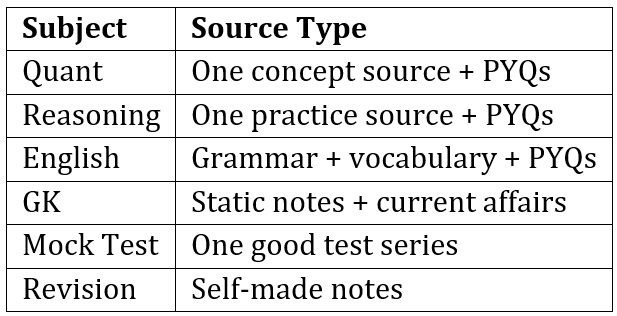
At Career Wave, we recommend: fewer sources, more revision.

Mistake 5: Running Behind Shortcuts from Day One
Shortcuts are useful, but only after concept clarity. Beginners often try to learn tricks without understanding the basic method.
Why This is a Mistake
Without concept clarity:
• Shortcuts become confusing
• Mistakes increase
• New question types become difficult
• Accuracy decreases
Correct Approach
Follow this order:
1. Understand concept
2. Learn formula
3. Solve basic questions
4. Practice previous year questions
5. Learn shortcut
6. Apply in timed practice
Shortcuts should improve speed, not replace understanding.

Mistake 6: Ignoring Basic Maths
Many SSC aspirants fear Maths and delay it. Some students study only Reasoning and GK because Maths feels difficult.
Why This is a Mistake
Quantitative Aptitude is important in exams like SSC CGL, CHSL, CPO, MTS and GD. Weak Maths can reduce overall score.
Important Maths Topics
• Number System
• Simplification
• Percentage
• Ratio and Proportion
• Average
• Profit and Loss
• Simple Interest
• Compound Interest
• Time and Work
• Time, Speed and Distance
• Mensuration
• Data Interpretation
Correct Approach
Start with arithmetic. Build basic calculation speed. Revise formulas daily. Solve topic-wise questions before full mocks.

Mistake 7: Ignoring English
Many Hindi-medium students avoid English because they think it is difficult. But English is a scoring subject if prepared regularly.
Why This is a Mistake
English can decide selection in many SSC exams, especially CGL, CHSL, CPO and Stenographer.
Important English Topics
• Grammar
• Vocabulary
• Error Detection
• Sentence Improvement
• Cloze Test
• Reading Comprehension
• Synonyms and Antonyms
• Idioms and Phrases
• One Word Substitution
• Active and Passive Voice
• Direct and Indirect Speech
Correct Approach
Study English daily.
Daily English plan:
• 10 vocabulary words
• 10 grammar questions
• 1 reading passage
• 5 error detection questions
• 5 sentence improvement questions
English improves slowly but strongly with consistency.

Mistake 8: Studying GK Without Revision
General Awareness is a wide subject. Many students keep reading new GK material but do not revise old facts.
Why This is a Mistake
GK is memory-based. Without revision, students forget most facts.
Correct Approach
Use a revision-based GK strategy.
Focus on:
• History
• Polity
• Geography
• Economy
• General Science
• Static GK
• Current Affairs
• Important Days
• Awards
• Sports
• Government Schemes
Make short notes and revise them repeatedly.
At Career Wave, we advise students not to collect unlimited GK. Study limited material and revise it multiple times.

Mistake 9: Not Solving Previous Year Questions
Previous year questions are the backbone of SSC preparation. Still, many students ignore PYQs and keep solving random questions.
Why This is a Mistake
PYQs show:
• Real exam level
• Repeated topics
• Question pattern
• Difficulty level
• Important areas
• Time requirement
Correct Approach
Solve PYQs in two stages:
1. Topic-wise PYQs
2. Year-wise PYQs
After completing each topic, solve previous year questions from that topic. This makes preparation exam-oriented.

Mistake 10: Giving Mock Tests Without Analysis
Many students give mock tests regularly but do not analyze them properly. They only check marks and rank.
Why This is a Mistake
Mock test score only shows performance. Mock analysis shows improvement direction.
Without analysis, the same mistakes repeat.
Correct Approach
After every mock, check:
• Which questions were wrong?
• Which topic is weak?
• Which questions took extra time?
• Which mistakes were silly?
• Which mistakes were due to guesswork?
• Which section needs revision?
Make an error notebook and revise it weekly.

Mistake 11: Attempting Too Many Questions Blindly
In SSC exams, accuracy is very important because negative marking can reduce the score. Many students attempt too many doubtful questions in mock tests and actual exams.
Why This is a Mistake
Blind guessing leads to:
• Negative marks
• Low accuracy
• Reduced final score
• Poor rank
Correct Approach
Attempt questions smartly.
A good attempt strategy:
• Easy questions first
• Moderate questions next
• Difficult questions later
• Avoid blind guessing
• Guess only after eliminating options
• Maintain accuracy above speed
Accuracy is more important than unnecessary high attempts.

Mistake 12: Not Managing Time in the Exam
Some students spend too much time on one difficult question and lose easy marks later.
Why This is a Mistake
SSC exams are time-bound. Poor time management can reduce score even if you know the answers.
Correct Approach
Use the 30-second rule.
If you do not understand the direction of a question within 30–40 seconds, leave it and move ahead.
Return to it later if time remains.

Mistake 13: Ignoring Calculation Practice
Many students know formulas but make calculation mistakes. This affects Quant score badly.
Common Calculation Issues
• Wrong multiplication
• Percentage error
• Decimal mistake
• Unit confusion
• Wrong approximation
• Slow calculation
Correct Approach
Practice daily:
• Tables
• Squares
• Cubes
• Percentage values
• Fraction values
• Simplification
• Approximation
Calculation speed can improve only through regular practice.

Mistake 14: No Revision Plan
Students often complete topics once and then move to new topics. They forget old topics before the exam.
Why This is a Mistake
SSC selection depends on retention. Without revision, preparation becomes weak.
Correct Approach
Follow a weekly revision plan.
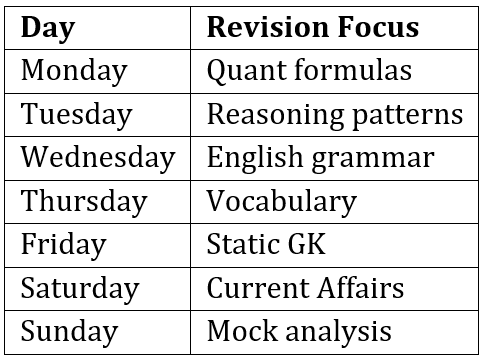
Revision should be part of daily study, not a last-month activity.

Mistake 15: Changing Strategy Again and Again
Many aspirants change their preparation strategy after every low mock score or after watching a new topper video.
Why This is a Mistake
Frequent strategy change leads to:
• Confusion
• Lack of consistency
• Incomplete syllabus
• Low confidence
Correct Approach
Follow one plan for at least 30 days. Then review your performance and make small corrections.
Do not change your entire strategy every week.

Mistake 16: Ignoring Physical Test in GD, CPO and Havaldar
Students preparing for SSC GD, CPO or Havaldar sometimes focus only on written exam and ignore physical preparation.
Why This is a Mistake
If you fail PET/PST, written marks will not help.
Correct Approach
Prepare written and physical stages together.
Physical preparation should include:
• Running
• Stretching
• Stamina building
• Strength training
• Height/chest standard awareness
• Medical fitness
• Proper sleep and diet
At Career Wave, we strongly advise GD and CPO aspirants to start running from day one.

Mistake 17: Ignoring Typing or Skill Test
CHSL, Stenographer and some other SSC posts require skill tests. Many students start typing or shorthand only after written result.
Why This is a Mistake
Skill cannot be developed overnight.
Correct Approach
If your exam requires typing, data entry or shorthand, start early.
Skill-based preparation:
• Daily typing practice
• Shorthand practice for Stenographer
• Computer familiarity
• Accuracy tracking
• Timed practice
Skill test may be qualifying, but failing it can stop final selection.

Mistake 18: Preparing Without an Error Notebook
An error notebook is very useful, but most students do not maintain it.
What to Write in Error Notebook
• Wrong formulas
• Grammar mistakes
• GK facts
• Repeated mock mistakes
• Calculation errors
• Difficult question types
• Short tricks
• Important PYQ observations
Correct Approach
Update the error notebook after every mock or practice session. Revise it every week.

Mistake 19: Comparing Yourself With Others
Many students lose confidence by comparing their mock scores with friends or toppers.
Why This is a Mistake
Every student has a different starting level, study time and background.
Correct Approach
Compare your current performance with your previous performance.
Ask:
• Is my accuracy improving?
• Are silly mistakes reducing?
• Is my speed improving?
• Are weak topics reducing?
• Am I more confident than last month?
Your real competition is your previous version.

Mistake 20: Lack of Consistency
SSC preparation rewards consistency. Many students study intensely for a few days and then stop.
Why This is a Mistake
Irregular preparation breaks momentum.
Correct Approach
Study daily, even if for limited hours.
A beginner can start with:
• 1 hour Quant
• 1 hour Reasoning
• 1 hour English
• 45 minutes GK
• 30 minutes revision
• 30 minutes practice
Consistency beats irregular hard work.

Exam-Wise Common Mistakes
SSC CGL Mistakes
• Ignoring Tier-II preparation
• Weak Quant practice
• Not preparing English deeply
• Not analyzing mocks
• Poor post preference understanding
SSC CHSL Mistakes
• Preparing only Tier-I
• Ignoring typing test
• Weak computer knowledge
• Not practicing speed-based questions
SSC MTS Mistakes
• Taking the exam lightly
• Ignoring GK revision
• Weak basic Maths
• Not practicing enough mock tests
SSC GD Mistakes
• Ignoring physical fitness
• Not checking height/chest standards
• Weak Maths and GK
• Not preparing running from day one
SSC CPO Mistakes
• Ignoring PET/PST
• Weak English Paper-II preparation
• Not checking medical standards
• Preparing like CGL only
SSC JE Mistakes
• Ignoring technical subjects
• Weak formula revision
• Not solving technical PYQs
• Preparing non-technical section too late
SSC Stenographer Mistakes
• Ignoring shorthand practice
• Starting transcription late
• Preparing only CBT
• Weak typing accuracy

How to Avoid Common SSC Preparation Mistakes
Step 1: Choose the Right Exam
Check qualification, age limit, job profile and exam pattern.
Step 2: Follow Limited Sources
Use one good source per subject and revise repeatedly.
Step 3: Study According to Syllabus
Do not study random topics.
Step 4: Solve PYQs
Previous year questions should be part of every topic.
Step 5: Give Mock Tests
Start with topic tests, then sectional tests, then full mocks.
Step 6: Analyze Mocks
Identify concept mistakes, silly mistakes, time mistakes and guesswork mistakes.
Step 7: Revise Regularly
Revision is the key to retention.
Step 8: Prepare Extra Stages
Typing, physical test, skill test or technical subjects should not be ignored.

Career Wave Guidance for SSC Aspirants
At Career Wave, our advice is clear: SSC preparation should be systematic, not random.
A serious SSC aspirant should follow this cycle:
1. Understand exam
2. Check eligibility
3. Study syllabus
4. Build basics
5. Practice PYQs
6. Attempt mocks
7. Analyze mistakes
8. Revise regularly
9. Improve accuracy
10. Stay consistent
Most students do not fail because they lack ability. They fail because they repeat avoidable mistakes.
Career Wave helps students prepare with clarity, structured planning, exam-wise strategy, mock analysis and disciplined revision.

FAQs
Q1. What is the biggest mistake in SSC preparation?
The biggest mistake is preparing without a clear exam target and syllabus understanding.
Q2. Is it necessary to solve previous year questions for SSC?
Yes. PYQs are very important because they show real exam pattern, repeated topics and actual difficulty level.
Q3. How many sources should I use for SSC preparation?
Use limited sources. One standard source per subject plus PYQs and mock tests is enough for most students.
Q4. Should I start mock tests from the first day?
Beginners should start with topic-wise tests first. Full mocks should begin after basic syllabus coverage.
Q5. Why is my mock score not improving?
Your score may not improve because of poor analysis, weak revision, low accuracy, repeated mistakes or too much guessing.
Q6. How can I improve accuracy in SSC exams?
Avoid blind guessing, revise concepts, read questions carefully, analyze mistakes and maintain an error notebook.
Q7. Is revision important for SSC?
Yes. Revision is essential, especially for formulas, grammar, vocabulary, GK and mock mistakes.
Q8. Should I prepare for all SSC exams together?
No. Choose one main exam and one backup exam. Preparing for too many exams randomly can reduce focus.

Conclusion
Common mistakes in SSC preparation can reduce score even if a student studies hard. Mistakes like unclear target, weak syllabus understanding, no revision, poor mock analysis, blind guessing, ignoring PYQs and avoiding skill or physical tests can badly affect selection chances.
The solution is simple: choose the right exam, follow the syllabus, build concepts, practice previous year questions, analyze mocks and revise consistently.
At Career Wave, we believe that smart preparation is not about studying everything. It is about studying the right things in the right way. If students avoid these common mistakes and follow a disciplined strategy, SSC preparation becomes more focused, practical and result-oriented.