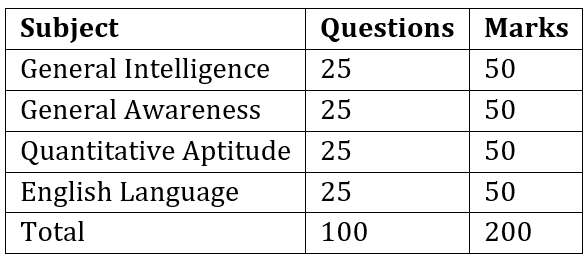
Key Points
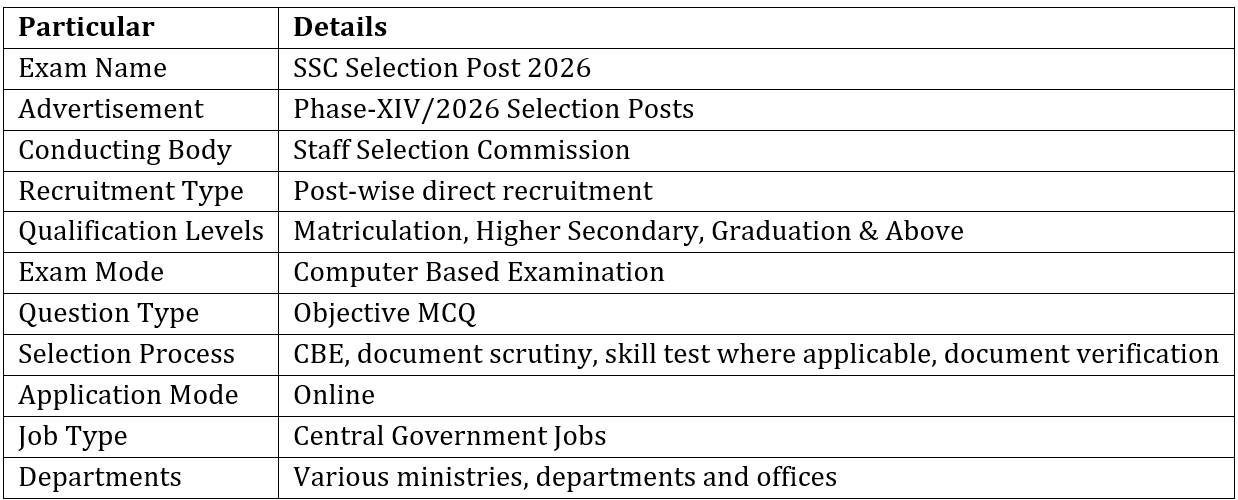
• Mode: Computer Based Examination
• Type: Objective MCQ
• Total Questions: 100
• Total Marks: 200
• Duration: 60 minutes
• Sectional Timer: 15 minutes for each part
• Negative Marking: 0.50 marks for each wrong answer
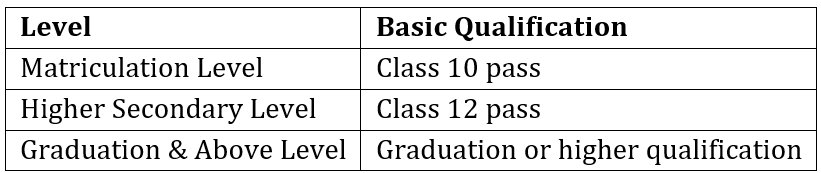
• Exam is conducted separately for different qualification levels
• Marks may be normalized if the exam is conducted in multiple shifts
The syllabus is based on qualification level. The overall subjects are the same, but difficulty level changes.
1. General Intelligence
This section checks reasoning and logical ability.
Important topics:
• Similarities and Differences
• Space Visualization
• Problem Solving
• Analysis
• Judgment
• Decision Making
• Visual Memory
• Relationship Concepts
• Figure Classification
• Number Series
• Non-Verbal Series
• Coding-Decoding
• Analogy
• Classification
• Direction Sense
• Blood Relation
• Syllogism
• Venn Diagram
Preparation Tips
• Practice reasoning daily.
• Start with easy topics.
• Solve topic-wise questions.
• Practice previous year questions.
• Give timed reasoning quizzes.
• Avoid overthinking.
2. General Awareness
This section checks general knowledge and awareness of current events.
Important topics:
• History
• Culture
• Geography
• Indian Polity
• Indian Constitution
• Economy
• Sports
• General Science
• Scientific Research
• Current Affairs
• Important Days
• Awards and Honours
• Books and Authors
• Government Schemes
• India and neighbouring countries
Preparation Tips
• Make short notes.
• Revise static GK regularly.
• Practice MCQs.
• Read monthly current affairs.
• Focus on repeated SSC topics.
• Avoid unlimited GK sources.
3. Quantitative Aptitude
This section checks basic arithmetic and numerical ability.
Important topics:
• Number System
• Whole Numbers
• Decimals and Fractions
• Relationship Between Numbers
• Fundamental Arithmetic Operations
• Percentage
• Ratio and Proportion
• Average
• Interest
• Profit and Loss
• Discount
• Time and Work
• Time and Distance
• Mensuration
• Tables and Graphs
Preparation Tips
• Start with arithmetic.
• Learn formulas.
• Practice calculation daily.
• Solve easy questions first.
• Move to PYQs.
• Revise formulas weekly.
4. English Language
This section checks basic English understanding.
Important topics:
• Vocabulary
• Grammar
• Sentence Structure
• Synonyms
• Antonyms
• Correct Usage
• Error Detection
• Fill in the Blanks
• Sentence Improvement
• Spellings
• Idioms and Phrases
• One Word Substitution
• Reading Comprehension
Preparation Tips
• Practice grammar daily.
• Learn vocabulary regularly.
• Solve previous year questions.
• Read short passages.
• Revise errors after mocks.
• Focus on accuracy.
The selection process generally includes:
1. Online Application
2. Computer Based Examination
3. Result and Shortlisting
4. Uploading of Documents
5. Scrutiny of Documents by User Department
6. Skill Test, wherever applicable
7. Document Verification
8. Final Selection and Nomination
Stage 1: Online Application
Candidates apply online for the post categories for which they are eligible.
Stage 2: Computer Based Examination
Candidates appear in the CBE according to qualification level.
Stage 3: Result and Shortlisting
Candidates are shortlisted based on marks, post-wise vacancies and cut-off.
Stage 4: Document Upload
Qualified candidates have to upload relevant documents on the portal.
Stage 5: Scrutiny of Documents
User departments scrutinize documents and verify whether candidates meet eligibility conditions.
Stage 6: Skill Test
If the post requires typing, data entry, computer proficiency or any other skill, candidates have to qualify the skill test.
Stage 7: Document Verification
Document verification is carried out by the concerned user department as per procedure.
Stage 8: Final Selection
Final selection is made according to merit, eligibility, vacancy and department rules.
In SSC Selection Post, the application is accepted provisionally. SSC does not verify every eligibility detail at the time of application.
Detailed scrutiny is done after the CBE result by the user department.
This means a candidate may be allowed to appear in the exam, but candidature can still be rejected later if eligibility, qualification, experience, age or category certificate is not valid.
Career Wave Advice
Do not apply casually. Before applying, check eligibility carefully. A wrong application may waste time, money and effort.
Selection Post has many post categories. Choosing the right post is very important.
Check These Before Applying
• Qualification level
• Subject requirement
• Age limit
• Experience requirement
• Skill test
• Pay level
• Posting region
• Department name
• Job profile
• Category-wise vacancy
• Physical or medical requirement, if any
Example
A graduate candidate should not apply only because a post is under Graduation level. They must check whether the post requires a specific subject, computer knowledge, experience or language proficiency.
Similarly, a 12th pass candidate must check whether the post requires Science, Mathematics, typing skill or technical certificate.
SSC Selection Post Salary
Salary is post-wise. Different posts have different pay levels.
Common pay levels may range from lower-level posts to higher-level posts depending on qualification and department.
Salary Components
Selected candidates may receive:
• Basic Pay
• Dearness Allowance
• House Rent Allowance
• Transport Allowance
• Medical benefits
• Leave benefits
• Pension-related benefits as per rules
• Other applicable government benefits
Important Point
Do not judge a post only by salary. Check job profile, location, skill requirement and growth opportunity also.
1. Prepare According to Your Qualification Level
If you are applying for Matriculation level posts, prepare according to 10th-level questions.
If you are applying for Higher Secondary level posts, prepare 12th-level questions.
If you are applying for Graduation & Above level posts, prepare graduation-level difficulty.
2. Focus on Four Main Subjects
The exam has four subjects:
• General Intelligence
• General Awareness
• Quantitative Aptitude
• English Language
Give equal importance to all four because each subject has 50 marks.
3. Practice With Sectional Timer
Selection Post exam has sectional timing. So candidates must practice with time limit.
Recommended practice:
• 15 minutes Reasoning
• 15 minutes GK
• 15 minutes Quant
• 15 minutes English
4. Solve Previous Year Questions
PYQs help understand real exam level and repeated topics.
5. Give Mock Tests
Mock tests help improve:
• Speed
• Accuracy
• Time management
• Sectional discipline
• Question selection
6. Revise Regularly
Revision is necessary for:
• GK facts
• English vocabulary
• Maths formulas
• Reasoning patterns
• Mock mistakes
7. Maintain an Error Notebook
Write down:
• Wrong formulas
• Repeated mistakes
• GK facts you forgot
• Grammar rules
• Mock errors
• Difficult questions
First 20 Days: Basic Foundation
Focus on:
• Syllabus understanding
• Exam pattern
• Basic Maths
• Basic Reasoning
• English grammar
• Static GK
• Current affairs
Next 20 Days: Practice Phase
Focus on:
• Topic-wise MCQs
• Previous year questions
• Sectional tests
• Formula revision
• GK revision
• Vocabulary practice
Final 20 Days: Mock and Revision Phase
Focus on:
• Full mock tests
• Sectional timer practice
• Error notebook
• PYQ revision
• GK short notes
• English vocabulary
• Accuracy improvement
• Applying without checking post-wise eligibility
• Ignoring experience requirement
• Not checking age limit
• Applying for wrong post category
• Not applying separately for multiple posts
• Filling wrong region or post code
• Ignoring skill test requirement
• Not keeping documents ready
• Not practicing with sectional timer
• Studying without syllabus
• Giving mocks without analysis
• Ignoring document scrutiny stage
• Depending on only one subject
Candidates should keep these documents ready:
• Class 10 certificate for date of birth
• Class 10 marksheet
• Class 12 marksheet and certificate, if applicable
• Graduation marksheets and degree, if applicable
• Diploma/certificate, if applicable
• Experience certificate, if required
• Category certificate, if applicable
• OBC-NCL certificate, if applicable
• EWS certificate, if applicable
• PwBD certificate, if applicable
• Ex-servicemen documents, if applicable
• Photo ID proof
• Application form printout
• Skill-related certificate, if applicable
• No Objection Certificate, if already employed
Document mismatch or missing documents can lead to rejection.
At Career Wave, our guidance for Selection Post aspirants is simple: read the post details carefully before applying.
Selection Post is not like one common exam for one common post. It is post-wise recruitment. Every post has its own eligibility, age limit, pay level, experience requirement and sometimes skill test.
A serious aspirant should follow this process:
1. Check post details.
2. Match qualification and age.
3. Check experience and skill requirements.
4. Apply separately for each suitable post.
5. Prepare four subjects equally.
6. Practice with sectional timer.
7. Solve PYQs and mocks.
8. Keep documents ready.
9. Upload documents on time after result.
10. Track regional office updates.
SSC Selection Post can become a strong opportunity for 10th, 12th and graduate candidates if they apply smartly and prepare consistently.
Q1. What is SSC Selection Post 2026?
SSC Selection Post 2026 is a post-wise recruitment process conducted by the Staff Selection Commission for various posts in central government ministries, departments and offices.
Q2. What is Phase-XIV/2026 Selection Posts?
Phase-XIV/2026 is the 2026 phase of SSC Selection Post recruitment. It includes multiple post categories across different qualification levels.
Q3. Who can apply for SSC Selection Post?
Candidates who meet post-wise eligibility can apply. Posts may be available for 10th pass, 12th pass and graduate candidates.
Q4. Is SSC Selection Post only for graduates?
No. SSC Selection Post includes Matriculation level, Higher Secondary level and Graduation & Above level posts.
Q5. What is the exam pattern of SSC Selection Post?
The exam has 100 questions for 200 marks. It includes General Intelligence, General Awareness, Quantitative Aptitude and English Language.
SSC Selection Post 2026 is a valuable opportunity for candidates from different educational levels. It provides post-wise recruitment in various central government departments and ministries. Candidates from 10th, 12th and graduation backgrounds can find suitable posts if they carefully check eligibility.
The most important point in Selection Post recruitment is post-wise awareness. Every post may have a different qualification, age limit, pay level, experience requirement and skill test condition.
At Career Wave, we advise every aspirant to apply carefully, read the post details properly, prepare all four subjects equally and keep documents ready. With the right post selection and focused preparation, SSC Selection Post 2026 can become a strong route to a stable government job.