AAI JE Airport Operations Syllabus 2026: Exam Pattern, Eligibility, Vacancies and Preparation
The Airports Authority of India has announced 79 vacancies for Junior Executive (Operations) under the AAI Recruitment 2026. This post offers an opportunity for eligible Science graduates with an MBA and Engineering graduates to build a career in airport operations and aviation management.
The AAI JE Operations examination covers both technical and non-technical subjects. Candidates must prepare Physics, Mathematics, Business Management, Reasoning, English, Quantitative Aptitude, General Awareness and aviation-related topics.
In this article, Career Wave provides the complete AAI JE Airport Operations syllabus, eligibility criteria, vacancy distribution, exam pattern and preparation approach recommended by Satyendra Sir.

AAI JE Airport Operations Recruitment 2026: Overview
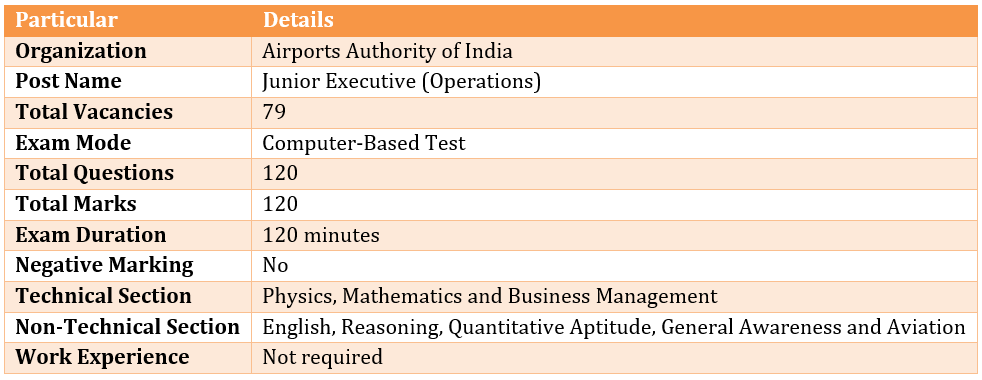
AAI JE Operations Vacancy 2026
A total of 79 vacancies have been announced for Junior Executive Operations.
Category-Wise Vacancy Distribution
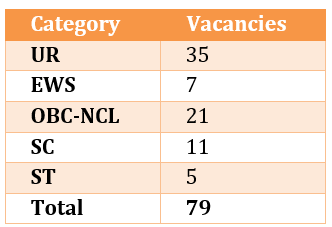
The vacancies also include identified PwBD seats under the applicable categories mentioned in the official notification.

AAI JE Airport Operations Eligibility Criteria 2026
Candidates must possess either of the following educational qualifications:
Option 1: Science Graduate with MBA
• Graduation in Science
• Full-time regular MBA of two years’ duration
Option 2: Engineering Graduate
• Full-time regular Bachelor’s Degree in Engineering
An Engineering graduate does not need an MBA to apply for Junior Executive Operations.
Is Work Experience Required?
No. The minimum required work experience for the Junior Executive Operations post is listed as Nil.
Fresh graduates who fulfil the prescribed educational qualification can apply.
Important Qualification Clarification
A candidate having only a B.Sc. degree without a two-year full-time regular MBA does not satisfy the qualification mentioned for this post.
Similarly, the MBA mentioned in the qualification should be a full-time regular MBA of two years’ duration.

AAI JE Airport Operations Exam Pattern 2026
The examination will be conducted through a Computer-Based Test.
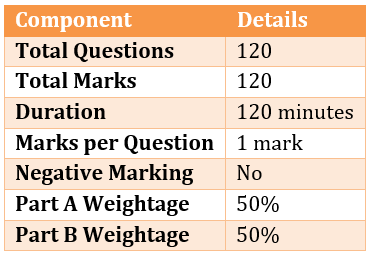
The paper is divided into two major sections:
• Part A: Non-Technical Subjects
• Part B: Subjects related to the prescribed educational qualification

AAI JE Airport Operations Subject-Wise Weightage
Part A: Non-Technical Section
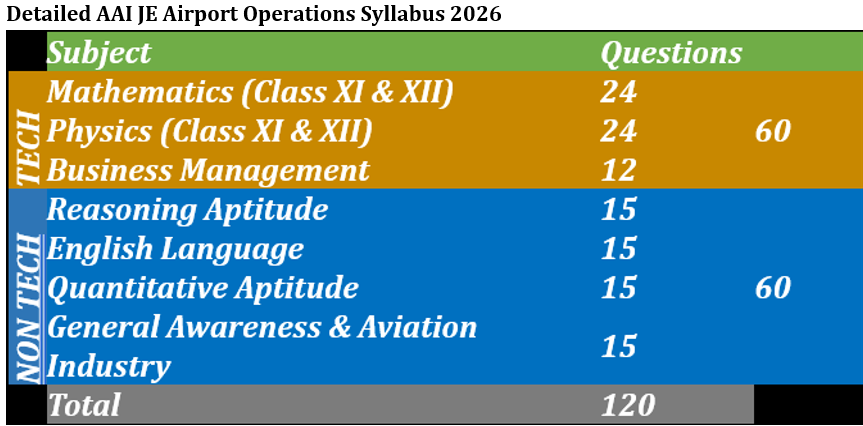
Part A carries 50% weightage, equivalent to approximately 60 questions.
The section includes:
• General Knowledge
• General English
• Quantitative Aptitude
• Reasoning Ability
• Aviation Awareness
According to the syllabus, 20% of Part A will cover aviation-related topics. In a 60-question Part A section, this is equivalent to approximately 12 aviation-based questions.
AAI has not provided a fixed individual question distribution for English, Reasoning, Quantitative Aptitude and General Knowledge in the syllabus extract. Therefore, candidates should prepare every subject properly rather than depending on an assumed subject-wise breakup.
Part B: Technical and Management Section
Part B also carries 50% weightage, equivalent to 60 questions.

Part A: General English
The English section evaluates a candidate’s understanding of grammar, vocabulary and comprehension.
Important areas include:
• Reading comprehension
• Error detection
• Sentence correction
• Fill in the blanks
• Synonyms and antonyms
• One-word substitution
• Idioms and phrases
• Active and passive voice
• Direct and indirect speech
• Para jumbles
• Sentence arrangement
• Vocabulary
• Basic grammar rules
Candidates should focus on accuracy because English questions are generally scoring when grammar rules and vocabulary are revised regularly.
Part A: Quantitative Aptitude
The Quantitative Aptitude section checks numerical ability and calculation skills.
Important topics include:
• Number system
• Simplification
• Percentage
• Ratio and proportion
• Average
• Profit and loss
• Discount
• Simple and compound interest
• Time and work
• Pipes and cisterns
• Time, speed and distance
• Boats and streams
• Mixture and allegation
• Partnership
• Data interpretation
• Mensuration
• Basic algebra
• Probability and statistics
Regular calculation practice is essential for improving speed in this section.
Part A: Reasoning Ability
The Reasoning section may contain both verbal and non-verbal reasoning questions.
Important topics include:
• Coding and decoding
• Blood relations
• Direction and distance
• Order and ranking
• Syllogism
• Inequality
• Analogy
• Classification
• Number series
• Alphabet series
• Statement and conclusion
• Statement and assumption
• Seating arrangement
• Puzzle
• Venn diagram
• Data sufficiency
• Clock and calendar
• Dice
• Cube and cuboid
• Mirror and water images
• Figure counting
• Non-verbal series
Candidates should practise timed question sets because reasoning can consume substantial time without a proper solving approach.
General Awareness Syllabus
The General Awareness section includes static knowledge, current affairs and developments related to India and the world.
Important areas include:
• Current affairs
• Indian history
• Indian polity
• Indian economy
• Indian geography
• General science
• Science and technology
• Sports
• Important national and international days
• Awards and honours
• Books and authors
• Government schemes
• National and international organizations
• Airports in India
• Airport codes
• Civil aviation
• Airports Authority of India
Candidates should pay special attention to current developments in infrastructure, airports, airlines, aviation policies and the civil aviation sector.
Aviation Awareness Syllabus
Aviation Awareness is one of the most important areas of the AAI JE Operations examination.
The syllabus includes the following topics:
Aviation Abbreviations
Candidates should understand important abbreviations such as:
• ICAO
• BCAS
• DGCA
• IATA
• FAA
• AERA
• AAI
• AI
• ACI
• ATC
• ATM
• ATS
• IAF
• IATA
Airport Terminology
Questions may be asked from definitions and functions of:
• Airport
• Aerodrome
• Runway
• Taxiway
• Apron
• Parking stand
• Aircraft
• Aeroplane
• Terminal building
Airlines Operating in India
Candidates should study:
• Domestic airlines
• International airlines operating in India
• Airline headquarters
• Airline codes
• Major routes and hubs
Basic Airport Operations
This area includes:
• Airside operations
• Landside operations
• Terminal operations
• Ground handling
• Apron management
• Aircraft movement
• Passenger handling
• Airport safety procedures
Passenger Journey at an Airport
Candidates should understand the passenger journey from the city side to boarding the aircraft, including:
• Entry into the terminal
• Check-in
• Baggage handling
• Security screening
• Immigration
• Customs
• Boarding gate procedures
• Aircraft boarding
Airport Security and Fire Services
Important areas include:
• Functions of airport security
• Role of BCAS
• Airport Rescue and Fire Fighting
• Emergency response
• Security screening
• Restricted airport areas
Aircraft and Aerodynamics
Candidates should prepare:
• Aircraft categories
• Basic aircraft components
• Aircraft manufacturing companies
• Fundamentals of aerodynamics
• Types of aircraft
• Basic principles of flight
Aviation Organizations and Regulators
Important organizations include:
• ICAO
• AAI
• DGCA
• BCAS
• AERA
• IATA
• Airports Council International
• Joint venture airport operators
Candidates should know the roles, headquarters and major functions of these organizations.
Aviation Meteorology
Important topics include:
• Fog
• Mist
• Haze
• Visibility
• METAR
• SPECI
• Wind direction
• Weather impact on airport operations
Agencies Working at Airports
Candidates should understand the functions of:
• Immigration
• Customs
• Airlines
• Airport operator
• Security agencies
• Ground handling agencies
• Air Traffic Control
• Airport health organization
• Fire services
Additional Aviation Areas
• Government policies related to aviation
• Major international and domestic airports
• Airport names and locations
• Airport codes
• Civil aviation developments
• Greenfield airports
• Regional connectivity
• Airport privatization
• Any other aviation-related knowledge
Part B: Physics Syllabus
The notification mentions Physics at the Class XII level. However, candidates should also revise supporting Class XI concepts because many numerical problems require fundamental knowledge from both classes.
Recommended Physics Coverage
Class XI Foundation
• Units and measurements
• Motion in a straight line
• Motion in a plane
• Laws of motion
• Work, energy and power
• System of particles and rotational motion
• Gravitation
• Mechanical properties of solids
• Mechanical properties of fluids
• Thermal properties of matter
• Thermodynamics
• Kinetic theory of gases
• Oscillations
• Waves
Class XII Topics
• Electric charges and fields
• Electrostatic potential and capacitance
• Current electricity
• Moving charges and magnetism
• Magnetism and matter
• Electromagnetic induction
• Alternating current
• Electromagnetic waves
• Ray optics
• Wave optics
• Dual nature of radiation and matter
• Atoms
• Nuclei
• Semiconductor electronics
Physics preparation should include formulas, concepts, numerical problems and previous-year questions.
Part B: Mathematics Syllabus
The Mathematics questions are prescribed at the Class XII level. Candidates should revise Class XI foundations wherever required.
Recommended Mathematics Coverage
• Sets
• Relations and functions
• Trigonometric functions
• Complex numbers
• Quadratic equations
• Linear inequalities
• Permutations and combinations
• Binomial theorem
• Sequence and series
• Straight lines
• Conic sections
• Limits and derivatives
• Mathematical reasoning
• Statistics
• Probability
• Matrices
• Determinants
• Continuity and differentiability
• Applications of derivatives
• Integrals
• Applications of integrals
• Differential equations
• Vector algebra
• Three-dimensional geometry
• Linear programming
Candidates should practise formula-based as well as application-based questions.
Business Management Syllabus
Business Management carries 20% weightage in Part B, which is equivalent to approximately 12 questions.
Candidates should understand the basic concepts of management and organizational behaviour.
Important topics include:
• Principles of management
• Planning
• Organising
• Staffing
• Directing
• Controlling
• Decision-making
• Leadership
• Motivation
• Communication
• Marketing management
• Human resource management
• Financial management
• Business environment
• Organizational behaviour
• Functions of management
• Management theories
• Coordination
• Business ethics
This section can be highly scoring when candidates prepare concise notes and revise definitions, functions and principles regularly.

How to Prepare for AAI JE Airport Operations 2026
According to Satyendra Sir, candidates should not prepare this examination like a general aptitude test. The paper contains an equal balance of technical and non-technical subjects, so both sections must be covered systematically.
1. Complete Physics and Mathematics First
Physics and Mathematics together account for approximately 48 questions. These subjects can significantly influence the final score.
Candidates should:
• Prepare chapter-wise formulas
• Solve concept-based numerical questions
• Revise NCERT-level theory
• Practise AAI and similar examination PYQs
• Maintain a formula revision notebook
2. Do Not Ignore Business Management
Business Management contributes approximately 12 questions. It requires less calculation and can become a high-scoring section with proper revision.
Prepare short notes for:
• Definitions
• Functions
• Principles
• Management thinkers
• Leadership theories
• Motivation theories
• Marketing and HR concepts
3. Build Aviation Knowledge Separately
Aviation questions should not be treated as ordinary current affairs.
Prepare separate notes for:
• Aviation organizations
• Airport terminology
• Indian airports
• Airport codes
• Airlines
• Aviation policies
• Aircraft manufacturers
• Airport operations
• Aviation meteorology
4. Practise Non-Technical Subjects Daily
Use a daily practice schedule for:
• English
• Reasoning
• Quantitative Aptitude
• General Awareness
Even 20–30 questions from each subject every day can improve speed and accuracy.
5. Use the No-Negative-Marking Advantage Carefully
There is no negative marking, but random guessing should not replace preparation.
Attempt strategy should be:
1. Solve direct questions first.
2. Complete strong subjects.
3. Return to lengthy calculations.
4. Use elimination for doubtful questions.
5. Attempt every question before submitting the paper.
6. Take Full-Length Mock Tests
The actual examination contains 120 questions to be solved in 120 minutes.
Mock tests should help candidates develop:
• One-minute-per-question discipline
• Subject switching ability
• Accuracy under pressure
• Question selection
• Final review strategy

Career Wave AAI JE Operations 2026 Complete Selection Batch
Career Wave has designed a dedicated preparation programme for candidates targeting the AAI Junior Executive Operations examination.
Under the guidance of Satyendra Sir, the batch focuses on:
• Complete technical syllabus
• Physics and Mathematics preparation
• Business Management
• Aviation Awareness
• General Awareness
• English
• Reasoning
• Quantitative Aptitude
• Previous-year questions
• Practice tests and mock examinations
• Exam-oriented revision
Join the Complete Selection Batch
AAI JE Operations 2026 Complete Selection Batch
Get AAI Previous-Year Question Books
AAI PYQs and E-Books
Important Preparation Resources
Stay connected with Career Wave for classes, exam updates, aviation current affairs and preparation guidance.
• Career Wave YouTube Channel
• Career Wave Telegram Channel
• Career Wave Instagram
• Career Wave Facebook Page

Frequently Asked Questions
1. How many vacancies are available for AAI JE Operations 2026?
AAI has announced 79 vacancies for Junior Executive Operations.
2. What is the qualification for AAI Junior Executive Operations?
Candidates must have either:
• Graduation in Science with a two-year full-time regular MBA, or
• A full-time regular Bachelor’s Degree in Engineering.
3. Can a B.Sc. graduate apply without an MBA?
No. A Science graduate must also possess a two-year full-time regular MBA to meet the stated qualification.
4. Can a B.Tech or BE graduate apply without an MBA?
Yes. A candidate having a full-time regular Bachelor’s Degree in Engineering can apply without an MBA.
5. Is work experience required for AAI JE Operations?
No. Work experience is not required for the Junior Executive Operations post.
6. What is the AAI JE Operations exam pattern?
The examination consists of 120 questions carrying 120 marks. The total duration is 120 minutes.
7. Is there negative marking in AAI JE Operations examination?
No. There is no negative marking.
8. What is the weightage of technical and non-technical subjects?
Part A and Part B carry 50% weightage each. Therefore, the paper broadly contains 60 non-technical and 60 technical or qualification-related questions.
9. Can candidates apply for more than one AAI post?
Candidates can apply for multiple posts, provided they fulfil the eligibility conditions for each post. Separate registration and application fee are required for every post.

Final Preparation Advice
AAI JE Airport Operations is a balanced examination in which technical knowledge, aptitude and aviation awareness carry equal importance. Candidates should avoid preparing only Physics and Mathematics or only the non-technical section.
A disciplined approach consisting of syllabus completion, PYQ practice, formula revision, aviation notes and regular mock tests will provide the best preparation framework. With the structured guidance of Satyendra Sir and the exam-oriented resources provided by Career Wave, candidates can prepare each section in a planned and focused manner.