ARTICLE
How to Study Aviation Awareness for AAI AO: Complete Smart Strategy
CAREER WAVE | JULY 17, 2026
When students start preparing for AAI Junior Executive Airport Operations (AAI AO), Aviation Awareness often creates a different kind of confusion.
“What exactly should I study?”
“How deep should I go into aviation?”
“Should I read complete aviation books?”
“Are current aviation updates enough?”
The biggest mistake is treating Aviation Awareness like unlimited General Knowledge.
It is not.
For AAI AO preparation, your objective should be to build exam-oriented aviation knowledge through limited sources, proper topic selection, revision, MCQs and PYQs.
At Career Wave, Satyendra Sir recommends a simple approach:
Understand the aviation ecosystem first, identify high-value topics, make concise notes, practise questions and revise repeatedly.
Here is a practical strategy.
1. First Understand What Aviation Awareness Actually Means
Aviation Awareness is broader than simply memorising airport codes or airline names.
For exam preparation, you should understand the basic ecosystem around:
• Airports
• Airlines
• Civil aviation
• Airport operations
• Aviation organizations
• Regulatory bodies
• Airport terminology
• Aviation infrastructure
• Important aviation facts
• Indian aviation sector
• Current aviation developments
The objective is not to become an aviation engineer.
The objective is to develop enough aviation awareness to confidently handle exam-level questions.
2. Start with the Indian Aviation Ecosystem
Before memorising isolated facts, understand how Indian civil aviation is structured.
Start with major institutions and their roles.
Focus on organizations such as:
• Ministry of Civil Aviation
• Airports Authority of India
• Directorate General of Civil Aviation
• Bureau of Civil Aviation Security
• Aircraft Accident Investigation Bureau
For every organization, study:
Full Form → Role → Major Functions → Headquarters → Administrative Relationship → Important Facts
Do not merely memorise abbreviations.
For example, knowing the full form of DGCA is useful, but understanding what DGCA actually does makes related questions much easier.
3. Study AAI Properly
If you are preparing for an AAI examination, you should have a basic understanding of the organization itself.
Cover important areas such as:
• Airports Authority of India
• Basic history of AAI
• Role and functions
• Airport infrastructure
• Air navigation-related role
• Types of airports handled
• Important organizational facts
• Recent AAI developments
Students sometimes spend hours memorising random aviation trivia while ignoring the organization conducting the recruitment.
That is not an efficient strategy.
4. Learn Important Aviation Organizations
Aviation contains several national and international organizations.
You should know important organizations and distinguish their roles.
Examples include:
• ICAO
• IATA
• AAI
• DGCA
• BCAS
• AAIB
For each organization, prepare a small table:
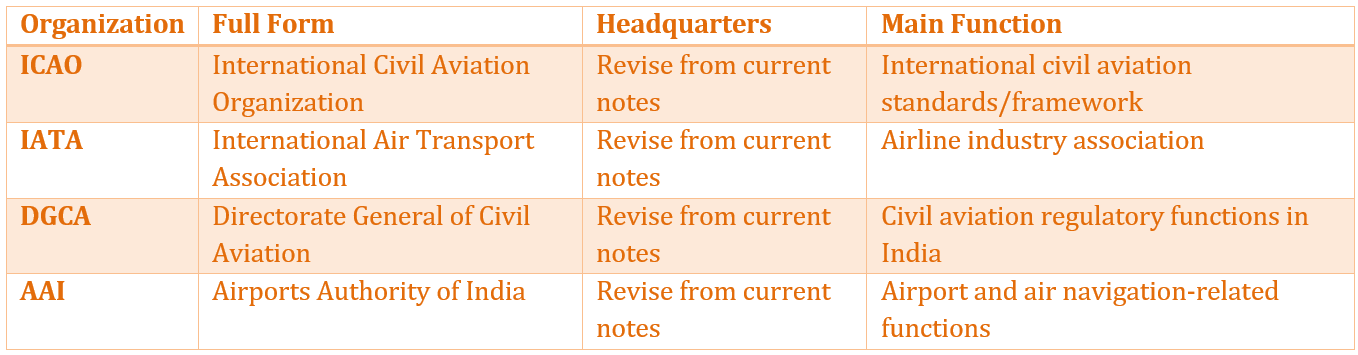
For headquarters, office-holders and other changeable facts, always revise from an updated source before the examination.
5. Airport Codes Are Important, but Don't Memorise Randomly
Airport codes can become confusing if you try to memorise a huge list at once.
Use categories.
First Priority
Major Indian airports and their IATA codes.
Second Priority
Important international airports frequently seen in aviation and current affairs.
Third Priority
Airports that have recently appeared in aviation news.
Use flashcards:
DEL → Delhi
BOM → Mumbai
BLR → Bengaluru
MAA → Chennai
CCU → Kolkata
Study a small set daily and revise repeatedly.
Do not attempt to memorise hundreds of codes in one sitting.
6. Understand Basic Airport Terminology
This is where conceptual preparation becomes useful.
You should know the meaning of common terms associated with airport operations and aviation.
Examples:
• Runway
• Taxiway
• Apron
• Terminal
• Hangar
• Aerodrome
• Airside
• Landside
• Boarding gate
• Aerobridge
• Check-in
• Baggage handling
• Ground handling
• ATC
• Flight Information
• NOTAM
Do not just memorise definitions.
Try to visualize where each component exists at an airport and what purpose it serves.
If you can mentally visualize an airport, many terminology-based questions become easier.
7. Learn Runway and Airport Basics Conceptually
Some aviation facts are easier when understood logically rather than memorised.
For example, students should understand at a basic level:
• What a runway is
• Why runway directions matter
• Basic runway numbering concept
• Difference between runway and taxiway
• Purpose of an apron
• Basic airport markings and signs
• Why aircraft need designated movement areas
You do not need unnecessary technical depth unless it is specifically relevant to the prescribed syllabus or PYQ trend.
The rule should be:
Exam Requirement First, Technical Depth Later.
8. Understand Basic Aircraft Terminology
You should also know basic terminology related to aircraft.
Focus on concepts such as:
• Fuselage
• Wings
• Cockpit
• Empennage
• Landing gear
• Engines
• Flaps
• Ailerons
• Rudder
• Elevator
Again, the objective is not to study complete aeronautical engineering.
You need enough understanding to identify important components and their basic purposes.
9. Study Aviation Abbreviations Separately
Aviation uses a large number of abbreviations.
If you mix all of them with regular notes, revision becomes difficult.
Maintain a dedicated abbreviation sheet.
For example:
AAI — Airports Authority of India
DGCA — Directorate General of Civil Aviation
ICAO — International Civil Aviation Organization
IATA — International Air Transport Association
BCAS — Bureau of Civil Aviation Security
AAIB — Aircraft Accident Investigation Bureau
ATC — Air Traffic Control
Keep adding important abbreviations as your preparation progresses.
A one- or two-page abbreviation sheet can become extremely useful during final revision.
10. Static Aviation + Current Aviation Must Be Prepared Together
Aviation Awareness should not be divided completely into static and current affairs.
They are connected.
Suppose a new airport appears in the news.
Do not only remember:
“A new airport was inaugurated.”
Also check:
• Location
• State
• Airport name
• Why it is important
• Operator, if relevant
• Related aviation project
• Important terminology associated with the news
This converts one current-affairs item into multiple possible exam questions.
11. What Aviation Current Affairs Should You Follow?
Do not collect every aviation news article.
Focus on exam-relevant developments such as:
• New airports
• Airport inaugurations
• Major airport projects
• New aviation policies
• Important government schemes
• Major AAI developments
• Significant regulatory developments
• Important aviation agreements
• Major international aviation developments
• Important appointments when relevant
• Significant airline and airport developments
Current affairs should be filtered, not accumulated.
12. Avoid Reading Aviation News Every Day Without a System
Reading random news daily may feel productive, but it can create information overload.
A better system is:
Weekly Aviation Current Affairs → Monthly Compilation → Final Revision Notes
For example:
Every week, identify only the most important aviation developments.
At the end of the month, reduce them to a concise revision sheet.
Before the examination, revise those consolidated sheets rather than hundreds of news articles.
13. Use PYQs to Understand the Required Depth
Previous Year Questions are one of the most useful tools for deciding:
What to study and how deeply to study it.
PYQs help you identify:
• Question level
• Repeated concepts
• Important factual areas
• Nature of aviation questions
• Required depth
• Frequently tested themes
This prevents two major mistakes:
Under-preparation and over-preparation.
At Career Wave, PYQ analysis is an important part of exam-oriented preparation because it helps students understand the examiner's pattern rather than studying aviation randomly.
You can access AAI PYQ resources here:
AAI PYQs:
https://careerwave.org/ebooks
14. Create Micro Notes, Not Huge Notebooks
Your Aviation Awareness notes should become smaller as the examination approaches.
A good note may look like this:
DGCA
• Full form
• Main role
• Ministry/administrative context
• Headquarters
• 2–3 important functions
• Important recent update
That's enough for quick revision.
Avoid writing three pages where six lines can cover the exam-relevant information.
Your notes should be designed for revision, not decoration.
15. Follow the 1-7-21 Revision Rule
Aviation contains many factual topics.
Without revision, they disappear quickly.
You can use a simple cycle:
Day 1: Learn
Day 7: Revise
Day 21: Revise again
For difficult facts such as codes, abbreviations and organizations, use even more frequent revision.
Repeated recall is more effective than repeatedly reading the same chapter.
16. Practise MCQs Immediately After Studying
Do not wait until you complete the entire Aviation Awareness syllabus.
Suppose today you study:
AAI + DGCA + ICAO
Immediately solve MCQs related to those topics.
This tells you whether you can actually identify the correct answer when similar facts appear together in options.
The learning cycle should be:
Study → Recall → MCQs → Check Mistakes → Revise
17. Maintain an Aviation Error Notebook
Every time you make an important mistake, record it.
Example:
Question: Which organization performs a particular aviation function?
If you confused DGCA with BCAS, do not simply check the answer and move ahead.
Write:
DGCA → Regulatory role
BCAS → Civil aviation security-related role
Comparative notes reduce repeated confusion.
18. Use Comparison Tables for Similar Organizations
Students often confuse organizations because their functions appear related.
Create comparison tables.

Comparison-based learning is particularly effective for MCQs.
19. Do Not Overstudy Technical Aviation
This is an important warning.
Once students become interested in aviation, they may start studying:
• Advanced aerodynamics
• Detailed aircraft systems
• Complex navigation
• Professional pilot material
• Deep aviation law
• Highly technical airport engineering
Unless the official syllabus or relevant question trend requires that depth, this can waste valuable preparation time.
Remember:
You are preparing for AAI AO, not a commercial pilot licence examination.
Study according to the exam.
20. A Practical Weekly Aviation Awareness Plan
You can structure your week like this:
Monday
AAI + Indian Aviation Structure
Tuesday
DGCA + BCAS + AAIB
Wednesday
ICAO + IATA + International Organizations
Thursday
Airport Terminology + Airport Infrastructure
Friday
Aircraft Basics + Aviation Abbreviations
Saturday
Aviation Current Affairs + Airport Codes
Sunday
Revision + PYQs + MCQ Test + Error Analysis
This is only a framework. Adjust it according to your overall AAI AO timetable.
21. Final 30-Day Aviation Strategy
During the final phase, avoid continuously adding new material.
Your priority should gradually shift toward:
Phase 1
Complete remaining important concepts.
Phase 2
Revise static aviation notes.
Phase 3
Revise current aviation affairs.
Phase 4
Solve PYQs and expected MCQs.
Phase 5
Analyse mistakes.
Phase 6
Revise codes, abbreviations, organizations and one-liners.
By the final week, your Aviation Awareness material should be extremely compact.
What Should You NOT Do?
Avoid these common mistakes:
• Reading random aviation websites without a syllabus
• Memorising hundreds of airport codes at once
• Making excessively long notes
• Ignoring aviation current affairs
• Studying only current affairs and ignoring static aviation
• Collecting too many PDFs
• Ignoring PYQs
• Giving tests without analysis
• Studying technical aviation beyond the required level
• Changing sources repeatedly
The biggest enemy of Aviation Awareness preparation is often not lack of content.
It is too much unfiltered content.
Career Wave Smart Strategy for Aviation Awareness
At Career Wave, Satyendra Sir recommends keeping Aviation Awareness preparation simple and exam-oriented.
Follow this sequence:
Syllabus → Core Aviation Concepts → AAI & Organizations → Airport/Aircraft Basics → Static Facts → Current Aviation → PYQs → MCQs → Revision → Mock Analysis
The objective is not to know everything about aviation.
The objective is to know the right information well enough to answer questions accurately in the examination.
Frequently Asked Questions
1. Is Aviation Awareness important for AAI AO?
Yes. If Aviation Awareness forms part of the applicable AAI AO syllabus, it should be prepared systematically rather than treated as random general knowledge.
2. How should a beginner start Aviation Awareness?
Start with AAI and the Indian civil aviation ecosystem. Then cover major organizations, airport terminology, aircraft basics, aviation abbreviations, airport codes and relevant current affairs.
3. Do I need technical aviation knowledge for AAI AO?
You should understand important basic concepts, but avoid unnecessary technical depth unless specifically required by the official syllabus or supported by the relevant exam trend.
4. Should I memorise all airport codes?
No. Start with major Indian airports and other high-value codes. Expand your list according to PYQs, practice questions and important current affairs.
5. Are aviation current affairs important?
Yes. Prepare important developments related to airports, AAI, aviation policies, regulatory changes and major national or international aviation events.
6. How should I prepare aviation organizations?
For each organization, learn its full form, headquarters, role, major functions and important current updates. Comparison tables are useful for similar organizations.
7. Are PYQs necessary for Aviation Awareness?
Yes. PYQs help determine the level, pattern and depth of preparation required and prevent unnecessary over-study.
8. How should I revise Aviation Awareness?
Use concise notes, flashcards, comparison tables, abbreviation sheets, MCQs and repeated revision cycles.
9. How much time should I give Aviation Awareness daily?
It depends on your overall preparation plan. A focused daily session combined with weekly revision and MCQ practice is generally more useful than irregular long sessions.
10. Where can I get AAI PYQs and preparation guidance?
Follow Career Wave and Satyendra Sir for AAI-focused preparation, Aviation Awareness guidance, PYQs, exam strategy and updates.
Connect with Career Wave
YouTube: https://www.youtube.com/@CAREERWAVE
Telegram: https://t.me/aai_atc
Instagram: https://www.instagram.com/careerwave.atc
Facebook: https://www.facebook.com/careerwave.atc
AAI PYQs & E-Books: https://careerwave.org/ebooks
Career Wave — AAI Exam Preparation with Satyendra Sir