Career Wave
AAI JE Airport Operations Work Profile: What Does an AO Do?
When students hear AAI Junior Executive (Airport Operations), the first thing many think about is the salary, eligibility, vacancies or exam pattern.
But there is another question that should be asked before preparing for any job:
“What will I actually do after selection?”
Will you sit in an office all day?
Will you work near aircraft?
Will you manage passengers?
Will you work in shifts?
Is Airport Operations similar to ATC?
What responsibilities does an Airport Operations officer actually handle?
The reality is that airport operations is a coordination-driven, safety-sensitive and operational role. An airport functions through the combined work of airlines, security agencies, ground handlers, air traffic services, engineering teams, fire services, terminal teams and several other stakeholders. Airport Operations personnel help ensure that these activities work within the required operational framework.
At Career Wave, Satyendra Sir advises aspirants to understand the job profile along with the syllabus. When you know what the job demands, you understand the career you are actually preparing for.
What Is AAI JE Airport Operations?
AAI JE Airport Operations refers to the Junior Executive (Airport Operations) position under the Airports Authority of India.
The role is associated with the operational functioning of airports.
An Airport Operations executive may be involved in activities related to:
• Airport operational coordination
• Airside and terminal operations
• Safety-related operational procedures
• Coordination among airport stakeholders
• Inspection and monitoring
• Operational documentation and reporting
• Emergency and irregular-operation coordination
• Compliance with applicable procedures
• Maintaining smooth airport operations
The exact duties can vary depending on the airport, posting, shift, department allocation and responsibilities assigned by AAI.
1. Airport Operations Is Primarily a Coordination Role
An airport is not operated by one department.
Multiple agencies work simultaneously, including:
• Airports Authority of India
• Airlines
• Security agencies
• Ground handling agencies
• Air Traffic Services
• Airport fire services
• Engineering and maintenance teams
• Commercial departments
• Passenger service teams
• Government and regulatory agencies
An Airport Operations officer may need to coordinate with different stakeholders to ensure that airport activities continue smoothly.
This is why communication and decision-making become important parts of the job.
2. Monitoring Day-to-Day Airport Operations
One of the broad responsibilities of Airport Operations personnel is supporting and monitoring routine airport operations.
This can involve checking whether operational activities are being conducted according to prescribed procedures.
An AO may need to remain aware of:
• Aircraft movement-related operational conditions
• Apron activities
• Parking stands
• Terminal conditions
• Operational restrictions
• Safety issues
• Coordination requirements
• Irregular situations
This makes the job different from a conventional fixed-desk position.
3. Airside Operations
The airside is one of the most important operational areas of an airport.
It broadly includes areas associated with aircraft operations, such as:
• Runways
• Taxiways
• Aprons
• Aircraft parking stands
• Other restricted operational areas
Airport Operations personnel may be involved in monitoring or coordinating activities in these areas according to assigned duties.
This is one reason why students preparing for AO should understand airport terminology practically rather than simply memorizing definitions.
4. Runway and Taxiway Awareness
Runways and taxiways are critical airport infrastructure.
Operational personnel must remain aware of issues that can affect their safe availability and use.
Depending on assigned responsibilities, this may involve operational inspections, reporting observations and coordinating necessary action.
For example, issues could involve:
• Surface conditions
• Foreign Object Debris (FOD)
• Operational obstructions
• Lighting-related observations
• Work in progress
• Temporary restrictions
The AO's role is not simply “looking at the runway.”
The purpose is maintaining operational awareness and ensuring that relevant issues are reported and acted upon through proper procedures.
5. Apron and Aircraft Parking Stand Operations
The apron is an active environment where aircraft and multiple ground activities come together.
Depending on the airport and assignment, operations personnel may need awareness of:
• Aircraft parking arrangements
• Stand availability
• Ground vehicle movements
• Operational congestion
• Safety procedures
• Coordination between relevant agencies
Apron discipline is important because several activities may take place around an aircraft within a limited area.
6. Terminal Operations
Airport Operations is not limited to the airside.
Terminal operations are also an important part of overall airport functioning.
Operational teams may deal with situations involving:
• Passenger flow
• Congestion
• Terminal facilities
• Coordination with airlines
• Operational disruptions
• Queue management issues
• Passenger-related operational requirements
The exact responsibility will depend on the airport's organizational structure and the officer's assignment.
7. Coordination With Airlines
Airlines are major airport stakeholders.
Airport Operations personnel may need to coordinate with airline representatives regarding operational matters.
Situations can include:
• Flight disruptions
• Stand-related requirements
• Terminal operational issues
• Passenger movement
• Airport resource coordination
• Irregular operations
The AO does not “run the airline.”
Instead, the role involves coordination from the airport operator's side wherever required.
8. Coordination With Ground Handling Agencies
Aircraft require several ground services between arrival and departure.
Ground handling activities can include areas such as:
• Baggage handling
• Ramp services
• Passenger-related ground support
• Equipment movement
• Aircraft turnaround support
Airport Operations personnel may need to coordinate or monitor relevant operational activities within their assigned responsibilities.
The objective is to support safe, orderly and efficient airport operations.
9. Safety Is a Major Part of Airport Operations
Airport Operations is not simply an administrative role.
Aviation is highly procedure-driven because seemingly small operational problems can create significant safety risks.
An AO must therefore develop a strong safety mindset.
This can include awareness of:
• Airside safety
• Operational hazards
• Vehicle movement
• FOD
• Restricted areas
• Apron discipline
• Emergency procedures
• Reporting systems
• Applicable operational instructions
The officer must learn to notice things that an ordinary passenger would never think about.
10. What Is FOD and Why Does It Matter?
FOD — Foreign Object Debris refers broadly to objects or debris in operational areas that can create hazards, particularly to aircraft.
Something that appears insignificant can become dangerous around aircraft.
Therefore, airport operational teams need strong awareness of airside cleanliness and potential hazards.
This is a good example of the difference between normal workplace thinking and aviation safety thinking.
At an airport:
Small operational details matter.
11. Inspections Are Part of Operational Discipline
Airport Operations can involve various inspections according to established procedures and assigned responsibilities.
These may relate to operational areas and conditions such as:
• Runway
• Taxiway
• Apron
• Parking stands
• Operational facilities
• Safety conditions
The objective is not simply to inspect.
The complete process is closer to:
Observe → Identify → Report → Coordinate → Record → Follow Up
Documentation and communication can be just as important as identifying the issue itself.
12. Documentation and Reporting
Students sometimes imagine Airport Operations as a completely field-based job.
That is not accurate either.
Operational work also requires documentation.
Depending on responsibilities, this can involve:
• Operational records
• Inspection records
• Incident-related documentation
• Shift information
• Reports
• Checklists
• Communication records
• Compliance documentation
In aviation, documentation matters because operational decisions and events often need proper records.
So the role can involve both:
Field Operations + Desk/Documentation Work
13. Emergency Situations
Airports must remain prepared for emergencies even though serious emergencies are uncommon.
Airport Operations personnel can be part of the larger coordination framework during abnormal or emergency situations.
Depending on established procedures, situations could involve:
• Aircraft-related emergencies
• Operational incidents
• Fire-related situations
• Medical emergencies
• Security-related disruptions
• Severe weather
• Infrastructure failures
• Other operational contingencies
An AO is not expected to independently handle every emergency.
The role is part of a coordinated airport response involving relevant departments and agencies.
14. Weather Can Affect Airport Operations
Weather has a direct impact on aviation.
Conditions such as:
• Fog
• Heavy rain
• Thunderstorms
• Strong winds
• Reduced visibility
can affect airport operations.
Airport Operations personnel need to understand how changing conditions can create operational consequences and what coordination may be required.
This is another reason the job requires situational awareness rather than only theoretical knowledge.
15. Shift Duty Can Be Part of the Job
Airports do not necessarily operate according to a standard 10 AM–5 PM office schedule.
Many airports have operations extending through the day and night.
Therefore, operational roles can involve shift duties, depending on posting and operational requirements.
A candidate should be mentally prepared for possibilities such as:
• Morning shifts
• Evening shifts
• Night shifts
• Weekend duties
• Holiday duties
If you specifically want a fixed Monday-to-Friday desk routine, you should understand this aspect before choosing an airport operations career.
16. Is AAI AO a Desk Job or Field Job?
It can involve both.
Depending on your posting and assignment, you may perform:
Field-Oriented Work
Operational inspections, monitoring, coordination and observation.
Office-Oriented Work
Reports, records, communication, planning and documentation.
Therefore, describing AAI AO as either a “pure desk job” or a “pure field job” would be misleading.
It is better understood as an operational role combining field awareness, coordination and documentation.
17. Does an AO Control Aircraft Like an ATC Officer?
No.
This distinction is very important.
Air Traffic Control and Airport Operations are different functions.
An ATC officer performs air traffic control duties within the applicable air traffic services framework.
An Airport Operations officer deals with airport operational functions and coordination.
Both may work within the aviation ecosystem, but:
AAI ATC ≠ AAI Airport Operations
Students should not choose AO assuming they will perform the same work as an Air Traffic Controller.
18. Does an AO Direct Pilots?
An Airport Operations officer should not be confused with an Air Traffic Controller.
Operational staff may coordinate airport-side activities, but the provision of air traffic control instructions/clearances is an ATC function under the relevant operational framework.
This distinction is fundamental to understanding the AO job profile.
19. Is Airport Operations Similar to Airport Management?
There can be management and coordination elements in the work, but Airport Operations is more specific than the broad phrase “airport management.”
The job can require practical involvement in:
Safety + Operations + Coordination + Compliance + Documentation
As officers gain experience, responsibilities can expand depending on organizational requirements and career progression.
20. Communication Skills Matter
Imagine an operational disruption involving:
• An airline
• Ground handling staff
• Security
• Terminal personnel
• Engineering
• Passengers
The ability to communicate clearly becomes extremely important.
An AO may need to:
• Understand information quickly
• Communicate accurately
• Coordinate with multiple teams
• Maintain professionalism
• Avoid ambiguity
• Escalate issues appropriately
Good communication is therefore not merely a “soft skill.”
In operations, it is a practical working skill.
21. Decision-Making Under Pressure
Airport operations can change quickly.
An issue may require:
Observe → Assess → Inform → Coordinate → Act according to procedure
An officer cannot panic every time something unexpected happens.
This does not mean making random independent decisions.
Aviation is procedure-oriented.
Good operational decision-making means understanding the situation and responding within the appropriate operational framework.
22. Why Is an LMV Licence Relevant?
Where the recruitment conditions require a valid Light Motor Vehicle (LMV) licence, candidates should not treat it as a minor formality.
Airport operational roles can involve movement and responsibilities across airport operational areas according to authorization and duty requirements.
Candidates should carefully check the exact licence requirement and relevant cut-off conditions in the official notification.
Do not wait until the last moment to verify this requirement.
23. Where Can an AAI AO Be Posted?
AAI manages airports and aviation infrastructure across different parts of India.
Depending on organizational requirements, selected candidates may be posted at locations determined by AAI.
Candidates should therefore approach the job with transfer and location flexibility.
Do not prepare with the assumption that selection guarantees posting in your home city.
24. Is the Work Stressful?
The level of pressure can vary according to:
• Airport traffic
• Shift
• Responsibilities
• Operational conditions
• Emergencies
• Weather
• Passenger load
• Staffing
• Airport size
Airport Operations is a responsibility-driven role.
Someone who likes structured systems, coordination, aviation and dynamic working environments may find the profile engaging.
Someone expecting a completely predictable desk routine should understand the operational nature of the job before joining.
25. What Skills Can Make You a Good Airport Operations Officer?
The role can benefit from a combination of technical and interpersonal abilities:
Situational Awareness
Notice what is happening around you.
Communication
Exchange operational information clearly.
Coordination
Work with multiple stakeholders.
Decision-Making
Respond appropriately under time pressure.
Safety Mindset
Never treat procedures casually.
Observation
Identify operational abnormalities.
Documentation
Maintain accurate records.
Teamwork
Airport operations cannot function in isolation.
Professional Discipline
Follow procedures and responsibilities consistently.
26. Why Business Management Is Relevant
Students sometimes ask:
“Why am I studying Business Management for an airport job?”
Because airport operations is not only about aircraft.
An airport is also a large organization involving:
• Planning
• Coordination
• Resources
• People
• Services
• Decision-making
• Organizational structures
• Management functions
Business Management concepts can therefore help develop an understanding of organizational functioning.
This is why aspirants should not dismiss management topics as irrelevant theory.
27. Why Aviation Awareness Is Directly Relevant
Unlike random factual preparation, many Aviation Awareness concepts help you understand the environment in which you may eventually work.
For example:
When you study:
• AAI
• DGCA
• BCAS
• ICAO
• IATA
• Runway
• Taxiway
• Apron
• Parking Stand
• Airport/Aerodrome
you are not simply memorizing exam terminology.
You are learning the language of the aviation ecosystem.
That makes Aviation Awareness one of the most naturally connected areas to the AO profile.
28. What Does a Typical AO Workday Look Like?
There may not be one universal “typical day.”
Depending on posting and assignment, a shift could involve a combination of:
Shift Briefing → Operational Status Review → Inspection/Monitoring → Stakeholder Coordination → Handling Operational Issues → Documentation → Shift Handover
On another day, the priority could be completely different because of:
• Weather
• Flight disruptions
• Maintenance
• Congestion
• Operational restrictions
• Special movements
• Other airport requirements
That variability is part of an operations career.
29. Who Should Consider AAI JE Airport Operations?
This career may suit candidates who are comfortable with:
• Aviation environment
• Operational responsibility
• Coordination
• Shift work
• Dynamic situations
• Rules and procedures
• Field + office responsibilities
• Working with different teams
• Posting flexibility
The attraction should not be based only on salary or the AAI name.
Understand the nature of the work before deciding whether the profile suits you.
30. Who May Find the Job Challenging?
The role may feel challenging if you strongly prefer:
• Fixed working hours
• Only desk-based work
• No operational pressure
• Minimal interaction with teams
• No shift duties
• Guaranteed home-city posting
• Completely predictable daily work
This does not make the job good or bad.
It simply means career suitability matters.
AAI AO vs ATC: Basic Work Profile Difference
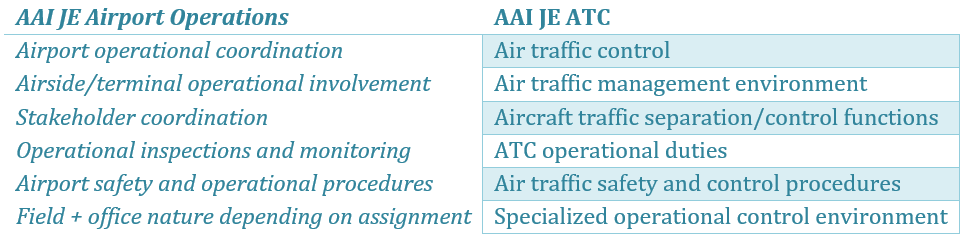
Both are important aviation careers, but the work profiles are different.
What Should Aspirants Learn From the Job Profile?
Understanding the work profile should change the way you prepare.
Do not study Aviation Awareness only to remember MCQ answers.
Understand the airport.
Do not study Business Management only to memorize definitions.
Understand coordination and organizational functions.
Do not practise Reasoning and Aptitude only for marks.
Develop decision-making speed.
Do not study English only for grammar questions.
Clear communication matters in professional operations.
The best preparation connects the exam syllabus with the career behind the exam.
Career Wave Approach for AAI AO Aspirants
At Career Wave, Satyendra Sir focuses on helping students understand not only what to study, but also why they are studying it.
For AAI JE Airport Operations, preparation should connect:
Business Management + Aviation Awareness + General Awareness + Reasoning + Aptitude + English + Relevant Exam Requirements
with:
PYQs + MCQs + Revision + Mock Tests + Exam Strategy
When students understand the job profile, the syllabus stops looking like a random collection of subjects.
It starts making more sense as preparation for an aviation operations career.
Final Takeaway
So, what does an AAI JE Airport Operations officer actually do?
The simplest answer is:
An AO helps support the safe, coordinated, compliant and efficient functioning of airport operations within the responsibilities assigned by AAI.
The role can involve:
Airside Operations
Terminal Operations
Operational Inspections
Safety Monitoring
Stakeholder Coordination
Documentation
Emergency Coordination
Shift Operations
It is neither purely a desk job nor purely a field job.
And it is definitely not the same as ATC.
If you are preparing for AAI JE Airport Operations, understand this work profile before you focus only on salary, vacancies or cutoff.
As Satyendra Sir at Career Wave emphasizes:
Prepare for the exam with the job in mind. Selection is the beginning of the career—not the end of the journey.
Frequently Asked Questions
1. What does an AAI JE Airport Operations officer do?
An AO supports airport operational activities involving coordination, monitoring, safety-related procedures, inspections, documentation and communication with relevant airport stakeholders, depending on assigned responsibilities.
2. Is AAI Airport Operations a desk job?
Not purely. The profile can involve both field-oriented airport operations and office-based reporting, coordination and documentation.
3. Does an AAI AO work on the runway?
Depending on posting, authorization and assigned responsibilities, airport operations personnel may perform or participate in operational inspections and monitoring of airside areas, which can include runway-related operational areas.
4. Is AAI AO the same as ATC?
No. Airport Operations and Air Traffic Control are different functions. ATC handles air traffic control responsibilities, while AO is associated with airport operational functions and coordination.
5. Does an AO control aircraft?
An Airport Operations officer should not be confused with an Air Traffic Controller. Air traffic control instructions and clearances belong to the ATC function under the applicable framework.
6. Does AAI AO involve shift duty?
Airport operational roles can involve shift duties because airports may operate beyond normal office hours. Exact duty schedules depend on posting and operational requirements.
7. Is AAI AO a field job?
It can include significant field responsibilities along with coordination, reporting and documentation. The balance depends on the assignment.
Connect with Career Wave
YouTube: Career Wave YouTube
Telegram: Career Wave Telegram
Instagram: Career Wave Instagram
Facebook: Career Wave Facebook
PYQs & E-Books: Career Wave AAI PYQs & E-Books
Career Wave — AAI Exam Preparation with Satyendra Sir