Career Wave
AAI AO PYQs vs Mock Tests: What Should You Practice First?
When preparing for the AAI Junior Executive – Airport Operations (AAI AO) exam, students often face one common confusion:
Should I solve AAI AO Previous Year Questions first, or should I start attempting mock tests?
Both are important, but they serve different purposes.
PYQs help you understand the exam. Mock tests help you prepare to perform in the exam.
At Career Wave, Satyendra Sir recommends using both strategically rather than choosing one and ignoring the other. The right sequence depends on where you currently stand in your preparation.
AAI AO PYQs vs Mock Tests: The Basic Difference
Before deciding what to practice first, understand what each resource actually does.
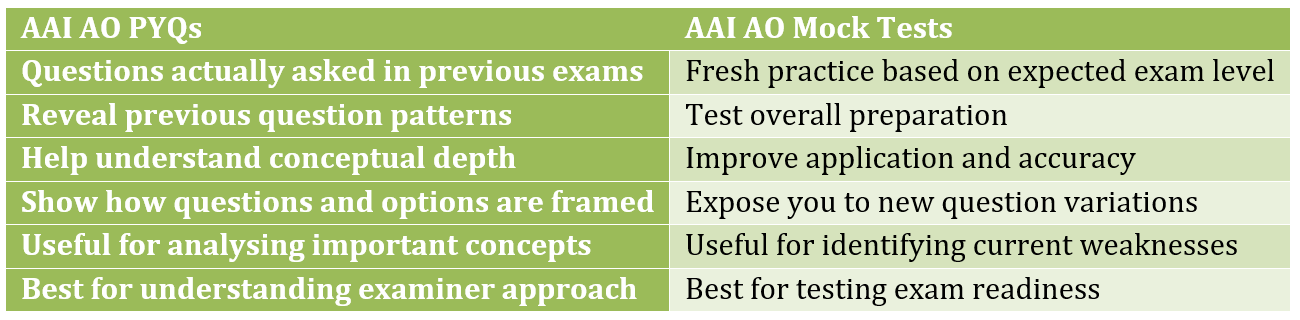
The conclusion is simple:
PYQs = Understand the Exam
Mock Tests = Test Your Preparation
You need both.
What Should You Practice First?
For most students, PYQs should come first.
But this does not mean you should finish every previous year paper before attempting a single mock.
A better sequence is:
Concept → Topic-wise PYQs → Sectional Practice → Full Mock Tests → Analysis → Revision
This creates a natural progression from learning to actual exam-level performance.
Why Should AAI AO PYQs Come First?
1. PYQs Show You What the Exam Actually Asks
The syllabus tells you the boundaries of preparation.
Previous year questions show you what those boundaries look like in an actual examination.
By studying PYQs, you start understanding:
• Question framing
• Conceptual depth
• Important areas
• Type of calculations
• Nature of factual questions
• Closely related options
• Common traps
• Expected level of understanding
Without PYQ analysis, students can easily prepare either too little or too much.
2. PYQs Help You Understand the Examiner’s Approach
Do not look at a previous year question simply as:
Question → Correct Answer
Instead, look at it as:
Topic → Concept → Question Framing → Options → Correct Answer → Possible Variations
For example, if a question tests a particular definition, formula or principle, do not memorise that question.
Ask:
What other questions can be created from the same concept?
This is where PYQ analysis becomes valuable.
At Career Wave, Satyendra Sir encourages students to extract the concept behind every important previous year question.
3. PYQs Tell You How Deeply to Study
One of the biggest challenges in competitive exams is deciding the required depth of preparation.
Some students read only basic definitions.
Others go far beyond the exam requirement and spend unnecessary time on advanced material.
PYQs help establish the balance.
They show whether a topic has previously been tested through:
• Direct facts
• Definitions
• Concepts
• Applications
• Numerical problems
• Statement-based questions
• Comparison-based questions
That helps you prepare more efficiently.
Then Why Are Mock Tests Necessary?
If PYQs are so useful, why not simply solve previous papers repeatedly?
Because the actual examination will contain fresh questions.
Knowing old questions is not enough.
You must be able to apply the same concepts when the wording, values, statements or options change.
That is where mock tests become important.
What Do AAI AO Mock Tests Actually Improve?
1. Application of Concepts
A good mock asks familiar concepts in unfamiliar ways.
If you genuinely understand a concept, you should be able to handle a new question based on it.
If you only memorised PYQs, fresh questions will expose that weakness quickly.
2. Accuracy
Knowing the answer and marking the correct answer under examination conditions are different skills.
Mock tests help identify:
• Calculation mistakes
• Misreading
• Confusion between options
• Guessing habits
• Lack of revision
• Conceptual gaps
Your mock score therefore becomes a diagnostic tool.
3. Time Management
A student may solve individual questions comfortably during practice but struggle when attempting an entire paper together.
Full mock tests help develop:
Speed + Accuracy + Question Selection + Concentration
These skills improve only through repeated exam-like practice.
4. Handling Fresh Questions
PYQs are limited.
Mocks can expose you to additional ways in which syllabus concepts may be tested.
This is particularly useful after your basic preparation and PYQ analysis are complete.
Career Wave provides an AAI AO Test Series 2026 containing full mock tests and sectional tests for structured practice.
AAI AO Test Series 2026 – Full Mock Tests + Sectional Tests
The Best AAI AO Practice Sequence
Instead of thinking PYQs vs Mock Tests, think PYQs + Mock Tests.
Phase 1: Learn the Concept
Complete the topic from your classes, notes or standard study material.
Do not immediately jump into full mocks when basic concepts are still unclear.
Phase 2: Solve Topic-Wise PYQs
After completing a topic, solve relevant previous year questions.
Ask yourself:
Can I solve the type of questions AAI has previously asked from this area?
Access available AAI AO previous year resources here:
AAI AO PYQs and eBooks – Career Wave
Phase 3: Analyse Every PYQ
Do not simply calculate your score.
For every question, check:
• Why is the correct option correct?
• Why are the other options incorrect?
• Which concept was tested?
• Could the same concept be asked differently?
• Did I solve it confidently or guess?
Phase 4: Attempt Sectional Tests
Once several topics of a subject are complete, move to sectional tests.
This checks whether you can connect different concepts within the same subject.
Phase 5: Start Full Mock Tests
Once you have reasonable syllabus coverage, begin full-length mocks.
Do not wait for the mythical point when preparation feels “100% complete.”
Mocks themselves are part of preparation.
PYQ Score vs Mock Test Score: Which Matters More?
Both tell you different things.
A high PYQ score can indicate that you understand previous exam questions well.
A high mock score can indicate that you are successfully applying those concepts to fresh questions.
But neither score should be viewed in isolation.
Suppose you score poorly in a mock.
The important question is not:
“Why is my score low?”
The useful question is:
“Where exactly did I lose marks?”
That leads to improvement.
Use the 5-Category Mock Analysis Method
After every mock, classify your incorrect questions into five categories:
1. Concept Error
You did not know or understand the concept.
Action: Relearn it.
2. Revision Error
You had studied it but could not recall it.
Action: Increase revision frequency.
3. Calculation Error
Your method was correct but execution failed.
Action: Practice similar problems.
4. Reading Error
You missed an important word or condition.
Action: Improve reading discipline.
5. Confusion Error
You narrowed the question to two options but selected the wrong one.
Action: Study the difference between those concepts.
This converts every mock test into a personalized revision plan.
Should Beginners Start with Full Mock Tests?
Not as their primary preparation method.
If your concepts are still developing, continuously attempting full mocks can produce low scores without solving the underlying problem.
A beginner can take an initial mock occasionally to understand the paper environment, but the main focus should be:
Concept Building → Topic Practice → PYQs
As preparation improves, sectional and full mocks should gradually increase.
What If Your Syllabus Is Already Complete?
Then the strategy changes.
If you have already completed the syllabus, your preparation should become increasingly practice-oriented.
A useful cycle is:
Full Mock → Detailed Analysis → Weak Topic Revision → PYQs → Sectional Practice → Next Mock
This is far more productive than repeatedly reading the entire syllabus.
What If the Exam Is Very Close?
When limited time remains, avoid collecting new resources unnecessarily.
Prioritize:
PYQ Revision + Weak Concepts + Mock Tests + Mock Analysis
At this stage, your objective is not to study everything again.
Your objective is to convert your existing preparation into maximum exam performance.
Common Mistakes Students Make
Students often reduce the effectiveness of PYQs and mocks by using them incorrectly.
Avoid:
• Attempting mocks without analysing them
• Memorising PYQ answers
• Checking solutions immediately
• Ignoring incorrect options
• Taking too many mocks without revision
• Comparing mock scores continuously with other students
• Avoiding mocks because of low scores
• Waiting for complete syllabus coverage before beginning any practice
• Solving questions without maintaining an error record
Remember:
The number of mocks attempted matters less than the number of mistakes corrected.
Satyendra Sir’s Recommended AAI AO Strategy
At Career Wave, Satyendra Sir recommends treating preparation as a cycle:
Learn → PYQ → Analyse → Practice → Mock → Analyse → Revise → Reattempt
Every stage has a specific purpose.
PYQs teach you about the examination.
Mocks teach you about your preparation.
Analysis connects the two.
That is why the real question should not be:
“PYQs or Mock Tests?”
It should be:
“How can I use PYQs and mock tests together?”
FAQs:
1. Should I solve AAI AO PYQs or mock tests first?
For most students, topic-wise PYQs should come before intensive mock-test practice. Once you have reasonable syllabus coverage, start sectional and full mock tests alongside PYQ revision.
2. Are AAI AO PYQs enough for preparation?
No. PYQs help you understand previous exam patterns and question framing, but you also need fresh practice, revision, sectional tests and full mocks.
3. Where can I get AAI AO PYQs?
You can check the available AAI AO PYQ and eBook resources on Career Wave.
4. When should I start AAI AO full mock tests?
Start full mocks once you have reasonable syllabus coverage. You do not need to wait until every chapter is perfectly completed.
5. Should beginners attempt AAI AO mock tests?
Beginners can attempt an initial mock to understand the examination environment, but their primary focus should remain on concept building and topic-wise PYQs.
6. How should I analyse an AAI AO mock test?
Classify mistakes into concept, revision, calculation, reading and confusion errors. Then revise those specific areas before moving blindly to the next mock.
7. Where can I practice AAI AO mock tests?
Career Wave provides full mock tests and sectional tests through its AAI AO Test Series 2026.
Practice AAI AO Mock Tests – Career Wave Test Series
8. Should I solve PYQs again after taking mocks?
Yes. Revisit PYQs related to topics where your mock performance is weak. This connects previous exam trends with your current preparation gaps.
9. Which is more important: solving more mocks or analysing mocks?
Analysis is critical. Ten carefully analysed mocks can provide more improvement than a larger number attempted without reviewing mistakes.
10. What is the best overall AAI AO practice strategy?
Use this sequence:
Concept → PYQs → Sectional Tests → Full Mocks → Analysis → Revision → Reattempt
Prepare for AAI AO with Career Wave
For AAI AO PYQs, classes, preparation strategies, mock tests, sectional tests and exam updates, stay connected with Career Wave and Satyendra Sir.
Career Wave AAI Telegram Channel
Final Takeaway
For most AAI AO aspirants, the right approach is not to choose between PYQs and mock tests.
Start with concepts and PYQs. Move gradually into sectional tests and full mocks. Then use every mistake to decide what you need to revise next.
PYQs show you the exam. Mock tests show you whether you are ready for it.
That combination should form the core of your AAI AO 2026 practice strategy with Career Wave and Satyendra Sir.