Career Wave
Common Mistakes Students Make While Solving AAI AO PYQs
Preparing for the AAI Junior Executive Airport Operations (AAI AO) exam requires more than completing the syllabus and solving hundreds of questions. One of the most valuable resources available to aspirants is AAI AO Previous Year Questions (PYQs).
But there is a problem.
Many students solve PYQs regularly and still do not get the expected improvement because they are using them incorrectly.
At Career Wave, Satyendra Sir recommends treating every PYQ as an opportunity to understand the concept, question pattern, options, mistakes, and required level of preparation.
The goal should not be:
“How many PYQs have I solved?”
A better question is:
“What did I learn from the PYQs I solved?”
Why AAI AO PYQs Matter
Previous year questions help you connect your syllabus with actual examination questions.
They can help you understand:
• How questions are framed
• What conceptual depth is required
• How similar options create confusion
• Which areas need stronger revision
• Where your preparation is weak
• Whether you can apply concepts to MCQs
• What types of mistakes you repeatedly make
However, these benefits come only when PYQs are analysed properly.
Here are some of the most common mistakes students should avoid.
1. Solving PYQs Only to Check the Score
This is perhaps the most common mistake.
A student solves 100 questions, gets 72 correct, calculates the percentage and moves to the next paper.
But what about the remaining questions?
Those incorrect, doubtful and unattempted questions contain some of the most useful information about your preparation.
After every PYQ session, analyse:
Correct + Incorrect + Doubtful + Unattempted
Your score tells you how you performed.
Your analysis tells you how to improve.
2. Memorising the Correct Option
Suppose you get a question wrong and immediately remember:
“Option C is correct.”
That is not enough.
If the same concept appears with different wording or options, you may again struggle.
Instead, ask:
• Why is C correct?
• Why are A, B and D incorrect?
• Which concept is being tested?
• Can the same concept be asked differently?
The objective is to remember the concept, not the position of the correct option.
3. Looking at the Solution Too Quickly
Some students read a question for a few seconds, feel unsure, and immediately open the solution.
This reduces the value of practice.
Before checking the answer, try to:
• Identify the topic
• Recall the relevant concept
• Eliminate incorrect options
• Apply the formula or fact
• Reach the best possible answer
Even an unsuccessful attempt can improve learning if you genuinely think through the question first.
4. Ignoring Incorrect Options
In MCQs, the wrong options can also be useful.
They may represent:
• A similar concept
• A common misconception
• A related fact
• A calculation trap
• A closely related term
Therefore, do not analyse only the correct answer.
For important PYQs, understand all four options.
This improves both conceptual clarity and elimination ability.
5. Treating Every Correct Answer as Mastery
A correct answer does not always mean that you knew the concept.
You might have:
• Guessed correctly
• Eliminated two options and taken a chance
• Remembered seeing the question earlier
• Been confused but selected the correct option
Satyendra Sir recommends separating correct answers into two categories:
Confident Correct – You can explain why the answer is correct.
Doubtful Correct – You got it right but were uncertain.
Doubtful correct questions should still be revised.
6. Not Identifying Why the Answer Was Wrong
Writing a red cross beside a question does not solve the problem.
Every wrong answer should have a reason.
A simple classification can help:
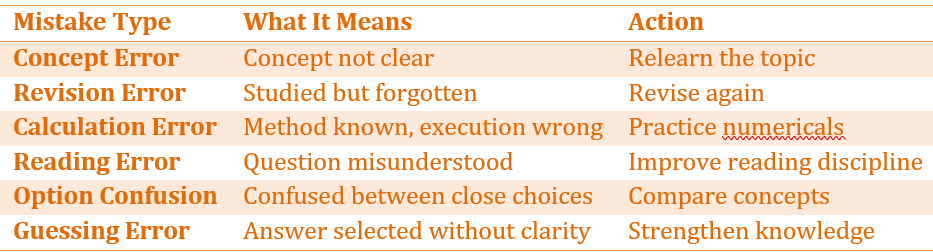
This transforms PYQ practice into a personalised improvement system.
7. Solving PYQs Without Revising the Topic
Some students repeatedly solve questions from a weak chapter without returning to the theory.
If the underlying concept is weak, simply increasing the number of questions may not fix the problem.
Use this sequence:
Wrong PYQ → Identify Concept → Revise Concept → Solve Similar Questions → Reattempt PYQ
If you continue making the same type of mistake, stop and repair the concept first.
8. Waiting Until the Entire Syllabus Is Complete
Another common mistake is keeping all PYQs for the end.
You do not necessarily need to complete the entire syllabus before starting previous year questions.
A more practical approach is:
Study Topic → Revise → Solve Topic-Wise PYQs → Analyse
This gives you early feedback about whether your preparation matches the level of questions you are practising.
9. Starting Full Papers Too Early
The opposite mistake also happens.
A beginner starts attempting complete papers before developing sufficient conceptual understanding.
Low scores then create unnecessary confusion.
Beginners can first focus on:
Concept Building → Topic-Wise PYQs → Sectional Practice
As syllabus coverage increases, move toward:
Full Previous Papers → Full Mock Tests
The difficulty and volume of practice should grow with your preparation.
10. Repeating PYQs Without Understanding Them
Repeated practice is useful only when it tests understanding.
If you already remember:
Question X → Option B
then solving it again may give you a misleading sense of improvement.
Instead, after revising the concept, try:
• A similar fresh question
• A modified numerical
• A different statement-based question
• A sectional test
This checks whether you can transfer the concept to a new question.
11. Not Maintaining an Error Log
Students often make the same mistake multiple times because there is no system to track it.
Maintain a small AAI AO PYQ Error Notebook.
You only need four things:
Topic | Mistake | Reason | Revision Required
For example:
Topic: Concept A
Mistake: Confused two definitions
Reason: Difference not clear
Revision: Comparison table
Over time, this becomes a highly personalised revision resource.
12. Ignoring Questions You Leave Unattempted
Students generally analyse incorrect answers but forget about questions they skipped.
An unattempted question can reveal:
• No knowledge of the concept
• Poor recall
• Lack of confidence
• Calculation difficulty
• Confusion between options
Therefore:
Incorrect + Unattempted + Doubtful Correct
should all become part of your analysis.
13. Collecting Too Many PYQ Resources
Having five different books, PDFs and question banks does not automatically improve preparation.
It can create duplication and confusion.
A better strategy is:
Choose reliable material → Complete it → Analyse it → Revise mistakes → Reattempt important questions
Career Wave provides AAI AO PYQ and eBook resources for students preparing for the examination.
AAI AO PYQs and eBooks – Career Wave
14. Solving PYQs but Avoiding Mock Tests
PYQs and mocks have different roles.
PYQs help you understand questions that have appeared previously.
Mock Tests provide fresh practice and test whether you can apply your preparation to new questions.
Once your preparation reaches an appropriate stage, combine both.
Career Wave provides an AAI AO Test Series 2026 with full mock tests and sectional practice.
AAI AO Test Series 2026 – Full Mocks & Sectional Tests
The Right Way to Solve AAI AO PYQs
Satyendra Sir recommends a simple cycle for Career Wave students:
Step 1: Study the concept
Step 2: Attempt relevant PYQs
Step 3: Check the answer
Step 4: Analyse all important options
Step 5: Classify your mistake
Step 6: Revise the weak concept
Step 7: Solve fresh questions
Step 8: Reattempt difficult PYQs
Step 9: Move to sectional and full mocks
The purpose is not merely to finish a PYQ book.
The purpose is to make fewer mistakes every time you practise.
A Simple Rule for Every PYQ
After solving an important AAI AO PYQ, ask yourself:
1. What concept was tested?
2. Why is the correct answer correct?
3. Why are the other options wrong?
4. Did I know the answer or guess it?
5. If I was wrong, why was I wrong?
6. Can I solve a fresh question based on the same concept?
If you can answer these questions, your PYQ practice is becoming much more meaningful.
FAQs –
1. What is the biggest mistake students make while solving AAI AO PYQs?
One major mistake is focusing only on the final score instead of analysing incorrect, doubtful and unattempted questions.
2. Should I memorise AAI AO PYQ answers?
No. Understand the concept and reasoning behind the answer. The same concept may appear later with different wording or options.
3. Should I analyse incorrect options too?
Yes. Incorrect options can contain related concepts and common traps, so analysing them can improve conceptual clarity and elimination skills.
4. Should I analyse a PYQ that I answered correctly?
Yes, particularly when the answer was based on guessing or uncertainty. A doubtful correct answer can still indicate a weak area.
5. Should I wait until my syllabus is complete before solving AAI AO PYQs?
Not necessarily. Topic-wise PYQs can be integrated with syllabus preparation after studying the corresponding concepts.
6. Where can I get AAI AO PYQs?
You can check the available AAI AO PYQs and eBooks through Career Wave.
AAI AO Previous Year Questions and eBooks
7. How can I stop repeating the same PYQ mistakes?
Maintain an error log, classify the cause of each important mistake, revise the underlying concept and then solve fresh questions before reattempting the PYQ.
8. Are PYQs enough for AAI AO preparation?
PYQs are important, but they should be combined with concept preparation, revision, sectional practice and full mock tests.
9. Where can I practice AAI AO mock tests?
Career Wave provides an AAI AO Test Series containing full mock and sectional practice.
AAI AO Test Series 2026 – Career Wave
10. What is Satyendra Sir's recommended PYQ strategy?
Follow this cycle:
Learn → Attempt PYQs → Analyse Mistakes → Revise → Practice Fresh Questions → Reattempt → Mock Test
Prepare for AAI AO with Career Wave
For AAI AO PYQs, preparation strategies, mock tests, sectional tests, classes and exam-related guidance, students can stay connected with Career Wave and Satyendra Sir.
Career Wave AAI Telegram Channel
Final Takeaway
The biggest purpose of solving AAI AO PYQs is not to prove how much you already know. It is to discover what still needs improvement.
Do not simply count questions.
Analyse your mistakes. Correct the concept. Reattempt the question. Test yourself with fresh problems.
With a structured approach, every previous year paper can become a practical roadmap for stronger AAI AO preparation with Career Wave and Satyendra Sir.