Career Wave
AAI AO PYQs 2026: Previous Year Questions with Complete Exam Analysis
Preparing for the AAI Junior Executive Airport Operations (AAI AO) 2026 exam becomes much more focused when you understand the nature of questions asked in previous examinations.
Reading the syllabus tells you what to study, but AAI AO Previous Year Questions (PYQs) help you understand how your knowledge is tested.
At Career Wave, Satyendra Sir recommends using PYQs not merely as a question bank but as an important part of your preparation strategy. A proper PYQ analysis can help you understand question framing, conceptual depth, important areas, option patterns, and your own preparation gaps.
The objective is simple:
Study → Solve PYQs → Analyse → Revise → Practice → Test Yourself
Why Are AAI AO PYQs Important for 2026?
One of the biggest challenges for any competitive-exam aspirant is deciding how deeply a topic should be studied.
Students often make one of two mistakes:
• Studying only surface-level information
• Going unnecessarily deep into every topic
Previous year questions can help establish the required level of preparation.
When you analyse PYQs properly, you begin to understand:
• How questions are framed
• Which concepts need stronger clarity
• How options are designed
• What type of application is expected
• Where factual recall is important
• Which areas require more practice
• What kinds of mistakes you personally make
This makes preparation more exam-oriented.
What Do AAI AO Previous Year Questions Reveal?
1. The Actual Nature of Questions
A syllabus heading may look simple, but it does not tell you exactly how that topic can appear as an MCQ.
PYQs help bridge this gap.
A topic may be tested through:
Definition-based questions
Conceptual questions
Application-based questions
Statement-based questions
Numerical questions
Fact-based questions
Comparison-based questions
Once you understand this, your preparation becomes more targeted.
2. The Required Conceptual Depth
Students sometimes assume that more advanced preparation is always better.
That is not necessarily efficient.
The better question is:
“What level of understanding is required to solve exam-level questions correctly?”
PYQs can help answer this.
If previous questions repeatedly test basic concepts through confusing options, then conceptual clarity and precise revision become more important than simply collecting advanced material.
3. PYQs Show the Importance of Strong Fundamentals
Previous year questions often expose whether your basics are actually clear.
You may have completed a chapter but still struggle when two closely related options appear together.
That indicates a conceptual gap.
For every PYQ, ask:
What basic concept is this question testing?
Then revise the surrounding concept instead of memorising only the answer.
4. Options Can Be as Important as the Question
Many students check only the correct answer.
This is a missed learning opportunity.
The remaining options may contain:
• Closely related concepts
• Common misconceptions
• Similar terminology
• Incorrect applications
• Calculation traps
• Facts worth revising
For important AAI AO PYQs, try to understand:
Why is the correct option correct?
and
Why are the remaining options incorrect?
This makes one MCQ useful for revising multiple concepts.
5. PYQs Reveal Your Personal Weaknesses
Previous papers do not only tell you about the examination.
They also tell you about your preparation.
Suppose you repeatedly make mistakes because you:
• Forget facts
• Misread questions
• Confuse similar concepts
• Make calculation errors
• Cannot eliminate options
• Guess too frequently
These are preparation patterns.
Once identified, they can be corrected.
How to Analyse AAI AO PYQs Properly
At Career Wave, Satyendra Sir recommends a structured approach instead of simply solving one paper after another.
Step 1: Attempt Without Seeing the Solution
Treat the question seriously.
Try to solve it independently before checking the answer.
Step 2: Mark Your Confidence Level
Divide questions into:
Confident Correct
You knew the concept and answer.
Doubtful Correct
You answered correctly but were uncertain.
Incorrect
Your final answer was wrong.
Unattempted
You could not reach an answer.
This provides much better information than your score alone.
Step 3: Identify the Concept
For every important question, determine:
Which topic was tested?
Then ask:
Could I solve another question based on the same concept?
If not, the concept still needs work.
Step 4: Analyse Your Mistakes
Every incorrect answer should have a reason.
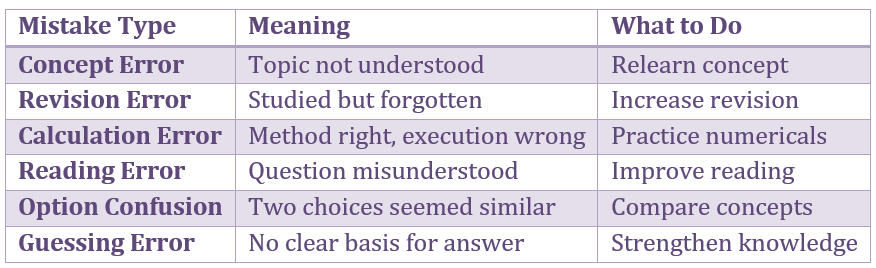
This turns PYQ practice into a diagnostic system.
Should You Memorise AAI AO PYQs?
No.
You should remember the concept, not simply the correct option.
For example, knowing that a particular question had answer (b) has little value if the next examination asks the same concept differently.
Instead, ask:
Why was (b) correct?
What concept supports it?
What would make the other options correct?
How can this concept be asked differently?
That is genuine PYQ preparation.
Topic-Wise PYQs or Full Previous Year Papers?
You should use both, but at different stages.
During Syllabus Preparation
Use:
Topic-wise PYQs
Follow:
Study Topic → Revise → Solve PYQs → Analyse Mistakes
This provides immediate feedback.
After Reasonable Syllabus Coverage
Move toward:
Sectional Tests + Full Previous Papers
Now you can evaluate your ability to handle mixed questions.
During the Final Phase
Focus increasingly on:
PYQ Revision + Full Mocks + Error Analysis + Weak-Topic Revision
This creates a more exam-oriented final preparation phase.
PYQs vs Mock Tests: Why You Need Both
PYQs and mock tests should not be treated as competitors.
They perform different functions.
AAI AO PYQs
Help you understand:
• Previously asked questions
• Question framing
• Important concepts
• Required depth
• Your conceptual weaknesses
AAI AO Mock Tests
Help you practise:
• Fresh questions
• Time management
• Accuracy
• Question selection
• Full-paper performance
• Application under test conditions
The practical sequence is:
Concept → PYQ → Sectional Test → Full Mock → Analysis → Revision
Career Wave provides an AAI AO Test Series 2026 with full mock tests and sectional practice.
AAI AO Test Series 2026 – Full Mock Tests & Sectional Tests
Create an AAI AO PYQ Error Notebook
One of the simplest ways to improve PYQ preparation is to maintain an error notebook.
You do not need to copy complete questions.
Record:
Topic | Mistake | Reason | Correct Concept | Revision Required
For example:
Topic: Concept A
Mistake: Confused two terms
Reason: Difference not clear
Action: Create comparison notes
After several papers, your error notebook becomes a personalised revision guide.
Instead of revising everything equally, you can concentrate on the areas actually causing mistakes.
How Often Should You Reattempt PYQs?
Do not immediately reattempt a wrong question after reading its solution.
You may simply remember the answer.
Instead:
Attempt → Analyse → Revise → Wait → Reattempt
When you return to the question, try solving it independently.
If you can explain the reasoning without remembering the solution mechanically, your understanding has improved.
Common Mistakes While Solving AAI AO PYQs
Avoid these habits:
• Solving PYQs only to calculate your score
• Memorising answer options
• Checking solutions too quickly
• Ignoring incorrect options
• Ignoring doubtful correct answers
• Not analysing unattempted questions
• Repeating questions without revising concepts
• Waiting until the entire syllabus is complete
• Taking full papers too early without sufficient preparation
• Not maintaining an error log
• Solving more questions without correcting repeated mistakes
• Depending entirely on PYQs and avoiding fresh mock tests
The objective is not maximum question count.
It is maximum learning from every important question.
Where Can You Get AAI AO PYQs?
Students preparing for AAI Junior Executive Airport Operations can check available PYQ and eBook resources through Career Wave.
AAI AO PYQs and eBooks – Career Wave
Use previous papers systematically rather than rushing through them.
Satyendra Sir's AAI AO PYQ Strategy
For students preparing with Career Wave, a practical PYQ cycle is:
Learn Concept → Solve PYQ → Analyse Options → Identify Mistake → Revise → Solve Fresh Questions → Reattempt → Take Mock
After every PYQ session, ask yourself:
What did this paper teach me about the exam?
and
What did this paper teach me about my preparation?
These two questions make PYQ practice much more useful.
AAI AO PYQs 2026: Final Preparation Approach
As the examination approaches, your strategy should gradually shift from learning new material toward improving retention and application.
Focus on:
Previous Year Questions
Revise important concepts and previously incorrect questions.
Error Notebook
Review repeated weaknesses.
Sectional Tests
Strengthen individual areas.
Full Mock Tests
Practise overall exam performance.
Mock Analysis
Identify remaining gaps.
Targeted Revision
Revise what your performance data shows you actually need.
This is more systematic than repeatedly reading the complete syllabus without analysing your performance.
FAQs –
1. Are AAI AO PYQs important for 2026 preparation?
Yes. Previous year questions help students understand how topics have been tested, the depth of preparation required, question framing and their own weak areas.
2. Where can I get AAI AO previous year questions?
You can check available AAI AO PYQs and eBook resources through Career Wave.
AAI AO Previous Year Questions & eBooks
3. Should beginners solve AAI AO PYQs?
Yes. Beginners can start with topic-wise PYQs after learning the corresponding concepts instead of immediately focusing only on complete papers.
4. Should I complete the entire syllabus before solving PYQs?
Not necessarily. Topic-wise PYQs can be integrated with syllabus preparation so that weaknesses are identified early.
5. How should I analyse AAI AO PYQs?
Analyse the concept tested, your confidence level, all important options and the reason behind every incorrect or doubtful answer.
6. Should I memorise previous year questions?
No. Focus on understanding the concept behind each question so that you can handle different variations of the same idea.
7. Should I solve AAI AO PYQs more than once?
Reattempt important, incorrect and doubtful questions after revision. Avoid mechanical repetition based only on remembering the previous answer.
8. Are PYQs enough for AAI AO 2026?
PYQs are an important preparation resource, but they should be combined with concept study, revision, sectional practice and fresh mock tests.
9. Where can I practice AAI AO mock tests?
Career Wave provides full-length and sectional practice through its AAI AO Test Series.
AAI AO Test Series 2026 – Career Wave
10. What is the best overall AAI AO PYQ strategy?
Use this sequence:
Concept → Topic-wise PYQs → Analysis → Revision → Sectional Tests → Full Mocks → Reanalysis
Prepare for AAI AO 2026 with Career Wave
For AAI AO PYQs, preparation strategies, classes, mock tests, sectional tests and exam-related guidance, students can stay connected with Career Wave and Satyendra Sir.
Career Wave AAI Telegram Channel
Final Takeaway
AAI AO PYQs should not be treated simply as old questions to complete before the examination.
They can help you understand question framing, conceptual requirements, option patterns and your own preparation gaps.
Study the concept. Solve the PYQ. Analyse the mistake. Revise the weakness. Test yourself again.
That is the approach Career Wave and Satyendra Sir recommend for making previous year questions a productive part of AAI AO 2026 preparation.