Career Wave
AAI AO PYQ Strategy 2026: How to Use Previous Year Questions Effectively
Preparing for the AAI Junior Executive Airport Operations (AAI AO) 2026 exam is not only about completing the syllabus. You also need to understand how that syllabus is converted into actual examination questions.
This is where Previous Year Questions (PYQs) become useful.
However, simply solving hundreds of PYQs does not guarantee improvement. The real value comes from how you attempt, analyse, revise, and reuse those questions.
At Career Wave, Satyendra Sir recommends treating PYQs as a learning and diagnostic resource rather than just a collection of old questions.
A practical approach is:
Learn Concept → Attempt PYQs → Analyse → Revise → Reattempt → Test with Fresh Questions
Why Should AAI AO Aspirants Solve PYQs?
Previous year questions can help you connect three important parts of preparation:
Syllabus → Concepts → Exam Questions
A syllabus tells you what areas to prepare.
Your classes and study material explain those areas.
PYQs show how previously tested concepts were framed as questions.
When analysed properly, PYQs can help you understand:
• Question framing
• Conceptual depth
• Important areas for revision
• Nature of options
• Common confusion points
• Application of concepts
• Your personal weak areas
This makes preparation more exam-oriented.
PYQs Are More Than Old Questions
One of the biggest mistakes students make is treating PYQs like an ordinary question bank.
They solve a question, check the answer and move ahead.
A better approach is to ask:
What concept is this question testing?
Why is this option correct?
Why are the other options incorrect?
Could the same concept be asked differently?
Would I still solve it if the wording changed?
These questions turn a single PYQ into a learning resource.
How to Use AAI AO PYQs Effectively
Step 1: Understand the Syllabus First
Before solving large numbers of PYQs, understand what you are expected to study.
Organise the syllabus into:
• Subjects
• Chapters
• Topics
• Subtopics
This helps you connect each PYQ to a specific part of your preparation.
Without this classification, PYQ practice can become random.
Step 2: Start with Topic-Wise PYQs
If you are still completing the syllabus, topic-wise PYQ practice is usually more useful than immediately attempting complete previous papers.
Follow this cycle:
Study Topic → Revise → Attempt PYQs → Analyse → Correct Weakness
For example, after completing a particular topic, solve previous questions related to it.
This immediately tells you whether you can apply what you have studied.
Step 3: Attempt Before Looking at the Answer
Do not turn PYQs into reading material.
Give every question a genuine attempt.
Before checking the solution:
1. Read the question carefully.
2. Identify what is being asked.
3. Recall the relevant concept.
4. Examine all options.
5. Eliminate incorrect choices where possible.
6. Select your answer.
7. Then check the solution.
Even when your answer is wrong, the thinking process makes the solution more meaningful.
Step 4: Use a Confidence-Based System
Do not classify questions only as correct or incorrect.
Use four categories:
Confident Correct
You knew the concept and could explain the answer.
Doubtful Correct
You selected the right answer but were uncertain.
Incorrect
You attempted the question but got it wrong.
Unattempted
You could not confidently reach an answer.
This gives you a much more accurate picture of your preparation.
A guessed correct answer should not be treated the same as a confidently solved question.
Step 5: Analyse All Important Options
One of the most effective PYQ habits is analysing the options.
Suppose option (b) is correct.
Do not stop there.
Ask:
Why is (a) incorrect?
Why is (c) incorrect?
Why is (d) incorrect?
The incorrect options may contain:
• Related concepts
• Similar terminology
• Common misconceptions
• Factual traps
• Conceptual differences
This can make one MCQ useful for revising multiple points.
Step 6: Classify Every Mistake
Every wrong answer has a cause.
Finding that cause is more important than simply recording the correct answer.
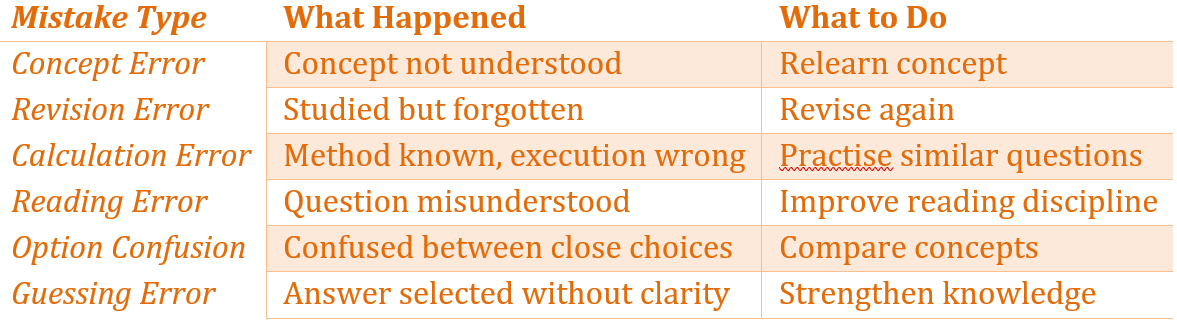
Once mistakes are classified, your revision becomes targeted.
Step 7: Maintain an AAI AO PYQ Error Notebook
An error notebook can become one of your most useful revision resources.
Do not copy every complete question.
Keep it concise:
Topic | Mistake | Correct Concept | Reason | Revision Required
For example:
Topic: Concept A
Mistake: Confused two terms
Reason: Difference unclear
Action: Make a comparison table
Over time, this notebook becomes a personalised list of the concepts most likely to cause you problems.
Step 8: Convert Every PYQ into Possible New Questions
This is an important advanced technique.
After solving a PYQ, ask:
“If I were setting the exam, how else could I test this concept?”
For example, a direct factual question could potentially be converted into:
• Statement-based question
• Match-the-following format
• Conceptual application
• Incorrect statement question
• Comparison question
This prevents you from becoming dependent on memorising old questions.
You start preparing for the concept behind the question.
Step 9: Reattempt Incorrect PYQs
Do not immediately reattempt a question after reading its solution.
You may simply remember the answer.
Instead follow:
Attempt → Analyse → Revise → Wait → Reattempt
During the second attempt, do not ask:
“Do I remember the answer?”
Ask:
“Can I independently solve and explain this question now?”
That is a much better test of improvement.
Step 10: Move from Topic-Wise PYQs to Full Papers
As your syllabus coverage increases, change your PYQ strategy.
Early Preparation
Concepts + Topic-Wise PYQs
Middle Stage
Topic-Wise PYQs + Sectional Tests + Selected Previous Papers
Advanced Stage
Full Previous Papers + Sectional Tests + Full Mock Tests
Final Revision
Important PYQs + Error Notebook + Mock Analysis + Weak Topics
Your practice should evolve with your preparation.
PYQs vs Mock Tests: Understand the Difference
Both are important, but they serve different purposes.
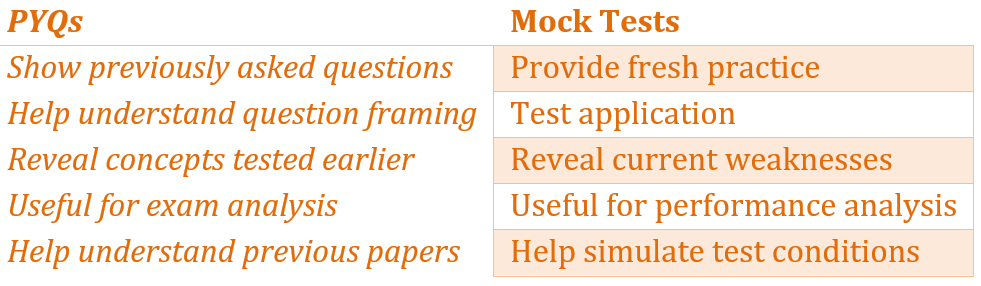
The correct approach is not:
PYQs vs Mock Tests
It is:
PYQs + Mock Tests
Career Wave provides an AAI AO Test Series 2026 with full mock tests and sectional practice.
AAI AO Test Series 2026 – Full Mock Tests & Sectional Tests
Where to Get AAI AO PYQs
Students preparing for AAI Junior Executive Airport Operations can check available previous year question and eBook resources through Career Wave.
AAI AO PYQs & eBooks – Career Wave
While solving them, focus on analysis rather than simply increasing your question count.
How Many Times Should You Solve AAI AO PYQs?
There is no need to mechanically repeat every question multiple times.
A more useful approach is:
First Round
Solve PYQs and identify important concepts and weaknesses.
Second Round
Reattempt:
• Incorrect questions
• Unattempted questions
• Doubtful correct questions
• Important conceptual questions
Final Round
Use selected PYQs for rapid concept revision and recall.
The objective should be to improve understanding each time.
Common Mistakes While Using AAI AO PYQs
Avoid these habits:
• Memorising answer options
• Checking solutions too quickly
• Solving without analysing mistakes
• Ignoring incorrect options
• Treating guessed answers as mastered
• Waiting until the entire syllabus is complete
• Repeating questions without revising concepts
• Ignoring unattempted questions
• Not maintaining an error record
• Depending only on PYQs
• Attempting mocks without connecting mistakes back to concepts
The purpose of PYQs is not simply completion.
It is better understanding and better decision-making in future questions.
Satyendra Sir's AAI AO PYQ Strategy
At Career Wave, Satyendra Sir recommends using this cycle:
Concept → PYQ → Option Analysis → Error Identification → Revision → Fresh Practice → Reattempt → Mock Test
After every PYQ session, ask:
What did I learn about the exam?
What did I learn about my preparation?
Which concept needs revision?
Which mistake should not appear again?
These questions make PYQ practice much more productive.
How to Combine PYQs with Mock Tests
Once you begin full mock practice, connect your mock analysis with your PYQs.
Suppose a mock reveals weakness in a particular topic.
Follow:
Mock Error → Revise Concept → Solve Related PYQs → Attempt Sectional Questions → Recheck
This creates a feedback loop.
Instead of randomly deciding what to study next, your test performance tells you where revision is required.
AAI AO PYQ Strategy for the Final Phase
As the exam approaches, reduce unnecessary resource collection.
Focus more on:
Important PYQs
Revise previously tested concepts.
Incorrect PYQs
Reattempt questions that caused problems earlier.
Doubtful Questions
Strengthen concepts where confidence is still low.
Error Notebook
Review repeated mistakes.
Mock Tests
Test fresh application and overall performance.
Targeted Revision
Revise areas identified through PYQ and mock analysis.
This is more efficient than restarting the entire syllabus repeatedly.
FAQs –
1. Are AAI AO PYQs important for 2026 preparation?
Yes. PYQs help students understand previous question framing, tested concepts, option patterns and their own preparation gaps.
2. When should I start solving AAI AO PYQs?
You can start topic-wise PYQs after studying the corresponding topic. There is no need to wait until the entire syllabus is completed.
3. Where can I get AAI AO previous year questions?
Available AAI AO PYQ and eBook resources can be accessed through Career Wave.
AAI AO Previous Year Questions & eBooks
4. Should I memorise AAI AO PYQ answers?
No. Focus on understanding the concept and reasoning behind each answer so that you can solve new variations.
5. Should I analyse all four options?
For important questions, yes. Analysing incorrect options can improve conceptual clarity and help you identify common traps.
6. How should I analyse a wrong PYQ?
Identify whether the error came from conceptual weakness, poor revision, calculation, reading, option confusion or guessing. Then correct that specific weakness.
7. Should I solve AAI AO PYQs more than once?
Reattempt incorrect, doubtful, unattempted and important questions after revision. Avoid mechanical repetition based only on remembered answers.
8. Are PYQs enough for AAI AO preparation?
PYQs should be combined with concept preparation, revision, sectional practice and fresh mock tests.
9. Where can I attempt AAI AO mock tests?
Career Wave provides full mock tests and sectional tests through its AAI AO Test Series.
AAI AO Test Series 2026 – Career Wave
10. What is the best AAI AO PYQ strategy for 2026?
Follow:
Learn → Solve PYQs → Analyse Options → Identify Mistakes → Revise → Reattempt → Solve Fresh Questions → Take Mocks
Prepare for AAI AO 2026 with Career Wave
For AAI AO PYQs, mock tests, sectional tests, preparation strategies, classes and exam-related guidance, stay connected with Career Wave and Satyendra Sir.
Career Wave AAI Telegram Channel
Final Takeaway
AAI AO PYQs become effective when you stop treating them simply as old questions.
Use them to understand concepts, question framing, options, mistakes and your own weak areas.
The most useful cycle is:
Solve → Analyse → Correct → Revise → Reattempt → Apply in Fresh Questions
That is the approach Career Wave and Satyendra Sir recommend for using Previous Year Questions effectively in AAI AO 2026 preparation.