Career Wave
Common Mistakes Students Make While Solving AAI AO PYQs
Previous Year Questions are one of the most useful resources for AAI Junior Executive Airport Operations (AAI AO) preparation. They help aspirants understand how questions are framed, how concepts are tested, and where their preparation actually stands.
But there is an important difference between solving PYQs and using PYQs effectively.
Many students complete hundreds of previous year questions but continue making the same mistakes because they focus only on whether their answer is right or wrong.
At Career Wave, Satyendra Sir recommends a different approach:
Attempt → Analyse → Find the Mistake → Revise the Concept → Reattempt
Your objective should not be to say, “I completed all the PYQs.”
Your objective should be:
“I understood what every important PYQ taught me.”
Why AAI AO PYQs Are Important
A syllabus tells you what to study, but previous year questions show you how concepts can actually appear in an examination.
Proper PYQ practice can help you:
○ Understand question framing
○ Identify conceptual weaknesses
○ Improve option elimination
○ Recognise areas requiring revision
○ Understand your common error patterns
○ Prepare for fresh questions based on similar concepts
However, these benefits are lost if PYQs are practised incorrectly.
Let us look at the most common mistakes.
Mistake 1: Solving PYQs Only to Check Your Score
This is one of the biggest mistakes.
Suppose you attempt 100 questions and get 72 correct.
Many students simply record:
Score: 72/100
and move to another paper.
But the real learning lies in analysing the remaining questions.
After every PYQ session, divide questions into:
Confident Correct – You knew the answer and reasoning.
Doubtful Correct – Your answer was correct, but you were unsure.
Incorrect – You attempted the question incorrectly.
Unattempted – You could not confidently answer it.
Your score tells you what happened.
Analysis tells you why it happened.
Mistake 2: Memorising the Correct Option
Suppose you got a question wrong and then remember:
“The answer is option C.”
This is not proper revision.
If the same concept appears in another form, remembering option C will not help.
Instead, understand:
○ Why is C correct?
○ Why are A, B and D incorrect?
○ Which concept is being tested?
○ What fact or principle should you remember?
○ How else can the same concept be asked?
Remember the concept, not the option.
Mistake 3: Checking the Answer Too Quickly
Some students read a difficult question and immediately check the solution.
This turns active practice into passive reading.
Before checking the answer:
Read → Think → Recall → Eliminate → Attempt
Even if your final answer is wrong, a genuine attempt helps you understand exactly where your thinking failed.
That makes the solution much more useful.
Mistake 4: Ignoring the Other Three Options
In an MCQ, learning should not always stop with the correct option.
The incorrect options may contain:
○ Related concepts
○ Similar terminology
○ Common misconceptions
○ Closely related facts
○ Typical exam traps
For important AAI AO PYQs, ask:
Why is the correct option correct?
and
Why are the remaining options incorrect?
One PYQ can sometimes help you revise multiple concepts.
Mistake 5: Treating a Guessed Answer as a Correct Answer
This is a dangerous habit.
Suppose you were confused between B and D and randomly selected D.
If D happens to be correct, you may mark the question as mastered.
But conceptually, you were still unsure.
Therefore, Satyendra Sir recommends distinguishing between:
Confident Correct
and
Doubtful Correct
A doubtful correct question should still enter your revision list.
Mistake 6: Not Finding the Reason Behind a Wrong Answer
Simply putting a red cross beside a question is not enough.
Ask:
Why did I get this question wrong?
Use a simple classification:
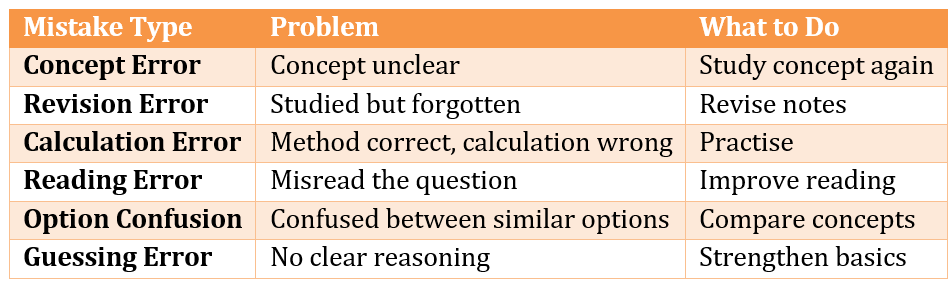
This makes your revision much more targeted.
Mistake 7: Repeating Questions Without Revising Concepts
Students sometimes solve the same question again immediately after seeing its solution.
Naturally, they get it correct.
But that does not necessarily mean the concept is now clear.
A better approach is:
Wrong PYQ → Analyse → Revise Concept → Solve Similar Fresh Questions → Reattempt PYQ
Now you can check whether the improvement is genuine.
Mistake 8: Ignoring Unattempted Questions
Incorrect questions receive attention.
Unattempted questions often do not.
This is a mistake.
An unattempted question may indicate:
○ No knowledge of the concept
○ Poor recall
○ Confusion
○ Lack of confidence
○ Calculation difficulty
○ Inability to eliminate options
Therefore, your analysis should include:
Incorrect + Unattempted + Doubtful Correct
not just incorrect answers.
Mistake 9: Waiting Until the Entire Syllabus Is Complete
Many students think:
“First I will complete the entire syllabus. Then I will start PYQs.”
This can delay useful exam-oriented feedback.
A better approach is:
Complete Topic → Revise → Solve Topic-Wise PYQs → Analyse
This helps you identify weaknesses while the topic is still fresh.
You do not need to wait until the complete syllabus is over.
Mistake 10: Starting Full Papers Too Early
The opposite mistake also occurs.
Some beginners start full previous year papers immediately and become worried when their scores are low.
If you have not covered enough syllabus, a low full-paper score may not provide meaningful feedback.
Beginners can start with:
Concepts → Topic-Wise Questions → Topic-Wise PYQs
Then move toward:
Sectional Tests → Full Previous Papers → Full Mock Tests
Your testing level should increase with your preparation level.
Mistake 11: Not Maintaining a PYQ Error Notebook
If you do not record repeated mistakes, you may continue making them.
Maintain a simple AAI AO Error Notebook.
You do not need to copy entire questions.
Use:
Topic | Error | Reason | Correct Concept | Action
For example:
Topic: Concept A
Error: Confused two terms
Reason: Difference not clear
Action: Revise comparison
Over time, this becomes a personalised revision resource.
Mistake 12: Focusing Only on Repeated Questions
Students sometimes solve PYQs only to identify questions they believe may repeat.
That is too narrow.
The greater value of PYQs lies in understanding:
Repeated concepts, question framing, required knowledge and common traps.
The exact question does not need to repeat for PYQ practice to be useful.
If you understand the underlying concept, you are better prepared for a new variation.
Mistake 13: Solving Too Many PYQs Without Revision
More questions do not automatically mean better preparation.
Suppose Student A solves 500 PYQs but barely analyses them.
Student B solves fewer questions but:
○ Checks every important mistake
○ Revises weak concepts
○ Analyses options
○ Reattempts difficult questions
○ Tests concepts through fresh MCQs
Student B is using PYQs more productively.
Focus on:
Quality of Analysis > Question Count
Mistake 14: Depending Only on PYQs
PYQs are important, but they are not the entire preparation strategy.
Previous year questions tell you what has been asked before.
You also need fresh questions to check whether you can apply concepts independently.
This is where sectional and full mock tests become useful.
The recommended progression is:
Concepts → PYQs → Sectional Tests → Full Mocks → Analysis → Revision
Career Wave provides an AAI AO Test Series containing sectional and full mock practice.
AAI AO Test Series – Full Mock Tests & Sectional Tests
Mistake 15: Attempting Mock Tests but Not Connecting Them with PYQs
PYQs and mock tests should work together.
Suppose a mock test reveals weakness in a particular topic.
Do not simply take another mock.
Follow:
Mock Mistake → Identify Topic → Revise Concept → Solve Related PYQs → Fresh Practice → Recheck
This creates a proper feedback loop.
Where Can You Practice AAI AO PYQs?
Career Wave provides available AAI AO PYQ and eBook resources for students preparing for the examination.
AAI AO PYQs & eBooks – Career Wave
Use them as a learning resource rather than simply trying to finish all questions quickly.
Satyendra Sir's Recommended AAI AO PYQ Method
At Career Wave, Satyendra Sir recommends this simple process:
Step 1: Learn the concept
Step 2: Attempt the PYQ independently
Step 3: Check the correct answer
Step 4: Analyse important options
Step 5: Identify why you were wrong or doubtful
Step 6: Revise the weak concept
Step 7: Solve fresh questions
Step 8: Reattempt selected PYQs
Step 9: Test yourself through sectional and full mocks
This converts PYQs from a question bank into a proper preparation system.
A Simple Rule After Every PYQ Session
Ask yourself five questions:
1. Which questions did I get wrong?
2. Which correct answers involved doubt or guessing?
3. Why did I make those mistakes?
4. Which concepts need revision?
5. What will I do differently when a similar question appears again?
If you can answer these five questions, your PYQ session has actually contributed to your preparation.
FAQs –
1. What is the biggest mistake students make while solving AAI AO PYQs?
One of the biggest mistakes is focusing only on the score instead of analysing why questions were incorrect, doubtful or unattempted.
2. Should I memorise AAI AO PYQ answers?
No. Understand the concept behind the answer. Memorising an option will not necessarily help when the same concept is tested differently.
3. Should I analyse all four options?
For important questions, yes. Other options can contain related concepts, common misconceptions and useful facts.
4. Is a guessed correct answer considered mastered?
No. If you were unsure or guessed, mark the question as doubtful and revise the underlying concept.
5. When should I start solving AAI AO PYQs?
Topic-wise PYQs can be started after studying the corresponding topic. You do not need to wait for complete syllabus coverage.
6. Should beginners attempt full previous year papers?
Beginners can first focus on concepts and topic-wise PYQs. Full papers become more useful after reasonable syllabus coverage.
7. Where can I get AAI AO PYQs?
You can access available AAI AO PYQ and eBook resources through Career Wave.
AAI AO Previous Year Questions & eBooks
8. Are AAI AO PYQs enough for preparation?
No. Combine PYQs with concept study, revision, fresh practice, sectional tests and full mock tests.
9. Where can I attempt AAI AO mock tests?
Career Wave provides full mock tests and sectional tests through its AAI AO Test Series.
AAI AO Test Series – Career Wave
10. What is Satyendra Sir's recommended PYQ strategy?
Follow:
Concept → PYQ → Analysis → Error Identification → Revision → Fresh Practice → Reattempt → Mock Test
Prepare for AAI AO with Career Wave
For AAI AO PYQs, mock tests, preparation strategies, sectional tests and exam guidance, stay connected with Career Wave and Satyendra Sir.
Career Wave AAI Telegram Channel
Final Takeaway
The biggest mistake in AAI AO PYQ preparation is treating previous questions as something that simply needs to be completed.
Instead:
Solve carefully. Analyse every important mistake. Understand the concept. Revise the weakness. Reattempt. Then test yourself with fresh questions.
Top of Form
That is how PYQs become a useful part of AAI AO preparation with Career Wave and Satyendra Sir.