Career Wave
How to Use AAI AO Mock Tests to Improve Score, Speed and Accuracy
Mock tests are one of the most important parts of AAI Junior Executive Airport Operations (AAI AO) preparation, but simply attempting more mocks does not automatically improve your performance.
Many students take a test, check the score, feel satisfied or disappointed, and then move directly to the next mock. The real improvement, however, happens after the test.
At Career Wave, Satyendra Sir recommends using every AAI AO mock as a performance-analysis tool:
Attempt → Analyse → Identify Weakness → Revise → Practice → Reattempt
A well-analysed mock can help you improve three critical areas:
Score + Speed + Accuracy
This guide explains how to use AAI AO mock tests effectively and turn every test into measurable improvement.
Why Are Mock Tests Important for AAI AO Preparation?
Concept classes and notes help you learn.
PYQs help you understand previously asked questions.
Mock tests help you determine whether you can apply your preparation to fresh questions under test conditions.
Regular mock practice can help you evaluate:
• Conceptual preparation
• Question-solving speed
• Accuracy
• Time management
• Question selection
• Weak topics
• Revision gaps
• Calculation mistakes
• Exam temperament
But these benefits depend heavily on how seriously you analyse each test.
The Wrong Way to Use Mock Tests
A common routine looks like this:
Attempt Mock → Check Score → Check Rank → Attempt Next Mock
This gives you practice, but limited improvement.
Instead, use:
Attempt Mock → Analyse Every Error → Find the Cause → Revise → Solve Related Questions → Apply Correction in Next Mock
Your mock score is an output.
Your analysis tells you what needs to change to improve that output.
1. Attempt the Mock Like the Actual Exam
A full mock should not feel like casual question practice.
Create realistic test conditions as far as possible.
During the test:
• Avoid unnecessary breaks
• Do not check notes
• Do not search for answers
• Follow the allotted test time
• Avoid distractions
• Use your planned question-selection strategy
If you repeatedly pause a mock or check concepts during the test, the resulting score will not accurately reflect your current preparation.
Career Wave provides an AAI AO Test Series with full mocks and sectional tests for structured practice.
AAI AO Test Series – Full Mock Tests & Sectional Tests
2. Don't Judge Yourself Only by the Score
Suppose you score higher in one mock and lower in another.
That does not automatically mean your preparation improved and then declined.
The papers may differ in difficulty or topic distribution.
Instead of tracking only the final score, track:
Score
Attempts
Correct Answers
Incorrect Answers
Accuracy
Unattempted Questions
Time-Consuming Areas
Repeated Mistakes
This provides a much clearer picture of performance.
3. Track Accuracy Properly
Accuracy is one of the simplest indicators of question-solving quality.
Use:
Accuracy = Correct Answers ÷ Attempted Questions × 100
For example:
If you attempt 100 questions and 85 are correct:
Accuracy = 85 ÷ 100 × 100 = 85%
Now suppose you increase your attempts but your accuracy falls sharply.
That tells you that increased speed or aggression is producing unnecessary errors.
The objective is not simply:
Attempt More
It is:
Attempt More Questions Correctly
4. Separate Questions into Four Categories
After every mock, classify your questions.
Confident Correct
You knew the concept and solved it correctly.
Doubtful Correct
You selected the correct answer but were uncertain.
Incorrect
You attempted the question but got it wrong.
Unattempted
You could not confidently solve it.
The last three categories require analysis.
Do not treat a lucky guess as complete mastery simply because the final answer was correct.
5. Identify Why Every Important Question Went Wrong
This is where real mock analysis begins.
Use an error classification system:
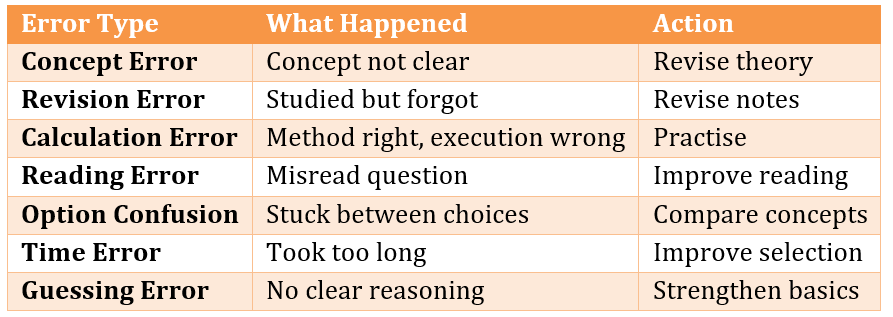
After several mocks, patterns will start appearing.
Those patterns tell you what is actually limiting your score.
How to Improve Score Through Mock Tests
Your score improves when the causes of lost marks are reduced.
After each mock, identify:
Easy Questions You Got Wrong
These should receive immediate attention because they represent avoidable losses.
Questions You Knew but Forgot
These indicate revision gaps.
Conceptual Questions You Could Not Solve
These require concept revision.
Questions Lost Through Carelessness
These require better reading and test discipline.
Time-Consuming Questions
These require better selection or faster methods.
Do not simply ask:
“How can I increase my score?”
Ask:
“Where exactly am I losing marks?”
That question gives you something actionable.
How to Improve Speed Through AAI AO Mocks
Speed does not mean solving every question as quickly as possible.
Good speed means using your time efficiently.
Step 1: Identify Slow Questions
After a mock, identify questions where you spent too much time.
Then ask:
Was the question genuinely difficult?
or
Was my concept or method weak?
The solution depends on the cause.
Step 2: Improve Question Selection
Not every question deserves equal time on the first pass.
A useful approach is:
Easy and Direct → Moderate → Time-Consuming
Do not allow one difficult question to consume time that could have been used on several manageable questions.
Step 3: Practise Weak Areas Separately
If one topic consistently consumes too much time, use sectional or topic-wise practice.
Follow:
Identify Slow Topic → Revise Method → Timed Practice → Sectional Test → Recheck Speed
Full mocks reveal the problem.
Focused practice fixes it.
How to Improve Accuracy Through Mock Tests
Accuracy often falls because students rush.
The solution is not always to slow down dramatically.
Instead, identify the source of incorrect answers.
Reading Errors
You may miss words such as:
NOT
Incorrect
Except
Maximum
Minimum
Train yourself to identify the instruction word before selecting an answer.
Calculation Errors
If you know the formula but repeatedly make arithmetic or substitution errors, practise short timed sets.
Do not relearn the entire chapter if the concept itself is already clear.
Option Confusion
If you regularly narrow questions down to two options but select the wrong one, your knowledge may lack precision.
Revise the exact difference between those two concepts.
Guessing Errors
During analysis, separately mark questions answered through guessing.
A guessed correct answer should still be reviewed.
Ask:
Could I explain why this option is correct?
If not, the concept requires revision.
Maintain an AAI AO Mock Error Log
Satyendra Sir recommends maintaining a simple Mock Error Log.
You can use:
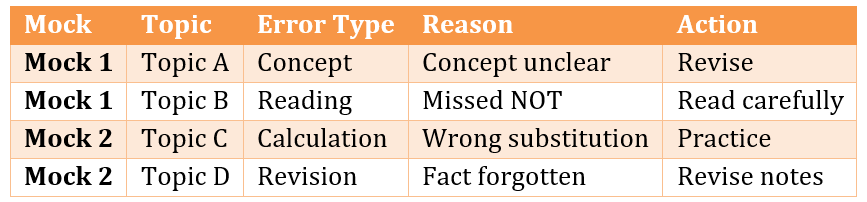
After several tests, this becomes one of your most useful revision resources.
You will begin to see whether your mistakes are random or repetitive.
Connect Mock Tests with AAI AO PYQs
Mock tests and PYQs should not be treated separately.
Suppose a mock reveals weakness in a particular concept.
Use:
Mock Mistake → Revise Topic → Solve Related PYQs → Solve Fresh Questions → Recheck in Sectional Test
This connects exam history with current performance.
Career Wave provides available AAI AO PYQ and eBook resources for additional practice.
AAI AO PYQs & eBooks – Career Wave
Full Mocks vs Sectional Tests
Both have different purposes.
Full Mock Tests
Use them to evaluate:
• Overall performance
• Time distribution
• Question selection
• Accuracy
• Mixed-topic recall
• Test-taking strategy
Sectional Tests
Use them to improve:
• Specific weak areas
• Topic speed
• Subject-level accuracy
• Targeted practice
The ideal cycle is:
Full Mock → Find Weak Section → Revise → Sectional Test → Full Mock Again
How to Analyse Your Mock-Test Progress
Do not judge improvement from a single test.
Track performance across multiple mocks.
A simple tracker can include:
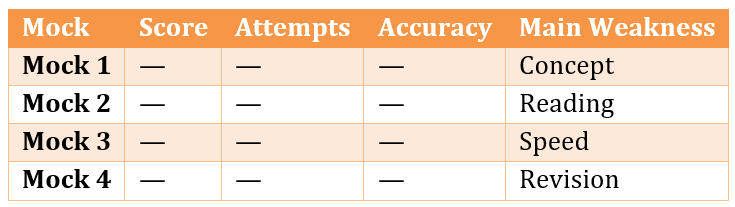
You are moving in the right direction if, over time:
• Accuracy becomes more stable
• Repeated mistakes decrease
• Easy questions are rarely lost
• Time distribution improves
• Doubtful attempts decrease
• Weak topics become manageable
Score improvement should emerge from these changes.
How Many Mock Tests Should You Attempt?
There is no universal number.
Your objective should not be:
“I must attempt X mocks.”
Instead ask:
“Can I properly analyse every mock I attempt?”
A mock without analysis provides limited feedback.
If you are attempting tests so frequently that you have no time to revise your mistakes, reduce the frequency and improve the analysis.
Should You Attempt Mocks Before Completing the Syllabus?
You do not necessarily need to wait for 100% syllabus completion.
A progressive approach works better.
Early Stage
Topic Practice + PYQs
Middle Stage
PYQs + Sectional Tests
Later Stage
Sectional Tests + Full Mocks
Final Stage
Full Mocks + PYQ Revision + Error Analysis + Targeted Revision
Testing should become more comprehensive as your syllabus coverage improves.
What to Do Immediately After an AAI AO Mock
Follow this sequence:
1. Record your score, attempts and accuracy.
2. Identify incorrect questions.
3. Review doubtful correct questions.
4. Analyse unattempted questions.
5. Classify each important mistake.
6. Identify repeated errors.
7. Revise the required concepts.
8. Solve related PYQs or fresh questions.
9. Reattempt selected difficult questions later.
10. Carry one specific improvement target into the next mock.
For example:
“In my next mock, I will reduce reading errors.”
or
“I will not spend excessive time on one difficult question.”
This gives every test a clear purpose.
Common Mistakes While Attempting AAI AO Mock Tests
Avoid:
• Taking mocks only to check rank
• Attempting too many mocks without analysis
• Ignoring guessed correct answers
• Focusing only on score
• Not tracking accuracy
• Repeating the same careless mistakes
• Ignoring unattempted questions
• Spending too long on difficult questions
• Not revising weak topics between mocks
• Comparing your mock count with other students
• Starting a new test immediately after a poor test without analysing it
The number of mocks matters less than what you learn from them.
Satyendra Sir's Mock Test Improvement Cycle
At Career Wave, the recommended process is:
Attempt → Analyse → Classify Errors → Revise → PYQ Practice → Sectional Practice → Next Mock
After every test, ask:
What reduced my score?
Where did I waste time?
Which mistakes were avoidable?
Which concepts need revision?
Which mistakes have appeared before?
What will I change in the next test?
This is how mock tests become an improvement system rather than just a scorecard.
FAQs –
1. How can AAI AO mock tests improve my score?
Mocks reveal exactly where you are losing marks. Once you identify conceptual, revision, calculation, reading and time-management errors, you can correct them systematically.
2. How can I improve speed in AAI AO mock tests?
Identify questions and topics consuming excessive time, improve question selection, practise slow areas separately and use timed sectional tests.
3. How can I improve accuracy?
Analyse every incorrect and doubtful answer. Track reading errors, calculations, option confusion and unnecessary guessing instead of simply trying to attempt more questions.
4. Should I analyse questions I answered correctly?
Analyse doubtful or guessed correct answers. Confident correct answers generally require less attention.
5. Should I attempt a mock every day?
Not necessarily. Mock frequency should leave sufficient time for detailed analysis, revision and correction of weaknesses.
6. Are sectional tests useful?
Yes. Sectional tests are particularly useful when a full mock reveals weakness or slow performance in a specific area.
7. Should I solve PYQs along with mock tests?
Yes. Use PYQs to revisit concepts exposed as weak during mock analysis.
8. Where can I attempt AAI AO mock tests?
Career Wave provides full mocks and sectional tests through its AAI AO Test Series.
AAI AO Test Series – Career Wave
9. Is mock-test score more important than accuracy?
Both provide useful information, but score alone does not explain your performance. Track attempts, accuracy, error types and time management together.
10. What is the best way to use an AAI AO mock test?
Follow:
Attempt → Analyse → Identify Error → Revise → Practise → Reattempt → Apply Correction in Next Mock
Prepare for AAI AO with Career Wave
For AAI AO mock tests, PYQs, sectional tests, preparation strategies and exam guidance, stay connected with Career Wave and Satyendra Sir.
Career Wave AAI Telegram Channel
Final Takeaway
Do not use AAI AO mock tests only to measure your preparation.
Use them to improve your preparation.
A mock should tell you:
Where you lose marks.
Where you lose time.
Why your answers go wrong.
What you need to revise next.
The most effective cycle is:
Mock → Analysis → Correction → Practice → Next Mock
That is how Career Wave and Satyendra Sir recommend using mock tests to steadily improve score, speed and accuracy for AAI AO.