Career Wave
How to Cross 110+ Marks in AAI ATC 2026: Complete Subject-Wise Preparation Strategy
AAI ATC 2026 | 110+ Score Strategy | Physics, Mathematics, Non-Technical Subjects, PYQs & Mock Tests
Scoring 110+ marks in the AAI Junior Executive (Air Traffic Control) examination is an ambitious target. It requires more than completing the syllabus, memorizing formulas, or solving a few previous year questions.
Every year, many AAI ATC aspirants study for months but struggle to convert their preparation into high examination scores.
Some students perform well in Physics and Mathematics but lose marks in English, Reasoning, and General Awareness. Others know the concepts but make calculation mistakes or struggle with time management during mock tests.
The question is:
How can an AAI ATC aspirant realistically target 110+ marks out of 120?
At Career Wave, Satyendra Sir recommends a preparation approach based on conceptual clarity, balanced subject preparation, previous year question analysis, repeated revision, and performance-based mock-test practice.
In this article, we will discuss a complete strategy to help aspirants work towards the 110+ score target in AAI ATC 2026.
1. Understand What Scoring 110+ Actually Means
Before preparing for 110+ marks, understand the level of accuracy required.
In the recent 120-mark AAI ATC CBT pattern:
• Total Questions: 120
• Total Marks: 120
• Technical Section: 60 Marks
• Non-Technical Section: 60 Marks
• Negative Marking: None under the recent pattern
Candidates should confirm the final examination pattern and marking scheme from the applicable official AAI notification.
AAI ATC Score vs Accuracy
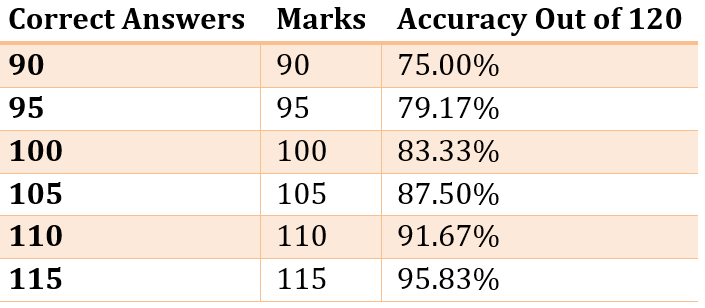
The accuracy column assumes all 120 questions are attempted and each correct answer earns one mark.
To score 110, you need at least 110 correct answers.
To score above 110, you need at least 111 correct answers.
This means a student targeting 110+ cannot afford repeated conceptual mistakes, poor revision, or unnecessary calculation errors.
Satyendra Sir's Advice: Do not focus only on attempting all questions. Focus on increasing the number of correct answers in every mock test.
2. Know the AAI ATC Exam Pattern and Subject Weightage
Understanding the subject-wise distribution is the foundation of a high-score strategy.
AAI ATC CBT Subject-Wise Distribution
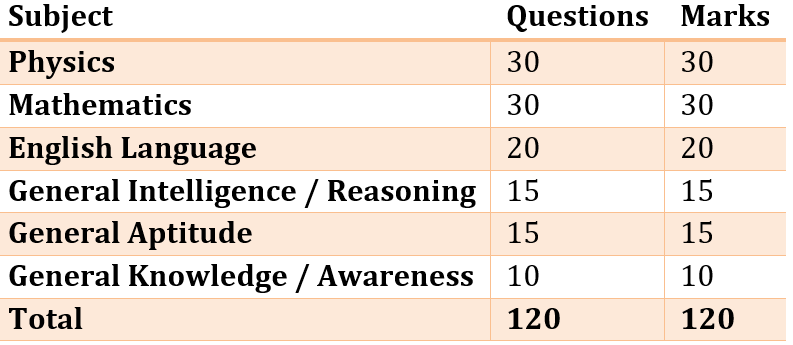
This distribution reflects the recent AAI ATC examination pattern and should be checked against the relevant recruitment notification.
Notice something important.
Physics and Mathematics together contribute 50% of the total marks.
The remaining 50% comes from non-technical subjects.
Therefore, preparing only Physics and Mathematics is not sufficient for a reliable 110+ strategy.
3. Create a Subject-Wise Target for 110+ Marks
A high score becomes easier to plan when you divide it into smaller subject-wise targets.
Suggested 110+ Score Distribution
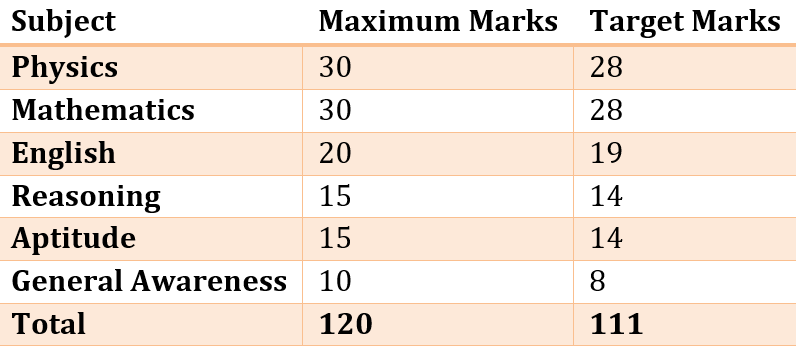
This is an illustrative target, not a predicted cutoff or guaranteed score.
The distribution shows that students need consistently strong performance across almost every subject.
Aspirants should adjust their individual targets according to their strengths and weaknesses while maintaining a total target above 110.
4. Physics Strategy: Target 28+ Out of 30
Physics is one of the most important subjects for AAI ATC preparation.
However, many students make the mistake of studying Physics only through formulas.
To achieve a high score, you need to understand the concepts behind those formulas.
Focus on Conceptual Clarity
Prepare important areas such as:
• Units, Dimensions, and Measurements
• Kinematics and Laws of Motion
• Work, Energy, and Power
• Rotational Motion and Gravitation
• Properties of Matter and Thermodynamics
• Oscillations and Waves
• Electrostatics and Current Electricity
• Magnetism and Electromagnetic Induction
• Alternating Current
• Ray Optics and Wave Optics
• Modern Physics
• Semiconductor Electronics
These are important preparation areas, not an exhaustive replacement for the official syllabus.
How to Prepare Physics for 28+ Marks
Step 1: Understand the theory and important concepts.
Step 2: Prepare a chapter-wise formula sheet.
Step 3: Solve standard numerical questions.
Step 4: Practise AAI ATC previous year questions.
Step 5: Attempt timed Physics sectional tests.
Step 6: Revise incorrect questions regularly.
Common Physics Mistakes to Avoid
Students frequently lose marks because of:
• Applying the wrong formula.
• Ignoring units.
• Incorrect sign conventions.
• Confusing similar physical quantities.
• Making calculation mistakes.
• Forgetting important conditions of a formula.
Satyendra Sir's Tip: When solving a numerical question, identify the concept first, then select the formula. Do not apply shortcuts without understanding their conditions.
5. Mathematics Strategy: Target 28+ Out of 30
Mathematics can become a high-scoring subject when preparation is systematic.
However, students often struggle with lengthy calculations, forgotten formulas, and poor question selection.
Important Mathematics Areas
Focus on:
• Sets, Relations, and Functions
• Complex Numbers
• Quadratic Equations
• Sequences and Series
• Permutations and Combinations
• Binomial Theorem
• Trigonometry
• Matrices and Determinants
• Limits, Continuity, and Differentiability
• Applications of Derivatives
• Integration
• Differential Equations
• Coordinate Geometry
• Vectors and Three-Dimensional Geometry
• Probability and Statistics
How to Improve Mathematics Accuracy
First: Revise formulas daily.
Second: Practise standard question types.
Third: Solve previous year questions chapter-wise.
Fourth: Identify lengthy and time-consuming problems.
Fifth: Use reliable shortcuts wherever appropriate.
Sixth: Analyse every incorrect calculation.
Avoid Repeated Calculation Errors
Many students understand the method but select the wrong answer because of a minor calculation error.
Create a separate Mathematics error notebook covering:
• Sign mistakes
• Formula mistakes
• Calculation errors
• Incorrect substitutions
• Wrong assumptions
• Unnecessary lengthy methods
Before every full mock, revise these errors.
Career Wave Tip: Accuracy should improve before you aggressively increase solving speed.
6. English Strategy: Target 19+ Out of 20
English can significantly contribute to a 110+ score.
However, students sometimes ignore English because they consider it less important than Physics and Mathematics.
This can be a serious mistake.
Important English Topics
Prepare:
• Error Detection
• Sentence Improvement
• Fill in the Blanks
• Synonyms and Antonyms
• Idioms and Phrases
• One-Word Substitution
• Reading Comprehension
• Active and Passive Voice
• Direct and Indirect Speech
• Grammar and Vocabulary
How to Target 19+ Marks
Practise English regularly rather than studying it only during the final revision period.
Focus on understanding grammar rules and applying them to exam-level questions.
For vocabulary, revise frequently tested words and practise them in context.
For error detection, identify the grammatical rule before selecting an answer.
Satyendra Sir's Advice: English preparation requires consistency. Even a short daily practice session can be useful when followed regularly.
7. Reasoning Strategy: Target 14+ Out of 15
Reasoning questions test logical thinking, pattern recognition, and analytical ability.
A high score requires both accuracy and efficient question selection.
Important Reasoning Topics
• Number and Alphabet Series
• Coding-Decoding
• Analogy
• Classification
• Blood Relations
• Direction Sense
• Syllogism
• Seating Arrangement
• Logical Reasoning
• Mathematical Operations
• Statement-Based Reasoning
How to Improve Reasoning Performance
Practise a mixture of direct and moderate-level questions.
Identify the topics where you repeatedly take too much time.
Avoid spending several minutes on one difficult question while easier questions remain unanswered.
During mock tests, attempt familiar and straightforward questions first.
Target: Develop enough confidence to solve most reasoning questions without unnecessary hesitation.
8. Aptitude Strategy: Target 14+ Out of 15
Aptitude can provide valuable marks when basic concepts and calculations are strong.
Important Aptitude Topics
• Percentage
• Profit and Loss
• Simple and Compound Interest
• Ratio and Proportion
• Average
• Time and Work
• Time, Speed, and Distance
• Mixture and Alligation
• Partnership
• Number System
• Simplification
• Data Interpretation
How to Prepare Aptitude
Strengthen basic calculations before relying on shortcuts.
Practise percentages, ratios, fractions, and approximation regularly.
Solve topic-wise questions under timed conditions.
Maintain a record of questions where the method was correct but the calculation was wrong.
Career Wave Tip: Aptitude speed improves through repeated practice of standard methods, not by memorizing every possible shortcut.
9. General Awareness Strategy: Target 8+ Out of 10
General Awareness has fewer questions than Physics or Mathematics, but it can make a meaningful difference when targeting 110+.
Important Preparation Areas
• Indian History
• Geography
• Indian Polity
• Indian Economy
• General Science
• Current Affairs
• Important National and International Events
• Aviation-Related General Awareness
Preparation Strategy
Prepare static General Knowledge systematically.
Revise current affairs from reliable sources.
Practise MCQs and maintain short factual notes.
Avoid spending excessive time collecting unrelated current affairs material.
Satyendra Sir's Advice: General Awareness should be revised repeatedly because factual information is easily forgotten without regular practice.
10. PYQs Are Essential for Scoring 110+
One of the biggest mistakes students make is preparing without analysing previous year questions.
AAI ATC PYQs help you understand:
• Previously tested concepts.
• Question formats.
• Important chapters.
• Numerical difficulty.
• Common traps.
• Areas requiring repeated revision.
How to Use PYQs Effectively
Do not simply solve a question and check the answer.
After solving it, ask:
Which concept was tested?
Could the same concept be asked differently?
Was there a faster method?
Why were the other options incorrect?
Can I solve a similar question without looking at the solution?
This approach helps build conceptual understanding.
AAI ATC PYQs and E-Books
Access AAI ATC previous year questions and preparation resources through Career Wave:
11. Full Mock Tests: The Most Important Performance Check
Students aiming for 110+ marks should not depend only on lectures and chapter-wise practice.
Full mock tests help evaluate whether your preparation can produce the required score under examination conditions.
What Full Mocks Reveal
A full mock test can identify:
• Your current score.
• Subject-wise accuracy.
• Weak chapters.
• Time-consuming questions.
• Calculation mistakes.
• Revision gaps.
• Poor question selection.
• Exam-pressure mistakes.
Recommended Mock-Test Analysis
After every mock, record:
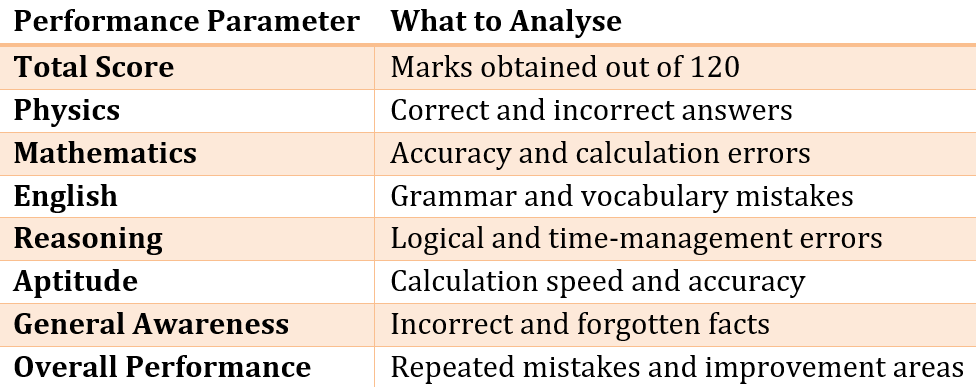
Important: Attempting more mock tests is useful only when you also analyse your performance and correct recurring mistakes.
12. Career Wave AAI ATC Full Test Series 2026
For aspirants targeting 110+ marks, Career Wave's AAI ATC Full Test Series 2026 provides an opportunity to practise full-length examinations and evaluate preparation progress.
Full mock tests help students develop:
• Exam-oriented question-solving skills.
• Time management.
• Speed and accuracy.
• Subject-wise performance awareness.
• Better question selection.
• Confidence under timed conditions.
Students should review their test performance and use the results to plan the next revision cycle.
AAI ATC Full Test Series 2026:
https://careerwave.org/test-series/22-atc-full-test-series-2026
13. The 110+ Mock Score Improvement Strategy
If your current mock score is below 110, do not try to improve every subject simultaneously without identifying the actual problem.
Divide your preparation into performance stages.
Stage 1: Build Towards 90+ Marks
Focus on completing important concepts, strengthening weak subjects, and reducing basic mistakes.
Stage 2: Move Towards 100+ Marks
Improve accuracy through sectional tests, PYQs, and targeted revision.
Identify chapters where you repeatedly lose marks.
Stage 3: Move Towards 105+ Marks
At this stage, avoid unnecessary experimentation.
Focus on correcting repeated mistakes, improving question selection, and maintaining consistency.
Stage 4: Target 110+ Marks
Once your scores approach 105, concentrate on the remaining score gap.
Identify exactly where marks are being lost.
For example, if your score is 105:
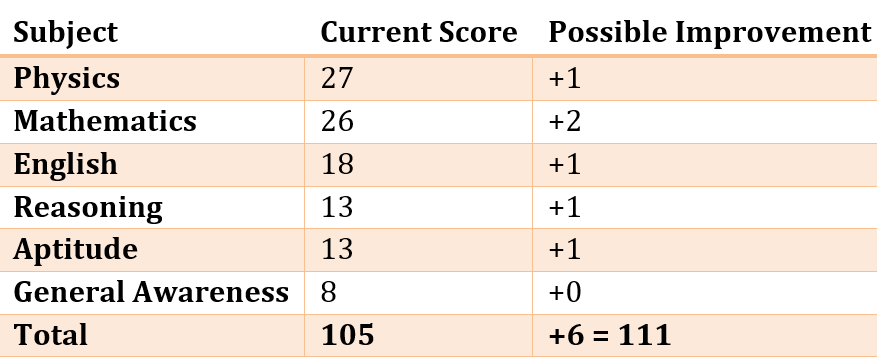
This is an illustrative improvement plan.
Instead of thinking, "I need six more marks," identify the exact concepts and errors responsible for those marks.
Satyendra Sir's Advice: Small improvements across multiple subjects can be more realistic than expecting a major improvement in only one subject.
14. Maintain an Error Notebook for Every Subject
A dedicated error notebook is one of the most useful revision tools for high-score preparation.
Physics
Record conceptual mistakes, formula confusion, and unit errors.
Mathematics
Record calculation mistakes, incorrect methods, and forgotten formulas.
English
Record grammar rules, vocabulary errors, and confusing sentence structures.
Reasoning
Record incorrect patterns, logical mistakes, and lengthy approaches.
Aptitude
Record calculation shortcuts, percentage errors, and inefficient methods.
General Awareness
Record incorrect facts, confusing information, and topics requiring revision.
Before every full mock, revise the mistakes you have made repeatedly.
The objective is simple:
Do not lose marks repeatedly for the same reason.
15. Follow a Smart Daily Study Routine
Students targeting 110+ should follow a balanced preparation schedule.
An illustrative six-hour self-study plan is given below.
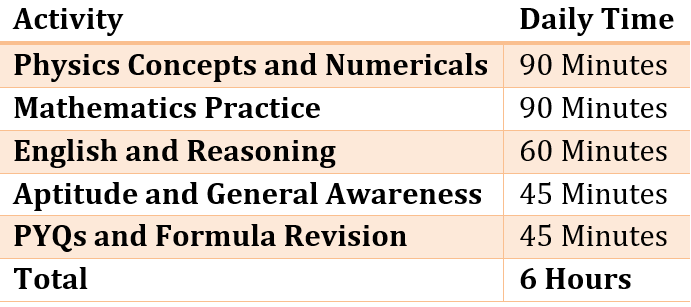
This is a sample schedule, not a compulsory timetable.
On full mock-test days, adjust your routine to accommodate the test and detailed analysis.
Students who have already completed the syllabus should devote more time to revision, sectional practice, and mock-test analysis.
16. Time Management Strategy for 110+ Marks
Even well-prepared students can lose marks because of poor time management.
The key is to avoid getting stuck on difficult questions while easier marks remain available.
Use a Two-Round Attempt Strategy
Round 1: High-Confidence Questions
Attempt questions that are direct, familiar, and relatively quick to solve.
Round 2: Time-Consuming Questions
Return to questions that require additional calculations or deeper reasoning.
Important Time-Management Rules
• Do not spend excessive time on one question.
• Read the complete question carefully.
• Avoid unnecessary recalculations.
• Use reliable shortcuts when appropriate.
• Mark difficult questions for later review.
• Reserve time to check doubtful answers.
In a no-negative-marking examination, students should also ensure that unanswered questions are addressed before time expires, provided the applicable marking scheme confirms there is no penalty.
17. Formula Revision Is Essential for High Accuracy
Physics and Mathematics together contribute 60 marks.
Forgetting even a few important formulas can reduce your score.
Recommended Formula Revision Method
Daily: Revise formulas from recently studied chapters.
Weekly: Revise important formulas across completed chapters.
Before Mock Tests: Review commonly confused formulas.
After Mock Tests: Add forgotten formulas to your revision notebook.
Avoid memorizing formulas without understanding the conditions under which they apply.
18. Avoid These Common Mistakes When Targeting 110+
Many students lose valuable marks because of avoidable preparation habits.
Mistake 1: Studying Only Physics and Mathematics
Non-technical subjects contribute 60 marks and require systematic preparation.
Mistake 2: Ignoring Previous Year Questions
PYQs help identify important concepts and understand previous examination patterns.
Mistake 3: Taking Mocks Without Analysis
A mock score is useful only when it helps you identify and correct weaknesses.
Mistake 4: Changing Resources Frequently
Using too many books and courses can reduce revision time and create confusion.
Mistake 5: Ignoring Easy Questions
Students sometimes spend too much time on difficult problems and miss straightforward questions.
Mistake 6: Revising Only Strong Subjects
Weak chapters require targeted attention, especially when repeated mistakes affect mock scores.
Mistake 7: Focusing Only on Attempt Count
Attempting more questions does not automatically mean scoring more marks.
Mistake 8: Becoming Overconfident After One High Mock Score
Consistency across multiple mocks is a better indicator of preparation than one exceptional result.
19. Final 15-Day Revision Strategy for AAI ATC
During the final preparation phase, the objective should be to strengthen existing preparation rather than begin too many new resources.
Days 1–5: Concept and Formula Revision
• Revise important Physics formulas.
• Revise Mathematics formulas.
• Practise weak chapters.
• Revise English grammar rules.
• Review important General Awareness facts.
Days 6–10: Mock Tests and Error Correction
• Attempt full-length mock tests.
• Analyse every incorrect answer.
• Revise recurring mistakes.
• Practise weak subjects through sectional tests.
• Improve question-selection strategy.
Days 11–13: High-Accuracy Practice
• Revise previous year questions.
• Review important formulas.
• Attempt exam-oriented practice sets.
• Focus on accuracy and time management.
Days 14–15: Final Consolidation
• Revise short notes.
• Review your error notebook.
• Avoid unnecessary new resources.
• Maintain a stable routine.
• Prioritize adequate sleep and examination readiness.
The exact number of mocks should depend on available time and the quality of analysis.
20. Satyendra Sir's Final 110+ Strategy
At Career Wave, Satyendra Sir recommends treating the 110+ target as a measurable performance goal.
Instead of simply studying more, students should focus on improving the quality of their preparation.
Follow this framework:
Concept Clarity → PYQs → Sectional Practice → Full Mock Tests → Error Analysis → Revision → Score Improvement
Remember these principles:
First: Build strong Physics and Mathematics fundamentals.
Second: Give equal strategic importance to the non-technical section.
Third: Practise PYQs to understand previous examination patterns.
Fourth: Use mock tests to identify weaknesses.
Fifth: Revise recurring mistakes until they stop appearing.
Sixth: Track performance consistently instead of depending on a single mock score.
A 110+ score is demanding and cannot be guaranteed. However, a disciplined and evidence-based preparation strategy can help aspirants improve their chances of reaching this target.
Frequently Asked Questions (FAQs)
1. Is it possible to score 110+ marks in AAI ATC?
Yes, it is mathematically possible to score above 110 in a 120-mark examination. However, it requires exceptionally strong accuracy and balanced preparation across subjects.
2. How many questions should I answer correctly to score 110+?
Under a one-mark-per-correct-answer pattern with no negative marking, you need at least 111 correct answers to score above 110.
3. How much should I target in Physics for 110+?
An ambitious target is 28 or more marks out of 30. Your actual subject-wise targets should depend on your strengths and overall score plan.
4. How much should I target in Mathematics?
Students targeting 110+ can aim for approximately 28 or more marks in Mathematics while maintaining high accuracy in other subjects.
5. Can I score 110+ by preparing only Physics and Mathematics?
No. Physics and Mathematics together contribute 60 marks in the recent 120-mark pattern. The non-technical subjects are essential for achieving 110+.
6. Are AAI ATC PYQs enough to score 110+?
No. PYQs are important, but students also need conceptual understanding, fresh practice questions, revision, and full mock tests.
7. How many mock tests should I attempt for AAI ATC?
There is no universal number. Attempt mocks regularly and prioritize detailed analysis, error correction, and measurable improvement.
8. How can I improve my score from 90 to 110?
Identify subject-wise weaknesses, revise important concepts, improve accuracy, practise PYQs, and use mock-test analysis to address recurring mistakes.
9. What should I do if my mock score is stuck at 100?
Analyse where you are losing marks. Separate conceptual mistakes from calculation errors, time-management problems, and forgotten facts. Then practise those specific areas.
10. Is there negative marking in AAI ATC?
Recent AAI ATC CBT patterns have not included negative marking. Always verify the applicable recruitment notification before finalizing your attempt strategy.
11. Which non-technical subject is most important for 110+?
All non-technical subjects matter. English carries 20 marks, Reasoning and Aptitude carry 15 marks each, and General Awareness carries 10 marks under the recent pattern.
12. How should I revise Physics and Mathematics formulas?
Maintain chapter-wise formula sheets, revise them regularly, and practise questions that require applying the formulas correctly.
13. Should I attempt difficult questions first?
Generally, securing quick and high-confidence marks first is a useful strategy. Test your preferred section order and attempt sequence during mocks.
14. Can an average student achieve 110+ in AAI ATC?
A student's starting level does not permanently determine their final performance. Improvement depends on preparation quality, available time, conceptual clarity, and consistent practice. However, 110+ remains a demanding target.
15. How can I avoid silly mistakes in AAI ATC?
Read questions carefully, check units and signs, avoid unnecessary rushing, maintain an error notebook, and revise repeated mistakes before mock tests.
16. Is 110+ a safe score for AAI ATC selection?
No score should be treated as a guaranteed safe score. Cutoffs and selection requirements depend on the recruitment cycle, category, vacancies, competition, and applicable selection stages.
17. Where can I get AAI ATC previous year questions?
You can access AAI ATC PYQs and e-books through Career Wave:
18. Where can I attempt AAI ATC Full Mock Tests 2026?
Career Wave provides an AAI ATC Full Test Series 2026:
https://careerwave.org/test-series/22-atc-full-test-series-2026
Conclusion: How to Achieve 110+ Marks in AAI ATC
Scoring 110+ in the AAI ATC examination is not about studying every subject endlessly.
It is about preparing with clarity, maintaining high accuracy, revising consistently, and making better decisions during the examination.
Students should focus on three essential goals:
Strong Concepts + High Accuracy + Consistent Mock Performance
At Career Wave, Satyendra Sir emphasizes that serious preparation must be supported by regular testing and honest performance analysis.
Do not simply ask:
"How many hours did I study today?"
Instead, ask:
"How many mistakes did I eliminate today?"
That shift in preparation can help you move closer to your target.
Target 110+. Prepare with discipline. Measure your progress. Improve with every test.
Connect with Career Wave
Stay connected with Career Wave and Satyendra Sir for AAI ATC preparation strategies, Physics and Mathematics classes, PYQs, mock tests, and examination updates.
YouTube Channel:
https://www.youtube.com/@CAREERWAVE
Telegram Channel:
https://t.me/aai_atc
Instagram:
https://www.instagram.com/careerwave.atc
Facebook:
https://www.facebook.com/careerwave.atc
AAI ATC Full Test Series 2026:
https://careerwave.org/test-series/22-atc-full-test-series-2026
AAI ATC PYQs and E-Books:
https://careerwave.org/ebooks
Career Wave — Your Success, Our Efforts