Career Wave
Can an Average Student Crack AAI ATC 2026? A Realistic Preparation Strategy by Satyendra Sir
AAI ATC 2026 Preparation Guide | Can Average Students Clear AAI ATC? | Physics & Mathematics Strategy | Self-Study Tips | PYQs | Mock Tests | Career Wave
Can an average student crack the AAI ATC examination?
This is one of the most common questions students ask when they begin preparing for the Airports Authority of India Junior Executive (Air Traffic Control) examination.
Many aspirants believe that AAI ATC is only for students who are exceptionally good at Physics and Mathematics or have studied at prestigious colleges.
Some students hesitate to begin preparation because they scored average marks in Class 12 or graduation. Others worry because they have forgotten basic Physics formulas or struggle with Mathematics calculations.
But here is something important to understand.
Your previous academic performance does not automatically determine your future competitive examination performance.
AAI ATC is a competitive recruitment examination. Your success depends on meeting the eligibility requirements, understanding the syllabus, developing the required skills, and performing well throughout the selection process.
At Career Wave, Satyendra Sir emphasizes that students should evaluate their preparation through conceptual understanding, question-solving ability, and mock-test performance rather than simply labelling themselves average or brilliant.
In this article, we will discuss whether an average student can crack AAI ATC 2026, the challenges such students face, how to prepare from basic concepts, and practical strategies to improve examination performance.
1. Can an Average Student Really Crack AAI ATC?
Yes. An academically average student can qualify for AAI ATC, provided they meet the official eligibility criteria and perform sufficiently well in the recruitment process.
The examination does not select candidates based on whether they were toppers throughout school or college.
However, AAI ATC is competitive, and qualifying requires serious preparation.
A student with average academic marks may perform well through structured preparation, while a student with strong academic marks may struggle if they neglect practice and revision.
What Matters More Than Your Academic Label?
• Understanding the examination syllabus.
• Building strong Physics and Mathematics fundamentals.
• Preparing non-technical subjects.
• Solving previous year questions.
• Improving speed and accuracy.
• Analysing mock-test performance.
• Maintaining preparation consistency.
Satyendra Sir's Advice: Do not decide your potential based only on your previous marks. Evaluate where you stand today and what you need to improve.
2. Why Do Average Students Feel AAI ATC Is Too Difficult?
There are several reasons why students hesitate to prepare for AAI ATC.
Fear of Physics
Students who struggled with Physics during graduation may assume that the examination will be beyond their ability.
Weak Mathematics Fundamentals
Some aspirants find Calculus, Algebra, Probability, and Trigonometry challenging.
Competition Pressure
The limited number of vacancies and competitive selection process can make students doubt their chances.
Comparison with Toppers
Students frequently compare their preparation with candidates who have stronger academic backgrounds.
Lack of Proper Guidance
Without a structured study plan, the syllabus may appear overwhelming.
The Solution
Instead of worrying about the entire syllabus, divide preparation into smaller, achievable targets.
Start with fundamentals and gradually progress to examination-level questions.
3. Understand the AAI ATC Exam Pattern Before Starting
Before preparing, students should understand the examination structure.
AAI ATC Exam Pattern
The recent AAI ATC Computer-Based Test has followed this pattern:
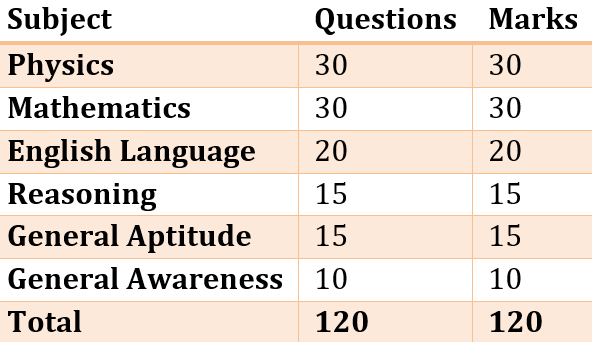
This table reflects the recent examination pattern. Candidates should check the applicable official AAI notification for the latest pattern, eligibility conditions, and marking scheme.
What Does This Mean for Average Students?
Physics and Mathematics together account for 60 marks.
The remaining 60 marks come from non-technical subjects.
Therefore, students should not focus exclusively on technical preparation.
A balanced strategy is essential for maximizing the overall score.
4. You Do Not Need to Be a Physics Genius
One of the biggest misconceptions is that AAI ATC requires extraordinary Physics knowledge.
The examination demands conceptual understanding and the ability to apply relevant principles.
Important Physics Areas
• Units and Measurements
• Motion in One and Two Dimensions
• Laws of Motion
• Work, Energy and Power
• Rotational Motion
• Gravitation
• Thermodynamics
• Oscillations and Waves
• Electrostatics
• Current Electricity
• Magnetism
• Electromagnetic Induction
• Optics
• Modern Physics
• Semiconductor Electronics
How Should an Average Student Prepare Physics?
Step 1: Begin with fundamental concepts.
Step 2: Understand important formulas and their applications.
Step 3: Solve basic numerical questions.
Step 4: Progress to standard examination-level questions.
Step 5: Practise chapter-wise PYQs.
Step 6: Revise formulas regularly.
Satyendra Sir's Physics Advice
Do not begin with the most difficult numerical questions.
First, develop conceptual clarity.
A student who understands the fundamentals can gradually improve problem-solving ability through consistent practice.
5. Weak in Mathematics? You Can Still Improve
Many students believe they cannot crack AAI ATC because Mathematics is their weakest subject.
However, Mathematics performance can improve through concept-based learning and systematic practice.
Important Mathematics Areas
• Algebra
• Trigonometry
• Complex Numbers
• Matrices and Determinants
• Limits and Continuity
• Differentiation
• Integration
• Differential Equations
• Coordinate Geometry
• Vectors
• Probability
• Statistics
Preparation Strategy
Start with topics where your fundamentals are relatively strong.
Then gradually move towards challenging chapters.
For each topic:
1. Understand the basic concept.
2. Learn standard formulas.
3. Solve simple questions.
4. Practise moderate-level problems.
5. Attempt PYQs.
6. Analyse mistakes.
Important: Mathematics improvement requires active problem-solving, not just watching lectures.
6. Non-Technical Subjects Can Strengthen Your Overall Score
Students with weaker Physics or Mathematics fundamentals should not ignore non-technical preparation.
The non-technical section provides an important opportunity to improve overall performance.
English
Focus on grammar, vocabulary, and comprehension.
Reasoning
Practise logical questions and pattern recognition.
General Aptitude
Improve calculation skills and understand common quantitative methods.
General Awareness
Prepare important static topics and relevant current affairs.
Practical Advice
Study non-technical subjects regularly instead of leaving them for the final month.
However, remember that strong non-technical performance does not eliminate the need to prepare Physics and Mathematics.
7. Start from Basic Concepts Without Feeling Embarrassed
One common mistake among average students is attempting advanced questions before understanding fundamentals.
Example: Physics
If you struggle with Electromagnetic Induction, first revise the underlying concepts of magnetic fields and magnetic flux.
Example: Mathematics
If Integration is difficult, revise relevant algebraic operations, functions, and differentiation.
The Right Approach
Basics → Concept Understanding → Standard Questions → PYQs → Timed Practice
There is no disadvantage in revisiting foundational concepts when necessary.
The real problem is moving forward without understanding them.
8. Do Not Compare Your Starting Point with Someone Else's Progress
Some aspirants begin preparation with strong Physics and Mathematics backgrounds.
Others need more time to revise their fundamentals.
Both groups can improve, but their preparation requirements may differ.
The Mistake
Comparing your first mock-test score with someone who has already completed months of preparation.
Better Approach
Track your own improvement.
For example:
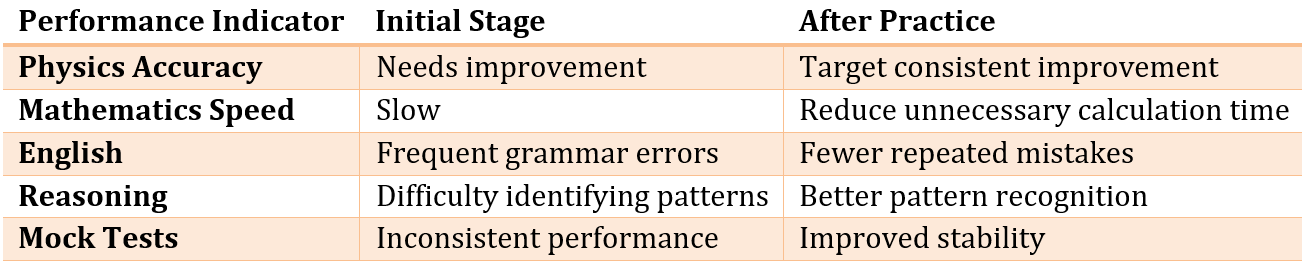
Focus on measurable progress rather than unrealistic comparisons.
9. Create a Realistic Daily Study Timetable
Average students often try to compensate for weak fundamentals by creating extremely demanding timetables.
However, studying for unrealistic hours can lead to fatigue and inconsistency.
Sample Six-Hour Daily Study Plan
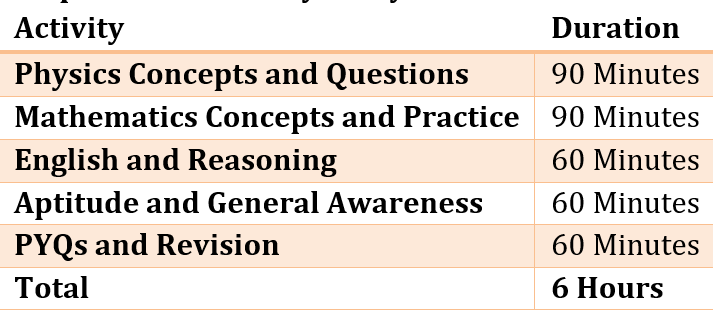
This is an illustrative timetable.
Students should adjust it according to their preparation level, classes, college schedule, or professional responsibilities.
Satyendra Sir's Advice: A timetable you can follow consistently is more valuable than an ambitious schedule you abandon after a few days.
10. Solve AAI ATC Previous Year Questions
Previous year questions help students understand the concepts and question types tested in earlier examinations.
For average students, PYQs are particularly useful because they help connect theoretical learning with examination-level application.
How to Use PYQs Effectively
After completing a chapter:
• Solve relevant previous year questions.
• Identify the concept behind each question.
• Understand why the correct answer is right.
• Analyse incorrect options.
• Practise similar questions.
• Record difficult concepts for revision.
Do not simply memorize PYQ answers.
Career Wave AAI ATC PYQs and E-Books
11. Mock Tests Are Important for Average Students
Mock tests help aspirants evaluate their preparation under timed conditions.
They reveal problems that may not be visible during regular study sessions.
What Can Mock Tests Tell You?
• Which subjects are weak?
• Where are you losing marks?
• Are you making calculation mistakes?
• Are you spending too much time on difficult questions?
• Are you forgetting previously studied concepts?
• Is your accuracy improving?
How to Begin
Start with chapter-wise and sectional tests.
Gradually introduce full-length mock tests as your syllabus coverage improves.
Career Wave AAI ATC Full Test Series 2026
Explore the AAI ATC Full Test Series:
https://careerwave.org/test-series/22-atc-full-test-series-2026
Career Wave Tip: Mock tests are not only for measuring performance. They are tools for identifying what needs improvement.
12. Do Not Get Discouraged by Low Initial Mock Scores
Suppose you attempt your first mock test and score 45 or 55 marks.
Does that mean you cannot crack AAI ATC?
No.
An initial mock score is only one measure of your current preparation.
What Should You Do?
Analyse the test carefully.
Identify whether marks were lost because of:
• Weak concepts.
• Incomplete syllabus.
• Calculation errors.
• Poor time management.
• Lack of revision.
• Careless mistakes.
Then address these problems systematically.
Important: Improvement is possible, but it is not automatic. It requires targeted practice and regular evaluation.
13. Maintain an Error Notebook for Every Subject
Students often repeat the same mistakes because they do not record them.
An error notebook helps identify recurring problems.
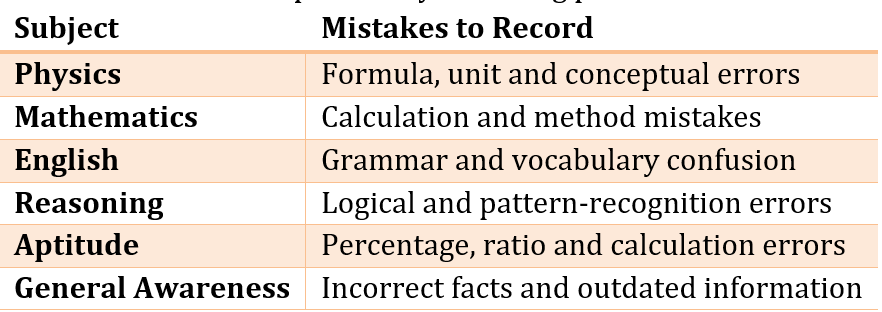
Revise these mistakes before important mock tests.
14. Improve Accuracy Before Speed
Many students focus on solving questions quickly.
However, speed without accuracy can reduce examination performance.
Better Strategy
Follow this sequence:
Understand → Solve Correctly → Improve Accuracy → Increase Speed
Begin by solving questions without unnecessary time pressure.
Once your accuracy becomes consistent, gradually introduce timed practice.
This is especially useful for students rebuilding their fundamentals.
15. Learn to Manage Difficult Questions
AAI ATC aspirants should understand that they may not immediately know how to solve every question.
The important skill is deciding how to use examination time efficiently.
Practical Strategy
During mock tests:
1. Attempt familiar questions first.
2. Avoid spending excessive time on one difficult problem.
3. Mark lengthy questions for later.
4. Return to difficult questions when time permits.
5. Review your question-selection strategy after the test.
This approach can help students use their available time more effectively.
16. Revision Is More Important Than Repeatedly Starting New Chapters
Some students continuously study new topics but rarely revise completed chapters.
As a result, they forget earlier concepts.
Suggested Revision Cycle
Daily: Review important formulas and concepts.
Weekly: Revise completed chapters.
Monthly: Revisit older topics and weak areas.
Before Mock Tests: Revise recurring mistakes.
The exact frequency should depend on how well you retain each topic.
17. Avoid the Trap of Collecting Too Many Resources
Many aspirants collect multiple books, PDFs, and video playlists.
However, excessive resources can make preparation confusing.
Recommended Resource System
Use:
• One reliable concept-learning source.
• One organized set of notes.
• Previous year questions.
• A practice question bank.
• A suitable mock-test series.
Satyendra Sir's Advice: Completing and revising reliable resources is more useful than collecting materials you never finish.
18. Consistency Matters More Than Occasional Long Study Sessions
A student who studies consistently can build knowledge and skills over time.
However, studying for ten hours one day and then avoiding preparation for several days can create unnecessary gaps.
Better Approach
Set manageable daily targets.
For example:
• Complete one Physics concept.
• Solve Mathematics questions.
• Practise English or Reasoning.
• Revise important formulas.
• Analyse mistakes.
Small, focused activities can contribute to steady progress.
19. Can You Prepare for AAI ATC Without Coaching?
Yes. Coaching is not compulsory for AAI ATC preparation.
Students can prepare through self-study if they have reliable resources, sufficient discipline, and a structured study plan.
However, some aspirants may benefit from guidance, particularly when they struggle with fundamentals or preparation planning.
Self-Study May Work Well If You Can:
• Understand concepts independently.
• Follow a consistent timetable.
• Solve questions regularly.
• Identify weak areas.
• Analyse mock tests.
• Maintain revision discipline.
Coaching May Help If You Need:
• Structured concept explanations.
• Regular guidance.
• Organized practice.
• Doubt clarification.
• A planned preparation schedule.
At Career Wave, Satyendra Sir emphasizes choosing a preparation method based on your actual learning needs rather than following others blindly.
20. How Long Does an Average Student Need to Prepare for AAI ATC?
There is no fixed preparation duration suitable for everyone.
The time required depends on:
• Physics and Mathematics fundamentals.
• Familiarity with non-technical subjects.
• Available daily study hours.
• Previous preparation experience.
• Learning speed.
• Revision requirements.
A student with strong fundamentals may need less time than someone rebuilding concepts from the beginning.
Important Advice
Instead of asking only how many months are required, assess how much of the syllabus you can understand, practise, and revise effectively within the available time.
21. Do Average Graduation Marks Affect AAI ATC Selection?
Academic marks matter for meeting the eligibility requirements specified in the official recruitment notification.
However, being an average student does not automatically mean being ineligible.
Candidates must satisfy the prescribed qualification, marks, age, and other conditions.
For example, recent AAI ATC recruitment notifications have prescribed minimum academic percentage requirements for qualifying degrees.
Always verify the exact eligibility requirements in the applicable official notification before applying.
Meeting the minimum eligibility criteria does not guarantee selection; candidates must also perform successfully in the recruitment process.
22. Understand That AAI ATC Selection Is More Than the CBT
Students should not focus only on the written examination.
Depending on the applicable recruitment notification, the selection process may include:
• Computer-Based Test.
• Voice Test.
• Psychological Assessment.
• Psychoactive Substances Test.
• Document Verification.
• Medical Examination.
Candidates must understand the complete selection process and applicable medical standards.
Practical Advice
Read the official notification carefully.
Do not assume that qualifying the CBT automatically guarantees final selection.
23. Build Confidence Through Preparation, Not Motivation Alone
Motivational videos can encourage students, but motivation cannot replace practice.
Confidence should come from measurable improvement.
Build Confidence By:
• Completing planned chapters.
• Solving questions independently.
• Improving mock-test accuracy.
• Reducing repeated mistakes.
• Revising weak concepts.
• Tracking weekly progress.
Career Wave Tip: Confidence becomes more reliable when it is supported by preparation evidence.
24. A Practical 90-Day Preparation Framework for Average Students
If an aspirant has approximately three months available, the following framework may help organize preparation.
This is a sample plan, not a guarantee of complete syllabus coverage or selection.

Students with significant conceptual gaps may require more time.
Phase 1: Build Fundamentals
Focus on understanding important Physics and Mathematics concepts.
Begin English, Reasoning, Aptitude, and General Awareness simultaneously.
Phase 2: Improve Question-Solving Ability
Solve chapter-wise questions and PYQs.
Attempt sectional tests and identify weak topics.
Phase 3: Improve Examination Performance
Revise formulas and concepts.
Attempt full-length mock tests.
Analyse mistakes and improve time management.
25. The Most Important Lesson: Stop Calling Yourself an Average Student
One of the biggest barriers to preparation is believing that previous academic performance permanently defines your ability.
A student may have struggled in school because of weak fundamentals, ineffective study methods, or inconsistent preparation.
These problems can be addressed.
Instead of repeatedly asking whether you are intelligent enough, ask:
• Which concepts do I need to improve?
• What mistakes am I repeating?
• How can I improve my accuracy?
• Am I revising regularly?
• Is my preparation strategy working?
Satyendra Sir's Advice: Focus on becoming a better-prepared candidate rather than trying to prove whether you are average or brilliant.
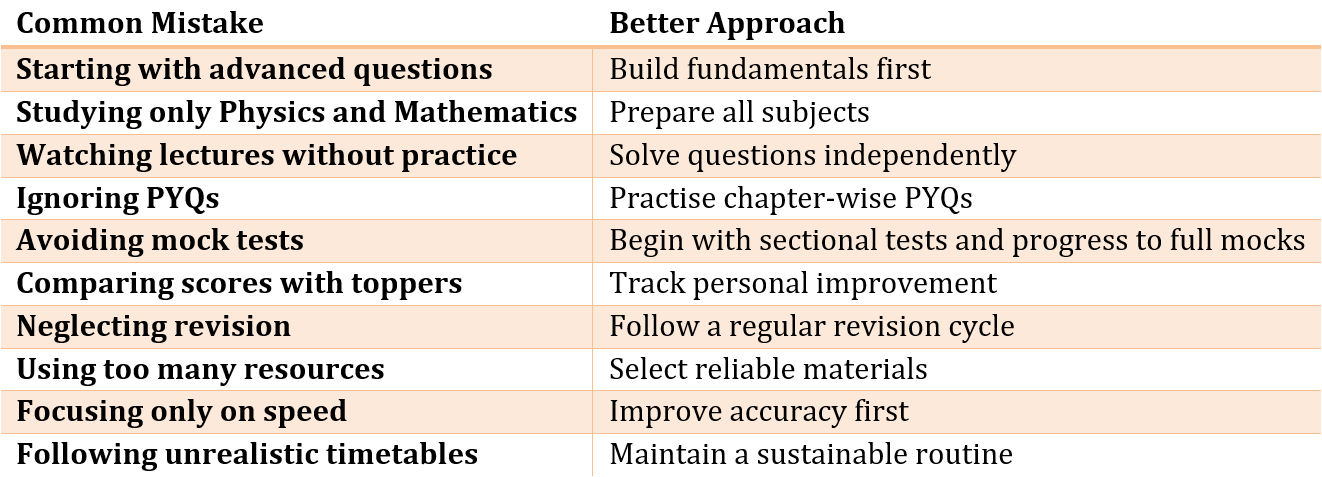
Common Mistakes Average Students Should Avoid in AAI ATC Preparation
How Career Wave Helps Average Students Prepare for AAI ATC
At Career Wave, Satyendra Sir focuses on helping aspirants develop conceptual clarity, structured preparation habits, and examination-oriented problem-solving skills.
Students can use Career Wave's preparation resources to strengthen their preparation.
1. Concept-Based Learning
Build a strong understanding of Physics and Mathematics concepts before moving to advanced questions.
2. AAI ATC Previous Year Questions
Practise PYQs to understand previous examination trends and important concepts.
AAI ATC PYQs and E-Books:
3. Full-Length Mock Test Practice
Evaluate speed, accuracy, and examination readiness through mock tests.
Career Wave AAI ATC Full Test Series 2026:
https://careerwave.org/test-series/22-atc-full-test-series-2026
4. Preparation Guidance by Satyendra Sir
Follow Career Wave for educational lectures, preparation strategies, revision guidance, and examination-related updates.
Career Wave YouTube Channel:
https://www.youtube.com/@CAREERWAVE
Frequently Asked Questions (FAQs)
1. Can an average student crack AAI ATC 2026?
Yes. An academically average student can qualify for AAI ATC if they meet the eligibility criteria and perform sufficiently well in the selection process. Strong preparation is essential.
2. Is AAI ATC only for toppers?
No. The examination is not restricted to academic toppers. Candidates must meet the prescribed eligibility conditions and qualify through the recruitment process.
3. Can a student weak in Physics crack AAI ATC?
Yes, improvement is possible through conceptual learning, regular numerical practice, formula revision, and PYQs. However, Physics preparation should not be neglected.
4. Can I crack AAI ATC if I am weak in Mathematics?
It is possible, but you must work on your fundamentals, problem-solving methods, accuracy, and speed.
5. Is AAI ATC difficult for average students?
AAI ATC is competitive. Students with weak fundamentals may find some topics challenging, but structured preparation can help them improve.
6. How many hours should an average student study for AAI ATC?
There is no universal requirement. A focused and sustainable study routine is more important than an arbitrary number of hours.
7. Can I crack AAI ATC in three months?
It depends on your existing fundamentals, available study time, syllabus coverage, and preparation quality. Three months may be sufficient for some candidates but not for everyone.
8. Is coaching necessary for average students?
No. Coaching is not compulsory. Students can prepare through self-study, although structured guidance may help those who need additional support.
9. Which subject should I start first for AAI ATC?
Begin with an assessment of your fundamentals. Start strengthening Physics and Mathematics while including non-technical preparation.
10. Where can I find AAI ATC previous year questions?
Explore Career Wave's PYQs and e-books:
11. Where can I attempt AAI ATC Full Mock Tests 2026?
Explore Career Wave's AAI ATC Full Test Series 2026:
https://careerwave.org/test-series/22-atc-full-test-series-2026
Conclusion: Average Academic Performance Does Not Define Your AAI ATC Potential
So, can an average student crack AAI ATC?
Yes, it is possible. But success requires eligibility, disciplined preparation, conceptual clarity, consistent practice, and strong examination performance.
You do not need to have been a topper throughout your academic life.
However, you must be willing to improve your weak areas, solve questions independently, revise regularly, and learn from mistakes.
Instead of worrying about your previous marks, focus on what you can improve today.
At Career Wave, Satyendra Sir encourages aspirants to follow a structured preparation strategy based on understanding, practice, and measurable progress.
Remember: Your starting point does not determine your final result. What matters is how effectively you prepare and perform.
Connect with Career Wave
Stay connected with Career Wave and Satyendra Sir for AAI ATC 2026 preparation strategies, Physics and Mathematics guidance, PYQs, mock tests, and examination updates.
YouTube Channel:
https://www.youtube.com/@CAREERWAVE
Telegram Channel:
https://t.me/aai_atc
Instagram:
https://www.instagram.com/careerwave.atc
Facebook:
https://www.facebook.com/careerwave.atc
AAI ATC Full Test Series 2026:
https://careerwave.org/test-series/22-atc-full-test-series-2026
AAI ATC PYQs and E-Books:
https://careerwave.org/ebooks
Career Wave — Your Success, Our Efforts