Civil Judge Exam Eligibility | November 2026 | 8 Min Read
Supreme Court Denies 1-Year Deemed Practice Benefit to 2026 Law Graduates: Civil Judge Exam Eligibility Explained
The Supreme Court of India, on 19 November 2026, refused to extend the benefit of one-year deemed legal practice to candidates who graduated or obtained provisional enrolment in 2026, in a significant development concerning eligibility for the Civil Judge (Junior Division) examination.
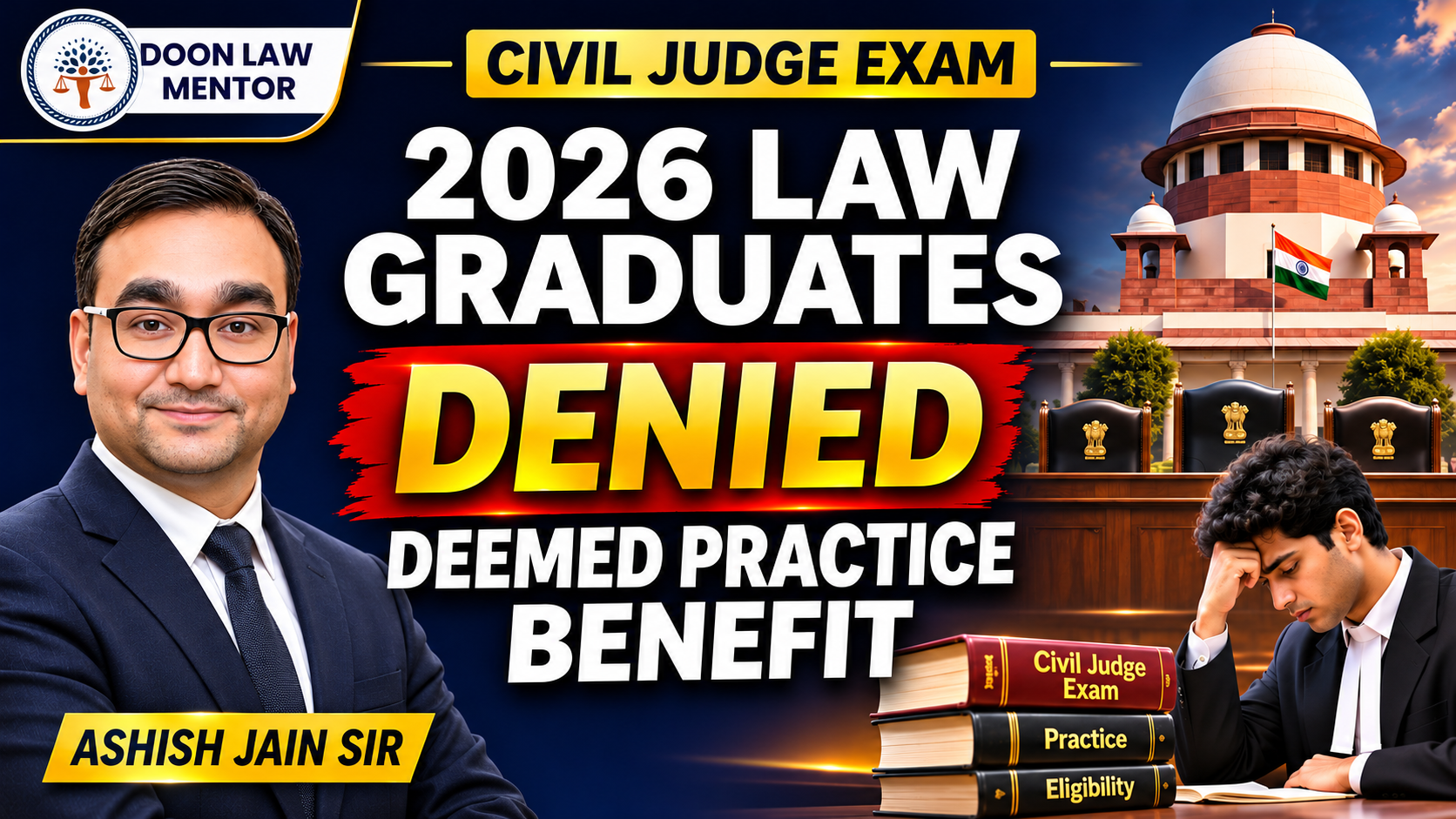
The decision came in Satyala Anjanapriya v. The Hon'ble High Court of Andhra Pradesh at Amaravati & Ors., arising from a challenge to the Andhra Pradesh High Court's Civil Judge recruitment notification dated 25 September 2026.
The controversy concerned the interpretation of the Supreme Court's earlier judgment in Bhumika Trust v. Union of India, delivered on 21 August 2026, which modified the mandatory legal practice requirement for entry-level judicial service recruitment.
The central question was straightforward but legally significant:
Can a newly qualified law graduate claim to have completed one year of legal practice under the transitional deemed-practice provision, even when one year has not elapsed since graduation or provisional enrolment?
The Supreme Court declined to extend that benefit to the 2026 graduates concerned.
However, this decision does not permanently disqualify the entire 2026 graduating batch from future Judiciary examinations. Its significance lies in the interpretation of the transitional eligibility arrangement and the importance of satisfying the applicable recruitment conditions.
This article explains the Supreme Court's latest decision, the background of the three-year practice rule, the Bhumika Trust judgment, the transitional period ending on 31 March 2027, and the requirements applicable from 1 April 2027.
Supreme Court Judgment: Key Highlights
| Particulars | Details |
|---|---|
| Case name | Satyala Anjanapriya v. The Hon'ble High Court of Andhra Pradesh at Amaravati & Ors. |
| Court | Supreme Court of India |
| Date | 19 November 2026 |
| Case number | SLP(C) No. 40139/2026 |
| Bench | CJI Surya Kant, Justice Joymalya Bagchi and Justice V. Mohana |
| Recruitment concerned | Andhra Pradesh Civil Judge (Junior Division) 2026 |
| Recruitment notification | 25 September 2026 |
| Related judgment | Bhumika Trust v. Union of India, 2026 INSC 904 |
| Central issue | Whether newly qualified 2026 law graduates could claim one year of deemed practice |
| Outcome | Supreme Court declined to extend the benefit to the petitioners |
| Important future date | 1 April 2027 — post-transitional framework applies |
What did the Supreme Court decide?
The Supreme Court declined to interfere in favour of newly qualified 2026 law graduates seeking the benefit of one-year deemed practice for the Andhra Pradesh Civil Judge recruitment.
The petitioners had relied on the transitional relaxation contained in the Bhumika Trust judgment.
However, the Court did not accept the proposition that the transitional deeming provision automatically entitled candidates to claim a completed year of practice when the relevant period had not elapsed since their law graduation or provisional enrolment.
The decision reinforces the distinction between a transitional concession granted to an existing category of law graduates and an unrestricted exemption for all future graduates.
Background: Andhra Pradesh Civil Judge Recruitment 2026
The High Court of Andhra Pradesh issued Notification No. 118/2026-RC on 25 September 2026, inviting applications for 119 posts of Civil Judge (Junior Division) in the Andhra Pradesh State Judicial Service.
The notification included a condition concerning the period elapsed since obtaining the law degree.
Under Clause II(A)(a), the relevant eligibility category covered law graduates who had obtained their law degree at least one year before the notification date.
As a result, candidates who obtained their LL.B. degrees within the immediately preceding year were excluded from applying under that category.
Several affected candidates approached the Andhra Pradesh High Court.
They argued that the recruitment condition was inconsistent with the transitional relaxation announced by the Supreme Court in Bhumika Trust v. Union of India.
Their principal argument was that the expression concerning eligibility of all law graduates during the transitional period should be interpreted broadly enough to include recently graduated candidates.
What was the petitioners' argument?
The petitioners contended that the Supreme Court had introduced a special transitional arrangement under which eligible law graduates were deemed to have completed one year of practice.
According to their interpretation, this deeming provision permitted even newly qualified graduates to participate in Civil Judge recruitment without completing an actual year after graduation.
They therefore challenged the restriction imposed by the Andhra Pradesh recruitment notification.
The dispute required the High Court to examine whether the transitional arrangement completely eliminated the one-year requirement or merely modified the manner in which an existing period of practice was recognised.
Andhra Pradesh High Court Judgment Dated 16 October 2026
A Division Bench comprising Chief Justice Lisa Gill and Justice Challa Gunaranjan considered the challenge.
In its judgment dated 16 October 2026, the Andhra Pradesh High Court dismissed the writ petitions and upheld the recruitment condition.
The High Court interpreted Bhumika Trust as providing limited transitional relief, rather than completely dispensing with the need for the relevant one-year period to have elapsed.
The Court reasoned that the deemed-practice provision was formulated against the background of the time that had already passed between the Supreme Court's judgments of 20 May 2025 and 21 August 2026.
It rejected the argument that a candidate who had graduated only a few months earlier could automatically be treated as having completed a full year.
The High Court also distinguished between:
- The requirement relating to one year of practice or the corresponding elapsed period.
- The concession relating to furnishing a separate Certificate of Practice for the deemed period.
In the High Court's interpretation, the transitional concession did not eliminate the first requirement merely because documentary proof of the deemed period had been relaxed.
Consequently, the High Court found no illegality in Clause II(A)(a) of the Andhra Pradesh recruitment notification.
The unsuccessful candidates subsequently approached the Supreme Court.
Supreme Court Hearing on 19 November 2026
The matter was considered by a Bench comprising Chief Justice Surya Kant, Justice Joymalya Bagchi and Justice V. Mohana.
Senior Advocate Pinky Anand appeared for the petitioner and sought an extension of the transitional benefit to newly qualified 2026 graduates.
The argument was that the relaxation under Bhumika Trust should also protect candidates affected by the September 2026 recruitment notification.
However, the Chief Justice explained the circumstances in which the earlier deemed-practice arrangement had been introduced.
The original Supreme Court judgment had been delivered in May 2025. The modified judgment followed in August 2026.
By that time, more than one year had elapsed.
As reported from the hearing, the Bench noted that candidates who had already graduated in 2025 had an opportunity during that intervening period to acquire practical exposure through legal offices, advocates' chambers and court-related work.
The deemed-practice provision was intended to address that transitional situation.
Newly qualified 2026 graduates, on the other hand, could not automatically claim that the same period had already been completed.
The Court emphasised the value of gaining practical experience before entering judicial service and declined to grant the requested extension.
Important legal distinction: The Court's reported oral observations explain its reasoning, while the actual operative order determines the formal disposal of the petition. They should not be treated as separate statutory eligibility rules.
Why Was a Three-Year Practice Requirement Introduced in 2025?
The present controversy cannot be fully understood without examining the Supreme Court's decision of 20 May 2025 in the All India Judges Association proceedings.
In that judgment, the Court restored a minimum requirement of three years of practice at the Bar for candidates seeking entry into the Civil Judge (Junior Division) cadre.
The underlying concern was the practical competence of newly recruited judicial officers.
Judicial officers frequently deal with matters involving property, personal liberty, contractual rights, family disputes, criminal proceedings and the interests of vulnerable individuals.
The ability to interpret a Bare Act is important, but actual judicial work also requires familiarity with:
- Courtroom procedure and professional conduct.
- Pleadings, evidence and examination of witnesses.
- Arguments advanced by advocates.
- Interlocutory applications and judicial orders.
- Practical difficulties encountered by litigants.
- The responsibility attached to judicial decision-making.
The Supreme Court considered prior courtroom exposure valuable in developing the judgment and temperament required of a judicial officer.
Nevertheless, the decision generated concerns among fresh law graduates and other aspirants who had prepared for judicial service examinations on the basis of earlier eligibility arrangements.
The Court was subsequently called upon to reconsider and clarify the requirement.
Bhumika Trust v. Union of India (21 August 2026): What Changed?
The Supreme Court delivered its significant judgment in Bhumika Trust v. Union of India and Others, 2026 INSC 904; 2026 SCC OnLine SC 1687, on 21 August 2026.
The case involved review and clarification of the earlier mandatory practice requirement.
The Court maintained the importance of practical legal exposure but modified the manner in which the requirement would operate.
Instead of requiring every candidate to complete three years of prior practice before appearing for the Civil Judge examination, the Court established a framework combining:
- One year of prior legal practice, where required under the post-transitional scheme.
- One year of institutional training after selection.
- One additional year of structured law clerkship after training.
The judgment created two distinct arrangements: one for the transitional period and another for recruitment notifications issued from 1 April 2027 onwards.
This distinction is central to understanding the November 2026 decision.
Paragraph 73: Transitional Eligibility Until 31 March 2027
Paragraph 73 of Bhumika Trust addresses recruitment advertisements issued after the judgment dated 20 May 2025 and up to 31 March 2027.
It provided a special arrangement for candidates affected by the transition from the previous recruitment system to the newly prescribed practice requirement.
The paragraph referred broadly to the eligibility of law graduates during the transitional period and introduced a legal fiction treating the relevant candidates as having completed one year of active practice for the purpose of their applications.
It also dispensed with the requirement of furnishing a separate Certificate of Practice for that deemed period.
However, a disagreement arose over the extent of this concession.
Did the expression concerning all law graduates cover candidates who had graduated only recently, or was it connected to the one-year period already elapsed since the May 2025 judgment?
In the Andhra Pradesh litigation, the High Court adopted the latter interpretation.
The Supreme Court's refusal of relief on 19 November 2026 meant that the newly qualified 2026 candidates before it could not rely on the transitional arrangement to overcome the disputed recruitment condition.
What does deemed practice mean?
A deeming provision creates a legal fiction under which a particular fact or status is treated as existing for a specified legal purpose.
Such provisions must be interpreted according to their wording, context and objective.
In the present setting, the deemed-practice arrangement was intended to accommodate candidates affected by a change in the judicial recruitment rules.
It was not treated by the courts in the Andhra Pradesh dispute as an unrestricted declaration that every new law graduate had automatically acquired one year of practice.
This distinction is especially important for candidates interpreting judicial recruitment notifications.
Paragraph 74: One-Year Actual Practice Rule From 1 April 2027
Paragraph 74 of Bhumika Trust establishes the framework for Civil Judge (Junior Division) recruitment notifications issued on or after 1 April 2027.
Under that framework, candidates are required to possess at least one year of actual legal practice before appearing for the recruitment examination.
The practice requirement must be supported by appropriate verification and certification in accordance with the mechanism prescribed by the competent High Courts.
The judgment specifically emphasises participation in effective judicial proceedings and proper documentation of courtroom experience.
It is therefore important to understand that the rule is not merely about allowing one calendar year to pass after completing an LL.B.
The post-transitional requirement concerns actual professional practice, subject to the applicable judicial directions.
Does law clerkship count as one year of prior practice?
The distinction between pre-recruitment practice and post-selection clerkship is crucial.
The Supreme Court clarified in Tapasmita Sutar v. Union of India, decided on 6 October 2026, that law clerkship cannot simply be substituted for the mandatory one-year practice at the Bar under the post-transitional framework.
The training and clerkship components under Bhumika Trust serve a different purpose after selection.
Candidates should therefore avoid assuming that employment as a law clerk, legal researcher or intern will automatically satisfy the requirement of actual practice for recruitment notifications issued from 1 April 2027.
The New 1+1+1 Framework for Civil Judge Recruitment
The framework introduced by Bhumika Trust can be understood through the following structure.
| Stage | Requirement | Purpose |
|---|---|---|
| Before the examination | 1 year of actual legal practice under the post-transitional scheme | Practical familiarity with legal proceedings |
| After selection | 1 year of intensive Judicial Academy training | Institutional judicial training |
| After academy training | 1 year of structured law clerkship | Supervised exposure to judicial functioning |
Stage 1: One year of actual legal practice
The candidate must fulfil the prescribed practice requirement before appearing for recruitment under the post-transitional rules.
The relevant experience and certification must comply with the applicable Supreme Court directions and High Court mechanism.
Stage 2: One year of Judicial Academy training
Selected candidates undergo intensive training at the concerned State Judicial Academy.
The objective is to develop competence in judicial procedure, court management, legal reasoning and the responsibilities associated with judicial office.
Stage 3: One year of structured law clerkship
The judgment provides for a further period of one year of clerkship.
The structure ordinarily comprises:
- First 6 months under the supervision of a Principal District Judge, District and Sessions Judge or a member of the Higher Judicial Services.
- Next 6 months under a sitting Judge of the concerned High Court.
The arrangement is intended to provide supervised practical exposure before regular judicial responsibilities are assumed.
Successful completion and satisfactory evaluation are important components of the scheme.
Remember: The 1+1+1 framework applies subject to the precise terms of the judgment and the relevant recruitment rules. Transitional selections are governed by the separate provisions of Paragraph 73.
Civil Judge Eligibility: Important Dates Explained
| Date / Period | Legal development | Significance |
|---|---|---|
| 20 May 2025 | All India Judges Association judgment | Three-year prior practice requirement restored |
| 21 August 2026 | Bhumika Trust judgment | Transitional and post-transitional frameworks prescribed |
| 25 September 2026 | Andhra Pradesh recruitment notification | Eligibility dispute concerning recent law graduates |
| 6 October 2026 | Tapasmita Sutar decision | Clarification concerning actual practice and law clerkship |
| 16 October 2026 | Andhra Pradesh High Court judgment | Challenge to recruitment condition dismissed |
| 19 November 2026 | Satyala Anjanapriya proceedings | Supreme Court declined relief to newly qualified 2026 graduates |
| 31 March 2027 | End of transitional notification period | Last date of the period covered by Paragraph 73 |
| 1 April 2027 | Post-transitional framework begins | One year of actual practice required under Paragraph 74 |
The relevant date for deciding which framework applies is generally the date of the recruitment notification, not merely the date on which the examination is eventually conducted.
Are 2025 Law Graduates Eligible for Civil Judge Examinations?
The Supreme Court's reasoning recognised the different position of candidates who had completed their legal education sufficiently earlier.
However, it would be incorrect to conclude that every person who graduated at any point in 2025 is automatically eligible for every recruitment.
The candidate's eligibility must be evaluated by considering the relevant recruitment notification, its cut-off date and the applicable judicial directions.
For example, a candidate who completed the law degree early in 2025 may be differently placed from a candidate who completed it towards the end of that year.
Other eligibility requirements, including age, qualifications, language and state-specific conditions, must also be satisfied.
Can 2026 Law Graduates Apply for Judiciary Examinations in 2027?
Yes, a 2026 law graduate may become eligible for a future judicial service examination, provided the applicable conditions are fulfilled.
The Supreme Court's November 2026 decision is not a permanent prohibition on the entire 2026 batch.
Consider a hypothetical example.
A candidate completes an LL.B. degree in July 2026 and subsequently obtains lawful provisional enrolment with the State Bar Council.
If a future recruitment notification is issued after the candidate has obtained the necessary practice experience, the candidate's eligibility must be examined under the rules applicable to that particular recruitment.
For notifications issued on or after 1 April 2027, the post-transitional requirement of actual practice and certification becomes especially relevant.
However, simply having a law degree that is one year old does not automatically establish the required actual practice.
Candidates must carefully distinguish between:
- Completion of the law degree.
- Provisional enrolment or registration with the State Bar Council.
- Completion of actual practice at the Bar.
- Certification or verification of that practice.
- Compliance with the specific recruitment notification.
Is the Practice Rule Applicable to Judiciary Examinations Across India?
The Bhumika Trust judgment lays down a framework for recruitment to the Civil Judge (Junior Division) cadre and is relevant to State Judicial Services across India.
Nevertheless, the application of its directions must be considered alongside the recruitment rules, notifications and implementation mechanisms of the concerned High Courts and states.
Aspirants preparing for Uttar Pradesh Judiciary, Uttarakhand Judiciary, Rajasthan Judiciary, Madhya Pradesh Judiciary, Bihar Judiciary, Delhi Judicial Services, Andhra Pradesh Judiciary and other state examinations should therefore examine their respective official notifications carefully.
The Andhra Pradesh decision arose from a specific recruitment condition and should not be treated as an automatic determination of every individual candidate's eligibility in another state.
What should aspirants verify?
Before submitting an application, candidates should confirm the date of the recruitment notification, the applicable practice requirement, the cut-off date, Bar Council enrolment status and documentary requirements.
They should also check whether any later judicial order or official corrigendum modifies the position.
Do not rely solely on social-media headlines claiming that all fresh graduates are either eligible or ineligible.
Constitutional Provisions Relevant to Judicial Service Recruitment
For Judiciary aspirants, the controversy also provides an opportunity to revise the constitutional structure governing the subordinate judiciary.
Article 233 — Appointment of District Judges
Article 233 concerns the appointment, posting and promotion of District Judges.
Article 233(2) provides specific eligibility requirements for persons not already in government service who seek appointment as District Judges.
Candidates must not confuse this provision with the framework for appointment to Civil Judge (Junior Division).
Article 234 — Recruitment to Judicial Service Other Than District Judges
Article 234 is particularly relevant to recruitment for entry-level judicial service posts.
It concerns appointments of persons other than District Judges to the judicial service of a state, made by the Governor in accordance with rules framed after consultation with the State Public Service Commission and the High Court.
The precise recruitment mechanism is governed by the constitutional framework and the applicable service rules.
Article 235 — Control Over Subordinate Courts
Article 235 vests control over district courts and courts subordinate thereto in the High Court.
It reflects the constitutional role of the High Courts in maintaining the functioning and institutional independence of the subordinate judiciary.
Constitutional significance
The eligibility controversy highlights the need to balance two legitimate objectives: maintaining professional competence in the judiciary and ensuring a fair opportunity for qualified law graduates to enter judicial service.
The Supreme Court's approach recognises the value of practical courtroom exposure while providing a structured transition and training framework.
Practical Guidance for Judiciary Aspirants
In light of the developments in Bhumika Trust and Satyala Anjanapriya, candidates preparing for Civil Judge examinations should adopt a preparation strategy that accounts for both academic and professional eligibility.
1. Complete State Bar Council enrolment formalities
Where applicable, candidates should promptly complete the necessary enrolment procedures and maintain accurate records.
2. Gain genuine courtroom experience
Candidates should seek meaningful exposure to pleadings, procedural applications, evidence, arguments and court functioning.
The objective should be professional learning, not merely obtaining a certificate.
3. Maintain evidence of professional participation
Preserve documents and records relevant to establishing actual practice, in accordance with applicable High Court requirements.
4. Continue Judiciary examination preparation
Professional practice and academic preparation should proceed together wherever possible.
Candidates should continue studying Constitutional Law, Civil Law, Criminal Law, procedural laws, evidence, landmark judgments and state-specific subjects.
5. Prepare for all three examination stages
Judicial service preparation should cover Prelims, Mains and Interview.
Candidates should develop objective-question accuracy, descriptive answer-writing skills and the capacity to apply law to practical situations.
6. Follow authoritative eligibility updates
Official recruitment notifications, judicial orders, corrigenda and High Court directions should be prioritised over unverified online claims.
Judiciary Prelims and Mains: Important Examination Points
The following points are useful for legal-current-affairs revision and judicial service interview preparation.
| Question | Answer |
|---|---|
| When was the original three-year practice judgment delivered? | 20 May 2025 |
| Which judgment introduced the modified framework? | Bhumika Trust v. Union of India |
| Date of Bhumika Trust judgment? | 21 August 2026 |
| Neutral citation? | 2026 INSC 904 |
| Which paragraph concerns transitional recruitment? | Paragraph 73 |
| When does the transitional notification period end? | 31 March 2027 |
| Which paragraph governs post-transitional recruitment? | Paragraph 74 |
| What is the minimum prior actual practice under Paragraph 74? | 1 year |
| How long is the Judicial Academy training? | 1 year |
| How long is the structured clerkship? | 1 year |
| Which constitutional Article is particularly relevant to entry-level judicial service appointments? | Article 234 |
| Which case concerned the 2026 Andhra Pradesh candidates? | Satyala Anjanapriya v. High Court of Andhra Pradesh |
Potential Judiciary Mains question:
Examine the constitutional and practical justification for requiring prior legal practice before appointment to the post of Civil Judge (Junior Division), with reference to the Supreme Court's decisions in All India Judges Association and Bhumika Trust.
A good answer should address the constitutional position, the practical need for courtroom experience, the changed recruitment framework, the transitional arrangement and the balance between equal opportunity and judicial competence.
Frequently Asked Questions
1. Has the Supreme Court banned 2026 law graduates from Judiciary examinations?
No. The Supreme Court refused to extend the particular deemed-practice benefit to the newly qualified 2026 candidates concerned in the Andhra Pradesh recruitment dispute. It did not impose a permanent prohibition on all 2026 graduates seeking judicial service appointments.
2. Can a 2026 law graduate claim one year of deemed practice under Bhumika Trust?
A newly qualified graduate cannot assume that the transitional deeming provision automatically creates one year of completed practice regardless of the elapsed period. The Supreme Court declined that interpretation in the present dispute.
3. What is the Civil Judge one-year practice rule from 2027?
For recruitment notifications issued on or after 1 April 2027, Paragraph 74 of Bhumika Trust requires at least one year of actual legal practice, subject to prescribed verification and certification.
4. Is three years of practice still compulsory before the Civil Judge examination?
Under the modified post-transitional framework, three years of practice at the Bar are not required entirely before the recruitment examination. The structure combines one year of prior actual practice with one year of academy training and one year of supervised clerkship after selection.
5. What is the difference between actual practice and deemed practice?
Actual practice refers to genuine professional legal practice satisfying the relevant judicial directions. Deemed practice is a legal fiction under which a specified period is treated as completed for a particular legal purpose.
6. Can law clerkship replace the one-year actual practice requirement?
Law clerkship cannot automatically replace the mandatory one-year actual practice required under the post-transitional framework. The Supreme Court clarified this distinction in Tapasmita Sutar v. Union of India.
7. Does the Bhumika Trust judgment apply to Uttarakhand Judiciary and other states?
The Supreme Court's framework is relevant to Civil Judge (Junior Division) recruitment across states. However, aspirants must examine the applicable state recruitment rules, official notification and High Court directions to determine individual eligibility.
8. What should fresh law graduates do before the next Judiciary recruitment?
Candidates should complete applicable Bar Council formalities, gain relevant legal practice, maintain practice records, follow official notifications and continue structured preparation for Prelims, Mains and Interview.
Conclusion: What Does the Supreme Court's Decision Mean for Judiciary Aspirants?
The Supreme Court's decision of 19 November 2026 in Satyala Anjanapriya v. High Court of Andhra Pradesh provides an important clarification concerning the scope of the transitional deemed-practice benefit introduced in Bhumika Trust.
The central takeaway is that a newly qualified 2026 law graduate cannot automatically claim to have completed one year of practice merely by invoking the transitional arrangement.
At the same time, the ruling should not be interpreted as permanently closing the doors of judicial service to the 2026 graduating batch.
Future eligibility depends on the applicable recruitment framework, the date of the notification, the candidate's qualifications and the fulfilment of the required legal practice conditions.
The wider significance of these developments is that judicial service recruitment increasingly emphasises a combination of legal knowledge, practical courtroom experience and structured institutional training.
For serious aspirants, the most effective approach is to develop both academic excellence and practical professional competence.
Prepare for Judiciary Examinations with Doon Law Mentor
Preparing for Judicial Services requires more than memorising statutory provisions.
At Doon Law Mentor, we support Judiciary and APO aspirants through structured preparation covering Prelims, Mains and Interview.
Our learning ecosystem includes:
- Judiciary and APO preparation courses.
- BNS, BNSS and BSA subject preparation.
- Constitutional, Civil and Criminal Law lectures.
- Previous-year question analysis.
- Mock tests and test series.
- Mains answer-writing guidance.
- Interview preparation and mock interviews.
- Free exam information and educational eBooks.
Our programmes are led by Ashish Jain Sir, UGC-NET & JRF qualified, LL.M. from the Faculty of Law, University of Delhi, with more than 14 years of experience in legal education.
Explore Judiciary exam information and resources:
https://doonlawmentor.com/law-exams-information
Explore courses, test series and learning resources:
https://academy.doonlawmentor.com/
Visit our main website:
https://doonlawmentor.com/
Learn from Ashish Jain Sir on YouTube:
https://www.youtube.com/@doonlawmentor
Doon Law Mentor — Structured Preparation for Judiciary, APO and Competitive Law Examinations.
Legal References and Sources
- Satyala Anjanapriya v. The Hon'ble High Court of Andhra Pradesh at Amaravati & Ors., SLP(C) No. 40139/2026, Supreme Court proceedings dated 19 November 2026. Supreme Court Latest Orders.
- Bhumika Trust v. Union of India and Others, 2026 INSC 904, 2026 SCC OnLine SC 1687, judgment dated 21 August 2026. Read judgment.
- Shaik Bushra Ahmed and connected matters v. State of Andhra Pradesh, judgment dated 16 October 2026, Andhra Pradesh High Court. Read judgment.
- Tapasmita Sutar v. Union of India, Supreme Court judgment dated 6 October 2026. Read judgment.
- Supreme Court hearing report, LiveLaw, 19 November 2026.
Editorial note: This article provides general legal and examination information. Eligibility must be determined using the applicable recruitment notification, service rules and authoritative judicial orders. The article distinguishes the earlier judicial directions from the Supreme Court's subsequent consideration of the 2026 Andhra Pradesh recruitment dispute.
Featured Courses
Discover our most popular courses