UP Judiciary |20 November 2026 | 8 Min Read
UPPSC PCS J 2026 Notification Out: 365 Civil Judge Vacancies
UPPSC PCS J 2026 notification released for 365 Civil Judge posts. Apply from 20 Nov to 21 Dec 2026. Check eligibility, age limit, dates and application process.
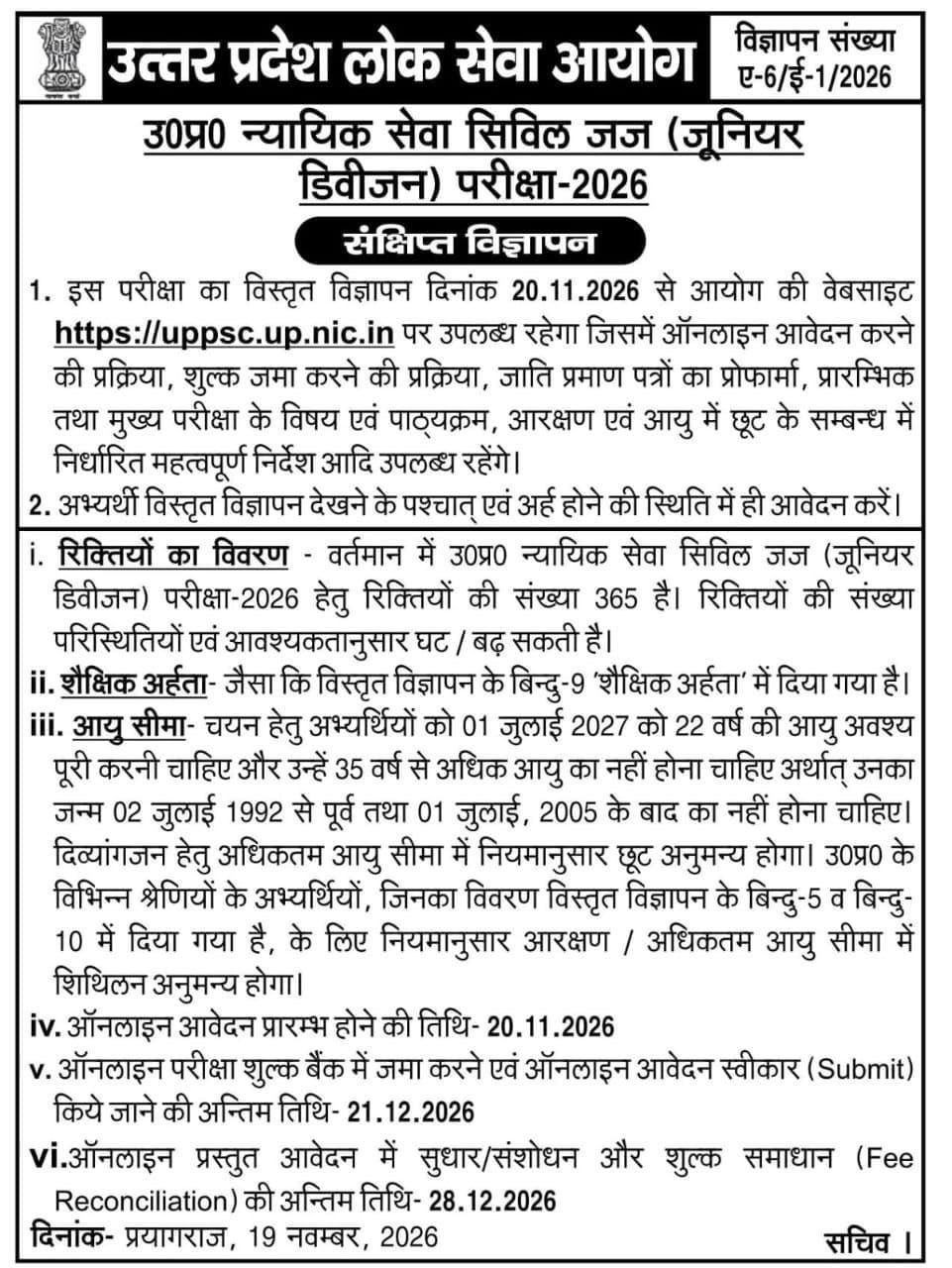
The Uttar Pradesh Public Service Commission (UPPSC) has officially announced the U.P. Judicial Service Civil Judge (Junior Division) Examination 2026, commonly known as the UP PCS J 2026 or UP Judiciary Examination 2026, to recruit candidates for 365 Civil Judge (Junior Division) vacancies.
The Commission issued the short advertisement on 19 November 2026, under Advertisement Number A-6/E-1/2026.
According to the official short notification, online applications commence on 20 November 2026, and the last date for submitting applications and depositing the examination fee is 21 December 2026.
Candidates will have until 28 December 2026 to make permitted corrections or modifications to submitted applications and complete fee reconciliation.
The Commission has prescribed an age limit of 22 to 35 years as of 1 July 2027, subject to applicable relaxations.
This recruitment announcement presents an important opportunity for law graduates preparing to enter the Uttar Pradesh Judicial Service.
However, candidates must carefully review the detailed advertisement before applying, particularly the educational and professional eligibility requirements, applicable age relaxations, reservation provisions and examination syllabus.
This article explains the confirmed details of the UPPSC Civil Judge Recruitment 2026, important dates, vacancy information, age limits, application procedure, eligibility considerations and preparation strategy.
UPPSC PCS J 2026 Notification: Latest Update
The Uttar Pradesh Public Service Commission, Prayagraj, published an abridged advertisement dated 19 November 2026 for the recruitment of Civil Judges (Junior Division).
The notification announces 365 vacancies and confirms the schedule for online applications, fee payment and application corrections.
The Commission has also announced that the detailed recruitment advertisement will be made available on its official website from 20 November 2026.
The detailed advertisement is expected to provide the complete instructions relating to:
- Educational and professional qualifications.
- Online application and fee payment procedures.
- Preliminary examination subjects and syllabus.
- Main examination subjects and syllabus.
- Reservation provisions and category-related requirements.
- Prescribed formats of caste certificates.
- Age relaxation and applicable conditions.
- Other important recruitment instructions.
Important: Candidates should not submit the application solely on the basis of the short advertisement. The Commission has expressly advised applicants to examine the detailed notification and apply only after confirming their eligibility.
Official UPPSC website: https://uppsc.up.nic.in/
UPPSC Civil Judge Recruitment 2026: Overview
| Particulars | Details |
|---|---|
| Recruiting authority | Uttar Pradesh Public Service Commission (UPPSC) |
| Examination | U.P. Judicial Service Civil Judge (Junior Division) Examination 2026 |
| Common examination name | UP PCS J / UP Judiciary 2026 |
| Advertisement number | A-6/E-1/2026 |
| Short advertisement date | 19 November 2026 |
| Post | Civil Judge (Junior Division) |
| Number of vacancies | 365 (provisional) |
| Application mode | Online |
| Online applications begin | 20 November 2026 |
| Last date for fee payment | 21 December 2026 |
| Last date for online application submission | 21 December 2026 |
| Last date for corrections and fee reconciliation | 28 December 2026 |
| Minimum age | 22 years |
| Maximum age | 35 years |
| Age calculation date | 1 July 2027 |
| Educational qualifications | As prescribed in Point 9 of the detailed advertisement |
| Preliminary examination date | Not specified in the short advertisement |
| Main examination date | Not specified in the short advertisement |
| Official website | https://uppsc.up.nic.in/ |
Candidates should bookmark this page and monitor the Commission's website for additional updates.
UP Judiciary Vacancy 2026: 365 Civil Judge Posts Announced
The short notification announces a total of 365 vacancies for the post of Civil Judge (Junior Division) under the Uttar Pradesh Judicial Service Examination 2026.
This is the advertised vacancy figure as of 19 November 2026.
However, the Commission has expressly stated that the number of vacancies may increase or decrease depending on circumstances and requirements.
Therefore, candidates should treat 365 as the present advertised number rather than a permanently fixed vacancy count.
UPPSC PCS J 2026 Vacancy Details
| Post | Advertised vacancies |
|---|---|
| Civil Judge (Junior Division) | 365 |
| Total | 365 |
Is the category-wise vacancy distribution available?
The supplied short advertisement does not specify the category-wise distribution of these vacancies.
Candidates should refer to the detailed advertisement for the number of posts assigned to individual reservation categories, where notified.
Reservation benefits, eligibility for particular categories and documentary requirements must be checked against the applicable recruitment provisions.
Candidates should not rely on category-wise vacancy figures circulated unofficially unless they correspond to the Commission's published advertisement.
UPPSC PCS J 2026 Important Dates
Candidates should carefully note the following dates.
| Event | Official date |
|---|---|
| Short notification issued | 19 November 2026 |
| Detailed advertisement scheduled for publication | 20 November 2026 |
| Online application starts | 20 November 2026 |
| Last date to deposit examination fee in the bank | 21 December 2026 |
| Last date to submit online application | 21 December 2026 |
| Application correction/modification deadline | 28 December 2026 |
| Last date for fee reconciliation | 28 December 2026 |
| Preliminary examination date | To be confirmed |
| Main examination date | To be confirmed |
What is the last date to apply for UP PCS J 2026?
The last date for submitting the online application is 21 December 2026.
The Commission has prescribed the same date for depositing the examination fee.
Candidates should therefore aim to complete both steps well before the deadline.
Waiting until the last day may create avoidable difficulties in case of payment failures, incomplete forms or technical problems.
What is the last date for application correction?
The last date for online correction or modification of submitted application details is 28 December 2026.
The same date applies to fee reconciliation.
This does not mean that candidates can submit a fresh application after 21 December 2026.
The correction facility is intended for permissible changes to applications already submitted, subject to the Commission's instructions.
UPPSC Civil Judge Eligibility Criteria 2026
Eligibility is among the most important aspects of the UP Judiciary 2026 recruitment.
Candidates must satisfy all requirements prescribed in the detailed advertisement, including educational qualifications, age criteria and any applicable professional eligibility conditions.
Educational qualification
Point 9 of the detailed advertisement contains the prescribed educational eligibility criteria.
The abridged advertisement does not reproduce those conditions.
Candidates must therefore examine the detailed notification before deciding whether they are qualified to apply.
In particular, applicants should verify the requirements relating to a recognised law qualification and any applicable enrolment, practice or other professional conditions.
A law degree alone should not be assumed to establish eligibility until every condition in the official advertisement has been checked.
Is prior legal practice compulsory for UP PCS J 2026?
This question is especially important following the Supreme Court's recent decisions concerning practical legal experience for entry-level judicial service.
In Bhumika Trust v. Union of India (2026), the Supreme Court modified the earlier framework concerning mandatory legal practice and introduced transitional provisions for certain judicial service recruitments.
The Supreme Court also considered the interpretation of the transitional deemed-practice benefit in Satyala Anjanapriya v. High Court of Andhra Pradesh in November 2026.
However, candidates should not assume that every fresh law graduate is automatically eligible merely because the UPPSC advertisement was issued before 1 April 2027.
The correct approach is to read the applicable judicial directions together with the specific eligibility conditions of Advertisement No. A-6/E-1/2026.
The short UPPSC notification refers candidates to the detailed advertisement for educational eligibility. It does not independently settle every question concerning practice requirements.
Aspirants should therefore verify the complete eligibility conditions before applying.
UPPSC PCS J Age Limit 2026
The Commission has prescribed the following age limits for the Civil Judge (Junior Division) Examination 2026:
- Minimum age: 22 years.
- Maximum age: 35 years.
- Age calculation date: 1 July 2027.
A candidate must have completed 22 years of age on 1 July 2027 and must not be older than 35 years, subject to the applicable relaxation provisions.
Eligible date-of-birth range
According to the short notification, candidates must not have been born:
- Before 2 July 1992.
- After 1 July 2005.
Accordingly, the ordinary date-of-birth range is:
2 July 1992 to 1 July 2005, both dates inclusive.
UPPSC Civil Judge Age Eligibility Examples
| Candidate's date of birth | Position under ordinary age limits |
|---|---|
| 1 July 1992 | Outside the ordinary upper age limit |
| 2 July 1992 | Within the age range |
| 1 January 2000 | Within the age range |
| 1 July 2005 | Within the age range |
| 2 July 2005 | Below the minimum age |
These examples illustrate the ordinary age boundaries stated in the notification.
Other eligibility conditions must still be fulfilled.
Age relaxation for reserved categories
The Commission has indicated that relaxation in the maximum age limit will be admissible as per the applicable rules.
This includes eligible categories covered by the relevant Uttar Pradesh reservation provisions and persons with disabilities, where applicable.
The exact relaxation, category-specific conditions and documentary requirements must be verified from the detailed advertisement.
Candidates claiming age relaxation should also ensure that their certificates comply with the prescribed format and relevant cut-off conditions.
UPPSC PCS J Application Form 2026: How to Apply Online
Applications for the U.P. Judicial Service Civil Judge (Junior Division) Examination 2026 are to be submitted through the official UPPSC website.
Candidates should follow the procedure specified in the detailed advertisement.
Step 1: Visit the official UPPSC website
Open:
Navigate to the recruitment notifications or application section.
Step 2: Find the Civil Judge Examination 2026 advertisement
Look for:
U.P. Judicial Service Civil Judge (Junior Division) Examination 2026 — Advertisement No. A-6/E-1/2026.
Before proceeding, read the complete notification.
Step 3: Complete One Time Registration, where required
UPPSC uses a One Time Registration (OTR) system for its recruitment applications.
Candidates should ensure that they possess a valid OTR number and complete any required registration formalities.
The official OTR website is:
Applicants should follow the instructions applicable to this recruitment rather than assuming that earlier registration details are sufficient.
Step 4: Complete the application form
After accessing the appropriate application process, enter the required information carefully.
This may include personal details, educational qualifications, contact information and category-related particulars.
Ensure that your name, date of birth and other relevant details match the supporting documents.
Step 5: Upload the required documents
Upload the photograph, signature and other documents according to the prescribed size, format and instructions.
Do not assume that documents accepted in an earlier UPPSC recruitment will automatically satisfy the requirements for this examination.
Step 6: Pay the examination fee
Deposit the prescribed examination fee through the payment facility and procedure specified by the Commission.
The deadline for payment is 21 December 2026.
The short advertisement does not provide the category-wise fee amounts. Candidates must consult the detailed notification for the applicable fee.
Step 7: Submit the final application
Review all entered information and complete the final submission process.
The final application submission deadline is 21 December 2026.
Where the Commission provides an acknowledgement or submitted application copy, preserve it for future reference.
Step 8: Check the submitted form
After submission, verify that the application has been accepted through the relevant portal.
If any permissible corrections or fee reconciliation are required, complete them by 28 December 2026, following the official instructions.
Documents Candidates Should Keep Ready
Candidates preparing to apply for UP PCS J 2026 should organise their documents in advance.
A practical preparation checklist includes:
- Valid identification documents.
- Educational certificates and marksheets.
- Law degree and relevant qualification records.
- Passport-style photograph and signature.
- Category certificate, wherever applicable.
- Disability certificate, if seeking an applicable benefit.
- Valid contact number and email address.
- OTR registration information.
- Any professional eligibility documents required under the detailed advertisement.
This is a preparatory checklist, not a substitute for the official document list.
The actual document requirements, formats and cut-off conditions must be followed exactly as prescribed by UPPSC.
UPPSC PCS J 2026 Selection Process
The abridged advertisement refers to the Preliminary Examination and Main Examination and states that their subjects and syllabi will be provided in the detailed notification.
The UP Judicial Service examination has traditionally involved multiple stages of assessment, including preliminary, main and interview stages.
However, the complete selection conditions for the 2026 recruitment must be read from the official detailed advertisement.
Candidates should avoid treating previous examination patterns as automatically unchanged.
UP Judiciary Preliminary Examination
The Preliminary Examination is generally intended to test candidates' knowledge of law and other prescribed subjects.
For the 2026 recruitment, candidates should confirm the following from the detailed notification:
- Number of papers.
- Subjects and syllabus.
- Question format.
- Maximum marks.
- Duration of examinations.
- Negative marking, if any.
- Qualifying conditions and other instructions.
The short advertisement does not independently specify these details.
UP Judiciary Main Examination
The Main Examination is especially important because it tests candidates' ability to explain and apply legal principles in written answers.
Preparation should focus on accurate statutory interpretation, logical presentation, analytical writing and relevant case law.
The exact papers, marks and syllabus applicable to 2026 must be verified from the detailed advertisement.
Interview Preparation
Candidates planning a judicial career should also develop their legal reasoning, communication skills, ethical judgment and understanding of the justice system.
The specific interview procedure and its weightage, if prescribed, should be confirmed from the official recruitment rules and detailed notification.
UP Judiciary Syllabus 2026: How Should Candidates Prepare?
Until candidates have examined the complete 2026 syllabus, preparation should focus on strengthening the fundamental legal subjects that commonly form the foundation of judicial service examinations.
For meaningful and systematic preparation, aspirants should organise their studies around the following areas.
Constitutional Law
Important areas for conceptual preparation include:
- Fundamental Rights and constitutional remedies.
- Directive Principles of State Policy.
- Union and State judiciary.
- Constitutional jurisdiction of courts.
- Judicial independence.
- Important Supreme Court decisions.
Civil Law
Candidates should strengthen their understanding of major civil-law subjects, including contractual obligations, property law, civil procedure, limitation and other subjects applicable to the notified syllabus.
Particular attention should be given to statutory provisions, illustrations, procedural applications and important judicial interpretations.
Criminal Law
Current criminal-law preparation should pay attention to:
- Bharatiya Nyaya Sanhita, 2023.
- Bharatiya Nagarik Suraksha Sanhita, 2023.
- Bharatiya Sakshya Adhiniyam, 2023.
Candidates should also study earlier legal provisions where the officially prescribed syllabus or examination context requires them.
Do not assume the exact coverage of the new criminal laws until the 2026 syllabus is checked.
General Knowledge and Current Legal Affairs
Aspirants should maintain regular revision of important national and state developments, particularly those relevant to the judicial system.
This can include current judgments, constitutional developments, legal reforms and Uttar Pradesh-related subjects where prescribed.
Legal Language and Answer Writing
Judicial service preparation also requires precision in legal expression.
Candidates should practise answering legal questions in a structured manner, supported by the correct provisions and judicial reasoning.
Any prescribed language papers, including the medium and language requirements, must be verified from the 2026 syllabus.
How to Prepare for UP PCS J 2026 After the Notification
Once the recruitment notification has been released, aspirants should move from general preparation to a structured examination-oriented approach.
Phase 1: Verify eligibility and understand the syllabus
Begin by carefully examining the detailed advertisement.
Identify the exact requirements, examination subjects, language papers and selection conditions.
Map the syllabus to your existing preparation.
Phase 2: Strengthen Bare Act knowledge
Bare Acts should form the foundation of law preparation.
Develop command over important provisions, definitions, exceptions and procedural requirements.
Avoid depending entirely on summaries or coaching notes without reading the statutory provisions.
Phase 3: Analyse previous-year questions
Previous-year papers help identify recurring legal concepts and patterns of examination questions.
Candidates should use them for practice and analysis, while remembering that the 2026 syllabus and examination conditions may differ from earlier cycles.
Phase 4: Start regular mock tests
Mock tests help candidates identify weak areas, improve accuracy and develop examination discipline.
After every mock test, analyse incorrect answers instead of focusing only on total marks.
Phase 5: Practise descriptive answer writing
Do not postpone Main Examination preparation until after the Preliminary Examination.
Regular answer-writing practice develops clarity, structure and the ability to apply legal provisions to factual situations.
Phase 6: Maintain a realistic revision schedule
A good preparation plan must provide sufficient time for revision.
Candidates should prioritise conceptual understanding, repeated statutory revision and active testing rather than attempting to read too many materials without consolidation.
Common Mistakes UP Judiciary Aspirants Should Avoid
The release of a major recruitment notification often creates urgency among aspirants.
However, avoidable mistakes can affect both eligibility and preparation.
Mistake 1: Applying without reading the detailed advertisement
The short notification does not contain every eligibility condition. Always examine the complete official document.
Mistake 2: Missing the examination fee deadline
The last date for fee deposit and application submission is 21 December 2026. Do not confuse this with the correction deadline.
Mistake 3: Assuming age relaxation automatically applies
Age relaxation depends on the candidate's category and the relevant rules.
Mistake 4: Relying on an outdated syllabus
The 2026 recruitment syllabus must be checked independently rather than assumed to be identical to an earlier examination.
Mistake 5: Ignoring professional eligibility requirements
Following recent Supreme Court developments, practice and enrolment-related questions require particular attention. Applicants should verify the actual conditions applicable to this notification.
Mistake 6: Preparing only for Preliminary Examination
Judicial service preparation should develop both objective-question accuracy and the ability to write well-reasoned legal answers.
Frequently Asked Questions: UPPSC PCS J 2026
1. Is the UPPSC PCS J 2026 notification released?
Yes. The Uttar Pradesh Public Service Commission issued the short advertisement on 19 November 2026 for the Civil Judge (Junior Division) Examination 2026.
2. How many vacancies are announced for UP Judiciary 2026?
The Commission has announced 365 provisional Civil Judge (Junior Division) vacancies. The number may increase or decrease.
3. What is the UPPSC PCS J 2026 application start date?
Online applications begin on 20 November 2026.
4. What is the last date to apply for UP Civil Judge 2026?
The last date for online application submission and examination fee payment is 21 December 2026.
5. What is the last date for application correction?
The announced correction, modification and fee reconciliation deadline is 28 December 2026.
6. What is the age limit for UPPSC Civil Judge 2026?
The ordinary age range is 22 to 35 years as of 1 July 2027, subject to applicable relaxation provisions.
7. What is the eligible date-of-birth range?
For candidates not claiming an applicable age relaxation, the stated range is 2 July 1992 to 1 July 2005, inclusive.
8. Can fresh LL.B. graduates apply for UP Judiciary 2026?
Candidates must satisfy the educational and professional eligibility conditions prescribed in the detailed advertisement and the applicable judicial directions. Fresh graduates should not assume eligibility solely from the short advertisement.
9. Is one year of legal practice compulsory for UP PCS J 2026?
The practice-related position must be assessed using the detailed recruitment conditions and applicable Supreme Court directions, including the transitional framework in Bhumika Trust. The supplied short advertisement does not expressly specify the complete practice requirement.
10. What is the UPPSC PCS J 2026 examination fee?
The category-wise examination fee is not specified in the short advertisement. Candidates should consult the detailed notification.
11. Has UPPSC announced the Preliminary Examination date?
No Preliminary Examination date is specified in the supplied short notification.
12. Where can candidates download the official UP Judiciary notification?
Candidates should visit https://uppsc.up.nic.in/ and locate Advertisement No. A-6/E-1/2026 in the relevant recruitment notification section.
Prepare for UP Judiciary 2026 with Doon Law Mentor
The announcement of 365 Civil Judge vacancies makes this an important opportunity for candidates preparing for the Uttar Pradesh Judicial Service.
However, selection requires much more than completing an online application.
Successful preparation requires a clear understanding of the prescribed syllabus, strong command over Bare Acts, regular question practice, legal reasoning and consistent revision.
Doon Law Mentor is an online legal-education platform specialising in Judiciary, APO and competitive law examinations.
Led by Ashish Jain Sir, UGC-NET & JRF qualified, LL.M. from the Faculty of Law, University of Delhi, with more than 14 years of legal teaching experience, Doon Law Mentor provides structured academic guidance for serious law aspirants.
Our learning ecosystem includes:
- Judiciary preparation courses covering Preliminary and Main Examinations.
- Detailed subject-wise legal lectures.
- BNS, BNSS and BSA preparation.
- Judiciary mock tests and test series.
- Previous-year question analysis.
- Mains answer-writing guidance.
- Interview guidance and mentorship.
- Digital study materials and eBooks.
- Online learning through the Doon Law Mentor application.
Explore Doon Law Mentor Judiciary courses and test series:
https://academy.doonlawmentor.com/
Access Judiciary examination information and resources:
https://doonlawmentor.com/law-exams-information
Watch our free Judiciary lectures and latest examination updates:
https://www.youtube.com/@doonlawmentor
Conclusion
The release of the UPPSC PCS J 2026 short notification for 365 Civil Judge (Junior Division) vacancies is a significant development for law graduates and judicial service aspirants.
The most important dates are:
- 20 November 2026: Online applications begin.
- 21 December 2026: Last date for fee payment and application submission.
- 28 December 2026: Last date for permitted corrections and fee reconciliation.
The ordinary age limit is 22 to 35 years as of 1 July 2027.
Candidates should now focus on two immediate priorities: verifying their eligibility against the detailed advertisement and organising their examination preparation according to the prescribed syllabus.
For a competitive examination such as UP PCS J, a disciplined combination of legal understanding, Bare Act mastery, practice tests and descriptive answer writing can make a meaningful difference.
Doon Law Mentor — Your Path to Judiciary & APO Success.
Official Source and Editorial Note
Source: Uttar Pradesh Public Service Commission, U.P. Judicial Service Civil Judge (Junior Division) Examination 2026, Short Advertisement No. A-6/E-1/2026, dated 19 November 2026.
Official website: https://uppsc.up.nic.in/
Official One Time Registration portal: https://otr.pariksha.nic.in/
Editorial note: This article is based primarily on the official short advertisement issued on 19 November 2026. The detailed advertisement was scheduled to become available on 20 November 2026. The complete eligibility conditions, category-wise vacancies, examination fees, syllabus and examination pattern must be verified from the detailed notification and any subsequent Commission updates. General preparation guidance in this article is educational advice, not a reproduction of the unverified 2026 syllabus.