


How to Become a Chartered Accountant (CA): The Complete Guide
Chartered Accountancy (CA) is one of the most prestigious, respected, and lucrative professional qualifications in India. Conducted and governed by The Institute of Chartered Accountants of India (ICAI), the CA course equips candidates with deep expertise in auditing, taxation, financial analysis, corporate law, and business advisory.
Whether you are completing Class 12 or already holding a graduate degree, this comprehensive guide covers the complete journey—from entry routes and exam structures to mandatory practical training and career opportunities.
1. Two Main Entry Routes to the CA Course
ICAI provides two primary pathways to enter the Chartered Accountancy curriculum:
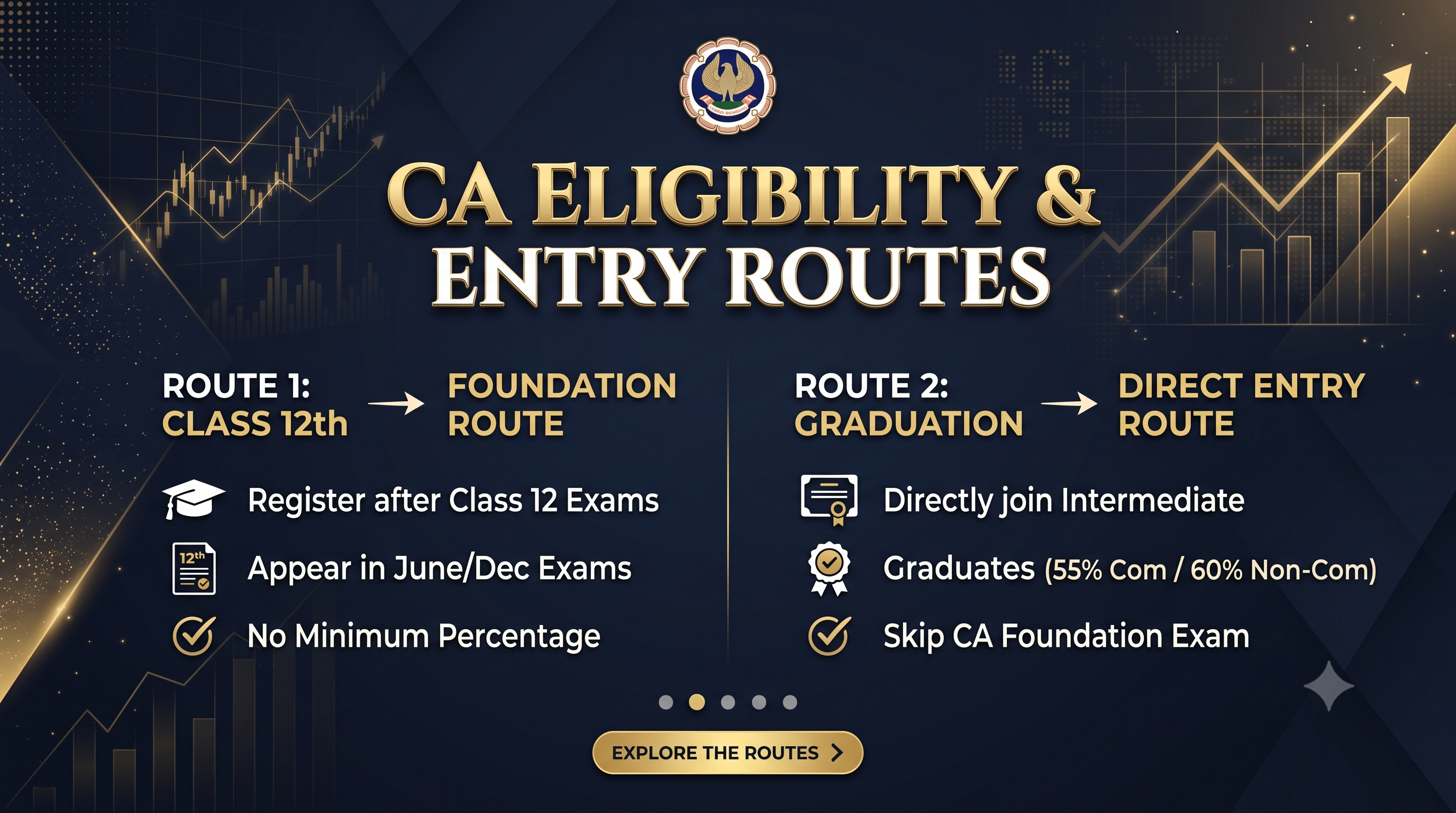
Route 1: Foundation Route (After Class 12)
- Eligibility: Candidates who have passed or appeared for the Class 12 examination from any stream (Commerce, Science, or Arts).
- Process: Register with ICAI for the CA Foundation course, complete the mandatory study period, and clear the Foundation examinations.
Route 2: Direct Entry Route (After Graduation / Post-Graduation)
- Eligibility Criteria:
- Commerce graduates/postgraduates: Minimum 55% aggregate marks.
- Non-commerce graduates/postgraduates: Minimum 60% aggregate marks.
- Candidates who have cleared the Intermediate level of ICSI (Company Secretary) or ICMAI (Cost & Management Accountant).
- Advantage: Direct entry candidates are completely exempt from CA Foundation and can register directly for CA Intermediate.
2. Course Structure & Exam Levels (ICAI New Scheme)
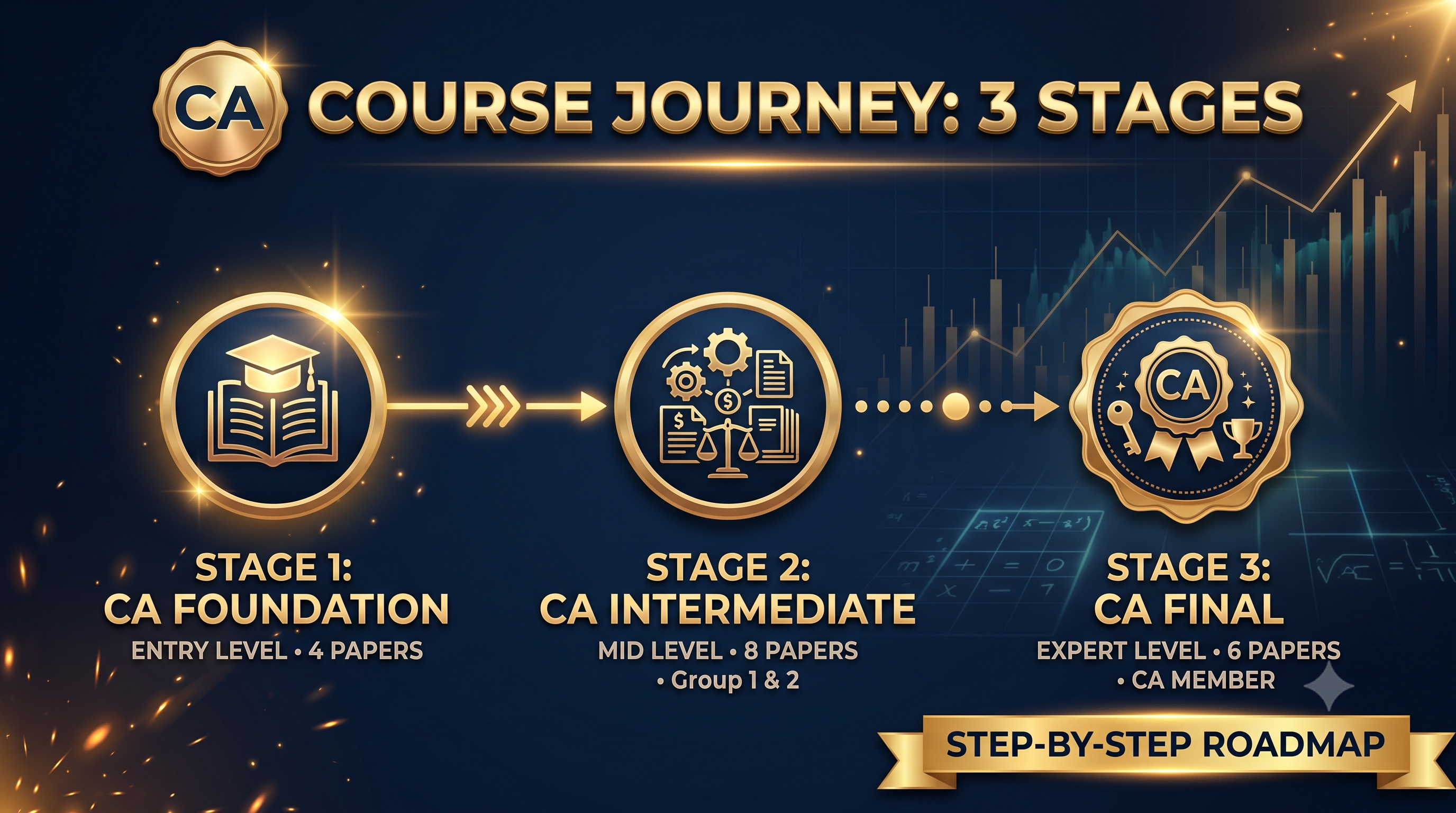
Under the updated ICAI Scheme of Education and Training, the examination structure comprises three stages:
Level 1: CA Foundation (4 Papers)
- Paper 1: Accounting
- Paper 2: Business Laws
- Paper 3: Quantitative Aptitude (Business Mathematics, Logical Reasoning & Statistics)
- Paper 4: Business Economics
Level 2: CA Intermediate (6 Papers in 2 Groups)
Eligible after clearing CA Foundation or via the Direct Entry route.
- Group 1:
- Paper 1: Advanced Accounting
- Paper 2: Corporate and Other Laws
- Paper 3: Taxation (Section A: Direct Tax Laws / Income Tax; Section B: Indirect Tax Laws / GST)
- Group 2:
- Paper 4: Cost and Management Accounting
- Paper 5: Auditing and Ethics
- Paper 6: Financial Management and Strategic Management (FM & SM)
Level 3: CA Final (6 Papers in 2 Groups)
Eligible after qualifying both groups of CA Intermediate, completing the mandatory training, and passing Self-Paced Online Modules (SPOM).
- Group 1:
- Paper 1: Financial Reporting (FR)
- Paper 2: Advanced Financial Management (AFM)
- Paper 3: Advanced Auditing, Assurance and Professional Ethics
- Group 2:
- Paper 4: Direct Tax Laws & International Taxation
- Paper 5: Indirect Tax Laws
- Paper 6: Integrated Business Solutions (Multidisciplinary Case Study)
3. Practical Training & Articleship
A defining hallmark of the CA designation is its rigorous practical exposure:
- ICITSS (Information Technology and Soft Skills): A mandatory 4-week practical program focusing on Information Technology (IT) and Orientation Course (soft skills) completed before commencing articleship.
- 2-Year Practical Articleship: After clearing both groups of CA Intermediate, students must undergo 2 consecutive years of full-time practical training under a practicing Chartered Accountant firm.
- Advanced ICITSS: Advanced IT and management communication training undertaken before appearing for the CA Final examination.
- Self-Paced Online Modules (SPOM): Online qualifying modules (Sets A, B, C, and D) completed at the candidate's own pace before sitting for CA Final papers.
4. Passing Criteria & Examination Rules
- Subject-Level Requirement: A minimum of 40% marks in each individual paper.
- Group-Level Requirement: An aggregate minimum of 50% marks across all papers in that specific group in a single sitting.
- Exemption Rule: Scoring 60% or more in any paper grants an exemption for that subject in subsequent attempts according to ICAI regulations.
5. Career Prospects & Compensation
A qualified Chartered Accountant enjoys a diverse range of employment and entrepreneurial opportunities:
- Independent Practice: Establishing a chartered accountancy firm offering statutory audit, internal audit, tax litigation, forensic review, and corporate consulting.
- Corporate & Multinationals: Leading positions across the Big 4 (Deloitte, PwC, EY, KPMG), top consultancies (McKinsey, BCG), and domestic corporate houses (Tata, Reliance, Aditya Birla):
- Chief Financial Officer (CFO) / Financial Controller
- Statutory & Forensic Auditor
- Corporate Tax Strategist & M&A Specialist
- Investment Banker & Equity Analyst
- Remuneration Trends: Freshly qualified Chartered Accountants typically command entry-level compensation packages between ₹8 Lakhs to ₹14 Lakhs per annum through campus placements, scaling significantly higher with technical specialization and experience.