B.Com vs BBA: The Ground Reality & Honest Comparison (What Colleges Won't Tell You)
Most private colleges sell a glossy dream: "Do a BBA and become a corporate manager immediately."
The hard market reality is completely different. Unless you graduate from an elite top-tier institute, a general management degree holds very little technical weight. Meanwhile, a standard B.Com degree offers hard technical skills, statutory government job eligibility, and an open pathway to an MBA.
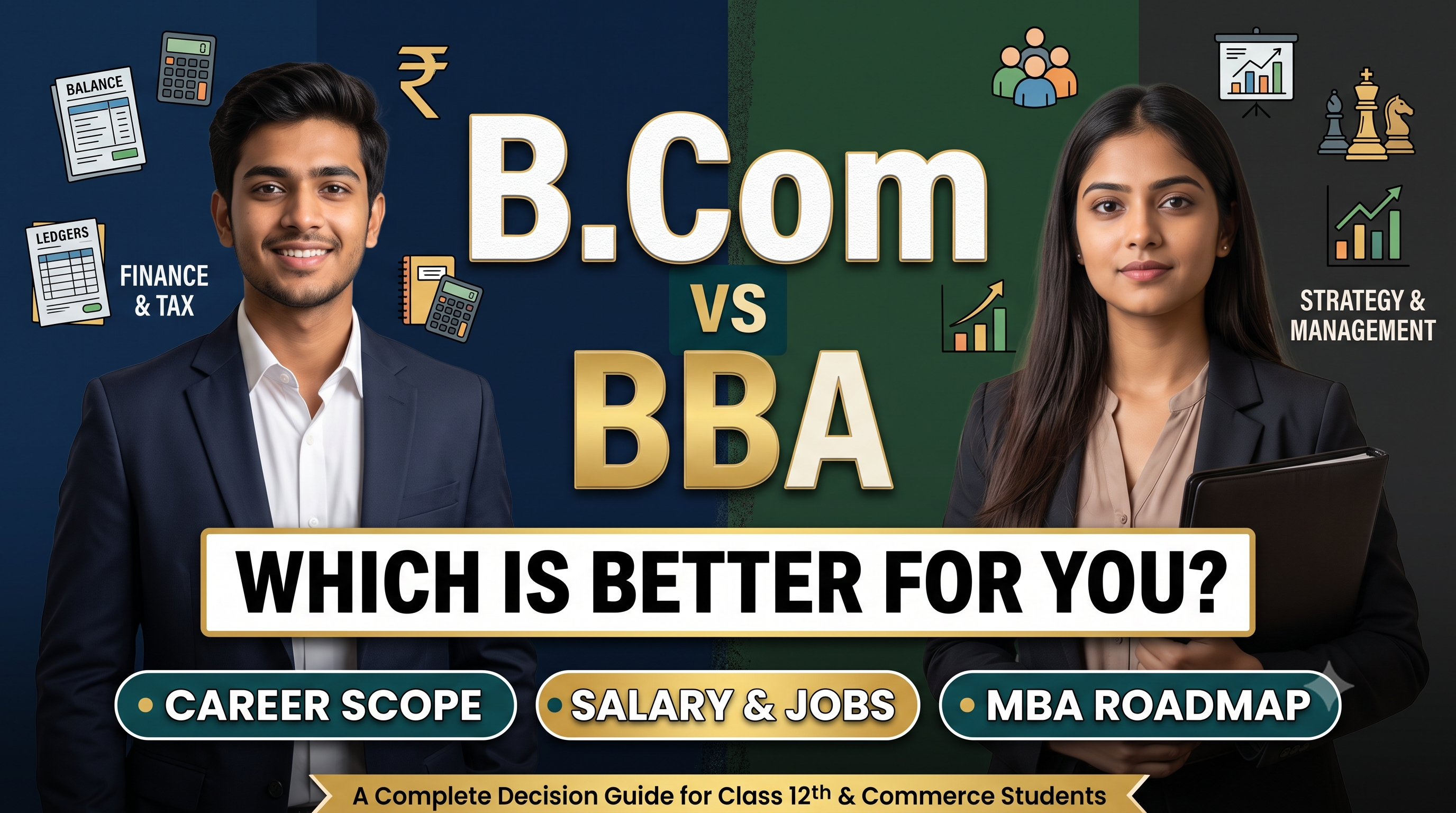
1. Direct Job Opportunities: Hard Technical Skills vs General Theory
| Parameter | B.Com (Ground Reality) | BBA (Ground Reality) |
| Core Technical Skillset | Financial accounting, taxation (GST & TDS), balance sheets, audit rules, and Excel. These are functional skills required by every small firm, CA office, and corporate accounts department. | Generalized business theory, presentations, and basic marketing concepts. No hard, legally indispensable skillset. |
| Off-Campus Employment | Even from an ordinary local college, you can land an entry-level accountant, bookkeeper, or audit assistant job paying ₹15,000–₹25,000/month based purely on accounting skills. | If not placed through an elite campus, off-campus opportunities mostly boil down to cold calling, telesales, customer support, or low-tier BPO roles. |
| Fee Structure vs ROI | Government/aided colleges cost ₹15,000 to ₹50,000 for the entire degree. Low financial risk, strong return on investment. | Private universities charge ₹3 Lakh to ₹8 Lakh, often resulting in entry-level sales jobs paying ₹15,000–₹20,000/month. |
2. Government Jobs & PSU Vacancies: The Huge B.Com Advantage
In the public sector, statutory eligibility rules strictly favour B.Com graduates over BBA holders:
- Specific Degree Eligibility: Numerous central and state government notifications explicitly demand: "Degree in Commerce (B.Com) from a recognized university." BBA graduates are routinely declared ineligible for these vacancies.
- Accountant & Audit Posts: Government departments, municipal bodies, state electricity boards, and railways recruit for Junior Accountant, Auditor, and Accounts Officer roles where only B.Com degrees qualify.
- SSC CGL (Assistant Audit Officer - AAO): One of the highest-paying posts via SSC CGL tests candidates on core Financial Accounting and Economics—subjects already mastered in B.Com.
- Banking (Specialist Officer - SO & Credit Analyst): Public and private banks prefer candidates with a commerce background (B.Com/M.Com) for finance and credit appraisal divisions over general management degree holders.
3. The MBA Myth: Why B.Com Still Wins
The most common reason students pick BBA is: "I want to pursue an MBA later."
Here is why that premise does not necessitate a BBA:
- MBA Entrance Exams (CAT/XAT/GMAT): Entrance tests evaluate Quantitative Aptitude (Maths), Data Interpretation & Logical Reasoning (DILR), and Verbal Ability (VARC). BBA coursework offers zero syllabus advantage here; you must prepare for CAT separately regardless of your undergraduate stream.
- MBA in Finance Advantage: In business school, students specializing in Finance study corporate tax, financial accounting, and advanced valuation. B.Com graduates already have this foundation, whereas BBA graduates often start from scratch.
- Academic Diversity Points: Top IIMs award academic diversity points to non-engineering candidates. B.Com and BBA students receive the exact same academic diversity weighting.
4. The ONLY Scenario Where BBA Makes Sense
A BBA is worthwhile under one specific condition:
- Top 10–15 Tier-1 Institutes: If you secure admission into institutes with premier brand equity and strong campus placements—such as the IIM IPM programs (IIM Indore/Rohtak), Shaheed Sukhdev College of Business Studies (SSCBS, DU), NMIMS Mumbai, or Christ University Bangalore.
- These institutions have established corporate pipelines where top management consultancies and investment banks recruit directly on campus.
If you are joining an average tier-2 or tier-3 college where campus recruitment is weak or absent, spending high fees on a BBA offers minimal market leverage.
Final Verdict
- B.Com is the practical, low-risk choice: Low college fees, clear accounting technical skills, exclusive eligibility for government accountancy jobs, and full flexibility to prepare for CA, CS, CMA, or an MBA alongside your studies.
- BBA works only at the top: High-value if done from an elite tier-1 brand with guaranteed campus recruitment. Otherwise, it carries high tuition costs with limited off-campus job prospects outside entry-level sales.