Which Stream Should You Choose After Class 10? (The No-Nonsense, Practical Guide)
Class 10 exams are over, and suddenly everyone—from your parents and relatives to your schoolteachers—is asking the exact same question: "Beta, aage kya loge? Science, Commerce, ya Arts?"
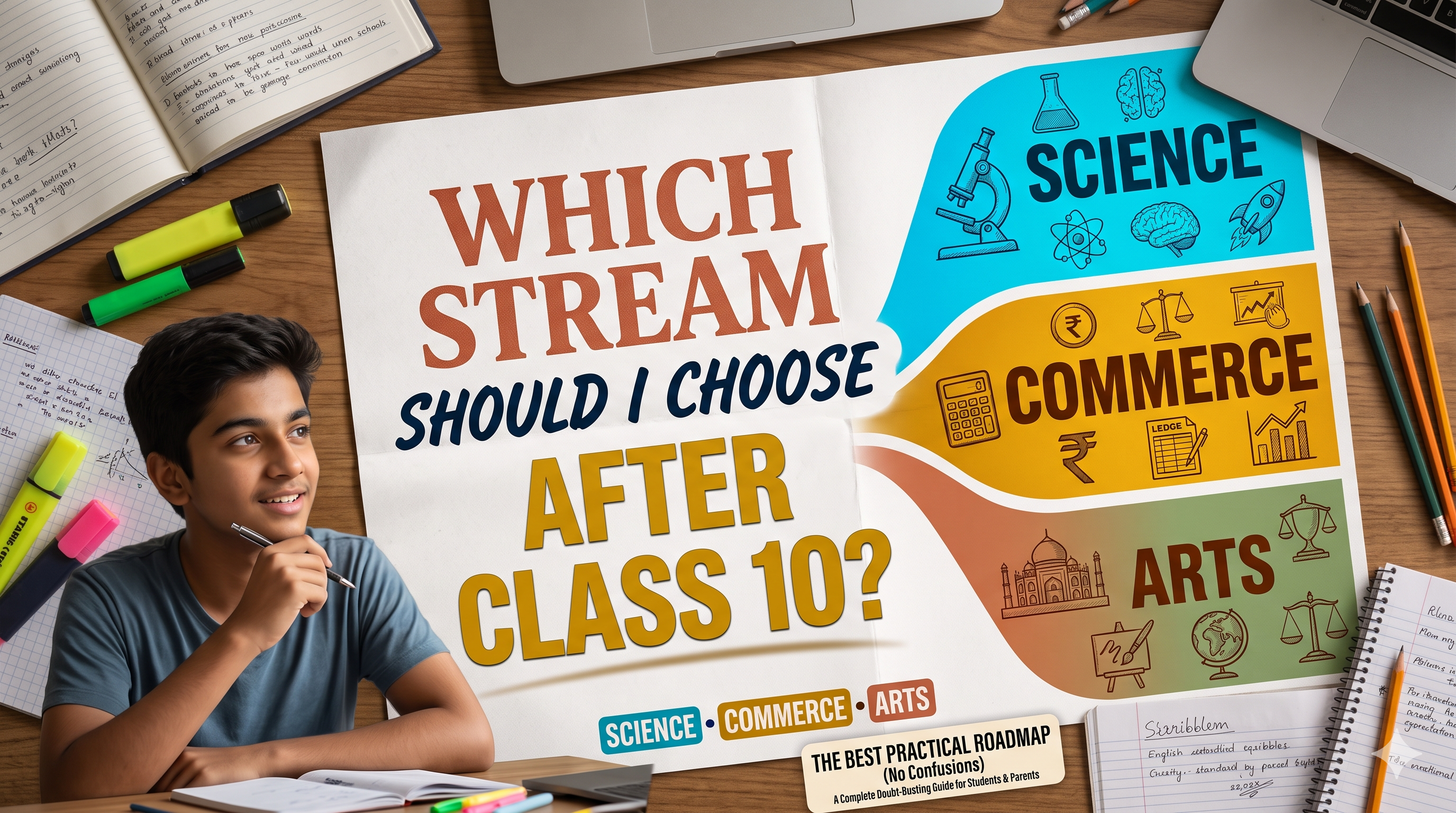
Most students make this critical decision based on a single, flawed metric: "Mera percentage kitna aaya."
- High percentage? "Science le lo."
- Medium percentage? "Commerce le lo."
- Low percentage? "Arts hi bacha hai."
This is the biggest mistake you can make. Your marks in a 2-hour board exam do not define your life's aptitude. Choosing a stream without analyzing career realities, professional fatigue, and academic lifestyles is like picking a door blindfolded.
Let’s dismantle the confusion, bust every common myth, and walk through a 100% practical roadmap to make the right choice.
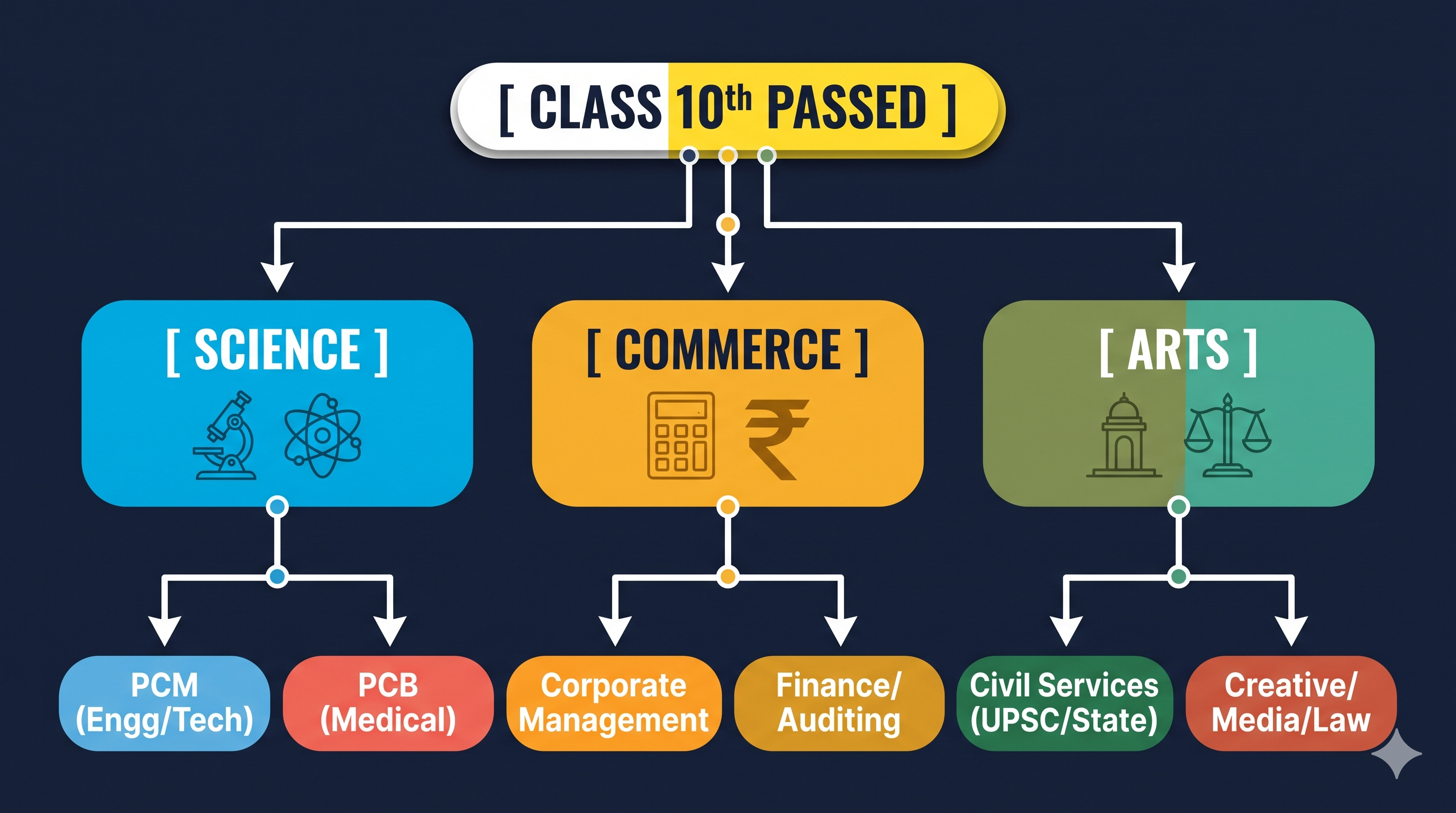
1. Ground Reality & Career Breakdown: Choose Your Path
Path A: Science (The Problem-Solvers & Builders)
Science is not just about memorizing formulas; it is about finding out how the universe and technology work.
- The Splits:
- PCM (Physics, Chemistry, Mathematics): Best for engineering (B.Tech), architecture, data science, defense (NDA), and core technology.
- PCB (Physics, Chemistry, Biology): Best for medicine (MBBS, BDS), biotechnology, pharmacy, and allied life sciences.
- PCMB: Only choose this if you are absolutely unsure and want to keep both engineering and medical open (but be warned: the workload is immense).
- The Lifestyle: Constant lab work, heavy numeric calculations, intense competitive exam preparation (JEE, NEET), and a high study-volume requirement.
- The Reality Check: Do not choose Science just because your parents want you to be a doctor or engineer. If you hate problem-solving, math, or logical deduction, 11th-grade Science can become incredibly stressful.
Path B: Commerce (The Business & Wealth Creators)
Commerce is the backbone of the economy. If you find yourself asking how businesses make money, how stock markets work, or how the government levies taxes, this is your zone.
- The Core Fields:
- Accounting, Business Studies, Economics, and Mathematics/Informatics Practices (IP). (Practical Tip: Opting for Mathematics with Commerce is highly recommended as it opens up top-tier university courses like B.Com Hons, eco-honors, and BMS/BFIA).
- Top Professional Pathways: CA (Chartered Accountant), CS (Company Secretary), CMA, CFA, MBA, Investment Banking, Tax Consultancy, Product Management.
- The Lifestyle: A balance of mathematical logic and theoretical business concepts. It's not as labor-intensive as PCB, but requires high analytical skills, especially for accounting and tax rules.
- The Reality Check: Commerce is a premium professional route—not a "safe fallback" for people who didn't get Science. It offers some of the highest-paying, most stable corporate careers in the world.
Path C: Arts & Humanities (The Critics, Creators & Administrators)
Humanities is not the "easy stream for low scorers." It is a vast and sophisticated domain that studies human society, history, behavior, and systems.
- The Core Fields: History, Political Science, Geography, Sociology, Psychology, Economics, and Fine Arts.
- Top Professional Pathways: Civil Services (UPSC, State PSC), Law (integrated BA LLB), Journalism & Mass Media, Design (Fashion, UX/UI, Graphic), International Relations, Psychology, Public Policy.
- The Lifestyle: Heavy reading, writing, essays, critical thinking, debates, and research.
- The Reality Check: Arts requires immense self-drive and creativity. Since there is no single standardized route (like Engineering in Science), you must actively build your network, look for internships, and customize your portfolio.
2. Busting the Major Stream Myths
- Myth 1: "Arts has no career scope."
- Reality: Corporate law, policy advisory, product design, international affairs, UI/UX, and marketing (which heavily utilize Humanities skills) are amongst the fastest-growing fields. A lawyer, policy designer, or media head can easily out-earn a standard engineer.
- Myth 2: "I'll do BBA so I need BBA/Commerce now."
- Reality: Anyone from any stream can do BBA, BBM, BMS, and ultimately an MBA. Science and Humanities students routinely make the jump. (But having Commerce gives you a smoother start).
- Myth 3: "Commerce with Math is impossible."
- Reality: It is challenging, but having Math is a massive advantage. Many top universities (such as Delhi University for B.Com Honors) and elite career paths explicitly require math. If you can handle average-to-high difficulty, keep Math.
3. The 3-Step Practical Filter: How to Choose
If you are still stuck, use this practical process:
Step 1: The "Hate" Elimination Method
What are you 100% sure you do not want to do? If you can't tolerate biology, rule out PCB. If the thought of endless history dates and long essays makes you fall asleep, rule out Arts. Elimination is often easier than selection.
Step 2: Read the Next-Level Textbooks
Before you choose, get a PDF or borrow Class 11 textbooks (Physics, Accounts, History) for just one week. Read 2–3 chapters of each. Check if the leap from 10th to 11th is something you actually find interesting. Many students realize they do not like Science after seeing what 11th-grade Physics actually involves.
Step 3: Match "Passion" with "Financial Appetite"
Some paths take longer to pay off. PCB/Medicine requires 5.5 years of MBBS plus 3 years of MD/MS (essentially 8-10 years of study) before you earn high income. Arts or Commerce might let you enter the workforce much sooner (in 3 to 5 years). Talk with your family about the timeline you and they are prepared for.
4. Final Verdict: The Honest Route
- Choose Science if you have a natural curiosity for logic, tech, machines, or natural systems, and enjoy intensive academic problem-solving.
- Choose Commerce if you are interested in finance, businesses, management, start-ups, and enjoy working with practical calculations.
- Choose Arts if you are creative, express yourself through reading, writing, or design, want to understand society/policies, or aim for top government services.
Take your time, read standard syllabus books, ignore the neighbors, and choose your path based on your real capability and career desires!