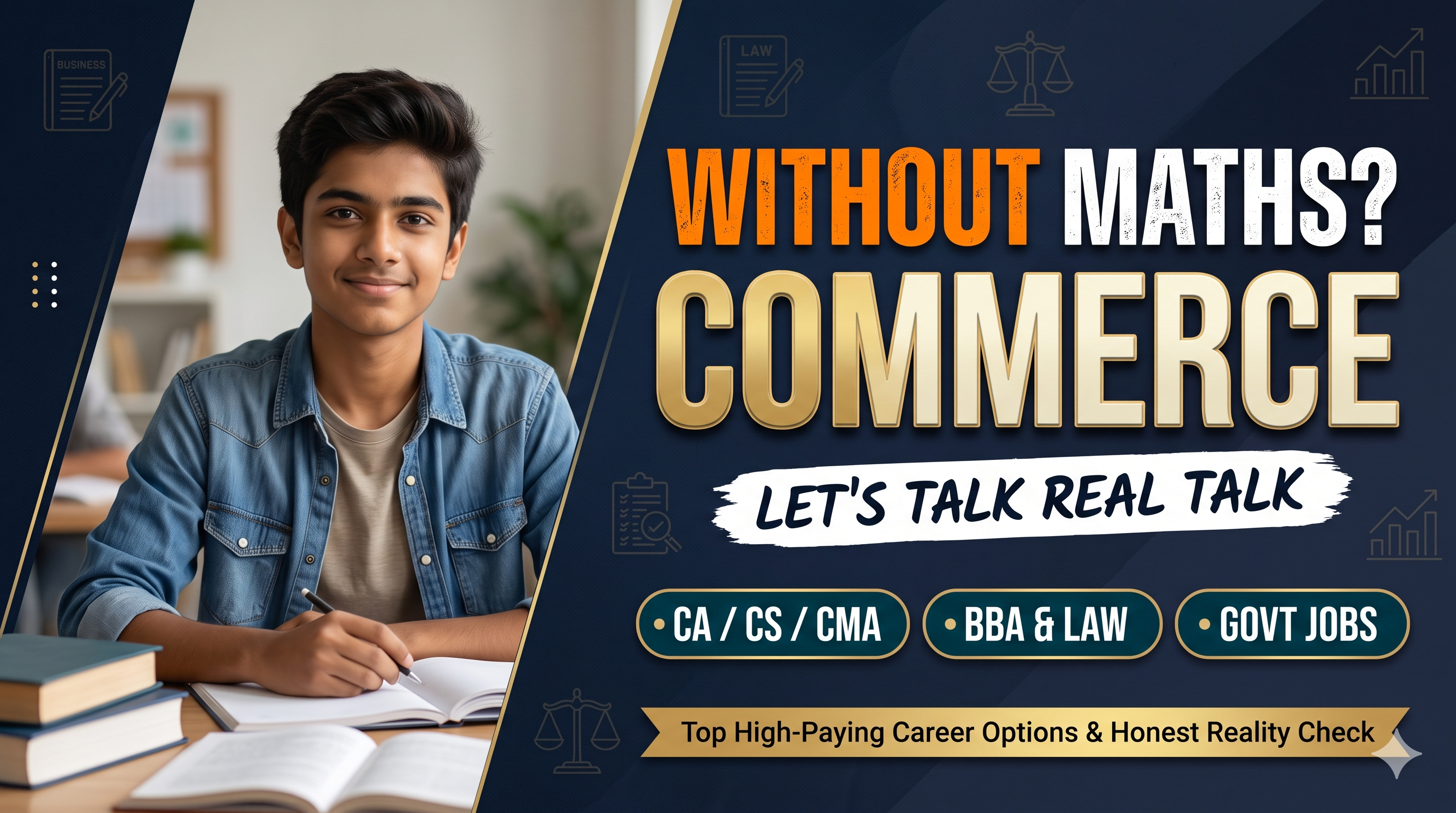
Can I Take Commerce Without Maths After Class 10? (Let's Talk Real Talk)
Hey there! If you just wrapped up your Class 10 board exams, I can almost guarantee you’ve heard this sentence at least a dozen times:
"Commerce le rahe ho? Maths toh zaroor lena, warna aage jaake pachtaoge!"
Your school seniors might be hyping up Mathematics like it’s oxygen, while your tuition teacher insists that skipping Maths will ruin your career. Meanwhile, every time you open a Class 10 Trigonometry chapter, you feel like running in the opposite direction.
Let’s hit the brakes for a second. Take a deep breath.
Can you take Commerce without Maths after Class 10? Yes, 100% absolutely.
Will it ruin your career? Not at all. But—and this is a big but—it does close a couple of specific doors while blowing wide open many others. Let’s sit down, skip the lecture, and break down the absolute ground reality so you can make the right call for yourself.
1. The Biggest Fear: "Does Accountancy require Class 10 Maths?"
Let’s bust this myth right out of the gate.
A lot of students think Accountancy is just Class 10 Maths wearing a suit. That is completely untrue.
- In Accountancy, you will never solve quadratic equations, calculate the height of a lighthouse using trigonometry, or deal with theorems.
- What you actually use is elementary arithmetic: Addition, Subtraction, Multiplication, Division, Percentages, and Ratios.
- If you know how to calculate 10% depreciation on ₹5,00,000, or how to divide profits in a 3:2:1 ratio, you already have all the math skills you need for Class 11 and 12 Accounts.
In fact, plenty of students without Core Maths score a solid 95 to 100 out of 100 in Accountancy every single year.
2. High-Paying Careers That Don’t Care If You Took Maths
Let’s talk about jobs and money, because that’s what matters in the long run. Here’s what remains wide open even if you drop Maths:
- Chartered Accountancy (CA): ICAI doesn't mandate Class 12 Maths. CA Foundation has a paper called Quantitative Aptitude, but it tests logical reasoning, statistics, and basic commercial math—things you can prepare for easily with coaching during your Foundation prep.
- Company Secretary (CS): If you love corporate laws, company governance, and legal compliance, CS is pure law and strategy. Zero high-level mathematics required.
- Cost & Management Accountant (CMA): Heavily focused on costing, production budgets, and managerial accounting rather than complex calculus.
- Corporate Law (BA LLB / BBA LLB via CLAT): Corporate lawyers at top law firms earn salaries that rival top tech engineers. Entrance exams like CLAT test basic numerical ability up to Class 10 level.
- Management & Business (BBA / BMS / IPMAT): You can target BBA programs or sit for IPMAT to enter IIMs directly after Class 12. Most aptitude tests stick to basic arithmetic and logical problem solving.
- Design, Media & Hotel Management: Fields like UI/UX design, journalism, digital marketing, and event management care about your portfolio and communication, not your algebra scores.
3. Now, The Real Catch: Which Doors Actually Close?
I wouldn't be doing my job if I only told you the rosy side. Skipping Maths does take a few specific paths off the table:
- B.A. Economics (Hons) in Top Colleges: In almost every premier university (like Delhi University), Class 12 Maths is compulsory for Eco (Hons) because advanced economics leans heavily on calculus and econometrics.
- B.Com (Hons) Mapping in Select Universities: While universities like DU now allow B.Com (Hons) through CUET using Accountancy instead of Maths, having Maths keeps your subject combinations more flexible.
- Actuarial Science & Quantitative Finance: If your dream is to become an Actuary or a high-frequency trading analyst, you need serious, advanced calculus and probability. Dropping Maths here is a bad idea.
4. What Should You Take Instead of Maths?
If you decide to let go of Maths, don't pick a random placeholder subject. Make your 5th or 6th subject work for you:
- Informatics Practices (IP) / Computer Science: You learn Python, SQL, and database management. Commerce paired with basic coding skills is an unbeatable combo for corporate placements.
- Applied Mathematics (The Middle Ground): If your school offers it, take a look at CBSE’s Applied Maths. It removes trigonometry and calculus geometry, focusing purely on financial math, taxation, and business statistics.
- Physical Education / Fine Arts: If your priority is keeping your stress low so you can dedicate 100% of your energy to scoring 95%+ in Accounts, Business Studies, and Economics, this is the safest route.
The Final Verdict: Ask Yourself These 2 Questions
- Do you genuinely hate Mathematics, or did you just have a bad teacher in Class 10? If looking at numbers makes you anxious, drop it. Forcing yourself through two years of advanced calculus in Class 11 and 12 will drag down your overall board percentage.
- Do you specifically want to study Economics (Hons) or Data Science? If yes, bite the bullet and keep Maths. If your sights are set on CA, CS, Law, BBA, or general corporate finance, feel free to drop it without any guilt.
At the end of the day, your success in Commerce comes down to your practical business sense, consistency, and problem-solving skills—not whether you can solve an integration problem.