Science vs Commerce vs Humanities: Let’s Settle This Once and for All
Let’s be honest for a second. Right after Class 10 results are out, Indian households turn into debate clubs.
Your parents might be secretly hoping you bring home a Science syllabus so they can proudly announce it to the relatives. Your school topper has probably already bought two massive JEE guides. Meanwhile, someone in your family just whispered that Arts is for kids who "didn’t study hard enough."
It’s exhausting, right?
Let’s hit pause on everyone else's opinions and look at the real facts. No stream is superior to another, and your Class 10 marks are not an indicator of your lifetime potential.
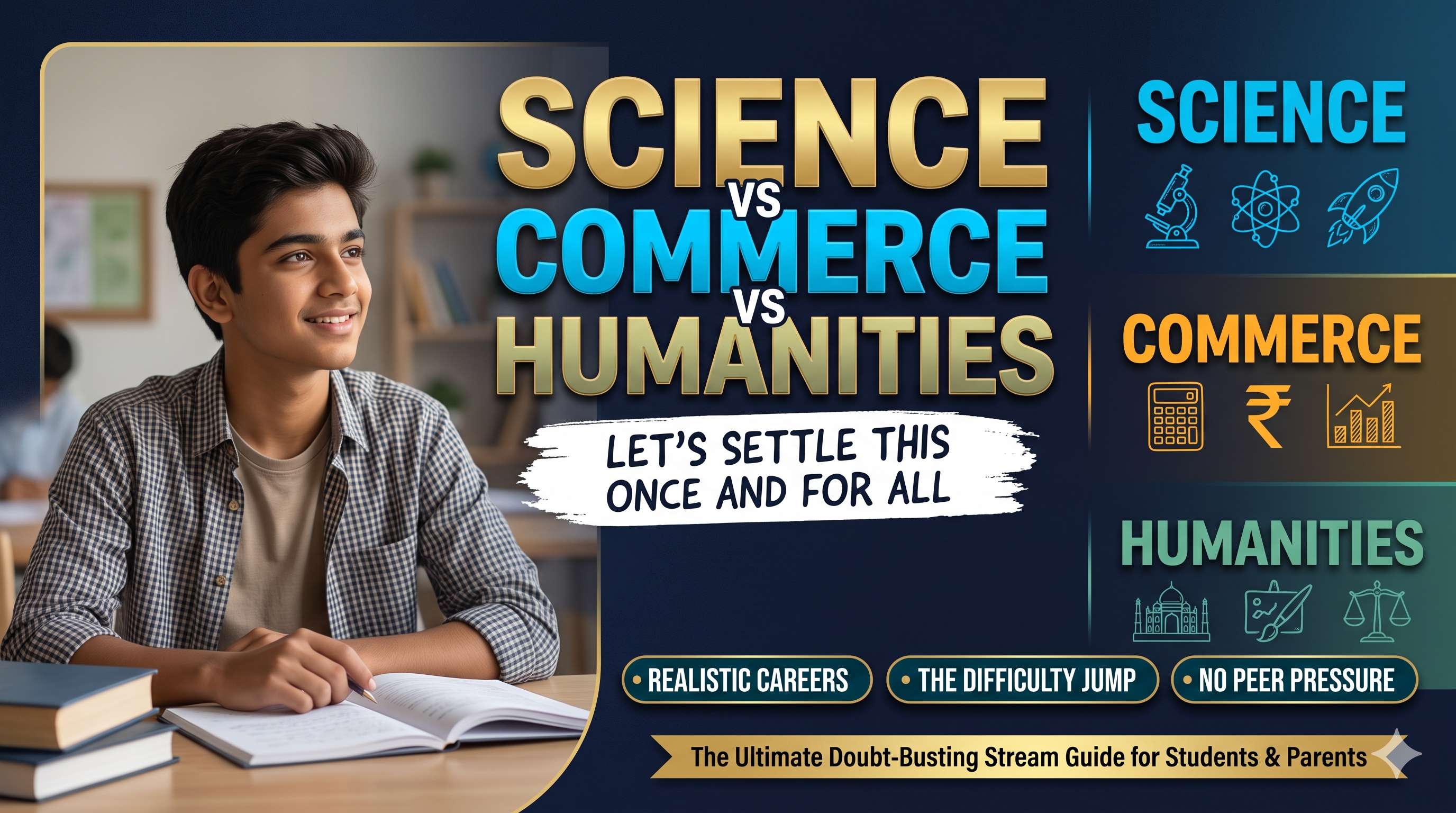
Let's break down the ground reality of Science, Commerce, and Humanities so you can pick the one that matches who you actually are.
1. The Three Streams: What You Actually Study and the Lifestyle
A. Science: The Domain of Problem-Solvers
Science isn't just about scoring 90% in Class 10 Biology or solving basic physics numericals. In Class 11, the difficulty jump is steep.
- The Core Splits:
- PCM (Physics, Chemistry, Maths): Geared toward Engineering (B.Tech), Architecture, Data Science, Defense (NDA), and Aviation.
- PCB (Physics, Chemistry, Biology): Geared toward MBBS, BDS, Nursing, Biotechnology, and Pharmacy.
- The Day-to-Day Reality: Constant lab experiments, extensive practice routines, and juggling competitive entrance exams like JEE or NEET alongside school board exams.
- Who It’s For: Choose Science only if you have genuine curiosity about how machines, code, or living systems function, and you don't mind sitting with tough numerical problems for hours.
B. Commerce: The Domain of Business and Wealth Builders
Commerce is the operating system of the modern economy. Every startup, tech giant, and manufacturing plant relies on financial minds to survive and grow.
- The Core Subjects: Accountancy, Business Studies, Economics, along with optional subjects like Mathematics or Informatics Practices (IP).
- Top Career Paths: Chartered Accountancy (CA), Company Secretary (CS), Cost and Management Accountant (CMA), Corporate Management (via BBA/IPMAT followed by an MBA), Investment Banking, Corporate Law, and Stock Market Analytics.
- The Day-to-Day Reality: A healthy balance of structured practical arithmetic (balance sheets, profit and loss, tax ratios) and real-world business theory.
- Who It’s For: Choose Commerce if you find yourself drawn to how businesses make profits, how startups raise money, how stock markets react to news, and how money flows through the economy.
C. Humanities / Arts: The Domain of Thinkers, Creators, and Administrators
The stereotype that "Arts has no scope" is decades out of date. The modern corporate, legal, and governmental worlds are packed with Humanities graduates leading major teams.
- The Core Subjects: Political Science, History, Psychology, Sociology, Geography, Economics, and English Literature.
- Top Career Paths: Corporate and Criminal Law (via CLAT/NLUs), Civil Services (UPSC and State PSCs), UI/UX and Graphic Design, Journalism, Public Policy, Psychology, and Advertising Strategy.
- The Day-to-Day Reality: Heavy reading, writing analytical essays, participating in structured debates, and understanding human behaviour and societal structures.
- Who It’s For: Choose Humanities if you love reading, critical analysis, storytelling, or design, or if you aspire to run public administration and legal institutions.
2. A Head-to-Head Comparison
| Reality Check | Science | Commerce | Humanities |
| Class 11 Difficulty Jump | Very High (Requires major adjustment from 10th) | Moderate (Brand new subjects, but logical) | Low-to-Moderate (More reading and essay writing) |
| Maths Dependency | Mandatory (PCM) / Physics numericals (PCB) | Flexible (Can be taken with or without Core Maths) | Mostly Optional (Except for Eco Hons) |
| Typical Study Routine | 5 to 7 hours of daily self-study + coaching | 2 to 4 hours of consistent conceptual study | Flexible, self-directed research, writing & projects |
| Backup Options | Can switch to Commerce or Arts later | Can switch to Arts, BBA, Law, or MBA | Specialized; difficult to switch to STEM later |
3. How to Pick Yours Without Regret
If you're still torn between two streams, try these three practical filters:
- Test the Next Step: Download or borrow the Class 11 NCERT textbooks for Physics, Accountancy, and Political Science. Spend just two days skimming through Chapter 1 and Chapter 2 of each. The jump from Class 10 is real—see which subject feels interesting rather than intimidating.
- Focus on the Lifestyle, Not Just the Job Title: Don't just picture yourself as a "Doctor" or an "Investment Banker." Ask yourself if you enjoy the daily work it takes to get there—the hospital shifts, the balance sheet audits, or the legal case readings.
- Check the Math Factor: If you dread numbers, steer clear of PCM and consider Commerce without Maths or Humanities. If you enjoy practical, puzzle-like numbers, Commerce is a great fit. If you love abstract equations, choose PCM.
Your stream in Class 11 is simply the platform you launch from—pick the one where your strengths naturally give you an advantage.