What to Do If You Have No Career Goal in Class 9 or 10? (Spoiler: You’re Normal)
Picture this scenario. You are sitting in class, and the teacher randomly asks everyone:
"So, what do you want to become in life?"
The kid on your left immediately yells, "Software engineer at Google!" The girl on your right says, "Cardiologist from AIIMS."
Then the teacher turns to you, and your mind is completely blank. The most urgent thing you were thinking about was what's in your tiffin or which game to play after school.
Suddenly, your palms start sweating. You wonder: Am I lagging behind? Is there something fundamentally wrong with me?
Let’s get one thing straight right now: Having zero career goals in Class 9 or 10 is not just normal—it is completely expected.
You are 14 or 15 years old. Your brain is still developing, you haven't seen how the real world works, and you haven't been exposed to 95% of existing modern jobs. Expecting a teenager to pick a single lifelong career path before they even learn how to file a tax return is absurd.
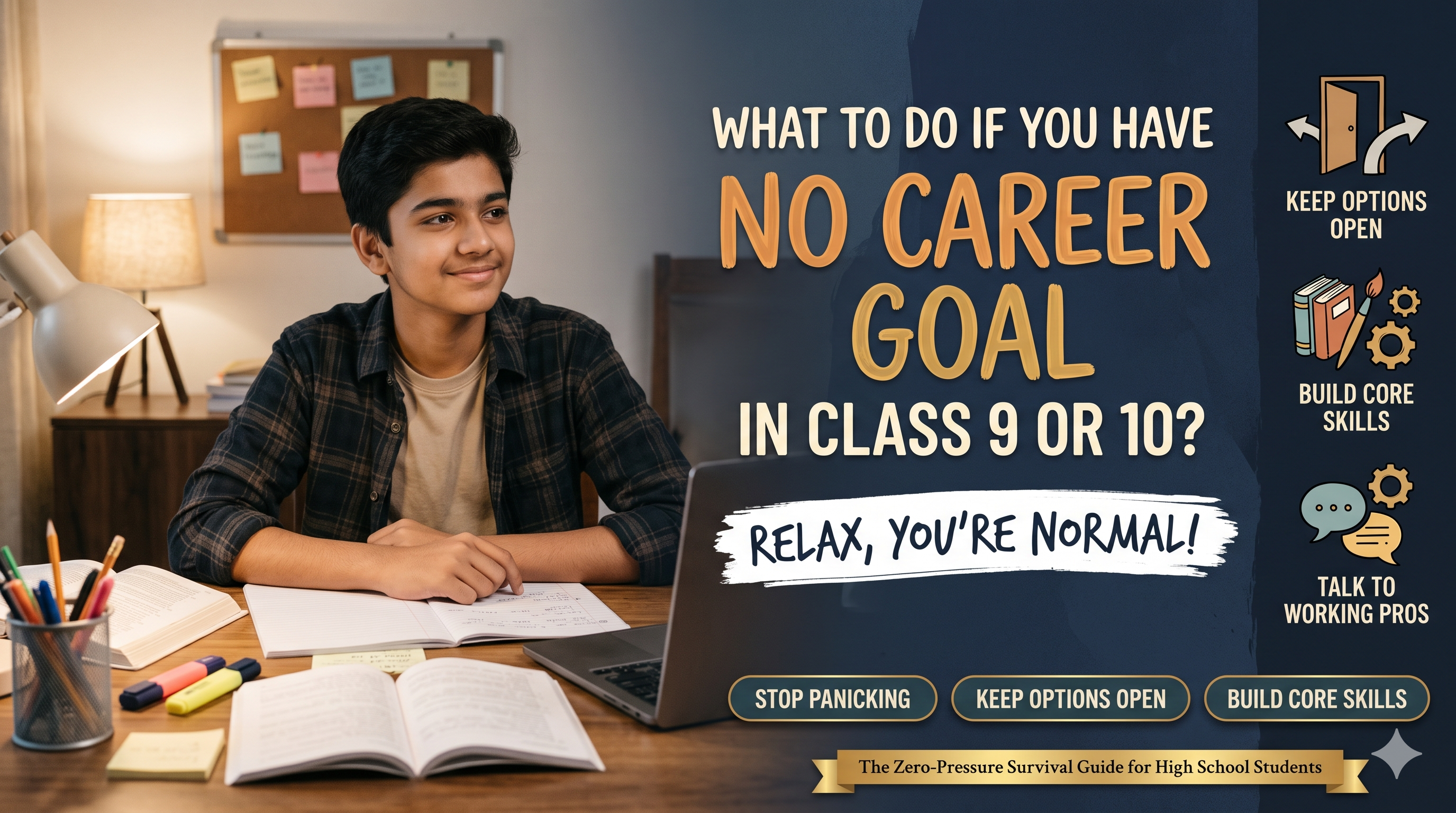
So, how do you handle this phase without panicking or making terrible choices? Here is your practical, no-stress survival guide.
1. Stop Looking for a "Destination", Start Building "Options"
When you don’t know where you want to go, your only job is not to box yourself into a corner.
Think of your education like an open-world video game:
- If you pick a hyper-specialized narrow path too early without liking it, you lock all the other doors.
- If you focus on keeping multiple paths unlocked, you can decide later when you have more information and maturity.
2. The 4 Universal Skills to Build Right Now
While your classmates are stressing over coaching entrance tests for careers they barely understand, focus on building skills that pay off in every single stream and industry:
- Clear, Crisp Communication (Writing & Speaking):
- Can you explain a simple idea without stammering or writing confusing sentences?
- Whether you end up as a lawyer, doctor, startup founder, or CA, people who write and speak well consistently get promoted faster and earn more.
- Basic Financial Literacy:
- Understand how money flows: What is an asset? What is a liability? How does compounding interest work? Why do companies issue shares?
- Knowing how money works gives you immediate clarity on which industries create real value.
- Digital & Logical Fluency:
- Learn basic Excel/Google Sheets, keyboard shortcuts, and how to query AI tools like a pro.
- Knowing how to organize data and solve logical problems will save you thousands of hours regardless of what field you enter.
- Consistency Over Cramming:
- Can you sit down and study for 90 focused minutes without checking your phone every 4 minutes? That single habit alone puts you ahead of 90% of students your age.
3. How to Choose Your Stream in Class 11 When You Have No Goal
Class 10 ends, and a choice has to be made. What do you do when you still don't have a specific ambition?
Use the Rule of Elimination and Flexibility:
- If you can handle Mathematics comfortably:
- Take Commerce with Maths or PCM.
- Why? Mathematics keeps technical, financial, economic, and business administration degrees open. You can switch to business, management, design, economics, or law at any point.
- If you hate Mathematics and formulas:
- Take Commerce without Maths or Humanities.
- Don't force yourself into PCM/PCB just because of peer pressure. You can target high-paying fields like Corporate Law (via CLAT), Management (BBA/IPM), Design, Content Strategy, or Civil Services without ever touching calculus again.
- Never pick PCB (Medical) unless you have 100% conviction:
- Medicine is a 10-year academic marathon. Picking it casually when you have no goal is a recipe for extreme burnout.
4. Talk to People Doing Real Jobs (Not Just Relatives)
The main reason you don’t have a career goal is simple: lack of exposure.
In school, you only see five traditional roles: Doctor, Engineer, Teacher, CA, and Police Officer. You don't see UI/UX designers, supply chain managers, financial risk analysts, performance marketers, corporate litigators, or product managers.
- Ask your cousins, elder siblings, or neighbors who are working in different companies:
- "What do you actually do from 9 AM to 5 PM?"
- "What do you enjoy about it, and what do you hate?"
- You will quickly realize that the real corporate and business world is far wider and more interesting than your school textbooks suggest.
The Bottom Line
Breathe easy. You do not need a 20-year master plan today.
Focus on getting decent board marks, read books outside your syllabus, pick up a sport or creative hobby, and learn how to communicate well. As long as you keep your doors open and work on your baseline habits, your path will make sense to you when the time is right.