The NEET Chemistry preparation strategy demands both conceptual clarity and consistent practice. So, we understand if Chemistry can sometimes feel overwhelming. However, unlike Physics or Biology, Chemistry neither requires hundreds of formulas nor detailed memorisation; rather, it comprises a perfect balance of logic and learning. Chemistry can actually yield good marks and drastically improve your AIR if prepared with regularity, discipline, and clarity. In this guide, we are going to discuss exactly that - how you should prepare Chemistry from zero level, achieving absolute mastery.
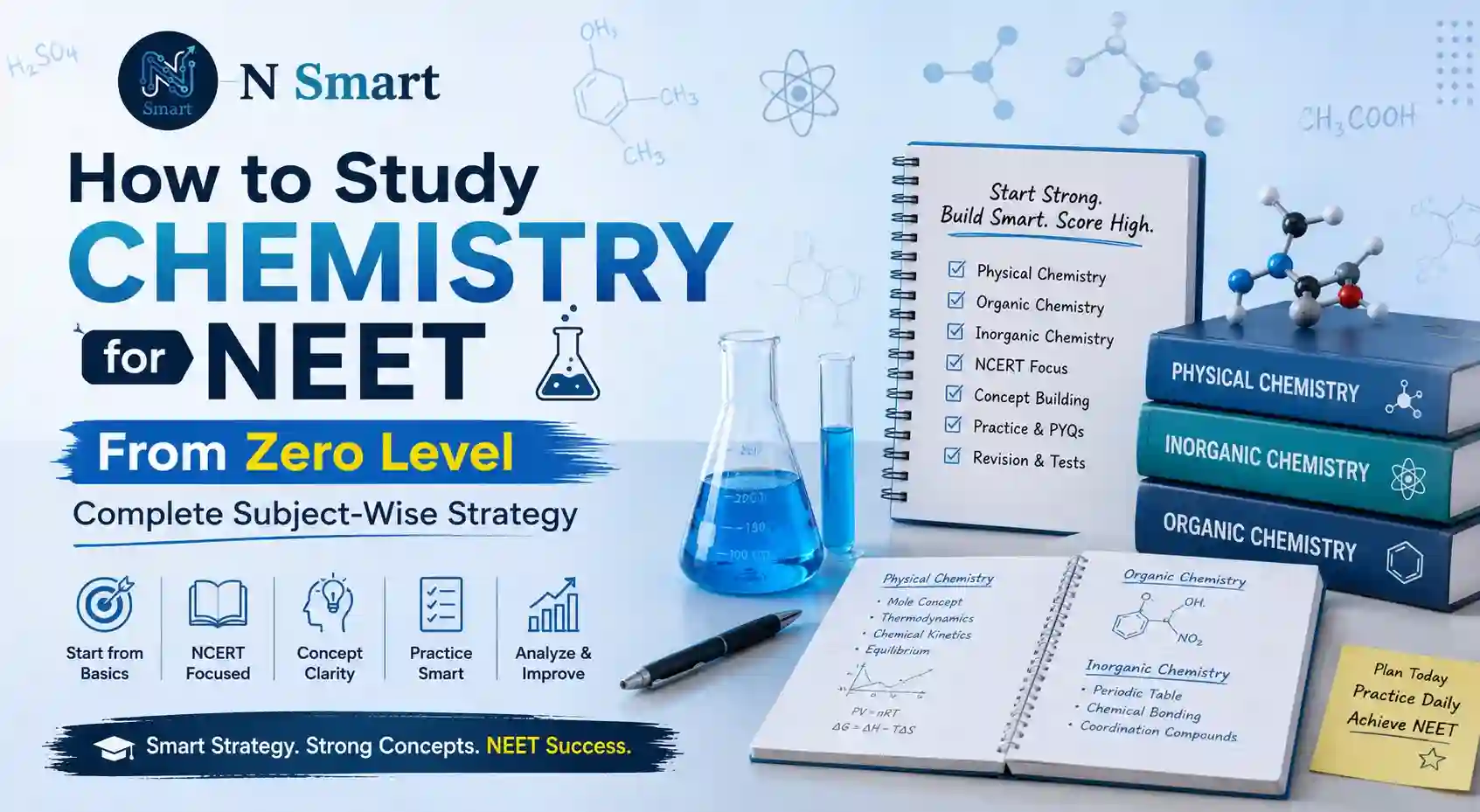
During preparation, students often approach all three branches of Chemistry in the same way, and the struggle begins from that point onwards. Here’s the ideal strategic approach for all three branches:
- Inorganic Chemistry: Requires NCERT, frequent revisions, and strong memorisation of facts, periodic trends, & exceptions.
- Organic Chemistry: Relies heavily on the understanding of mechanisms, concepts, & flow of reactions and practice of conversions.
- Physical Chemistry: This section demands conceptual understanding, mastery of formulas, derivations, and calculation practice.
[Note: This NEET Chemistry strategy, prepared by N Smart Chemistry expert Dr. Srimanta Pal, is built around these requirements so that you have a clear roadmap in front of you before you start your preparation journey. This guide also works as an advanced module inside N Smart’s NEET Preparation Strategy Hub blueprint.]
Inorganic Chemistry Tricks for NEET That Actually Work
Inorganic Chemistry tests your memory retention. Every trend, every exception, every colour can be a question here, so reading NCERT line-by-line becomes extremely crucial. The last five years' Chemistry question analysis shows that chapters like Chemical Bonding and Molecular Structure, Coordination Compounds, The d and f-Block Elements, and Classification of Elements & Periodicity in Properties hold the most weight.
Tricks for NEET Inorganic Chemistry: Periodic Table Tracking
Instead of just reading the periodic table, track patterns from day one: atomic radius, ionization enthalpy, electron gain enthalpy, metallic character, and oxidation states. The Inorganic Chemistry trick for NEET is to always go vertically down a group and horizontally across a period.
Make Short Notes on Exceptions
In Inorganic Chemistry, exceptions are everything that can take your score close to 180. From Nitrogen’s electron gain enthalpy, boron family anomalies, coordination number oddities to colour/magnetism, every exception should go into your notes for quick/weekly revisions.
Master Chemical Bonding
Chemical bonding is one of the heaviest chapters in NEET Inorganic Chemistry, and that’s why you need to develop speed & accuracy here. For hybridization, geometry, and magnetic moment, use shortcut rules until they become automatic.
NEET Chemistry Tricks for Organic
For organic chemistry, the last five-year question analysis shows that chapters like Basic Principles and Techniques, Hydrocarbons, Aldehydes, Ketones and Carboxylic Acids, and Amines pull the most weight. And these chapters need an in-depth understanding of mechanisms. To command mastery over this:
Organic Chemistry Strategy for NEET: Focus on Core Concepts
Start with inductive effect, resonance, hyperconjugation, and electron donation/withdrawal; understand one concept completely before moving to the next. Once you master these, understanding acidity, basicity, stability, and reaction becomes easier, and the flow of reactions becomes natural.
Build Master Chart for Reactions
Create a master conversion chart from alcohols to halides, alkenes to alcohols, aldehydes to acids, acids to amines, and so on. The most effective organic Chemistry tricks for NEET are to visualise every named reaction as a sequence map. Then, keep practising them regularly.
Create Reagent Sheet
Make a single-page reagent sheet for oxidizing agents, reducing agents, catalysts, and special reagents. Keep it simple: one reagent, one action, one common trap, and keep revising it.
NEET Chemistry Preparation Tips: How to Study Physical Chemistry
The last five-year question analysis shows us that chapters like Thermodynamics, Equilibrium, Chemical Kinetics, Solutions, Electrochemistry, and basic mole-based topics are the highest-weightage chapters for NEET Chemistry. These chapters demand fast and correct execution from you. That’s why you need to practise it more - the more, the better.
Make Your Own Formula Sheet
Keep all formulas together by building a chapter-wise formula sheet. Extract formulas, units, conditions, exceptions, and one sample question for each chapter, and keep revising them throughout your NEET chemistry preparation. Before you memorise any of these formulas, understand the theory well.
Mathematical Chemistry Shortcuts
Focus on learning logarithm values, mole ratios, common equilibrium simplifications, and redox balancing patterns so you can move past questions quickly with approximation values.
NEET Chemistry Strategy: Chapter-Wise Weightage & Month-Wise Study Plan
A proper NEET Chemistry preparation strategy is built around real, raw data, prioritising high-weightage chapters/topics more. Here’s the actual data extracted directly from NTA NEET Chemistry question papers:
| Chapter | No. of Questions in Five Years | Approx. Weightage | Smart Strategy |
| Aldehydes, Ketones, and Carboxylic Acids top | 19 | 16.5% | Master named reactions and their mechanisms. |
| Organic Chemistry: Basic Principles and Techniques | 14 | 12.2% | Understand electronic effects and intermediate stability. |
| Hydrocarbons | 13 | 11.3% | Focus strictly on NCERT electrophilic addition and aromatic substitution reactions. |
| Chemical Bonding and Molecular Structure | 13 | 11.3% | Build speed calculation of hybridization, VSEPR shapes, and molecular orbital bond orders. |
| Coordination Compounds | 13 | 11.3% | Prioritise crystal field theory, valence bond theory, and complex isomerism. |
| Equilibrium | 12 | 10.4% | Master ionic pH calculations and buffer formulas; skip complex cubics. |
| Chemical Kinetics | 12 | 10.4% | Understand zero- and first-order rate equations, half-lives, and graphs. |
| Some Basic Concepts of Chemistry | 11 | 9.6% | Master limiting reagents and stoichiometry. |
| Solutions | 8 | 7% | Apply the vant Hoff factor to colligative property calculations. |
[Disclaimer: This is not the ultimate truth, but rather a trend analysis. Students are advised to use this table to prioritise these chapters more, but they still have to study the rest to achieve a high NEET AIR.]
NEET Chemistry Study Plan: Month-Wise Breakdown
Month 1-2:
- Focus on conceptual understanding & building clarity, especially for Organic & Physical Chemistry.
- Read NCERT & build short notes.
- Watch short crash courses for individual chapters & solve chapter-wise questions.
Month 3:
- Prioritise solving more chapter-wise questions and MCQs, and building speed.
- Daily target MCQs: 60 Physical Chemistry Questions, 40 Organic Chemistry Questions, & 30 Inorganic Chemistry Questions.
- Solve chapter-based tests weekly.
- Time your every MCQ and chapter-based test session.
Month 4-5:
- Revise the entire Chemistry syllabus multiple times from NCERT.
- Take full-length mock tests.
- Maintain a mistakes log and keep learning from your mistakes.
- Your goal here should be to target 90% accuracy within the allotted time.
Mistakes You Must Avoid in NEET Chemistry Preparation Strategy
- Ignoring NCERT: Don’t underestimate the power of NCERT, especially when it comes to Organic & Inorganic Chemistry. Make sure you understand the concepts first, and revise as many times as you can, along with your notes.
- Avoiding mock analysis: After you’re done with your mock, track every wrong answer by its type: is it a concept gap, a memory gap, a calculation slip, a misread statement, or a silly mistake?
- Rote memorisation over conceptual clarity: Instead of trying to memorise every reaction blindly, first understand its principles.
- Using multiple resources: Don’t use various resources to prepare for NEET Chemistry.
- Not sticking to basics: NCERT, Coaching notes & Chapter-wise crash course & nothing else. No video hopping or trying to learn from a new source for every single topic.
Final Thoughts
If you are wondering how to prepare Chemistry for NEET from zero level or how the ideal NEET Chemistry strategy should look, segregate your preparation plan accordingly: Physical for calculation, Organic for mechanism, and Inorganic for retention. Just follow this simple rule: NCERT first, PYQs next, and chapter-wise testing after that, and prioritise high-weightage topics more.
Frequently Asked Questions
How to create a daily study plan for NEET chemistry preparation?
To have an effective strategy for NEET Chemistry preparation, allot 3 hours in your daily plan. Focus on learning conceptual fundamentals, NCERT reading, numerical practice, and regular revision, along with rotation among Physical, Organic, & Inorganic every 2 days to keep up consistency and avoid burnout.
What is the 80/20 rule in NEET Chemistry?
The Pareto Principle, aka the 80/20 rule in NEET Chemistry, suggests that about 80% of the marks come from 20% of the total syllabus. So, instead of focusing on every chapter equally, prioritise high-yield, high-weightage chapters to maximise your Chemistry score in NEET 2027.
How can I improve my Chemistry for NEET?
Focus on mastering the NCERT textbooks, as most of the questions come directly or in the form of conceptual questions from the textbook. Approach the Physical, Organic, & Inorganic sections differently and have different strategies for them as well. Prioritise conceptual learning, especially for Physical Chemistry, and solve lots of PYQs & mock tests.
How many hours should I study Chemistry for NEET 2027 daily?
Aim for 2 to 3 hours of dedicated Chemistry study sessions daily. Plan your weekly schedule in a way so that every section, Physical, Organic, & Inorganic, gets at least one session, and dedicate more sessions to whichever section you’re weak in.
How to prepare for NEET Chemistry for 2027?
To master Chemistry for NEET 2027, focus on NCERT textbooks for conceptual understanding and revision. Practise mock tests, solve previous year question papers regularly, and have a distinctive preparation strategy for the three sections of the subject: Organic, Inorganic, & Physical.
How to score 180 marks in NEET UG 2027 Chemistry?
If you want to score a perfect 180/180 marks in NEET 2027 Chemistry, follow a structured preparation strategy for NEET where NCERT is prioritised, followed by MCQ practice, PYQ solution, mock test practice, and in-depth analysis.
How to study Organic Chemistry effectively for NEET 2027?
For Organic Chemistry, focus on mastering reaction mechanisms, functional groups, and practising named reactions. These are your core concepts that should be prioritised and must be at your fingertips.