Often, most students confuse NEET Physics preparation with JEE Physics, thinking they need rigorous practice in numerical problem solving. In reality, studying Physics for NEET is much more relaxed and focuses on concept-based MCQs rather than lengthy calculations. NEET Physics preparation strategy demands conceptual understanding of theory, formulas, & short 2-3 step calculations at most.
[This Physics Study Plan for NEET is a part of N Smart’s NEET Preparation Strategy hub. For detailed guidance for NEET, you should check our complete guide.]
Why Scoring High in NEET Physics Is Important
In the current exam pattern, NEET Physics has 45 questions with a total of 180 marks. Unlike Biology or Chemistry, a good score in Physics decides whether you will achieve a 650+ score & how good your AIR will be, even though most students are scared of the subject. The truth is, if you don’t score well in Physics, you can’t cross the 600 boundary. According to Deepak Shukla, a Physics expert at N Smart, to study Physics for NEET effectively, you need to dump the “rote memorisation” approach, as in Biology, and prioritise in-depth understanding and concept-based learning.
How to Prepare Physics for NEET 2027: Complete Step-by-Step Guide
Syllabus Weightage & Important Chapters for NEET Physics 2027
Understanding the syllabus weightage, the most important chapters in NEET Physics are the very first step towards subject mastery. Not every chapter holds the same weightage. Here’s the physics chapter-wise weightage for NEET, so you have a clear roadmap to the chapters that deserve the most attention.
| Chapter | No. of Questions in Five Years | Approx. Weightage | NEET Physics Strategy |
| Current Electricity | 22 | 9% | Focus on Kirchhoff's laws and complex circuits. Memorize formulas; practice numericals. |
| Electrostatic Potential & Capacitance | 16 | 7% | Understand the concepts of gravitation. Prioritise capacitor circuits and dielectric insertion effects. |
| Semiconductor Electronics | 15 | 6% | Memorise NCERT line-by-line. Important: logic gates and diodes. |
| Ray Optics & Optical Instruments | 14 | 6% | Master sign conventions. Practise strict ray diagrams & prioritize optical instrument formulas. |
| Units and Measurements | 14 | 6% | Focus on error limits, dimensional analysis, and precision instrument readings. |
| Moving Charges & Magnetism | 13 | 5% | Master right-hand rules for 3D visualization. Rote-learn standard formula applications. |
| Gravitation | 10 | 4% | Copy-paste electrostatic concepts here. Focus on orbital mechanics, escape velocity, and Kepler's laws. |
| Rotational Motion | 10 | 4% | Master moment of inertia, torque, and rolling kinematics. |
| Waves | 3 | 1% | Skim basic equations, but isolate the Doppler effect and beats. |
[Disclaimer: This chapter weightage is based on the last five-year analysis of Physics papers and not on an official NTA chapter-wise release. Use it as a priority map, but do not skip any chapter for optimal NEET Physics preparation.]
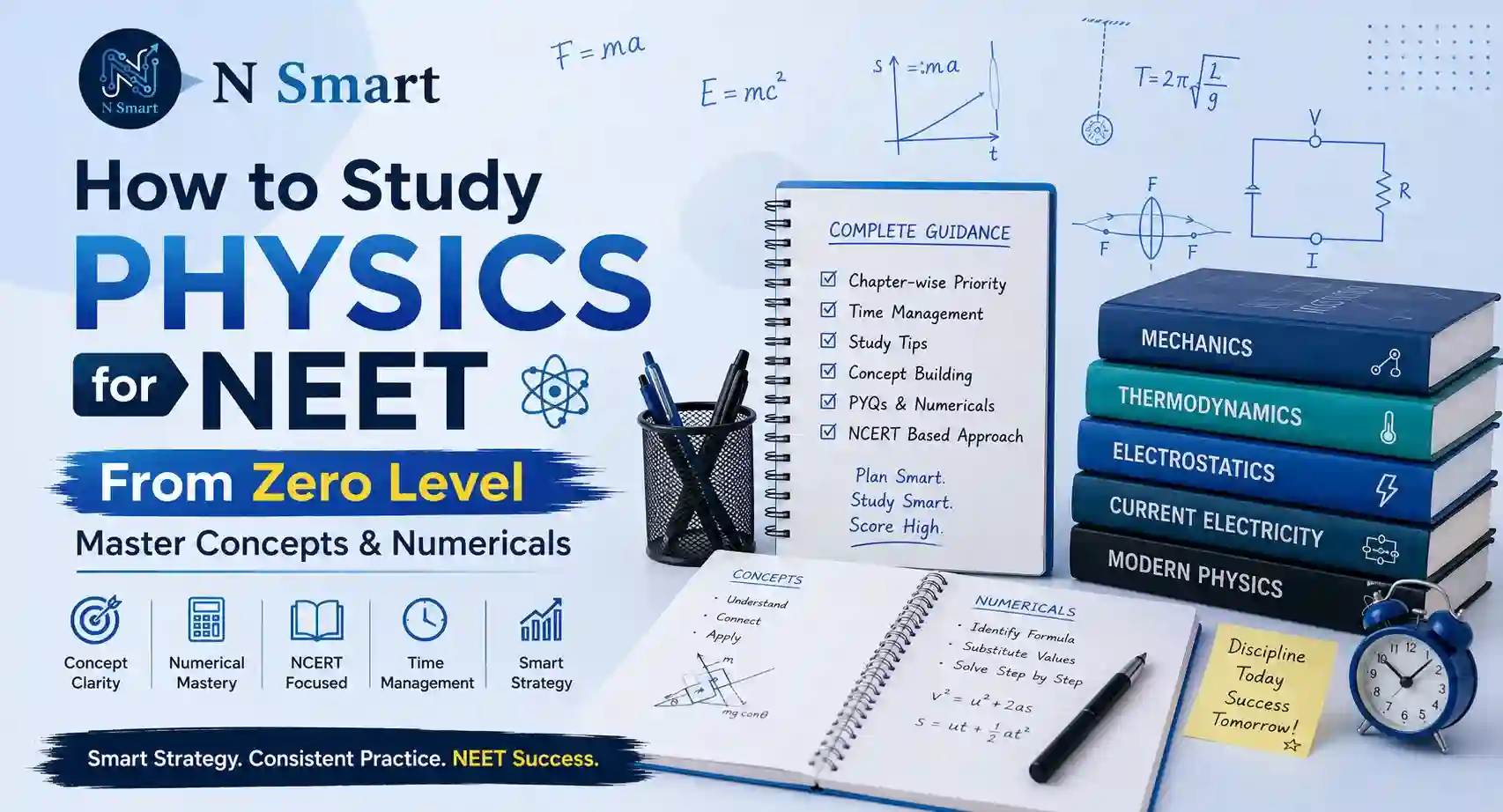
Prioritise Conceptual Learning: NCERT & Coaching Notes
Start with NCERTs for an in-depth understanding of concepts. Instead of trying to memorise everything, focus on “what is happening” & “why is happening”. After you finish a chapter, cross-reference your understanding with your coaching notes or watch a short crash course on that particular chapter, and solve basic MCQs.
Solve Previous Year Questions & Chapter-Based MCQs
Once you’re done with half of the syllabus, start solving previous-year question papers and chapter-based MCQs during weekends to have a clear understanding of where you stand in your preparation and test the depth of your concept understanding. Track your mistakes and clear the concepts before you move on to the next chapter.
Focus on Mock Tests: Smart Physics Strategy for NEET
Even though mock tests are great for measuring your overall performance, it’s the error analysis that can set you apart from the competition. After mock tests, track every single error and make short notes: is the mistake a calculation error, a conceptual error, or a silly mistake? And build your revision strategy around these short notes. For example, for conceptual errors: get back to NCERT, relearn the concept, and you can even watch a short video for better understanding. Similarly, for calculation errors or silly mistakes, focus more on practice, faster calculation methods, and greater attentiveness when reading questions.
Revision, Revision & Revision
This is the hard truth. The golden rule for NEET Physics strategy is having no upper limit on how many times you can or should revise a certain chapter or a topic; you can do it as many times as you need until you master that specific topic. Take your mocks, analyse the mistakes thoroughly, and revise weak concepts.
How to Study Calculus and Vectors for NEET Physics: Overcoming the Fear
If you freeze when you see calculus or vectors, it's usually because of weak basics. For NEET Physics preparation, you just need enough calculus and vector sense to survive kinematics, graphs, motion, and forces.
Integration in Physics in Class 11
For Physics Integration in Class 11, focus on area under graphs, displacement from velocity-time graphs, and basic motion relations. You don’t need in-depth knowledge of engineering preparation. You just need to know how the rules work and how to translate a physical situation into a solvable expression.
Differentiation & Vector Algebra
In NEET Physics preparation, learning differentiation requires focus on velocity, acceleration, field gradient, or rate of change, and Vector algebra requires learning resolution, magnitude, direction, and basic trigonometric handling first. If you plan your learning step by step, you can easily master NEET Physics preparation from a zero level.
NEET Physics Preparation Tips: Target 160+ Score
Physics NCERT Reading Trick for NEET
You might have already heard toppers saying that every NEET question in Physics is present in the NCERT itself. That is a hard truth; you just need to know how to extract data properly as you read. Break chapters into smaller sections, use visual aids like flowcharts to understand concepts quickly, redraw every diagram from your memory, and solve every NCERT question & example independently.
Practise Numericals More & More
If you really want to know how to study Physics for NEET from zero level, don’t just mug up a theory; practise those numericals every day. That is the only reliable solution. Start with easy problems and slowly move towards the difficult ones.
NEET Physics Tricks: How You Should Manage Time
In the exam, a total of 45 questions are there, for which 60 minutes timer is allotted (3.5 hrs full exam time).
Time management strategy:
- Attempt all the certain questions in the first 25 minutes.
- Don’t stay stuck on a question for more than 60 seconds.
- Go back to probable questions for the next 25 minutes.
- Use the elimination strategy and the approximation method.
- For the last 10 minutes, review all the answers.
Should You Solve HC Verma for NEET Physics?
If you’re wondering whether to solve HC for NEET Physics, the answer is: HC Verma is great for deep concept-building that is essential for JEE preparation. But NEET Physics requires speed and accuracy. HC Verma trains for in-depth knowledge. So it is only beneficial if you already have a strong foundation in Physics. So, in short, HC Verma is an overkill for NEET. For NEET, your real focus should be NCERT, coaching module, NCERT Exemplar practice, PYQs, and mock tests. That is enough for NEET Physics preparation.
Mistakes You Must Avoid in NEET Physics Preparation
- Ignoring NCERT questions & NCERT completely: Almost every question can be traced back to NCERT. So, that should be your main resource for learning.
- MCQs before concepts: Don’t dive into MCQs or chapter-based questions before you master the concepts.
- Rote memorisation: Don’t memorise formulas without understanding the derivation concepts first.
- Ignoring mock analysis: Track your mistakes; repeating errors indicates poor understanding of concepts. Focus on them more.
Negative Marking Trap
Students often lose 20-30 marks just from negative marking in the Physics paper. To tackle this negative marking, categorise the question paper into three sections:
- Confident: You know the concept & confident about solving it. Attempt immediately.
- Uncertain or Probable: You know the concept, but the calculation is difficult. Use the process of elimination and approximation.
- Completely Unaware: You don’t know the concept. Skip completely.
By following this strategy, you make sure you don’t lose any marks to negative marking and boost your score.
Frequently Asked Questions
How to study physics for NEET 2027?
To achieve absolute mastery over Physics preparation in NEET 2027, build a strong foundation with NCERT textbooks, solve PYQs, and maintain a personal formula sheet for repeated revision. Dedicate 2 to 3 hours daily and prioritise numerical practice and chapters like Mechanics, Electrodynamics, & Modern Physics.
How to score 170+ in Physics NEET 2027?
If you want to score 170/180 in Physics, focus on fundamental derivations over rote memorisation, practise 70-90 numerical problems daily, and prioritise high-yield chapters.
How to learn Physics easily for NEET?
To master NEET Physics easily, shift your approach from rote learning to conceptual learning, and focus on high-weightage chapters like Thermodynamics, Electrostatics, Modern Physics, and rigorous practice.
Is NEET Physics very hard?
Yes, Physics preparation for NEET is definitely hard and is the toughest and time-consuming section of the exam. Unlike Biology or Chemistry, Physics demands formula application, numerical practice, and conceptual reasoning, rather than rote memorisation. This makes it difficult, especially for students who dropped mathematics after Class 10th.
What is a good score in NEET Physics?
Scoring 150+ in NEET Physics is generally considered a great score, which can drastically improve your AIR.
Is NCERT sufficient to study NEET Physics from zero level?
No, while NCERT builds a strong base for NEET Physics preparation, you still need to practice MCQs, numericals, solve PYQs, take mocks, analyse your mistakes, and build your own formula sheet to do well.
Can I prepare for NEET Physics without coaching?
Yes, it is possible to prepare for NEET 2027 Physics without coaching by following a structured & disciplined preparation strategy, building a foundation with online resources, prioritising important chapters, and regularly monitoring your progress with mock tests.