Yes. The short answer is that NCERT books are enough to crack NEET only if you use them the right way. The National Eligibility Cum Entrance Test demands hard work, dedication, discipline, and a proper NEET preparation strategy that includes studying NCERT line by line as well.
Statistical data shows that almost 80% to 85% of the questions are derived directly or indirectly from NCERT topics alone. You might have heard toppers saying, “I only read NCERT & cracked NEET”. That's definitely true, but it only tells half the story. While the toppers definitely studied NCERT rigorously to build the base, there were other materials (notes, PYQs, & mock tests) too, contributing to their success. So, in this N Smart guide, we are going to discuss the actual benefit of studying NCERT textbooks and how you should study them to crack NEET 2027.
Why NCERT Is Essential for NEET: Benefits of NCERT Textbooks
- NTA Followed Syllabus: The biggest advantage of NCERT textbooks (Class 11 & 12) is that their syllabus is mostly aligned with the NEET syllabus. So, every line you’re studying from NCERT can be converted into a question.
- Language Familiarity: Since NTA directly follows NCERT for its questions, the questions often use wording, facts, or concepts resembling exactly NCERT language, especially in Biology & Inorganic Chemistry. That’s why reading NCERT attentively and revising it multiple times becomes much more important.
- Precise Information: NEET questions are MCQ-based, and they demand high precision. The NCERT supports this exact framework, allowing you to consume facts and information without unnecessary details.
- Best for Structured Revision: Revising NCERT is one of the best ways to get your revision done for NEET because of its compact & structured data. The short chapters, clear headings, and simple presentation make repeated revision faster and more effective in the final months.
Disadvantages of Relying Only on NCERT for NEET
- Missing Advanced Questions: NCERT textbooks don’t provide the challenging, advanced-level questions required for the NEET exam. While they are excellent at building concepts, they are not sufficient alone for the variety, depth, and trap-style questions in NEET.
- Physics Limitations: Physics requires in-depth conceptual knowledge, speed, numerical mastery, & problem-solving ability, but the Physics NCERT textbooks only explain conceptual theory, which is not sufficient to clear the cut-off.
- Insufficient Competitive Learning: The high cut-off can only be achieved through competitive precision. However, NCERT fails to provide enough materials for competitive-level practice. While it’s great for learning theory, you still need rigorous practice with MCQs, PYQs, & mock tests to get into a government medical college.
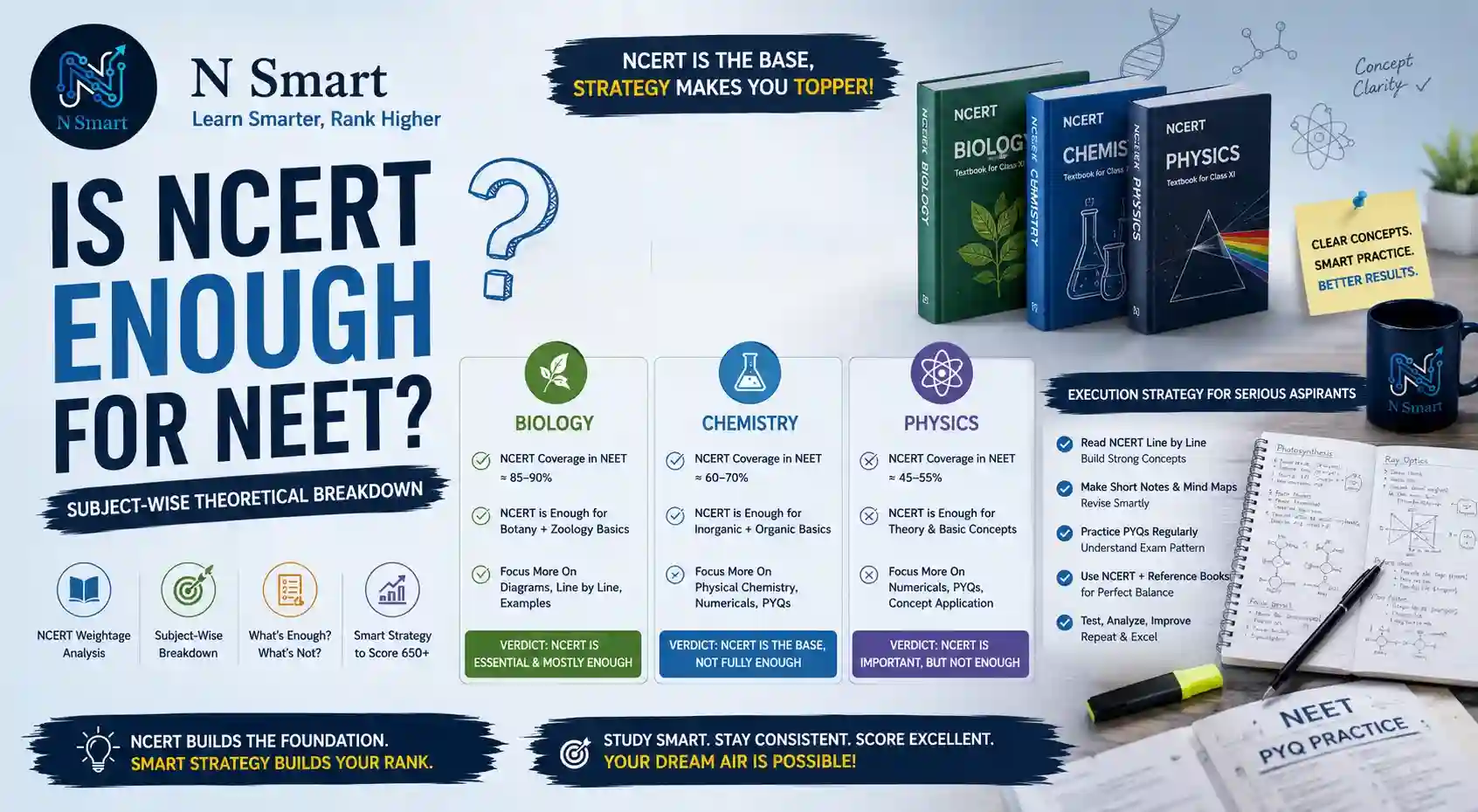
How to Read NCERT for NEET Effectively: A Complete Subject-Wise Breakdown
The right approach to crack and score good marks in NEET, you need a step-by-step, subject-wise framework with regular practice, mock tests, & revision.
Is NCERT Enough for NEET Biology?
NCERT is a must for NEET Biology since nearly 100% of the questions asked are directly or indirectly derived from it. Candidates who score 650+ in NEET always follow the same habit of reading NCERT Biology again and again till they remember every fact, examples, diagrams, terminology, & tables. To study NCERT for NEET Biology effectively, focus on:
- Line-by-line NCERT reading.
- Focus on assertion-reasoning topics.
- Interlinking facts across chapters.
Is NCERT Enough for NEET Physics?
No; NCERT Physics is definitely not enough to crack NEET. Physics paper demands an understanding of numerical problems, conceptual variations, and the ability to convert this knowledge accurately in the exam under immense time pressure. While NCERT is designed to give you the knowledge, the practical application, the speed & accuracy come from constant practice of problem solving, MCQs, & PYQs. While studying or revising Physics NCERT textbooks, focus on chapters like Mechanics, Thermodynamics, Electromagnetism, Optics, Modern Physics, and practise solving problems from these chapters more.
Is NCERT Enough for NEET Chemistry?
Unlike Biology, where NCERT is the main focus, and Physics, where conceptual understanding & intense practice are the only solutions, Chemistry demands a balance of both. Inorganic Chemistry requires absolute control over NCERT facts since most questions asked here are fact-based only. For the other two sections: NCERT is helpful for Organic Chemistry, but an in-depth understanding of mechanisms is highly needed. For Physical Chemistry, NCERT is not enough as it requires numerical ability, an approximation sense, and timed problem-solving.
Is NCERT Enough to Score 650 in NEET 2027?
A competitive exam like NEET asks for control over facts & foundational strength, but scoring 650 needs much more than that: managing time under examination pressure and accurately calculating and converting NCERT knowledge to answers in that time frame. While most questions, especially in Biology & Chemistry, are asked directly from NCERT, you still need MCQ practice, problem solving, PYQ solving, & mock tests, and this demand for practice is typically required more for Physics.
So, to answer your question: No, NCERT alone is not enough to score 650 in NEET, but it is a must-have foundational build. You need MCQ-solving, PYQs practice, and routined Mock tests as supplementary resources if you want to score 650 in NEET 2027.
Final Verdict
To summarise everything for the question “Is NCERT enough for NEET?”, the answer is subject-oriented. For Biology, it is definitely enough, but for Physics, it’s not; you need more focus on practice rather than reading. And for Chemistry, NCERT is essential, but it needs conceptual understanding & practice sessions as well, especially Physical Chemistry.
Frequently Asked Questions
Can I crack NEET by studying only NCERT?
You can build a solid foundation for NEET by studying NCERT only. However, without any external practice like solving MCQs, mock tests, and PYQs, you can’t crack NEET. You need them to measure your progress.
Can I score 720 in NEET with only NCERT?
No. You can't score a full 720/720 in NEET with only NCERT textbooks. Even though NCERTs are essential for building a conceptual foundation, you still need regular, intensive practice & exam-like tests to build speed, accuracy, and application strategies if you want a perfect score.
Is NCERT needed for NEET?
Undoubtedly yes. Class 11 & 12 NCERT textbooks are the absolute backbone of NEET preparation. The majority of questions come directly from NCERT only, or in the form of concept-based questions.
How many questions come from NCERT in NEET?
According to the NEET previous-year question analysis, almost 80% to 85% of the questions are directly derived from NCERT, especially in subjects like Biology and Chemistry, or they come in a form where NCERT conceptual knowledge is absolutely required, like Physics.
Is the NEET syllabus & NCERT syllabus the same?
No. The NTA-dictated NEET syllabus is not exactly the same as the NCERT syllabus. However, the major part (about 85% to 90%) of the syllabus is kept the same as the NCERT syllabus. Along with this major content overlap, the syllabus also contains a few subtopics that are not included in the NCERT syllabus.
Are NCERT books enough to crack NEET 2027?
While NCERT books are a non-negotiable asset that you can’t ignore, they are not enough on their own. You still need rigorous practice from reference books and mock tests, especially for subjects like Chemistry & Physics. In short, NCERT books are there to build your foundation, but they are not sufficient alone for NEET.
How many times should I read NCERT for NEET?
While there is no hard number on how many times you should revise NCERT for NEET at most, you should definitely read NCERT books at least 4 to 5 times. But your reading should be completely surgical, highlighting & extracting potential questions in every read and focusing on your weak areas more after every mock analysis.