Every year, NEET aspirants make the same mistake of believing that buying more books for NEET can magically improve their NEET preparation. The harsh reality is that while the right NEET preparation books can make the preparation more focused & productive, too many books can make it messy and confusing. According to toppers, the best way to study for NEET is to study NCERT first, reference books second, and practice resources like PYQs and Mock Tests next. This N Smart guide is all about the second stage: picking the right NEET reference books that can help you build accuracy, speed, and exam temperament for NEET 2027.
[Note: Before you buy a single book, make sure your NEET preparation strategy is structured and effective enough to help you achieve your MBBS dream.]
For NEET Preparation Books: NCERT Comes First; Reference Books Second
If you think NCERTs are too basic or that reference books for NEET can give more information than NCERT textbooks, you’d be completely wrong. Most toppers say that almost 70%-85% of the questions are directly or indirectly (require deep conceptual understanding) extracted from NCERTs. So, if you ever ask yourself the question “Which is the best book for NEET preparation?” The obvious answer is “Class 11 & 12 NCERT textbooks.” Our N Smart subject experts suggest that all NEET aspirants study NCERT thoroughly before using reference books for a deeper understanding. Read our detailed guide on “Is NCERT Enough for NEET?” before you invest in additional NEET study material.
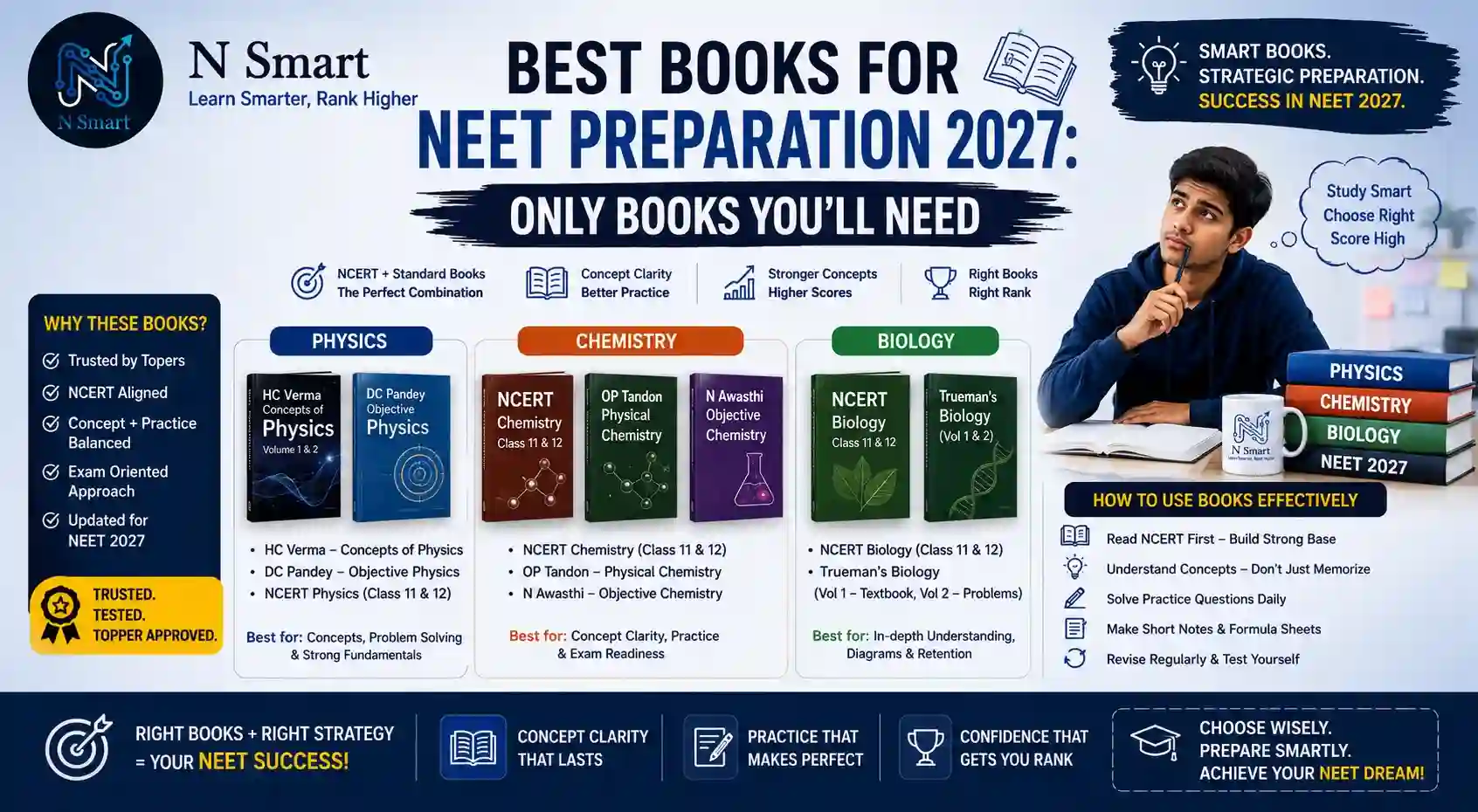
Best NEET Books for Biology (360/360 Target)
Biology contains 360 marks in NEET, so it becomes absolutely essential to choose the best books for NEET Biology that can actually help you get the full 360 score. Here’s the list for the same:
| Book Name | Author | Why This Book |
| NCERT Biology Class 11 & Class 12 | - | Fundamental theories, concepts & exercises. Toppers recommends multiple revisions of these. |
| MTG NCERT at your Fingertips | MTG Editorial Board | Targets Statement-Based & Assertion-Reason questions. NCERT line-by-line practice & PYQ pattern recognition. |
| Trueman’s Elementary Biology Vol. 1 & 2 (Optional) | MP Tyagi & KN Bhatia | In-depth explanation of Biology concepts. |
| Objective Biology | Dinesh Publications | Practice of objective questions. |
Best NEET Books for Physics (Concept & Application)
The majority of NEET aspirants find Physics the most difficult subject, so choosing the best Physics books for NEET that help with Mechanics, Thermodynamics, Current Electricity, Ray Optics, and Modern Physics concepts is undoubtedly helpful. Even though Physics is a more concept-focused subject, students should still prioritise NCERT first before moving on to reference or objective books. Here’s a list of the best NEET books for Physics:
| Book Name | Author | Why This Book |
| NCERT Physics Class 11 & Class 12 | - | Understanding of concepts, theory, practice exercise & solved examples. |
| Concepts of Physics (Volume 1 & 2) | HC Verma | To develop conceptual understanding & problem-solving techniques. |
| Objective Physics | DC Pandey | Master objective questions through rigorous practice. |
| Errorless Physics (Optional) | - | For objective question practice, you can also choose this instead of the previous one. |
Best NEET Books for Chemistry
Never treat or study Chemistry as one subject. The three sections, Physical, Organic, and Inorganic Chemistry, require different strategies & different books for NEET. Here’s the list of the best Chemistry books for NEET for each section:
| Book Name | Author | Why This Book |
| NCERT Chemistry Class 11 & Class 12 | - | Master conceptual understanding, theory & exercises, especially for Inorganic Chemistry. |
| Physical Chemistry | N Avasthi | For calculations & numerical speed. |
| Organic Chemistry | MS Chauhan | For reaction mechanism & application. |
| Inorganic Chemistry | JD LEE | Complete understanding of Inorganic Chemistry. |
How You Should Choose the Best NEET Preparation Books
Use NCERT as your fundamental core. Your primary source of learning should always be NCERT, as most questions (70%-85%) are derived from there only. If you’re clueless or have no idea which books are best for NEET preparation, just follow N Smart’s recommendation. Otherwise, if you’re picking the best NEET preparation books for yourself, follow this strategy:
- For reference books, pick books that focus on conceptual clarity and detailed solutions to help you strengthen your core concepts.
- For practice books, choose the ones with plenty of chapter-wise MCQs and Previous Year Questions (PYQs).
How to Use Reference Books for NEET UG Preparation?
Now that you know which books are best for NEET preparation or how to buy them correctly, you should also know how to use these NEET books effectively. Most students make the mistake of solving three different books one time. While toppers do the exact opposite: they solve one reference book three to four times. The correct approach to using reference books for NEET UG preparation is:
- First Round: Solve every question. Mark the difficult concepts, questions, or the incorrect ones.
- Second Round: Only study the marked questions or concepts.
- Third Round: Attempt the same questions under proper timed conditions. This will help you build speed, accuracy, and exam confidence.
Final Verdict
All in all, you don’t need a lot of books for NEET preparation; you just need the right ones along with the discipline to finish them multiple times. Here’s the complete list of the best books for NEET preparation recommended by N Smart experts, at a glance:
| Subject | Recommended Books |
| Biology | NCERT + MTG NCERT + Objective Biology |
| Physics | NCERT + Concepts of Physics + Objective Physics |
| Physical Chemistry | Physical Chemistry - N Avasthi |
| Organic Chemistry | Organic Chemistry - MS Chauhan |
| Inorganic Chemistry | NCERT + Inorganic Chemistry - JD LEE |
Frequently Asked Questions
Which is the best book for NEET preparation?
The best books for NEET preparation are undoubtedly the NCERT textbooks for Classes 11 & 12. They are your core fundamentals builder & primary resource of knowledge.
How many books are required for NEET preparation?
If you’re self-studying, one reference book & one MCQ practice book for Physics, Chemistry & Biology are enough for NEET preparation.
Which is the best Biology book for NEET?
Undoubtedly, Class 11 & Class 12 NCERT textbooks are the best books for NEET Biology. For MCQ practice, NCERT at Your Fingertips is a must for objective practice.
Which is the best Physics book for NEET?
The best Physics books for NEET are HC Verma - Concepts of Physics & DC Pandey - Objective Physics.
Which is the best Chemistry book for NEET?
For NEET Chemistry, NCERT, MS Chauhan, and N Avasthi are the best books for preparation. Please keep in mind that each section in Chemistry demands a different approach & strategy.
Which books do NEET toppers use?
Every NEET topper recommends NCERT textbooks as their primary source of learning material. Along with NCERTs, toppers also suggest coaching materials & MCQ books to improve speed and accuracy.
Which NEET prep book is good for beginners?
If you’re in Class 11 starting your NEET preparation, start with your Class 11 NCERT textbooks and school-level concepts. Then slowly build MCQ practice with subject-wise objective books.