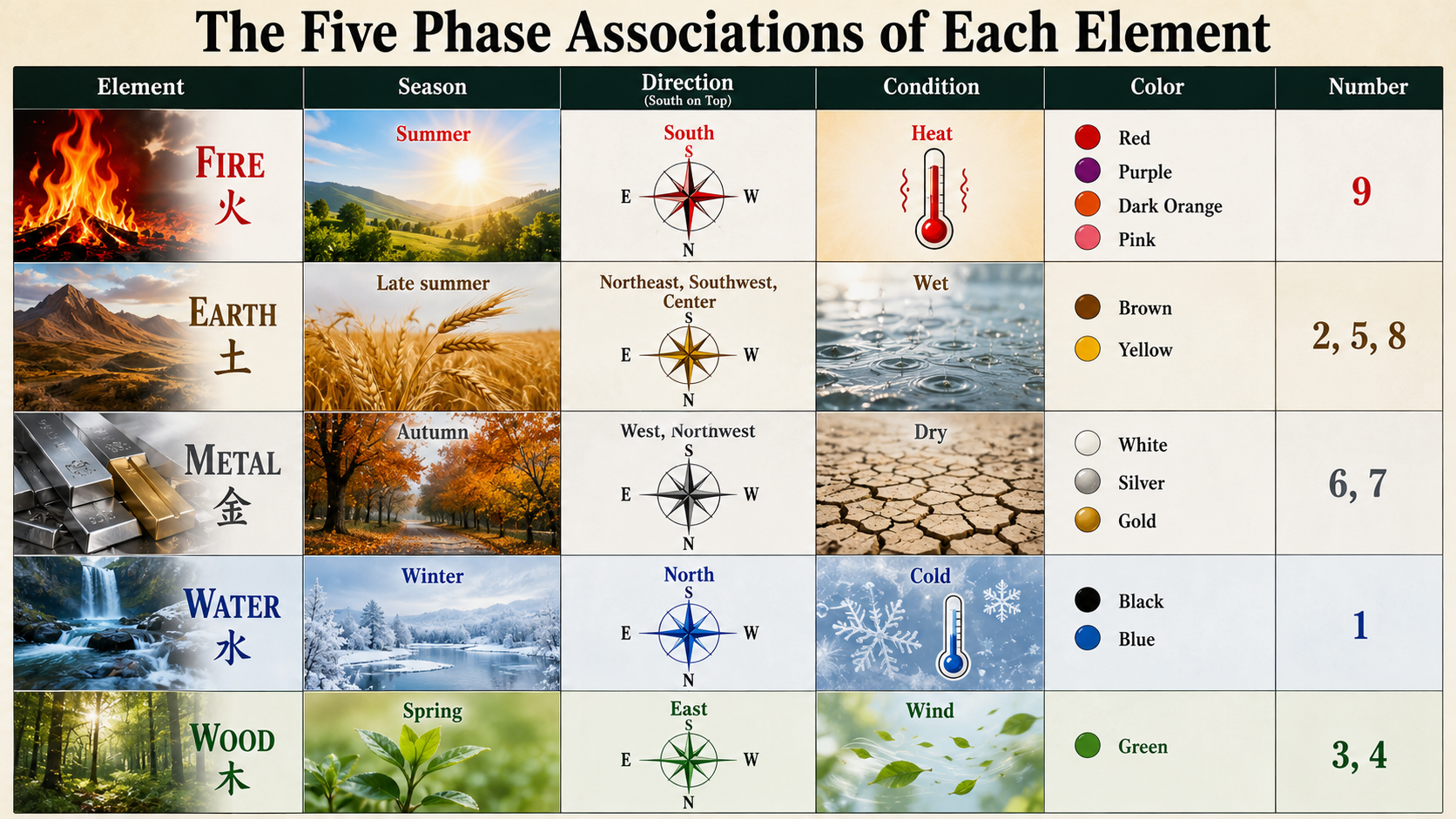
The ancient Chinese observed that nature and human beings are deeply connected. Just as the world is governed by the dynamic interplay of the Five Elements—Fire, Earth, Metal, Water, and Wood—our bodies, emotions, and behaviors are influenced by these same forces. Each element resides within us through specific organs and emotional expressions. Fire governs the heart and small intestine and is reflected in our capacity for joy and excitement. Earth is linked to the spleen and stomach, influencing our ability to think, focus, and nurture. Metal governs the lungs and large intestine and is associated with grief and sadness. Water controls the kidneys and bladder and manifests through fear and courage. Wood governs the liver and gallbladder, expressing itself through determination, ambition, and anger.
The wisdom of the Five Elements teaches us that emotions are not merely psychological experiences—they also affect our physical health. Have you ever noticed how intense sadness often brings tears, sighing, and a feeling of heaviness in the chest? According to Five Element theory, this is because grief directly impacts the lungs, the organ associated with the Metal element. Similarly, extreme fear can affect the kidneys and bladder. This is why people experiencing sudden terror may lose bladder control. Excessive joy, though generally considered positive, can also create imbalance. There are even cases where overwhelming excitement has put severe stress on the heart. One such example involved a woman who won a large jackpot at a casino. The shock and exhilaration of her unexpected fortune were so intense that she suffered a heart attack moments after receiving the news. Recognizing these connections, practitioners of acupuncture, acupressure, herbal medicine, and traditional Chinese healing use the Five Element system to identify and correct imbalances in the body's life force energy, known as Qi. By restoring harmony among the elements, they seek to promote both physical health and emotional well-being.
The Five Element system was also used to explain the structure of the universe. Ancient scholars first connected the elements with the four cardinal directions. Fire was placed in the South, Metal in the West, Water in the North, and Wood in the East. Earth, representing stability and balance, was positioned at the Center. As Chinese metaphysical systems evolved, these elemental associations were integrated with more complex frameworks such as the Eight Directions, the Eight Trigrams (Bagua), and the Nine Numbers of the Lo Shu Magic Square. However, combining a system of five elements with systems containing eight or nine categories created challenges. To bridge this gap, ancient scholars creatively assigned the elements to the four corner directions and corresponding Lo shu numbers. While these assignments were not always perfectly logical, they allowed different systems of Chinese philosophy, Feng Shui, astrology, and medicine to work together as a unified model of understanding the universe and human life. Thus, the Five Elements became much more than a theory of nature. They evolved into a profound map connecting the cosmos, the environment, the human body, emotions, health, and destiny—revealing the belief that everything in existence is interconnected and constantly influencing everything else.