Indian Constitution (भारतीय संविधान)
Quick Index | Chapter Overview
1. Constitutional History, Making & Constituent Assembly
2. Salient Features, Preamble & Basic Structure
3. Union & Territory + Citizenship
4. Fundamental Rights
5. DPSP + Fundamental Duties
6. Constitutional Amendment + Important Doctrines
7. President, Vice-President & Union Executive
8. Parliament
9. Supreme Court & Constitutional Judiciary
10. Governor & State Executive
11. State Legislature
12. High Courts & Subordinate Judiciary
13. Centre–State Relations
14. Emergency Provisions
15. Panchayats, Municipalities & Co-operative Societies
16. Elections + Election Commission
17. Constitutional Bodies + Public Service Commissions
18. Finance, Property, Contracts, Services & Tribunals
19. Trade & Commerce + Official Language + Special Provisions
20. Schedules + Important Amendments + Landmark Cases + Miscellaneous Articles
Constitutional History, Making & Constituent Assembly
संवैधानिक इतिहास, निर्माण एवं संविधान सभा
- रेग्युलेटिंग एक्ट, 1773 को भारत में ब्रिटिश शासन के केंद्रीकरण की पहली प्रमुख संवैधानिक शुरुआत माना जाता है।
- रेग्युलेटिंग एक्ट, 1773 ने बंगाल के गवर्नर को गवर्नर-जनरल ऑफ बंगाल का पद दिया।
- वॉरेन हेस्टिंग्स बंगाल के प्रथम गवर्नर-जनरल थे।
- कलकत्ता में सुप्रीम कोर्ट की स्थापना 1774 में हुई।
- पिट्स इंडिया एक्ट, 1784 ने भारत के प्रशासन पर ब्रिटिश सरकार का नियंत्रण और मजबूत किया।
- पिट्स इंडिया एक्ट, 1784 के तहत बोर्ड ऑफ कंट्रोल की स्थापना की गई।
- चार्टर एक्ट, 1813 ने ईस्ट इंडिया कंपनी के व्यापारिक एकाधिकार को काफी हद तक समाप्त कर दिया।
- चार्टर एक्ट, 1833 ने बंगाल के गवर्नर-जनरल को गवर्नर-जनरल ऑफ इंडिया बना दिया।
- लॉर्ड विलियम बैंटिक भारत के प्रथम गवर्नर-जनरल थे।
- चार्टर एक्ट, 1833 के बाद विधि-संहिताकरण की दिशा में पहला लॉ कमीशन गठित किया गया।
- प्रथम लॉ कमीशन के अध्यक्ष लॉर्ड मैकॉले थे।
- चार्टर एक्ट, 1853 ने गवर्नर-जनरल की परिषद के विधायी और कार्यपालिका कार्यों में पृथक्करण की दिशा दिखाई।
- गवर्नमेंट ऑफ इंडिया एक्ट, 1858 ने भारत का शासन ईस्ट इंडिया कंपनी से ब्रिटिश क्राउन को सौंप दिया।
- 1858 के बाद भारत में सेक्रेटरी ऑफ स्टेट फॉर इंडिया का पद अस्तित्व में आया।
- इंडियन काउंसिल्स एक्ट, 1861 ने प्रांतीय विधायी परिषदों को पुनर्जीवित किया।
- 1861 के अधिनियम से पोर्टफोलियो प्रणाली को संस्थागत आधार मिला।
- इंडियन काउंसिल्स एक्ट, 1892 ने बजट पर चर्चा का सीमित अधिकार दिया।
- इंडियन काउंसिल्स एक्ट, 1909 को मॉर्ले-मिंटो सुधार कहा जाता है।
- 1909 के अधिनियम ने मुसलमानों के लिए पृथक निर्वाचन प्रणाली शुरू की।
- गवर्नमेंट ऑफ India एक्ट, 1919 को मोंटेग्यू-चेम्सफोर्ड सुधार कहा जाता है।
- 1919 के अधिनियम ने प्रांतों में द्वैध शासन (Dyarchy) लागू किया।
- गवर्नमेंट ऑफ India एक्ट, 1935 ब्रिटिश भारत का सबसे विस्तृत संवैधानिक अधिनियम था।
- 1935 के अधिनियम ने प्रांतीय स्वायत्तता का प्रावधान किया।
- 1935 के अधिनियम में अखिल भारतीय संघ की कल्पना की गई थी, पर वह लागू नहीं हो सका।
- 1940 के अगस्त प्रस्ताव में पहली बार ब्रिटिश सरकार ने भारतीयों को स्वयं संविधान बनाने का आश्वासन दिया।
- 1942 के क्रिप्स प्रस्तावों ने युद्ध के बाद संविधान-निर्माण निकाय की बात की।
- भारत के लिए संविधान सभा का विचार सर्वप्रथम 1934 में एम.एन. रॉय ने प्रस्तुत किया था।
- भारतीय राष्ट्रीय कांग्रेस ने 1930 के दशक में संविधान सभा की मांग को राजनीतिक रूप से अपनाया।
- संविधान सभा का गठन कैबिनेट मिशन योजना, 1946 के आधार पर हुआ था।
- संविधान सभा का गठन प्रत्यक्ष वयस्क मताधिकार से नहीं, बल्कि अप्रत्यक्ष निर्वाचन से हुआ था।
- प्रांतीय विधानसभाओं के निर्वाचित सदस्यों ने संविधान सभा के सदस्यों का चुनाव आनुपातिक प्रतिनिधित्व और एकल संक्रमणीय मत प्रणाली से किया।
- संविधान सभा की कुल प्रारंभिक सदस्य संख्या 389 थी।
- 389 में से 292 सदस्य ब्रिटिश भारतीय प्रांतों से, 93 देशी रियासतों से और 4 मुख्य आयुक्त प्रांतों से थे।
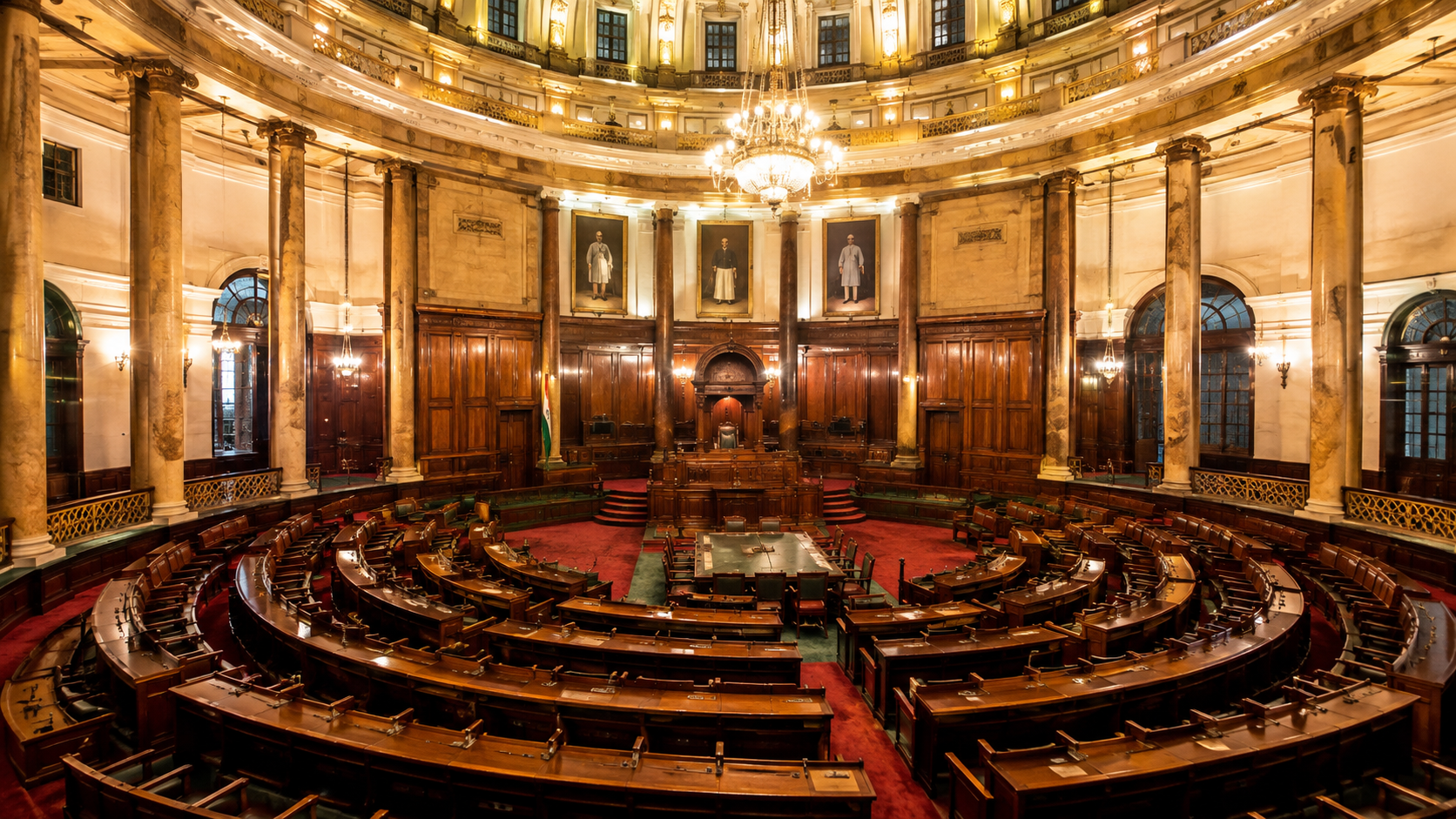
- संविधान सभा की पहली बैठक 9 दिसंबर 1946 को नई दिल्ली के कॉन्स्टिट्यूशन हॉल में हुई, जिसे आज संसद भवन के केंद्रीय कक्ष के रूप में जाना जाता है।
- संविधान सभा की पहली बैठक के अस्थायी अध्यक्ष डॉ. सच्चिदानंद सिन्हा थे।
- 11 दिसंबर 1946 को डॉ. राजेंद्र प्रसाद संविधान सभा के स्थायी अध्यक्ष निर्वाचित हुए।
- एच.सी. मुखर्जी संविधान सभा के उपाध्यक्ष थे।
- मुस्लिम लीग ने संविधान सभा की पहली बैठक का बहिष्कार किया था।
- जवाहरलाल नेहरू ने 13 दिसंबर 1946 को उद्देश्य प्रस्ताव (Objectives Resolution) प्रस्तुत किया।
- उद्देश्य प्रस्ताव 22 जनवरी 1947 को संविधान सभा द्वारा स्वीकार किया गया।
- उद्देश्य प्रस्ताव को ही आगे चलकर संविधान की प्रस्तावना का दार्शनिक आधार माना गया।
- बी.एन. राउ संविधान सभा के संवैधानिक सलाहकार थे।
- देश के विभाजन के बाद संविधान सभा की सदस्य संख्या 389 से घटकर 299 रह गई।
- विभाजन के बाद 299 सदस्यों में 229 प्रांतों के और 70 रियासतों के प्रतिनिधि थे।
- 15 अगस्त 1947 के बाद संविधान सभा एक प्रभुसत्ता-संपन्न निकाय के रूप में कार्य करने लगी।
- स्वतंत्रता के बाद संविधान सभा ने अस्थायी संसद (Dominion Legislature) के रूप में भी कार्य किया।
- प्रारूप समिति (Drafting Committee) का गठन 29 अगस्त 1947 को किया गया।
- डॉ. भीमराव अम्बेडकर प्रारूप समिति के अध्यक्ष थे।
- प्रारूप समिति के मूल सदस्यों में एन. गोपालस्वामी अय्यंगार, अल्लादी कृष्णास्वामी अय्यर, के.एम. मुंशी, मोहम्मद सादुल्ला, बी.एल. मिटर और डी.पी. खेतान शामिल थे।
- बी.एल. मिटर के स्थान पर एन. माधव राव को प्रारूप समिति में लिया गया।
- डी.पी. खेतान के निधन के बाद टी.टी. कृष्णमाचारी प्रारूप समिति में शामिल किए गए।
- संघ संविधान समिति (Union Constitution Committee) के अध्यक्ष जवाहरलाल नेहरू थे।
- संघ शक्तियाँ समिति (Union Powers Committee) के अध्यक्ष भी जवाहरलाल नेहरू थे।
- प्रांतीय संविधान समिति (Provincial Constitution Committee) के अध्यक्ष सरदार वल्लभभाई पटेल थे।
- मौलिक अधिकार, अल्पसंख्यक, जनजातीय एवं बहिष्कृत क्षेत्रों संबंधी परामर्श समिति (Advisory Committee) के अध्यक्ष सरदार पटेल थे।
- संचालन समिति (Steering Committee) के अध्यक्ष डॉ. राजेंद्र प्रसाद थे।
- नियम समिति (Rules of Procedure Committee) के अध्यक्ष डॉ. राजेंद्र प्रसाद थे।
- राष्ट्रीय ध्वज पर तदर्थ समिति के अध्यक्ष भी डॉ. राजेंद्र प्रसाद थे।
- डॉ. अम्बेडकर ने प्रारूप संविधान को संविधान सभा में 4 नवंबर 1948 को प्रस्तुत किया।
- संविधान सभा ने प्रारूप संविधान पर धारावार विस्तृत विचार-विमर्श किया।
- 26 नवंबर 1949 को संविधान सभा ने संविधान को अंगीकृत, अधिनियमित और आत्मार्पित किया।
- अंगीकरण के समय संविधान में 395 अनुच्छेद और 8 अनुसूचियाँ थीं।
- लोकसभा की आधिकारिक जानकारी के अनुसार संविधान सभा ने 11 सत्रों में संविधान-निर्माण का कार्य पूरा किया।
- संविधान के अधिकांश प्रावधान 26 जनवरी 1950 से प्रभावी हुए।
- अनुच्छेद 394 के अनुसार कुछ प्रावधान, जैसे नागरिकता से जुड़े अनुच्छेद 5 से 9 तथा अन्य कुछ अनुच्छेद, तुरंत प्रभाव में आए थे।
- 26 जनवरी को संविधान लागू करने का निर्णय 1930 के पूर्ण स्वराज दिवस की स्मृति में लिया गया था।
- अनुच्छेद 393 के अनुसार इस विधि का संक्षिप्त नाम “भारत का संविधान / The Constitution of India” है।
- अनुच्छेद 395 ने Indian Independence Act, 1947 तथा Government of India Act, 1935 को निरस्त कर दिया।
- मूल संविधान की हस्तलिखित प्रतियाँ अंग्रेज़ी और हिंदी दोनों में तैयार की गई थीं।
- मूल अंग्रेज़ी संविधान की सुलेख-लिपि प्रेम बिहारी नारायण रायज़ादा ने लिखी थी।
- संविधान की मूल हस्तलिखित प्रति का अलंकरण नंदलाल बोस और शांतिनिकेतन के कलाकारों ने किया था।
- 24 जनवरी 1950 को संविधान सभा के 284 सदस्यों ने संविधान की मूल प्रति पर हस्ताक्षर किए।
- 24 जनवरी 1950 को डॉ. राजेंद्र प्रसाद स्वतंत्र भारत के प्रथम राष्ट्रपति निर्वाचित हुए।
- 24 जनवरी 1950 को संविधान सभा ने “जन गण मन” को राष्ट्रगान के रूप में स्वीकार किया।
- 24 जनवरी 1950 को “वन्दे मातरम्” को राष्ट्रीय गीत के रूप में समान सम्मान दिया गया।
- संविधान सभा की बहसें भारतीय संवैधानिक इतिहास को समझने का अत्यंत महत्त्वपूर्ण स्रोत हैं।
- भारत का संविधान किसी एक व्यक्ति की रचना नहीं, बल्कि बहु-स्तरीय समिति-कार्य, बहस और सहमति का परिणाम है।
- संविधान-निर्माण की प्रक्रिया ने विधिक परंपरा, राष्ट्रीय आंदोलन और लोकतांत्रिक विमर्श—तीनों को एक साथ जोड़ा।
Salient Features, Preamble & Basic Structure
प्रमुख विशेषताएँ, प्रस्तावना एवं मूल संरचना
A. Salient Features | संविधान की प्रमुख विशेषताएँ
- भारत का संविधान देश की सर्वोच्च विधिक प्राधिकारिता (Supreme Legal Authority) है।
- विधायिका, कार्यपालिका और न्यायपालिका—तीनों संविधान से अपनी शक्तियाँ प्राप्त करते हैं।
- भारत का संविधान एक लिखित और विस्तृत संविधान है।
- भारतीय संविधान संसदीय शासन प्रणाली स्थापित करता है।
- संसदीय व्यवस्था में वास्तविक कार्यपालिका मंत्रिपरिषद होती है।
- भारत में संघ और राज्यों के बीच शक्तियों का संवैधानिक विभाजन किया गया है।
- भारतीय संविधान संघीय शासन-व्यवस्था स्थापित करता है, किंतु संघ को महत्त्वपूर्ण संवैधानिक शक्तियाँ भी प्रदान करता है।
- विधायी विषयों का वितरण मुख्यतः सातवीं अनुसूची की संघ, राज्य और समवर्ती सूचियों के माध्यम से किया गया है।
- भारतीय संविधान संविधान की सर्वोच्चता को स्वीकार करता है, न कि ब्रिटिश अर्थ में संसदीय सर्वोच्चता को।
- संसद की विधायी शक्ति स्वयं संविधान के अधीन है।
- भारत में स्वतंत्र न्यायपालिका संवैधानिक व्यवस्था की प्रमुख विशेषता है।
- न्यायपालिका संविधान-विरोधी विधायी अथवा सरकारी कार्रवाई को अमान्य घोषित कर सकती है।
- न्यायिक पुनरावलोकन (Judicial Review) भारतीय संवैधानिक व्यवस्था का महत्त्वपूर्ण तत्व है।
- संविधान नागरिकों को मौलिक अधिकार प्रदान करता है।
- राज्य की नीति के निदेशक तत्व शासन के लिए सामाजिक-आर्थिक उद्देश्यों का मार्गदर्शन करते हैं।
- मूल कर्तव्य संविधान के Part IVA में दिए गए हैं।
- भारत में एकीकृत न्यायिक व्यवस्था है, जिसके शीर्ष पर Supreme Court of India है।
- भारतीय संविधान लोकतांत्रिक गणराज्य की स्थापना करता है।
- भारत में राज्य का प्रमुख वंशानुगत सम्राट नहीं होता।
- सार्वभौमिक वयस्क मताधिकार भारतीय लोकतंत्र का आधार है।
- भारत में संघीय स्तर पर एकल नागरिकता (Single Citizenship) की व्यवस्था है।
- भारतीय संविधान धर्मनिरपेक्ष राज्य की स्थापना करता है।
- धर्मनिरपेक्षता का अर्थ राज्य द्वारा किसी एक धर्म को अपना राजधर्म घोषित करना नहीं है।
- संविधान विचार, विश्वास, आस्था और उपासना की स्वतंत्रता को संवैधानिक मान्यता देता है।
- संविधान सामाजिक, आर्थिक और राजनीतिक न्याय को संवैधानिक लक्ष्य बनाता है।
- संविधान में सामान्य परिस्थितियों के साथ-साथ आपातकालीन परिस्थितियों के लिए भी विशेष प्रावधान हैं।
- भारतीय संविधान पूर्णतः कठोर अथवा पूर्णतः लचीला नहीं है।
- संविधान में विभिन्न प्रकार के संशोधनों के लिए अलग-अलग प्रक्रियाएँ पाई जाती हैं।
- भारतीय शासन प्रणाली में शक्तियों का पृथक्करण कठोर अमेरिकी अर्थ में नहीं अपनाया गया है।
- भारतीय संविधान विभिन्न संस्थाओं के बीच functional separation तथा checks and balances की व्यवस्था करता है।
- संघ स्तर पर द्विसदनीय संसद की व्यवस्था की गई है।
- राष्ट्रपति संसद का संवैधानिक अंग है।
- केंद्र की मंत्रिपरिषद लोकसभा के प्रति सामूहिक रूप से उत्तरदायी होती है।
- संविधान स्वतंत्र और निष्पक्ष चुनावों के लिए संवैधानिक ढाँचा प्रदान करता है।
- संविधान के अधीन कानून का शासन (Rule of Law) शासन-व्यवस्था का मूल सिद्धांत है।
- समानता के समक्ष कानून और कानूनों का समान संरक्षण संवैधानिक व्यवस्था के केंद्रीय तत्व हैं।
- संविधान अल्पसंख्यकों के सांस्कृतिक और शैक्षणिक अधिकारों को संरक्षण देता है।
- संविधान सामाजिक परिवर्तन और व्यक्तिगत स्वतंत्रता दोनों को साथ लेकर चलने का प्रयास करता है।
- 73वें और 74वें संविधान संशोधनों ने ग्रामीण और शहरी स्थानीय स्वशासन को संवैधानिक आधार दिया।
- चुनाव आयोग, नियंत्रक एवं महालेखा परीक्षक और लोक सेवा आयोग जैसे निकायों को संविधान स्वयं मान्यता देता है।
B. Preamble | प्रस्तावना
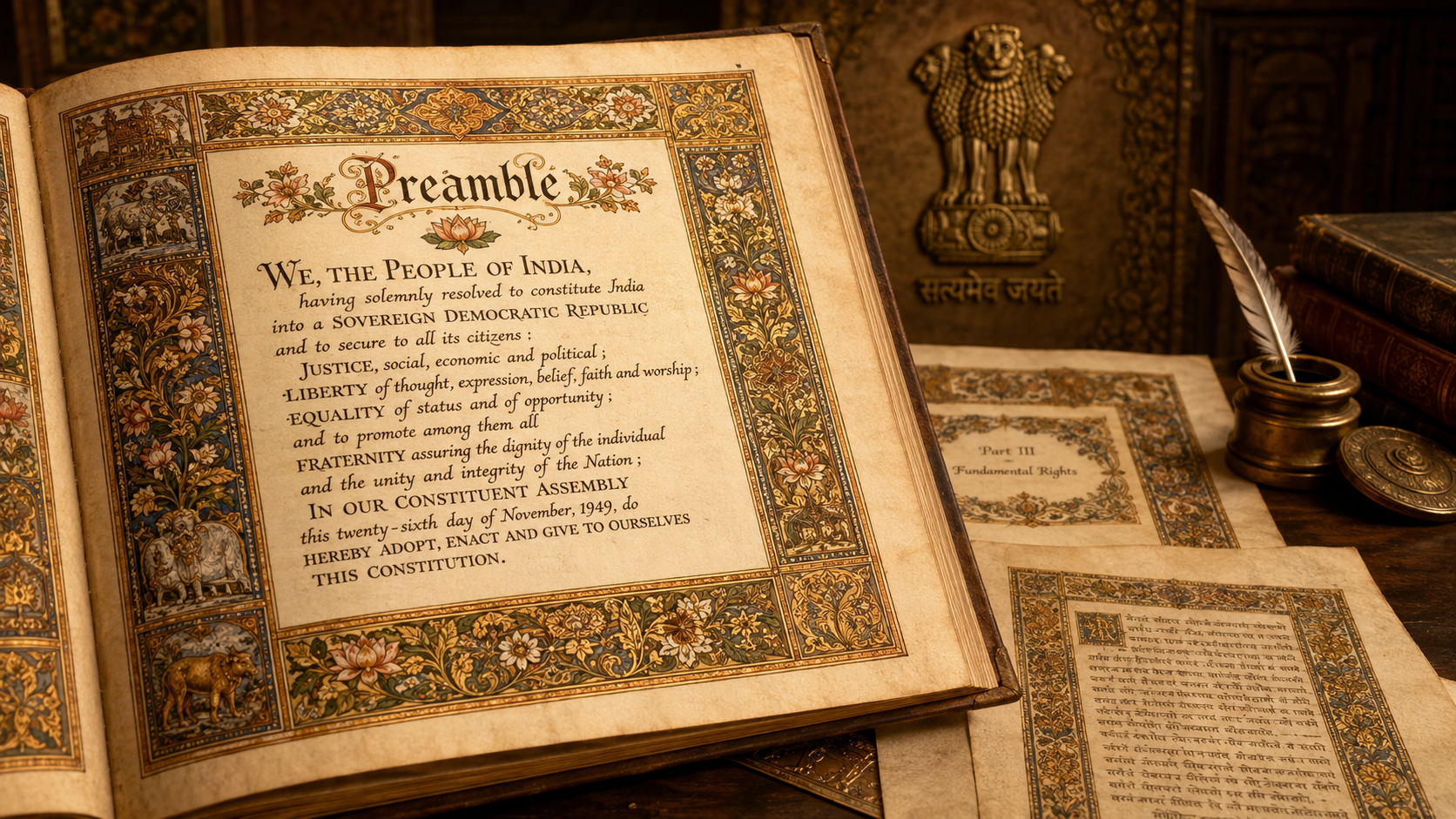
- भारतीय संविधान की प्रस्तावना “WE, THE PEOPLE OF INDIA” अर्थात् “हम, भारत के लोग” से आरंभ होती है।
- “हम, भारत के लोग” संविधान की सत्ता के अंतिम स्रोत के रूप में जनता को इंगित करता है।
- संविधान की प्रस्तावना 26 नवंबर 1949 को संविधान के साथ अंगीकृत हुई।
- प्रस्तावना भारत को “Sovereign Socialist Secular Democratic Republic” घोषित करती है।
- प्रस्तावना में “Sovereign” का अर्थ भारत की आंतरिक और बाह्य संप्रभुता से जुड़ा है।
- “Republic” वंशानुगत राष्ट्राध्यक्ष की अवधारणा को अस्वीकार करता है।
- “Democratic” राजनीतिक सत्ता को जनता की लोकतांत्रिक भागीदारी से जोड़ता है।
- “Secular” भारतीय राज्य की धर्मनिरपेक्ष प्रकृति को दर्शाता है।
- भारतीय धर्मनिरपेक्षता में राज्य का अपना कोई धर्म नहीं है और सभी धर्मों के व्यक्तियों को संवैधानिक स्वतंत्रता प्राप्त है।
- “Socialist” शब्द भारतीय संदर्भ में किसी एक अनिवार्य आर्थिक मॉडल तक सरकार को सीमित नहीं करता।
- Supreme Court के अनुसार भारतीय संदर्भ में socialism कल्याणकारी राज्य तथा सामाजिक-आर्थिक न्याय के उद्देश्य से जुड़ा है।
- प्रस्तावना सामाजिक, आर्थिक और राजनीतिक—तीनों प्रकार के न्याय का उल्लेख करती है।
- प्रस्तावना विचार की स्वतंत्रता प्रदान करने के लक्ष्य का उल्लेख करती है।
- प्रस्तावना अभिव्यक्ति की स्वतंत्रता को संवैधानिक आदर्श के रूप में मान्यता देती है।
- प्रस्तावना विश्वास (belief) की स्वतंत्रता का उल्लेख करती है।
- प्रस्तावना आस्था (faith) की स्वतंत्रता का उल्लेख करती है।
- प्रस्तावना उपासना (worship) की स्वतंत्रता का उल्लेख करती है।
- प्रस्तावना प्रतिष्ठा/स्थिति की समानता (Equality of Status) का लक्ष्य रखती है।
- प्रस्तावना अवसर की समानता (Equality of Opportunity) का लक्ष्य रखती है।
- प्रस्तावना बंधुता (Fraternity) को बढ़ावा देने की बात करती है।
- बंधुता का उद्देश्य व्यक्ति की गरिमा (Dignity of the Individual) सुनिश्चित करना भी है।
- बंधुता राष्ट्र की एकता और अखंडता से भी जुड़ी है।
- मूल प्रस्तावना में “Socialist” शब्द नहीं था।
- मूल प्रस्तावना में “Secular” शब्द भी नहीं था।
- मूल प्रस्तावना में भारत को “Sovereign Democratic Republic” कहा गया था।
- “Socialist” और “Secular” शब्द 42वें संविधान संशोधन अधिनियम, 1976 द्वारा जोड़े गए।
- 42वें संशोधन द्वारा “Unity of the Nation” के स्थान पर “Unity and Integrity of the Nation” किया गया।
- प्रस्तावना में 42वें संशोधन के ये परिवर्तन 3 जनवरी 1977 से प्रभावी हुए।
- प्रस्तावना में अब तक औपचारिक रूप से केवल 42वें संविधान संशोधन द्वारा परिवर्तन किया गया है।
- प्रस्तावना में “Federal” शब्द का प्रयोग नहीं किया गया है।
- प्रस्तावना में “Parliamentary” शब्द भी नहीं लिखा गया है।
- संविधान की संघीय तथा संसदीय प्रकृति उसके अन्य प्रावधानों से स्थापित होती है।
- प्रारंभिक Berubari Union मत में Supreme Court ने प्रस्तावना को संविधान का भाग नहीं माना था।
- Kesavananda Bharati मामले ने यह स्थिति स्पष्ट कर दी कि प्रस्तावना संविधान का अभिन्न अंग है।
- Supreme Court ने 2026 में भी दोहराया कि Preamble संविधान का integral part है।
- K.S. Puttaswamy निर्णय में Justice, Liberty, Equality और Fraternity को प्रस्तावना के foundational values के रूप में स्वीकार किया गया।
- प्रस्तावना संविधान की मूल संवैधानिक दर्शन-धारा को समझने में महत्त्वपूर्ण है।
- प्रस्तावना स्वयं अलग से कोई स्वतंत्र विधायी शक्ति प्रदान नहीं करती।
- संवैधानिक शक्तियों का वास्तविक स्रोत संविधान के operative Articles हैं।
- प्रस्तावना संविधान की व्याख्या में मार्गदर्शक भूमिका निभा सकती है।
- संविधान की प्रस्तावना भी Article 368 के अंतर्गत संशोधित की जा सकती है।
- प्रस्तावना में किया गया संशोधन भी Basic Structure की सीमा के अधीन है।
- Supreme Court ने 2024 में स्पष्ट किया कि Article 368 की संशोधन शक्ति Preamble तक विस्तृत है।
- 26 नवंबर 1949 की adoption date संसद की Preamble संशोधित करने की Article 368 शक्ति को समाप्त नहीं करती।
- 2024 में Supreme Court ने “Socialist” और “Secular” शब्दों को हटाने की मांग वाली याचिकाएँ खारिज कर दीं।
- Supreme Court ने पुनः स्वीकार किया कि secularism संविधान की basic feature है।
- भारतीय secularism सभी faiths के प्रति संवैधानिक समानता से जुड़ा है।
- प्रस्तावना में “Justice” को “Liberty” से पहले रखा गया है।
- प्रस्तावना में “Equality” के बाद “Fraternity” का उल्लेख किया गया है।
- “We, the People” और “Give to Ourselves” दोनों अभिव्यक्तियाँ लोकप्रिय संप्रभुता को रेखांकित करती हैं।
- Supreme Court ने 2026 में fraternity को केवल aspirational शब्द न मानकर substantive constitutional meaning वाला सिद्धांत माना है।
C. Basic Structure Doctrine
मूल संरचना सिद्धांत
- Basic Structure Doctrine का प्रमुख प्रतिपादन Kesavananda Bharati v. State of Kerala (1973) में हुआ।
- Kesavananda Bharati का निर्णय 13 न्यायाधीशों की Constitution Bench द्वारा दिया गया था।
- Kesavananda Bharati में यह स्थापित हुआ कि Parliament की Article 368 के अंतर्गत संशोधन शक्ति व्यापक है, लेकिन असीमित नहीं।
- Parliament संविधान में संशोधन कर सकती है, लेकिन उसकी मूल संरचना को नष्ट नहीं कर सकती।
- Article 368 Parliament को Constitution की basic structure अथवा framework बदलने की शक्ति नहीं देता।
- “Basic Structure” शब्द स्वयं Article 368 में लिखे हुए नहीं हैं।
- Basic Structure Doctrine न्यायिक व्याख्या के माध्यम से विकसित हुआ है।
- Basic Structure की कोई एक पूर्ण और बंद सूची Supreme Court ने निर्धारित नहीं की है।
- किसी विशेष विशेषता के Basic Structure होने का निर्णय संवैधानिक योजना में उसके स्थान और महत्त्व को देखकर किया जाता है।
- Constitution की supremacy को Basic Structure का तत्व माना गया है।
- Republican form of Government को Basic Structure के तत्वों में माना गया है।
- Democratic form of Government को Basic Structure का हिस्सा माना गया है।
- Secular character of the Constitution Basic Structure का हिस्सा है।
- Legislature, Executive और Judiciary के बीच separation of powers Basic Structure से जुड़ा है।
- Federalism भारतीय संविधान की Basic Structure का हिस्सा है।
- व्यक्ति की dignity और freedom को भी Basic Structure की व्याख्या में महत्त्व दिया गया है।
- Social, Economic and Political Justice को भी Kesavananda opinions में मूल विशेषताओं से जोड़ा गया।
- राष्ट्र की Unity and Integrity को Basic Structure से संबंधित माना गया है।
- Sovereignty of India को Basic Structure की प्रमुख विशेषताओं में माना गया है।
- Parliamentary form of democracy को भी Basic Structure की व्याख्या में स्थान मिला है।
- Judicial Review भारतीय संविधान की Basic Structure का हिस्सा है।
- Parliament की limited amending power स्वयं Basic Structure का हिस्सा है।
- Parliament अपनी सीमित संशोधन शक्ति का उपयोग करके स्वयं को असीमित संशोधन शक्ति नहीं दे सकती।
- Minerva Mills v. Union of India (1980) ने limited amending power के सिद्धांत को दृढ़ किया।
- Minerva Mills ने Article 368 में 42वें संशोधन द्वारा जोड़े गए clauses (4) और (5) को असंवैधानिक घोषित किया।
- Article 368(4) द्वारा constitutional amendments को judicial review से पूर्णतः बाहर करने का प्रयास किया गया था।
- Article 368(5) द्वारा Parliament की constituent power को असीमित घोषित करने का प्रयास किया गया था।
- Supreme Court ने माना कि ऐसी unlimited amending power स्वयं Basic Structure को नष्ट कर देगी।
- Minerva Mills ने Judicial Review को भी Basic Structure की essential feature माना।
- Fundamental Rights और Directive Principles के बीच harmony and balance को भी Basic Structure माना गया है।
- संविधान Fundamental Rights और DPSP में से किसी एक को पूर्णतः दूसरे पर नष्टकारी प्रधानता देने की अनुमति नहीं देता।
- Indira Nehru Gandhi v. Raj Narain (1975) ने Basic Structure Doctrine को आगे विकसित किया।
- Indira Gandhi case में प्रधानमंत्री के चुनाव को judicial review से बचाने वाले Article 329A(4) को अमान्य किया गया।
- Free and Fair Elections लोकतांत्रिक संवैधानिक व्यवस्था की मूल विशेषताओं से जुड़े हैं।
- Rule of Law को Basic Structure jurisprudence में महत्वपूर्ण स्थान प्राप्त है।
- Judicial independence Basic Structure का अभिन्न तत्व है।
- Supreme Court और High Courts की constitutional judicial review powers Basic Structure से संरक्षित हैं।
- L. Chandra Kumar v. Union of India (1997) ने Articles 32 तथा 226/227 की judicial review powers को संविधान की मूल संरचना से जोड़ा।
- Tribunals High Courts और Supreme Court की constitutional judicial review को पूर्णतः समाप्त नहीं कर सकते।
- S.R. Bommai v. Union of India (1994) ने secularism को Basic Structure का हिस्सा माना।
- S.R. Bommai निर्णय भारतीय संघवाद की संवैधानिक महत्ता को भी रेखांकित करता है।
- I.R. Coelho v. State of Tamil Nadu (2007) ने Ninth Schedule को Basic Structure review से पूर्णतः प्रतिरक्षित नहीं माना।
- 24 अप्रैल 1973 के बाद Ninth Schedule में रखे गए कानून भी Basic Structure test के अधीन हो सकते हैं।
- Ninth Schedule का संरक्षण Parliament को Basic Structure को नष्ट करने का अधिकार नहीं देता।
- Constitutional amendment को केवल इसलिए वैध नहीं माना जा सकता कि उसे Article 368 की औपचारिक प्रक्रिया से पारित किया गया है।
- Amendment की substantive validity भी Basic Structure के आधार पर जांची जा सकती है।
- Basic Structure Doctrine Constitution की identity को नष्ट होने से बचाता है।
- Basic Structure Doctrine का अर्थ यह नहीं है कि संविधान के प्रत्येक Article में कोई परिवर्तन नहीं किया जा सकता।
- Fundamental Rights में भी संशोधन संभव है, पर ऐसा संशोधन Basic Structure को नष्ट नहीं कर सकता।
- किसी Fundamental Right का Part III में होना मात्र उसे हर प्रकार के amendment से पूर्णतः immune नहीं बनाता।
- Basic Structure Constitution की broad identity और framework की रक्षा करता है।
- सभी basic features एक ही judgment में अंतिम रूप से सूचीबद्ध नहीं किए गए हैं।
- Basic Structure का content Supreme Court की constitutional jurisprudence के माध्यम से समय के साथ विकसित हुआ है।
- Constitutional supremacy, judicial review और limited amending power परस्पर जुड़े Basic Structure principles हैं।
- Parliament Constitution द्वारा निर्मित संस्था है और उसकी amendment power भी Constitution से ही उत्पन्न होती है।
- Constitution से प्राप्त शक्ति का उपयोग Constitution की स्वयं की मूल पहचान को नष्ट करने के लिए नहीं किया जा सकता।
- 99वें संविधान संशोधन द्वारा स्थापित NJAC व्यवस्था को Supreme Court ने 2015 में रद्द कर दिया था।
- NJAC judgment में judiciary की independence को Basic Structure की केंद्रीय विशेषता माना गया।
- Basic Structure Doctrine भारतीय constitutionalism में majority power पर constitutional limitation का प्रमुख साधन है।
- Basic Structure Doctrine का मूल उद्देश्य constitutional amendment और constitutional destruction के बीच अंतर बनाए रखना है।
Union & Territory + Citizenship
संघ एवं राज्य-क्षेत्र + नागरिकता
A. Union and its Territory | संघ और उसका राज्य-क्षेत्र
- भारतीय संविधान का Part I “The Union and its Territory” से संबंधित है।
- Part I में अनुच्छेद 1 से 4 तक शामिल हैं।
- अनुच्छेद 1(1) के अनुसार, “India, that is Bharat, shall be a Union of States.”
- संविधान में India और Bharat दोनों नामों को अनुच्छेद 1 में मान्यता प्राप्त है।
- संविधान ने भारत को “Federation of States” नहीं बल्कि “Union of States” कहा है।
- अनुच्छेद 1(2) के अनुसार राज्यों और उनके राज्य-क्षेत्रों का विवरण First Schedule में दिया गया है।
- अनुच्छेद 1(3) भारत के राज्य-क्षेत्र के तीन घटकों को पहचानता है।
- भारत के राज्य-क्षेत्र में States के territories शामिल हैं।
- भारत के राज्य-क्षेत्र में First Schedule में उल्लिखित Union Territories भी शामिल हैं।
- भारत के राज्य-क्षेत्र में ऐसे अन्य क्षेत्र भी शामिल हो सकते हैं जिन्हें भारत द्वारा acquire किया जाए।
- “Territory of India” की अवधारणा केवल राज्यों के क्षेत्र तक सीमित नहीं है।
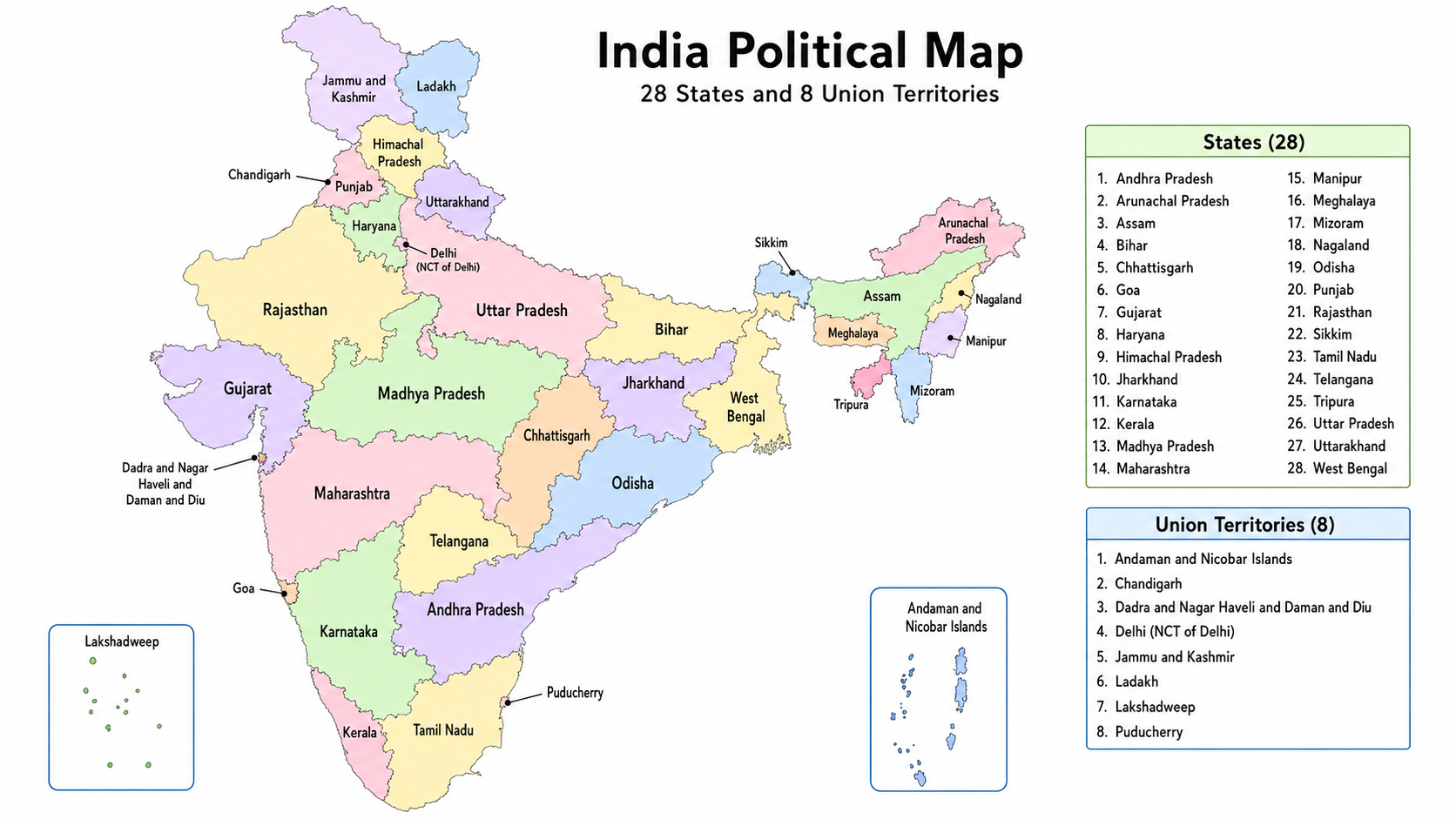
- वर्तमान में भारत में 28 States और 8 Union Territories हैं।
- आठ संघ राज्य-क्षेत्र हैं—Andaman & Nicobar Islands, Chandigarh, Dadra & Nagar Haveli and Daman & Diu, Delhi, Jammu & Kashmir, Ladakh, Lakshadweep और Puducherry।
- वर्तमान में Delhi, Puducherry और Jammu & Kashmir वे तीन Union Territories हैं जिनकी Legislative Assemblies हैं।
- शेष पाँच Union Territories में Legislative Assembly नहीं है।
- अनुच्छेद 2 नए राज्यों के admission अथवा establishment से संबंधित है।
- अनुच्छेद 2 के अंतर्गत Parliament किसी नए State को Union में admit कर सकती है।
- Parliament अनुच्छेद 2 के अंतर्गत नया State establish भी कर सकती है।
- अनुच्छेद 2 के तहत Parliament admission या establishment के लिए terms and conditions निर्धारित कर सकती है।
- अनुच्छेद 3 मौजूदा भारतीय राज्य-क्षेत्र के पुनर्गठन की व्यापक शक्ति Parliament को देता है।
- Parliament किसी State के territory को अलग करके नया State बना सकती है।
- Parliament दो या अधिक States को मिलाकर नया State बना सकती है।
- Parliament दो या अधिक States के parts को मिलाकर भी नया State बना सकती है।
- Parliament किसी territory को किसी State के भाग के साथ मिलाकर नया State बना सकती है।
- Parliament किसी State का area बढ़ा सकती है।
- Parliament किसी State का area घटा सकती है।
- Parliament किसी State की boundaries बदल सकती है।
- Parliament किसी State का name बदल सकती है।
- अनुच्छेद 3 के उद्देश्य वाला Bill President की recommendation के बिना Parliament में introduce नहीं किया जा सकता।
- Article 3 Bill Lok Sabha या Rajya Sabha—किसी भी House में introduce किया जा सकता है।
- यदि प्रस्ताव किसी State के area, boundary या name को प्रभावित करता है, तो President उसे संबंधित State Legislature के विचार हेतु भेजता है।
- State Legislature को अपनी views देने के लिए President एक निश्चित अवधि निर्धारित करता है।
- President State Legislature को views देने के लिए दी गई अवधि को आगे बढ़ा सकता है।
- Article 3 में State Legislature से “views” मांगी जाती हैं; constitutional text “consent” शब्द का प्रयोग नहीं करता।
- Article 3 की Explanation I में clauses (a) से (e) के लिए “State” में Union Territory भी शामिल है।
- लेकिन Article 3 के proviso में “State” के भीतर Union Territory शामिल नहीं है।
- Article 3 की Explanation II Parliament को State या Union Territory के किसी भाग को दूसरे State या UT से मिलाकर नया State/UT बनाने की शक्ति स्पष्ट करती है।
- अनुच्छेद 4 Articles 2 और 3 के तहत बनाए गए कानूनों के consequential effects से संबंधित है।
- Article 2 या 3 के कानून से First Schedule में आवश्यक संशोधन किया जा सकता है।
- Article 2 या 3 के कानून से Fourth Schedule में भी आवश्यक संशोधन किया जा सकता है।
- Fourth Schedule का संबंध Rajya Sabha में seats के allocation से है।
- Article 4 के तहत supplemental, incidental और consequential provisions भी बनाए जा सकते हैं।
- State reorganisation law Parliament में representation संबंधी consequential provisions भी कर सकता है।
- ऐसा कानून प्रभावित State Legislature की representation से संबंधित provisions भी कर सकता है।
- Article 4(2) स्पष्ट करता है कि Article 2 या 3 के अंतर्गत ऐसा कानून Article 368 के उद्देश्य से Constitutional Amendment नहीं माना जाएगा।
- इसलिए State reorganisation के लिए प्रत्येक बार Article 368 की special amendment procedure आवश्यक नहीं होती।
- Article 3 के कानून सामान्य legislative process के माध्यम से पारित किए जाते हैं।
- Article 3 Bill के लिए States द्वारा Article 368 वाली ratification आवश्यक नहीं है।
- 35th Constitutional Amendment, 1974 ने Article 2A जोड़ा था।
- Article 2A Sikkim को Union के साथ associate करने से संबंधित था।
- 36th Constitutional Amendment, 1975 ने Article 2A को omit कर दिया।
- 36th Constitutional Amendment द्वारा Sikkim को भारत का पूर्ण State बनाया गया।
- Article 2A का omission 26 April 1975 से प्रभावी हुआ।
- 5th Constitutional Amendment, 1955 ने Article 3 के proviso में परिवर्तन किया।
- 18th Constitutional Amendment, 1966 ने Article 3 में Explanations I और II जोड़ीं।
- 7th Constitutional Amendment, 1956 ने Union और States की constitutional territorial scheme में बड़े परिवर्तन किए।
- Andhra State Act, 1953 के तहत Andhra State का appointed day 1 October 1953 था।
- States Reorganisation Act, 1956 भारत के राज्यों के व्यापक पुनर्गठन से संबंधित प्रमुख कानून है।
- States Reorganisation Act, 1956 के तहत Kerala का गठन और अनेक राज्यों के territorial changes किए गए।
- Supreme Court की Berubari principle के अनुसार भारतीय territory का किसी foreign State को cession केवल Article 3 से नहीं किया जा सकता।
- Indian territory के cession के लिए constitutional amendment की आवश्यकता पड़ती है।
- लेकिन वास्तविक और अनिश्चित international boundary को निर्धारित करने वाला settlement प्रत्येक स्थिति में “cession” नहीं माना जाता।
- Madhya Pradesh Reorganisation Act, 2000 के तहत Chhattisgarh 1 November 2000 से अस्तित्व में आया।
- Uttar Pradesh Reorganisation Act, 2000 के तहत Uttaranchal 9 November 2000 से अस्तित्व में आया।
- Uttaranchal का नाम बाद में Uttarakhand कर दिया गया।
- Bihar Reorganisation Act, 2000 के तहत Jharkhand 15 November 2000 से अस्तित्व में आया।
- Andhra Pradesh Reorganisation Act, 2014 के तहत Telangana 2 June 2014 से अस्तित्व में आया।
- Jammu and Kashmir Reorganisation Act, 2019 ने तत्कालीन State of Jammu and Kashmir का पुनर्गठन किया।
- 31 October 2019 से Union Territory of Jammu & Kashmir और Union Territory of Ladakh अस्तित्व में आए।
- Jammu & Kashmir एक Legislature वाला Union Territory है, जबकि Ladakh Legislature रहित Union Territory है।
- Dadra and Nagar Haveli तथा Daman and Diu को 2019 के Merger Act द्वारा एक Union Territory में मिलाया गया।
- इन दोनों Union Territories का merger 26 January 2020 से प्रभावी हुआ।
- वर्तमान संयुक्त Union Territory का नाम Dadra and Nagar Haveli and Daman and Diu है।
- किसी State का constitutional name और territory जानने का primary constitutional reference First Schedule है।
- State reorganisation और constitutional amendment एक ही चीज नहीं हैं; Article 4 इस distinction को स्पष्ट करता है।
B. Citizenship under the Constitution | संविधान के अंतर्गत नागरिकता
- भारतीय संविधान का Part II Citizenship से संबंधित है।
- Part II में Articles 5 से 11 तक शामिल हैं।
- Articles 5 से 9 मुख्यतः संविधान के commencement के समय नागरिकता तय करने से संबंधित थे।
- Article 10 ऐसी citizenship की continuance से संबंधित है।
- Article 11 Parliament की citizenship संबंधी legislative power को सुरक्षित करता है।
- Article 5 Constitution के commencement पर citizenship की सामान्य व्यवस्था देता है।
- Article 5 में domicile in the territory of India एक अनिवार्य आधार है।
- केवल भारत में जन्म लेना Article 5 के लिए पर्याप्त नहीं था; domicile की requirement भी लागू होती थी।
- Domicile के साथ भारत में जन्म Article 5 का एक qualifying ground था।
- Domicile के साथ माता या पिता में से किसी एक का भारत में जन्म दूसरा qualifying ground था।
- Domicile के साथ Constitution के commencement से ठीक पहले कम-से-कम पाँच वर्ष की ordinary residence तीसरा qualifying ground था।
- Article 5 में domicile के साथ तीन alternative conditions में से किसी एक की पूर्ति आवश्यक थी।
- Article 6 Pakistan से India migrate करने वाले कुछ व्यक्तियों की citizenship से संबंधित है।
- Article 6 के लिए व्यक्ति या उसके parent/grandparent में से किसी का Government of India Act, 1935 के अनुसार India में जन्म होना relevant था।
- Article 6 में 19 July 1948 एक महत्वपूर्ण cut-off date है।
- 19 July 1948 से पहले India आए qualifying migrant को migration के बाद से ordinarily resident होना आवश्यक था।
- 19 July 1948 या उसके बाद India आए qualifying migrant के लिए registration की व्यवस्था थी।
- ऐसा registration Constitution के commencement से पहले application के आधार पर होना था।
- Article 6 के registration के लिए application से ठीक पहले कम-से-कम six months residence आवश्यक थी।
- Article 7 India से Pakistan migrate करने वाले कुछ व्यक्तियों से संबंधित है।
- 1 March 1947 के बाद India से Pakistan migrate करने वाला व्यक्ति सामान्यतः Articles 5 और 6 के आधार पर citizen नहीं माना गया।
- Article 7 में resettlement या permanent return permit वाला एक महत्वपूर्ण exception दिया गया है।
- ऐसे permit पर India लौटने वाले व्यक्ति को Article 6(b) के लिए 19 July 1948 के बाद India migrate किया हुआ माना जाता है।
- Article 8 India के बाहर रहने वाले persons of Indian origin से संबंधित है।
- Article 8 में व्यक्ति, parent या grandparent का Government of India Act, 1935 के अनुसार India में जन्म relevant है।
- Article 8 के अंतर्गत citizenship के लिए Indian diplomatic या consular representative द्वारा registration आवश्यक था।
- Article 8 की application Constitution के commencement से पहले या बाद में भी की जा सकती थी।
- Article 9 voluntary acquisition of foreign citizenship से संबंधित है।
- Article 9 के अनुसार voluntarily foreign citizenship लेने वाला व्यक्ति Articles 5, 6 या 8 के आधार पर Indian citizen नहीं रह सकता।
- Article 9 विशेष रूप से Articles 5, 6 और 8 को refer करता है।
- Article 10 Part II के तहत प्राप्त citizenship को continue करता है।
- Article 10 की continuance Parliament द्वारा बनाए गए citizenship law के अधीन है।
- Article 11 Parliament को citizenship के acquisition और termination पर law बनाने की शक्ति देता है।
- Article 11 Parliament को citizenship से संबंधित all other matters पर भी legislation की शक्ति देता है।
- Constitution ने post-commencement citizenship की पूरी statutory scheme स्वयं निर्धारित नहीं की।
- Post-commencement citizenship को regulate करने के लिए Parliament ने Citizenship Act, 1955 बनाया।
- Citizenship, naturalisation and aliens Union List की Entry 17 में आते हैं।
- इसलिए citizenship पर legislative competence मुख्यतः Parliament के पास है।
- भारतीय constitutional scheme single citizenship को अपनाती है।
- भारत में Union citizenship से अलग कोई स्वतंत्र “State citizenship” constitutional status नहीं है।
- Part II और Citizenship Act, 1955 को एक ही चीज नहीं समझना चाहिए।
- Part II मुख्यतः commencement-time citizenship बताता है, जबकि Citizenship Act आगे की acquisition और termination को regulate करता है।
- Article 5 का “domicile” और केवल temporary residence एक समान अवधारणाएँ नहीं हैं।
- Articles 6 और 7 में 19 July 1948 और 1 March 1947 अलग-अलग महत्वपूर्ण dates हैं।
- Citizenship के constitutional questions में Articles 5–11 को Citizenship Act के साथ पढ़ना आवश्यक है।
C. Citizenship Act, 1955 | नागरिकता अधिनियम, 1955
- Citizenship Act, 1955 Act No. 57 of 1955 है।
- Citizenship Act, 1955 को 30 December 1955 को enacted किया गया था।
- इस Act का उद्देश्य Indian citizenship के acquisition और determination के लिए statutory framework देना है।
- Citizenship Act citizenship प्राप्त करने के पाँच प्रमुख modes प्रदान करता है।
- ये modes हैं—Birth, Descent, Registration, Naturalisation और Incorporation of Territory।
- Section 3 citizenship by birth से संबंधित है।
- 26 January 1950 से पहले 1 July 1987 तक India में जन्मा व्यक्ति, statutory exceptions को छोड़कर, citizen by birth था।
- Section 3 में foreign diplomatic envoy से संबंधित एक exception है।
- Enemy alien parent और enemy-occupied place में birth भी Section 3 का statutory exception हो सकता है।
- 1 July 1987 से 3 December 2004 से पहले जन्म के लिए माता-पिता में से कम-से-कम एक का Indian citizen होना आवश्यक था।
- 3 December 2004 से लागू व्यवस्था में जन्म के समय दोनों parents Indian citizens हों तो citizenship by birth मिल सकती है।
- 3 December 2004 से लागू व्यवस्था में एक parent Indian citizen और दूसरा illegal migrant न हो, तब भी citizenship by birth मिल सकती है।
- Citizenship Act में “illegal migrant” की statutory definition दी गई है।
- Valid passport/travel documents के बिना India में प्रवेश करने वाला foreigner statutory conditions में illegal migrant हो सकता है।
- Valid documents से प्रवेश करके permitted period से अधिक रहने वाला foreigner भी illegal migrant की definition में आ सकता है।
- Section 4 citizenship by descent से संबंधित है।
- 26 January 1950 से 10 December 1992 से पहले India के बाहर जन्मे व्यक्ति के मामले में पिता की citizenship relevant थी।
- 10 December 1992 या उसके बाद India के बाहर जन्मे व्यक्ति के लिए माता या पिता में से किसी एक की Indian citizenship relevant है।
- 3 December 2004 से लागू व्यवस्था में citizenship by descent के लिए overseas birth की Indian Consulate में registration महत्वपूर्ण है।
- सामान्यतः ऐसी birth registration एक वर्ष के भीतर की जानी होती है।
- निर्धारित period के बाद Central Government की permission से registration संभव हो सकती है।
- Post-2004 consular registration के लिए parents को minor के foreign passport संबंधी statutory declaration देना होता है।
- Citizenship by descent वाला minor यदि किसी अन्य country का भी citizen है, तो full age के बाद उसके लिए विशेष renunciation rule लागू होता है।
- वह दूसरे देश की citizenship/nationality को full age पाने के छह महीने के भीतर renounce न करे तो उसकी Indian citizenship समाप्त हो सकती है।
- Section 5 citizenship by registration से संबंधित है।
- Section 5 के तहत registration automatic नहीं है; statutory application और conditions आवश्यक हैं।
- Person of Indian origin जो India में निर्धारित अवधि से ordinarily resident है, registration के लिए eligible category हो सकता है।
- Section 5 में ऐसी category के लिए सामान्यतः seven years ordinary residence का requirement है।
- Undivided India के बाहर ordinarily resident person of Indian origin भी Section 5 की एक category है।
- Indian citizen से married person के लिए भी Section 5 में registration का route है।
- ऐसे spouse के लिए सामान्यतः India में seven years ordinary residence requirement लागू होती है।
- Indian citizens के minor children Section 5 की अलग eligible category हैं।
- कुछ persons जिनके parents Indian citizens के रूप में registered हैं, Section 5 के तहत eligible हो सकते हैं।
- पूर्व में independent India का citizen रहा व्यक्ति या उसके qualifying parent से संबंधित category भी Section 5 में है।
- ऐसी former-citizen category के लिए application से पहले 12 months ordinary residence relevant है।
- OCI Cardholder पाँच वर्ष के registration और application से पहले 12 months ordinary residence के बाद Section 5 route का उपयोग कर सकता है।
- Section 5 की कुछ categories में “seven years” का अर्थ immediately preceding 12 months + उससे पहले के आठ वर्षों में aggregate छह वर्ष residence है।
- Full-age person को Section 5 registration से पहले prescribed Oath of Allegiance लेना होता है।
- Section 6 citizenship by naturalisation से संबंधित है।
- सामान्य naturalisation applicant full age और capacity वाला होना चाहिए।
- सामान्यतः illegal migrant Section 6 के तहत naturalisation route का उपयोग नहीं कर सकता।
- Naturalisation की qualifications Third Schedule में दी गई हैं।
- General rule में application से immediately preceding 12 months residence/service requirement है।
- उससे पहले के 14 वर्षों में aggregate 11 years residence/service का general requirement है।
- Naturalisation applicant का good character होना एक statutory qualification है।
- Applicant को Eighth Schedule में निर्दिष्ट किसी language का adequate knowledge होना चाहिए।
- Naturalisation के लिए India में reside करने अथवा qualifying service जारी रखने की intention भी relevant है।
- Applicant से foreign citizenship renounce करने का undertaking भी statutory scheme का हिस्सा है।
- Special circumstances में Central Government immediately preceding 12-month requirement को अधिकतम 30 days तक relax कर सकती है।
- Science, philosophy, art, literature, world peace या human progress में distinguished service वाले applicant के लिए Central Government qualifications waive कर सकती है।
- Naturalisation certificate मिलने के बाद prescribed Oath of Allegiance लेना आवश्यक है।
- Section 7 citizenship by incorporation of territory से संबंधित है।
- यदि कोई territory India का हिस्सा बनता है, Central Government Gazette order द्वारा उससे जुड़े persons की citizenship निर्धारित कर सकती है।
- ऐसे persons की citizenship Government order में specified date से प्रभावी होती है।
- Citizenship Act citizenship समाप्त होने के तीन प्रमुख statutory modes प्रदान करता है।
- ये हैं—Renunciation, Termination और Deprivation।
- Section 8 renunciation of citizenship से संबंधित है।
- Full age और capacity वाला Indian citizen prescribed declaration द्वारा citizenship renounce कर सकता है।
- Renunciation declaration registration के बाद citizenship समाप्त होती है।
- India के war में engaged होने की स्थिति में renunciation declaration की registration को रोका जा सकता है।
- Parent की Section 8 renunciation से उसका minor child भी Indian citizenship खो सकता है।
- ऐसा minor full age प्राप्त करने के एक वर्ष के भीतर declaration देकर Indian citizenship resume कर सकता है।
- Section 9 voluntary acquisition of foreign citizenship के कारण termination से संबंधित है।
- Indian citizen द्वारा दूसरे country की citizenship voluntarily acquire करने पर Section 9 लागू हो सकता है।
- Section 9 में India के war में engaged होने की स्थिति के लिए विशेष proviso है।
- किसी foreign citizenship को कब और कैसे acquire किया गया, इस प्रश्न का determination prescribed authority/rules के अनुसार होता है।
- Section 10 deprivation of citizenship से संबंधित है।
- Section 10 सभी citizens पर identical manner में लागू नहीं होता; statute specified categories बताता है।
- Fraud, false representation या material fact concealment deprivation का statutory ground है।
- Constitution के प्रति disloyalty या disaffection भी specified ground है।
- War के दौरान enemy के साथ unlawful trade/communication भी deprivation ground हो सकता है।
- Registration या naturalisation के पाँच वर्ष के भीतर कम-से-कम दो वर्ष की imprisonment specified circumstances में deprivation ground हो सकती है।
- लगातार सात वर्ष India से बाहर ordinary residence भी statutory conditions के अधीन deprivation ground हो सकती है।
- Section 10 deprivation के लिए public good और procedural safeguards का भी प्रावधान करता है।
- Section 13 citizenship पर doubt होने की स्थिति में Central Government द्वारा certificate जारी करने से संबंधित है।
- Section 14 Sections 5, 6 और 7A की applications के disposal से संबंधित है।
- Section 14 के तहत prescribed authority/Central Government grant या refusal में statutory discretion रखती है और Act reasons assign करना अनिवार्य नहीं करता।
- Section 14A Central Government को citizens की compulsory registration और national identity card संबंधी statutory power देता है।
- Section 14A Central Government को National Register of Indian Citizens maintain करने और National Registration Authority स्थापित करने की शक्ति देता है।
- Section 14A के तहत Registrar General, India National Registration Authority के रूप में कार्य करता है।
D. Assam Accord, CAA & OCI
- Section 6A Assam Accord से covered persons के लिए special citizenship provisions देता है।
- Section 6A Citizenship (Amendment) Act, 1985 द्वारा जोड़ा गया था।
- Section 6A में “specified territory” का अर्थ तत्कालीन Bangladesh के territories से है।
- 1 January 1966 से पहले specified territory से Assam आए qualifying persons के लिए विशेष citizenship rule है।
- आवश्यक conditions पूरी करने वाला ऐसा person 1 January 1966 से citizen deemed किया जाता है।
- 1 January 1966 या उसके बाद लेकिन 25 March 1971 से पहले Assam आए qualifying persons के लिए अलग व्यवस्था है।
- ऐसे person के लिए ordinary residence और “detected to be a foreigner” जैसी statutory conditions relevant हैं।
- Section 6A(3) के qualifying person को prescribed authority के सामने registration करना होता है।
- Detection के समय electoral roll में उसका नाम हो तो statutory scheme के तहत नाम हटाया जाता है।
- Registration के बाद ten-year period के दौरान उसे अधिकांश citizen rights मिलते हैं, लेकिन electoral roll में inclusion का अधिकार नहीं मिलता।
- Ten-year period समाप्त होने के बाद qualifying registered person को all purposes के लिए citizen माना जाता है।
- Supreme Court की Constitution Bench ने Section 6A से संबंधित constitutional challenge पर In Re: Section 6A of the Citizenship Act, 1955, 2024 INSC 789 में निर्णय दिया।
- Citizenship (Amendment) Act, 2019 Act No. 47 of 2019 है।
- Citizenship (Amendment) Act, 2019 को Presidential assent 12 December 2019 को प्राप्त हुआ।
- CAA 2019 के संबंधित statutory amendments 10 January 2020 से प्रभावी हुए।
- CAA proviso छह communities को specifically refer करता है—Hindu, Sikh, Buddhist, Jain, Parsi और Christian।
- ये statutory provisions Afghanistan, Bangladesh और Pakistan से आए specified persons से संबंधित हैं।
- CAA proviso में relevant entry cut-off 31 December 2014 है।
- केवल specified community और country पर्याप्त नहीं; statutory exemption conditions भी पूरी होनी चाहिए।
- Qualifying person को Passport (Entry into India) Act/Foreigners Act framework के तहत prescribed exemption category में होना आवश्यक है।
- ऐसे qualifying persons को Citizenship Act के उद्देश्य से “illegal migrant” नहीं माना जाता।
- CAA description में आने मात्र से citizenship स्वतः प्रदान नहीं हो जाती।
- Section 6B के तहत application और statutory process आवश्यक है।
- Section 6B के तहत certificate of registration या certificate of naturalisation प्रदान किया जा सकता है।
- Section 6B applicant के लिए Section 5 अथवा Third Schedule की applicable statutory conditions relevant रहती हैं।
- Section 6B के तहत citizenship grant होने पर व्यक्ति को उसकी India में entry की date से citizen deemed किया जाता है।
- Citizenship confer होने पर qualifying pending illegal-migration/citizenship proceeding के abatement का Section 6B में प्रावधान है।
- Section 6B Assam, Meghalaya, Mizoram और Tripura के Sixth Schedule tribal areas पर लागू नहीं होता।
- Section 6B notified Inner Line areas पर भी लागू नहीं होता।
- CAA-specified communities from the three specified countries के लिए naturalisation के aggregate residence/service requirement को 11 years के स्थान पर 5 years पढ़ा जाता है।
- Citizenship (Amendment) Rules, 2024 को 11 March 2024 को notified किया गया।
- ये Rules Section 6B के citizenship application process को operational framework प्रदान करते हैं।
- Section 7A Overseas Citizen of India Cardholder की registration से संबंधित है।
- OCI Cardholder होना Indian citizenship के समान नहीं है।
- ऐसा foreign citizen जो Constitution के commencement पर या उसके बाद कभी Indian citizen था, OCI eligibility की category में आ सकता है।
- Constitution के commencement पर Indian citizenship के लिए eligible रहा foreign citizen भी qualifying category में आ सकता है।
- 15 August 1947 के बाद India का भाग बने territory से संबंधित qualifying person भी OCI route में आ सकता है।
- Eligible person का child, grandchild या great-grandchild भी statutory conditions में OCI category में आ सकता है।
- Qualifying person का minor child OCI registration के लिए eligible category हो सकता है।
- Indian citizen parent वाला qualifying minor भी Section 7A में covered category हो सकता है।
- Indian citizen अथवा OCI Cardholder के foreign-origin spouse के लिए भी OCI route उपलब्ध है।
- ऐसे spouse का marriage registered और application से immediately preceding कम-से-कम two years continuously subsisting होना चाहिए।
- Foreign-origin spouse की OCI eligibility prior security clearance के अधीन है।
- जिस person या उसके parent/grandparent/great-grandparent में से कोई Pakistan या Bangladesh का citizen रहा हो, वह सामान्यतः Section 7A के तहत OCI registration के लिए eligible नहीं है।
- Central Government अन्य country को भी statutory notification द्वारा इस exclusion में specify कर सकती है।
- Existing PIO Cardholders को notification द्वारा OCI Cardholders deemed करने की statutory व्यवस्था भी Section 7A में है।
- OCI Cardholder को Section 7B के तहत Government notification द्वारा specified rights दिए जा सकते हैं।
- OCI Cardholder को Indian citizen वाला right to vote प्राप्त नहीं है।
- OCI Cardholder President या Vice-President के election के लिए citizen वाला eligibility right नहीं रखता।
- OCI Cardholder Supreme Court या High Court Judge के appointment के लिए citizen वाला statutory entitlement नहीं रखता।
- OCI Cardholder Lok Sabha या Rajya Sabha membership के लिए citizen वाला eligibility right नहीं रखता।
- OCI Cardholder State Legislature membership के लिए citizen वाला eligibility right नहीं रखता।
- OCI Cardholder Article 16 के तहत public-employment वाला citizen right नहीं रखता, subject to statutory Government specification.
- Section 7C OCI Card के renunciation से संबंधित है।
- OCI Cardholder के renunciation का effect certain foreign-origin spouse और minor children पर भी पड़ सकता है।
- Section 7D OCI registration के cancellation से संबंधित है।
- Fraud या false representation से OCI registration प्राप्त करना cancellation ground है।
- Constitution के प्रति disaffection OCI cancellation का statutory ground हो सकता है।
- Specified criminal conviction और national-security/public-interest grounds भी Section 7D में दिए गए हैं।
- Foreign-spouse category में marriage dissolution या subsisting marriage के दौरान another marriage भी statutory cancellation ground हो सकता है।
- Section 7D के तहत cancellation order से पहले OCI Cardholder को reasonable opportunity of being heard देना आवश्यक है।
- OCI को “dual citizenship” समझना exam में गलत हो सकता है; OCI एक अलग statutory status है।
- Citizenship by birth और citizenship by descent को अलग करने का सबसे सरल rule है—birth in India बनाम birth outside India।
- Constitutional Articles 5–11 और Citizenship Act के Sections 3–10 की dates को अलग-अलग याद रखना आवश्यक है।
- Article 9 और Section 9 समान नहीं हैं—Article 9 commencement-related constitutional bar है, जबकि Section 9 statutory termination mechanism है।
- Article 11 Parliament की citizenship law बनाने की constitutional foundation है।
- Citizenship Act की Section 6B और Section 6A अलग-अलग statutory schemes हैं।
- Section 6A का विशेष संबंध Assam Accord से है।
- Section 6B का विशेष संबंध CAA 2019 specified category से है।
- OCI Cardholder और Indian citizen के political rights समान नहीं हैं।
- Citizenship और passport को पूर्णतः समान legal concept नहीं समझना चाहिए।
- Citizenship acquisition के लिए केवल India में long residence प्रत्येक case में अपने-आप citizenship नहीं देता; prescribed statutory mode आवश्यक है।
- Naturalisation और registration दो अलग statutory modes हैं।
- Citizenship by incorporation of territory का statutory source Section 7 है, जबकि territory का constitutional framework Articles 1–4 में है।
- Union & Territory और Citizenship को जोड़ने वाला महत्वपूर्ण conceptual link यह है कि territory बदलने पर citizenship consequences के लिए Parliament/statutory law की भूमिका महत्वपूर्ण हो सकती है।
Fundamental Rights
मौलिक अधिकार
A. General Provisions Articles 12–13
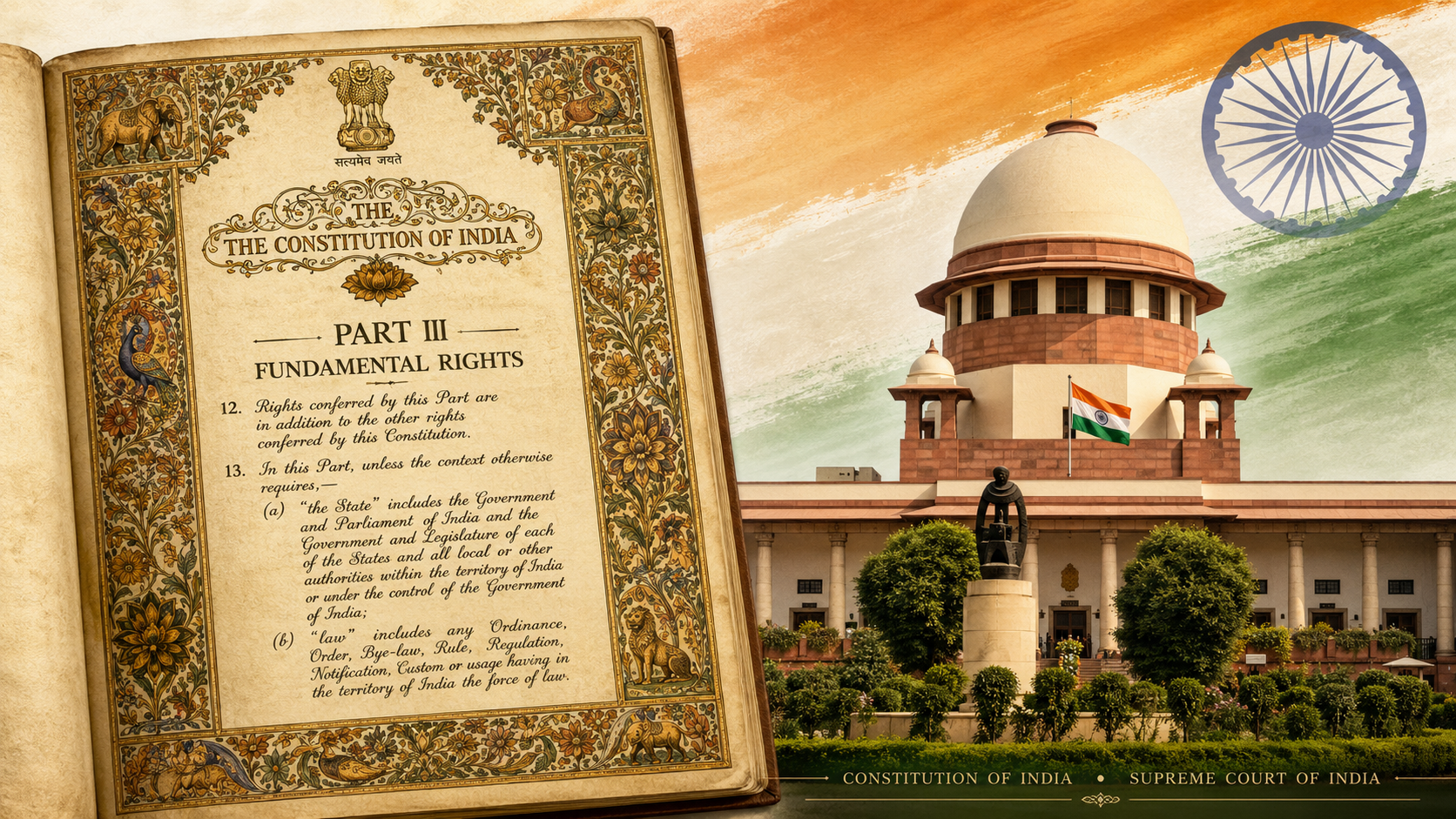
- भारतीय संविधान का Part III Fundamental Rights से संबंधित है।
- Part III में Articles 12 से 35 शामिल हैं।
- Fundamental Rights न्यायालय द्वारा enforce किए जा सकते हैं।
- Article 12 Part III के लिए “State” की परिभाषा देता है।
- Article 12 में Government of India शामिल है।
- Article 12 में Parliament of India शामिल है।
- Article 12 में प्रत्येक State की Government शामिल है।
- Article 12 में प्रत्येक State Legislature शामिल है।
- Article 12 में India के territory के भीतर local authorities भी शामिल हैं।
- Government of India के control में आने वाली other authorities भी Article 12 के दायरे में आ सकती हैं।
- Article 13 Fundamental Rights के विपरीत laws से संबंधित है।
- Pre-Constitution law Fundamental Rights से inconsistent होने पर inconsistency की सीमा तक void होता है।
- Article 13(2) State को Fundamental Rights छीनने या abridge करने वाला law बनाने से रोकता है।
- Article 13 के तहत पूरा law हमेशा void होना आवश्यक नहीं; केवल unconstitutional portion void हो सकता है।
- इसी विचार से Doctrine of Severability जुड़ा है।
- Pre-Constitution laws के संदर्भ में Doctrine of Eclipse का विशेष महत्व है।
- Article 13 में “law” में Ordinance भी शामिल है।
- Article 13 में order भी “law” हो सकता है।
- Bye-law, rule और regulation भी Article 13 के “law” में शामिल हैं।
- Notification भी Article 13 के अंतर्गत law हो सकती है।
- Legal force रखने वाला custom या usage भी Article 13 में law के अंतर्गत आ सकता है।
- Article 13(4) के अनुसार Article 368 के तहत Constitutional Amendment पर Article 13 लागू नहीं होता।
- Article 13(4) को 24th Constitutional Amendment Act, 1971 द्वारा जोड़ा गया था।
- Constitutional Amendment Article 13 से बाहर होने के बावजूद Basic Structure Doctrine के अधीन है।
- Fundamental Rights constitutional limitations on State power का महत्वपूर्ण माध्यम हैं।
B. Article 14 | Right to Equality
- Article 14 equality before law और equal protection of laws की guarantee देता है।
- Article 14 का लाभ केवल citizens तक सीमित नहीं है; यह any person को उपलब्ध है।
- Foreigners भी Article 14 की protection claim कर सकते हैं।
- “Equality before law” negative concept के रूप में unequal privilege के absence को दर्शाता है।
- “Equal protection of laws” similarly situated persons के समान treatment से जुड़ा है।
- Article 14 का अर्थ प्रत्येक व्यक्ति के साथ हर परिस्थिति में identical treatment नहीं है।
- Article 14 reasonable classification की अनुमति देता है।
- Reasonable classification के लिए intelligible differentia आवश्यक है।
- उस differentia का legislative object से rational nexus होना चाहिए।
- Class legislation prohibited है, लेकिन reasonable classification prohibited नहीं है।
- Arbitrary State action Article 14 की scrutiny में आ सकता है।
- Supreme Court ने Article 14 को केवल formal equality तक सीमित नहीं रखा है।
- Substantive equality का उद्देश्य वास्तविक और systemic disadvantage को address करना भी है।
- State action fair, reasonable और non-arbitrary होना चाहिए।
- Article 14 Rule of Law से निकटता से जुड़ा constitutional guarantee है।
C. Articles 15–18 | Equality & Non-Discrimination
- Article 15(1) केवल citizens के विरुद्ध specified grounds पर State discrimination को रोकता है।
- Article 15(1) में religion एक prohibited ground है।
- Race Article 15(1) का prohibited ground है।
- Caste Article 15(1) का prohibited ground है।
- Sex Article 15(1) का prohibited ground है।
- Place of birth Article 15(1) का prohibited ground है।
- Article 15(1) में residence expressly prohibited ground नहीं है।
- Article 16(2) में residence expressly शामिल है।
- Article 15(2) shops और public restaurants के access से भी संबंधित है।
- Article 15(2) hotels और places of public entertainment तक access को protect करता है।
- State-funded या general public के लिए dedicated wells और tanks Article 15(2) में covered हैं।
- Bathing ghats, roads और public resorts भी Article 15(2) के दायरे में आ सकते हैं।
- Article 15(3) State को women और children के लिए special provisions बनाने की अनुमति देता है।
- Article 15(4) socially and educationally backward classes के advancement से संबंधित है।
- Article 15(4) Scheduled Castes और Scheduled Tribes के लिए special provisions की अनुमति देता है।
- Article 15(4) First Constitutional Amendment, 1951 से जोड़ा गया था।
- Article 15(5) educational admissions में special provisions से संबंधित है।
- Article 15(5) aided तथा unaided private educational institutions तक extend कर सकता है।
- Article 15(5) Article 30(1) वाले minority educational institutions को exclude करता है।
- Article 15(5) 93rd Constitutional Amendment द्वारा जोड़ा गया था।
- Article 15(6) Economically Weaker Sections यानी EWS से संबंधित है।
- Article 15(6) उन EWS citizens के लिए है जो Article 15(4) और 15(5) वाली classes में नहीं आते।
- Article 15(6) educational institutions में EWS reservation की constitutional basis देता है।
- EWS reservation existing reservation के अतिरिक्त हो सकता है।
- Article 15(6) के तहत reservation अधिकतम 10% of seats in each category तक हो सकता है।
- Article 15(6) Article 30(1) minority institutions को exclude करता है।
- EWS की पहचान family income और अन्य economic disadvantage indicators के आधार पर की जा सकती है।
- Article 15(6) 103rd Constitutional Amendment Act, 2019 द्वारा जोड़ा गया।
- Article 16 public employment में equality of opportunity से संबंधित है।
- Article 16(1) केवल citizens को protection देता है।
- Article 16(2) में descent एक prohibited ground है।
- Article 16(2) में residence भी prohibited ground है।
- Article 16(3) Parliament को certain employment के लिए residence requirement prescribe करने की शक्ति देता है।
- Article 16(4) inadequately represented backward classes के लिए reservation की अनुमति देता है।
- Article 16(4A) SC/ST के लिए promotion में reservation की constitutional enabling provision है।
- Article 16(4A) में consequential seniority का provision भी शामिल है।
- Article 16(4B) carry-forward reserved vacancies से संबंधित है।
- Article 16(6) EWS के लिए public employment reservation का आधार है।
- Article 16(6) के तहत EWS reservation अधिकतम 10% posts in each category तक हो सकता है।
- Article 15 और Article 16 equality के साथ affirmative action को भी constitutional recognition देते हैं।
- Article 17 Untouchability को abolish करता है।
- Article 17 untouchability की practice को किसी भी form में forbid करता है।
- Untouchability से उत्पन्न disability enforce करना punishable offence है।
- Article 17 की भाषा केवल State action तक सीमित नहीं है।
- Article 17 private persons के conduct पर भी प्रभाव डाल सकता है।
- Article 17 को enforce करने के लिए Parliament ने statutory laws बनाए हैं।
- Article 18 Abolition of Titles से संबंधित है।
- State military distinction प्रदान कर सकता है।
- State academic distinction भी प्रदान कर सकता है।
- Military और academic distinctions Article 18(1) के prohibition से बाहर हैं।
- Indian citizen किसी foreign State से title स्वीकार नहीं कर सकता।
- Non-citizen यदि State के office of profit or trust में है तो foreign title के लिए President की consent आवश्यक है।
- State के office of profit or trust वाला person foreign State से present या emolument President की consent के बिना स्वीकार नहीं कर सकता।
- Article 18 hereditary/artificial titles की constitutional culture के विरुद्ध है।
- Equality Code के core Articles सामान्यतः Articles 14, 15 और 16 को माना जाता है।
D. Article 19 | Six Freedoms
- Article 19 के rights केवल citizens को उपलब्ध हैं।
- Article 19(1)(a) freedom of speech and expression देता है।
- Article 19(1)(b) peaceably and without arms assemble करने का right देता है।
- Article 19(1)(c) associations या unions बनाने का right देता है।
- Article 19(1)(c) में co-operative societies भी शामिल हैं।
- Article 19(1)(d) पूरे India में freely move करने का right देता है।
- Article 19(1)(e) India के किसी भाग में reside और settle करने का right देता है।
- Article 19(1)(g) profession practice करने का right देता है।
- Article 19(1)(g) occupation, trade और business करने का right भी protect करता है।
- वर्तमान Article 19 में कुल six freedoms operative हैं।
- Original Article 19(1)(f) property acquire, hold और dispose करने से संबंधित था।
- Article 19(1)(f) को 44th Constitutional Amendment द्वारा omit किया गया।
- Freedom of Press को Constitution में अलग Article के रूप में नहीं लिखा गया है।
- Freedom of Press को Article 19(1)(a) के protection में judicially recognised किया गया है।
- Article 19 rights absolute नहीं हैं।
- Article 19 restrictions Constitution में expressly specified grounds पर आधारित होने चाहिए।
- Restrictions का reasonable होना आवश्यक है।
- Speech पर restriction और assembly पर restriction के grounds identical नहीं हैं।
- Associations पर restriction के grounds भी अलग constitutional clause में हैं।
- Profession/business पर reasonable restrictions Article 19(6) में governed हैं।
- Article 19(2) speech and expression पर reasonable restrictions से संबंधित है।
- Sovereignty and integrity of India Article 19(2) का ground है।
- Security of the State Article 19(2) का ground है।
- Friendly relations with foreign States Article 19(2) का ground है।
- Public order Article 19(2) का ground है।
- Decency Article 19(2) का ground है।
- Morality Article 19(2) का ground है।
- Contempt of court Article 19(2) का ground है।
- Defamation Article 19(2) का ground है।
- Incitement to an offence Article 19(2) का ground है।
- Article 19(3) peaceful assembly पर restrictions से संबंधित है।
- Article 19(3) में sovereignty and integrity of India एक ground है।
- Article 19(3) में public order दूसरा principal ground है।
- Article 19(4) associations/unions पर restrictions से संबंधित है।
- Article 19(4) sovereignty and integrity, public order और morality को recognise करता है।
- Article 19(5) movement और residence freedoms पर restrictions से संबंधित है।
- Article 19(5) general public interest में restrictions की अनुमति देता है।
- Article 19(5) Scheduled Tribe interests की protection के लिए भी restrictions की अनुमति देता है।
- Article 19(6) profession, occupation, trade और business पर reasonable restrictions allow करता है।
- Professional or technical qualifications Article 19(6) के तहत prescribe की जा सकती हैं।
- State monopoly भी Article 19(6) के constitutional framework में permissible हो सकता है।
- Shreya Singhal v. Union of India (2015) में Section 66A IT Act को unconstitutional घोषित किया गया।
- Shreya Singhal judgment ने discussion, advocacy और incitement के distinction को महत्व दिया।
- Anuradha Bhasin v. Union of India (2020) ने internet को speech और business exercise करने का important medium माना।
- Internet access itself को unrestricted absolute fundamental right घोषित नहीं किया गया।
- Internet के माध्यम से Article 19(1)(a) और 19(1)(g) rights का exercise constitutional protection प्राप्त कर सकता है।
- Restrictions on Article 19 freedoms proportionality और reasonableness scrutiny के अधीन हो सकती हैं।
E. Article 20 | Protection in Criminal Law
- Article 20 criminal conviction से संबंधित तीन important protections देता है।
- Article 20 का protection any person को उपलब्ध है।
- Article 20(1) ex post facto criminal law के विरुद्ध protection देता है।
- किसी act को बाद के law द्वारा retrospectively offence बनाकर conviction नहीं किया जा सकता।
- Offence के समय applicable penalty से अधिक retrospective penalty नहीं दी जा सकती।
- Article 20(1) का protection criminal liability के संदर्भ में है।
- Beneficial retrospective criminal law Article 20(1) के समान prohibition में नहीं आता।
- Article 20(2) constitutional protection against double jeopardy देता है।
- Article 20(2) कहता है कि same offence के लिए person को prosecuted and punished more than once नहीं किया जा सकता।
- Article 20(2) में शब्द “prosecuted and punished” दोनों महत्वपूर्ण हैं।
- केवल departmental proceeding हर situation में Article 20(2) की prosecution नहीं होती।
- Same facts से अलग ingredients वाले distinct offences उत्पन्न हो सकते हैं।
- अलग offences होने पर Article 20(2) का bar automatically लागू नहीं होता।
- Article 20(3) protection against self-incrimination देता है।
- Article 20(3) केवल person accused of an offence को protection देता है।
- Accused को स्वयं के विरुद्ध witness बनने के लिए compel नहीं किया जा सकता।
- Article 20(3) में compulsion महत्वपूर्ण element है।
- Testimonial compulsion और physical evidence में constitutional distinction किया गया है।
- Involuntary narco-analysis constitutional protections का violation कर सकता है।
- Supreme Court ने Selvi v. State of Karnataka में forced narco-analysis जैसी techniques को unconstitutional माना।
- 2025 में Supreme Court ने फिर स्पष्ट किया कि involuntary narco-analysis personal liberty का violation करता है।
- Article 20(2) का protection ordinary statutory double-jeopardy provisions से conceptually related लेकिन textually narrower हो सकता है।
- Articles 20 और 21 का enforcement Emergency में भी Article 359 द्वारा suspend नहीं किया जा सकता।
F. Article 21 | Life and Personal Liberty
- Article 21 कहता है कि किसी person को life या personal liberty से procedure established by law के अलावा deprived नहीं किया जाएगा।
- Article 21 केवल citizens तक सीमित नहीं है।
- Article 21 foreigners को भी उपलब्ध हो सकता है।
- Original constitutional text Article 21 में “due process of law” शब्द प्रयोग नहीं करता।
- Article 21 में “procedure established by law” phrase प्रयोग किया गया है।
- A.K. Gopalan era में Article 21 की relatively narrow interpretation अपनाई गई थी।
- Maneka Gandhi v. Union of India (1978) ने Article 21 की interpretation को व्यापक बनाया।
- Maneka Gandhi के बाद life/liberty depriving procedure fair, just और reasonable होना चाहिए।
- Arbitrary procedure Article 21 की constitutional requirement satisfy नहीं करता।
- Articles 14, 19 और 21 को interconnected constitutional guarantees के रूप में पढ़ा गया है।
- Article 21 में “life” का अर्थ केवल animal existence नहीं है।
- Human dignity Article 21 का central constitutional value है।
- Right to live with dignity Article 21 jurisprudence का हिस्सा है।
- K.S. Puttaswamy v. Union of India (2017) ने privacy को fundamental right माना।
- Privacy dignity और liberty से closely connected है।
- Privacy absolute right नहीं है।
- State interference with privacy constitutional justification और proportionality scrutiny के अधीन हो सकती है।
- Personal autonomy Article 21 jurisprudence से जुड़ी है।
- Bodily integrity constitutional liberty का important component है।
- Decisional autonomy privacy jurisprudence का महत्वपूर्ण aspect है।
- Olga Tellis v. Bombay Municipal Corporation ने livelihood को life से जोड़कर पढ़ा।
- Right to livelihood Article 21 jurisprudence में recognised facet है।
- Speedy trial Article 21 से जुड़ा constitutional right है।
- Free legal aid का constitutional dimension Article 21 से जुड़ा है।
- Prisoner fundamental rights से पूर्णतः वंचित नहीं हो जाता।
- Custodial torture Article 21 के constitutional guarantee के विपरीत है।
- D.K. Basu v. State of West Bengal custodial arrest safeguards का landmark case है।
- Illegal detention के मामलों में constitutional courts compensation award कर सकते हैं।
- Fair trial Article 21 का essential component माना गया है।
- Access to justice Article 21 jurisprudence से जुड़ा constitutional value है।
- Right to reputation को भी dignity के संदर्भ में constitutional protection प्राप्त है।
- Right to travel abroad personal liberty से संबंधित माना गया है।
- Choice of partner personal autonomy और liberty से जुड़ा constitutional interest है।
- Sexual orientation और individual identity dignity तथा liberty jurisprudence से जुड़े हैं।
- Navtej Singh Johar v. Union of India (2018) equality, dignity, privacy और autonomy का landmark judgment है।
- Joseph Shine v. Union of India (2018) ने adultery offence को Articles 14, 15 और 21 के संदर्भ में unconstitutional माना।
- Right to clean environment को life jurisprudence से जोड़ा गया है।
- Clean air और water human life की quality से जुड़े constitutional interests हैं।
- Health protection Article 21 jurisprudence में significant position रखती है।
- Emergency medical treatment को life protection से जोड़ा गया है।
- Right to shelter को dignified life से judicially जोड़ा गया है।
- Right to sleep को भी limited contexts में Article 21 से जोड़ा गया है।
- Death penalty Article 21 के कारण per se unconstitutional नहीं है।
- Criminal punishment procedure fair, just और constitutionally valid होना चाहिए।
- Right to die सामान्य unlimited fundamental right नहीं है।
- लेकिन right to die with dignity को end-of-life circumstances में constitutional recognition मिला है।
- Passive euthanasia और advance directives पर Supreme Court ने constitutional safeguards विकसित किए हैं।
- Article 21 judicial interpretation के माध्यम से सबसे व्यापक Fundamental Rights में विकसित हुआ है।
- Articles 14 और 21 दोनों “person” को protection देते हैं, केवल citizen को नहीं।
- Article 21 State power पर substantive और procedural दोनों constitutional limits का source बन चुका है।
G. Article 21A | Right to Education
- Article 21A Right to Education से संबंधित है।
- Article 21A 6 से 14 वर्ष के बच्चों पर लागू है।
- State को इस age group के children को free and compulsory education देना है।
- Education किस manner में दी जाएगी, यह law द्वारा determine किया जा सकता है।
- Article 21A को 86th Constitutional Amendment Act, 2002 द्वारा जोड़ा गया।
- Article 21A 1 April 2010 से effective हुआ।
- Article 21A से पहले Supreme Court ने education को Article 21 के संदर्भ में भी विकसित किया था।
- Unni Krishnan v. State of Andhra Pradesh pre-Article-21A education jurisprudence का महत्वपूर्ण case है।
- Article 21A का age bracket “up to 14” नहीं बल्कि specifically six to fourteen years है।
- Six years से कम बच्चों से संबंधित constitutional direction मुख्यतः Article 45 में मिलता है।
H. Article 22 | Arrest & Preventive Detention
- Article 22 arrest और detention के विरुद्ध constitutional safeguards देता है।
- Arrested person को arrest के grounds as soon as may be बताना आवश्यक है।
- Arrested person को legal practitioner of his choice से consult करने का right है।
- Arrested person को legal practitioner द्वारा defended होने का right है।
- Arrested and detained person को nearest magistrate के सामने produce किया जाना चाहिए।
- Production सामान्यतः arrest से 24 hours के भीतर होनी चाहिए।
- Arrest place से magistrate court तक journey time 24 hours calculation से exclude किया जाता है।
- Magistrate authority के बिना detention 24 hours से आगे continue नहीं किया जा सकता।
- Article 22(1) और 22(2) enemy alien पर लागू नहीं होते।
- Article 22(1) और 22(2) preventive detention law के तहत detained person पर भी लागू नहीं होते।
- Constitution स्वयं preventive detention को completely prohibit नहीं करता।
- वर्तमान operative Article 22(4) में सामान्य constitutional threshold three months है।
- Three months से आगे detention के लिए specified constitutional safeguards लागू होते हैं।
- Advisory Board में High Court Judges या High Court Judge बनने की qualification रखने वाले persons का role है।
- Preventive detainee को grounds of detention communicate किए जाने चाहिए।
- Detainee को detention order के विरुद्ध earliest opportunity of representation मिलनी चाहिए।
- Public interest के विरुद्ध disclosure माने गए facts disclose करना authority के लिए आवश्यक नहीं है।
- Parliament preventive detention की maximum periods और circumstances पर law बना सकता है।
- Deep Trap: 44th Amendment ने Article 22 में “two months” वाली substitution प्रस्तावित की थी।
- लेकिन उस particular substitution का commencement अब तक notified नहीं हुआ, इसलिए official current text में operative rule three months ही है।
I. Articles 23–24 | Right against Exploitation
- Article 23 trafficking in human beings को prohibit करता है।
- Article 23 begar को prohibit करता है।
- Article 23 other similar forms of forced labour को भी prohibit करता है।
- Article 23 का violation offence punishable by law है।
- Article 23 केवल State के विरुद्ध right नहीं है।
- Private individuals द्वारा forced labour भी Article 23 के दायरे में आ सकता है।
- State public purposes के लिए compulsory service impose कर सकता है।
- Compulsory public service में religion के आधार पर discrimination नहीं किया जा सकता।
- Race के आधार पर भी ऐसा discrimination prohibited है।
- Caste और class के आधार पर भी Article 23(2) discrimination को रोकता है।
- Article 24 child labour के specific constitutional prohibition से संबंधित है।
- चौदह वर्ष से कम child को factory में employ नहीं किया जा सकता।
- चौदह वर्ष से कम child को mine में employ नहीं किया जा सकता।
- ऐसे child को other hazardous employment में भी engage नहीं किया जा सकता।
- Articles 23 और 24 का horizontal dimension Judiciary examinations में important है।
J. Articles 25–28 | Freedom of Religion
- Article 25 freedom of conscience से संबंधित है।
- Article 25 religion freely profess करने का right देता है।
- Article 25 religion practice करने का right देता है।
- Article 25 religion propagate करने का right देता है।
- Article 25 का protection all persons को उपलब्ध है।
- Article 25 public order के अधीन है।
- Article 25 morality के अधीन है।
- Article 25 health के अधीन है।
- Article 25 other Fundamental Rights के अधीन भी है।
- Article 25 secular activities associated with religion को State regulation से पूर्ण immunity नहीं देता।
- Economic activity associated with religious practice regulate की जा सकती है।
- Financial और political secular activities भी regulate की जा सकती हैं।
- State social welfare और reform के लिए law बना सकता है।
- Public Hindu religious institutions सभी classes और sections के लिए खोले जा सकते हैं।
- Article 25 Explanation I Sikh religion के profession में kirpan wearing and carrying को include करता है।
- Article 25(2)(b) के purpose के लिए “Hindus” में Sikhs भी शामिल किए गए हैं।
- उसी Explanation में Jains भी शामिल हैं।
- Buddhists भी Article 25(2)(b) की इस specific constitutional explanation में included हैं।
- Article 26 religious denomination या section thereof के rights से संबंधित है।
- Religious denomination religious and charitable institutions establish और maintain कर सकता है।
- Religious denomination matters of religion में अपने affairs manage कर सकता है।
- Religious denomination movable और immovable property own/acquire कर सकता है।
- Such property को law के अनुसार administer किया जा सकता है।
- Article 26 भी public order, morality और health के अधीन है।
- Article 27 किसी particular religion के promotion के लिए specifically appropriated taxes से protection देता है।
- Article 28(1) wholly State-funded educational institution में religious instruction prohibit करता है।
- State-administered लेकिन endowment/trust के तहत established institution Article 28(2) exception में आ सकता है।
- State-recognised या State-aided institution में person को religious instruction/worship में force नहीं किया जा सकता।
- Minor के case में guardian की consent relevant हो सकती है।
- Articles 25–28 individual conscience, denominational autonomy और secular State regulation के बीच constitutional balance बनाते हैं।
K. Articles 29–30 | Cultural & Educational Rights
- Article 29(1) केवल “minorities” शब्द तक सीमित नहीं है।
- Article 29(1) any section of citizens having distinct language, script or culture को protection देता है।
- Such section को अपनी language conserve करने का right है।
- अपनी script conserve करने का right भी Article 29(1) में protected है।
- अपनी culture conserve करने का right भी Article 29(1) में protected है।
- Article 29(2) State-maintained educational institution में admission discrimination से protection देता है।
- State-aided educational institution भी Article 29(2) के scope में है।
- Article 29(2) में religion, race, caste और language prohibited grounds हैं।
- Article 29(2) केवल citizens को protection देता है।
- Article 30 religious और linguistic minorities को अपनी choice के educational institutions establish और administer करने का right देता है।
Article 30, Property & Remedies
- Article 30 में minority दो bases पर recognised है—religion और language।
- Article 30(1A) minority educational institution की compulsory acquisition से संबंधित safeguard देता है।
- Acquisition amount ऐसा नहीं होना चाहिए जिससे Article 30(1) right restrict या abrogate हो जाए।
- State aid देते समय केवल minority management के ground पर discrimination नहीं कर सकता।
- Article 30 rights absolute और regulation-free नहीं हैं।
- Educational standards के लिए reasonable regulation permissible हो सकता है।
- T.M.A. Pai Foundation Articles 29–30 का landmark Constitution Bench decision है।
- Minority status determination में State-level context को T.M.A. Pai jurisprudence में importance मिला है।
- Minority institution का right administration का है, maladministration का नहीं।
- National interest और academic standards के reasonable regulations minority character destroy नहीं करने चाहिए।
L. Articles 31, 31A, 31B & 31C
- Original Constitution में Right to Property एक Fundamental Right था।
- Article 31 compulsory acquisition of property से संबंधित था।
- Article 31 को 44th Constitutional Amendment द्वारा omit किया गया।
- Right to Property अब Fundamental Right नहीं है।
- वर्तमान constitutional Right to Property Article 300A में मिलता है।
- Article 300A एक constitutional right है, Fundamental Right नहीं।
- Article 31A specified categories of laws को Article 14 और Article 19 challenges से protection देता है।
- Article 31A का historic connection agrarian and property reforms से है।
- Article 31B Ninth Schedule से संबंधित है।
- Ninth Schedule में law डालना Basic Structure review से पूर्ण immunity नहीं देता।
- Article 31C originally Article 39(b) और 39(c) implement करने वाले laws की protection से जुड़ा था।
- 42nd Amendment ने Article 31C को सभी Directive Principles तक expand करने का प्रयास किया था।
- Minerva Mills v. Union of India (1980) ने इस expansion को invalid घोषित किया।
- इसलिए operative Article 31C protection को Article 39(b) और 39(c) context में पढ़ना आवश्यक है।
- Official 2026 Constitution text में भी Minerva Mills invalidation का footnote expressly दिया गया है।
M. Articles 32–35 | Constitutional Remedies
- Article 32 Fundamental Rights के enforcement के लिए Supreme Court जाने का guaranteed right देता है।
- Article 32 स्वयं एक Fundamental Right है।
- Supreme Court Article 32 में directions issue कर सकता है।
- Supreme Court Article 32 में orders issue कर सकता है।
- Supreme Court Article 32 में writs issue कर सकता है।
- Habeas Corpus Article 32 के recognised writs में से एक है।
- Mandamus Article 32 के recognised writs में से एक है।
- Prohibition Article 32 के recognised writs में से एक है।
- Certiorari Article 32 के recognised writs में से एक है।
- Quo Warranto Article 32 के recognised writs में से एक है।
- Article 32 writ jurisdiction का purpose Part III rights का enforcement है।
- Parliament other courts को भी Article 32(2) जैसी specified powers प्रदान कर सकता है।
- Article 32 right केवल Constitution द्वारा expressly provided manner में suspend किया जा सकता है।
- Dr. B.R. Ambedkar ने Article 32 को Constitution का “very soul” और “very heart” कहा था।
- Article 226 और Article 32 की scope identical नहीं है।
- High Court Article 226 में Fundamental Rights के अलावा “for any other purpose” भी writ issue कर सकता है।
- इसलिए Article 226 की substantive writ jurisdiction Article 32 से broader है।
- Article 33 Parliament को certain forces/personnel के Fundamental Rights restrict या abrogate करने की शक्ति देता है।
- Armed Forces Article 33 में expressly covered हैं।
- Public order maintain करने वाली Forces Article 33 के scope में हैं।
- Intelligence और counter-intelligence organisations के personnel भी Article 33 में covered हो सकते हैं।
- Related telecommunication systems के persons भी Article 33 में covered हो सकते हैं।
- Article 33 का purpose proper discharge of duties और discipline सुनिश्चित करना है।
- Article 34 martial law वाले area से संबंधित special constitutional provision है।
- Parliament martial law context में certain acts के लिए indemnity law बना सकता है।
- Constitution “martial law” को Part III में separately define नहीं करता।
- Article 35 कुछ Fundamental Rights matters पर Parliament को exclusive legislative competence देता है।
- Article 16(3) से संबंधित law Parliament बनाता है।
- Article 32(3) से संबंधित law Parliament बना सकता है।
- Article 33 के तहत law-making power Parliament की है।
- Article 34 से संबंधित law-making power भी Parliament की है।
- Part III में offence घोषित acts के punishment के लिए Parliament legislation कर सकता है।
- Article 17 का enforcement Article 35 के legislative scheme से linked है।
- Article 23 के offence-related enforcement में भी Parliamentary legislation का role है।
- Article 32 judicial review और Fundamental Rights enforcement की constitutional backbone है।
⚖️ Landmark Cases
- Kesavananda Bharati (1973): Parliament Fundamental Rights amend कर सकती है, लेकिन Basic Structure destroy नहीं कर सकती।
- E.P. Royappa: Equality jurisprudence में arbitrariness और Article 14 का important linkage विकसित हुआ।
- Maneka Gandhi (1978): Article 21 procedure fair, just और reasonable होना चाहिए।
- Indra Sawhney (1992): Article 16 reservation jurisprudence का landmark judgment है।
- Shreya Singhal (2015): Section 66A IT Act freedom of speech के violation के कारण struck down हुआ।
- K.S. Puttaswamy (2017): Right to Privacy Fundamental Right है।
- Navtej Singh Johar (2018): Dignity, privacy, equality और sexual autonomy को constitutional protection दिया गया।
- Joseph Shine (2018): IPC adultery offence unconstitutional घोषित हुआ।
- Anuradha Bhasin (2020): Internet को Article 19 rights exercise करने के medium के रूप में constitutional protection मिली।
- Selvi v. State of Karnataka: Involuntary narco-analysis और similar testimonial techniques constitutional protections का violation हैं।
- Olga Tellis: Right to livelihood को Article 21 से जोड़ा गया।
- D.K. Basu: Arrest और custodial detention safeguards का landmark case है।
- Bijoe Emmanuel: Freedom of conscience और religious belief को constitutional protection दिया गया।
- T.M.A. Pai Foundation: Minority educational institutions के Article 30 rights का leading judgment है।
- Minerva Mills (1980): Fundamental Rights–DPSP balance और limited amending power को constitutional importance दी गई।
Constitutional Amendment + Important Doctrines
संवैधानिक संशोधन + महत्वपूर्ण संवैधानिक सिद्धांत
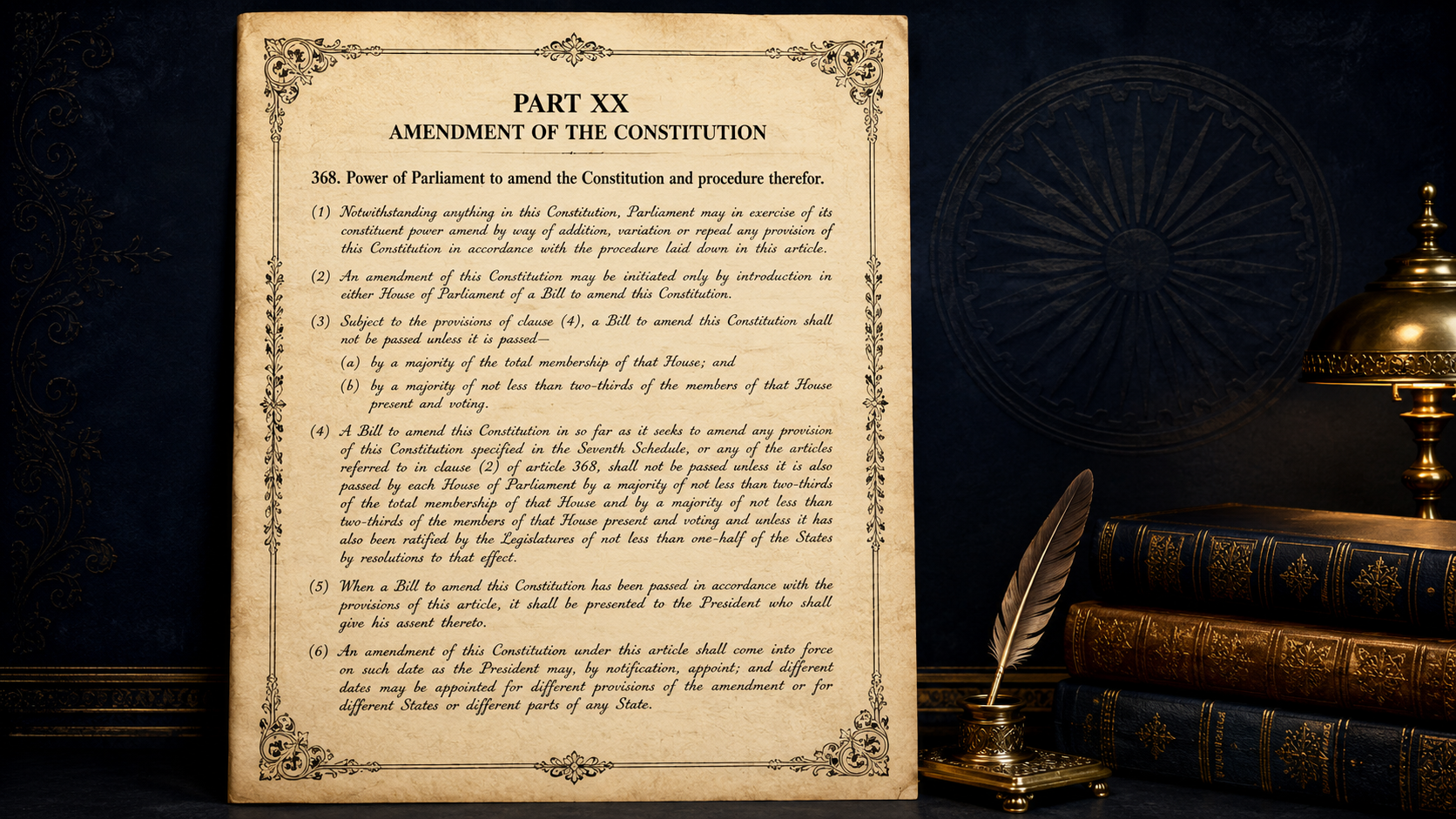
A.Constitutional Amendment–Basic Framework
- भारतीय संविधान में amendment की मुख्य व्यवस्था Part XX में दी गई है।
- Part XX में केवल Article 368 है।
- Article 368 का marginal heading है—Power of Parliament to amend the Constitution and procedure therefor.
- Article 368 Parliament की constituent power को recognize करता है।
- Parliament Constitution में addition द्वारा amendment कर सकती है।
- Parliament Constitution में variation द्वारा amendment कर सकती है।
- Parliament Constitution के किसी provision को repeal भी कर सकती है।
- Article 368 के अंतर्गत amendment केवल Parliament में Bill के माध्यम से initiate किया जाता है।
- Constitutional Amendment Bill Lok Sabha या Rajya Sabha, किसी भी House में introduce किया जा सकता है।
- State Legislature Article 368 amendment Bill initiate नहीं कर सकती।
- Constitutional Amendment Bill के introduction के लिए Article 368 President की prior recommendation prescribe नहीं करता।
- Constitutional Amendment Bill को दोनों Houses द्वारा अलग-अलग pass करना आवश्यक है।
- Article 368 Bill के लिए joint sitting का कोई provision नहीं है।
- एक House द्वारा Bill reject होने पर दूसरे House की approval अकेले पर्याप्त नहीं है।
- Constitutional Amendment Bill पर Lok Sabha और Rajya Sabha की constitutional status समान है।
- Article 368 amendment के लिए प्रत्येक House में majority of total membership आवश्यक है।
- इसके साथ present and voting members के कम-से-कम two-thirds majority की भी आवश्यकता है।
- Article 368 की special majority में दोनों requirements simultaneously satisfy होनी चाहिए।
- “Total membership” का अर्थ House की कुल sanctioned constitutional membership से संबंधित है।
- Abstaining member “present and voting” calculation में vote नहीं करता।
- लेकिन total membership वाली first requirement abstention से समाप्त नहीं होती।
- Constitution amendment के लिए ordinary Bill वाली simple majority पर्याप्त नहीं होती, जहाँ Article 368 लागू है।
- Article 368 के कुछ amendments के लिए States की ratification भी आवश्यक है।
- State ratification कम-से-कम one-half of the States द्वारा होनी चाहिए।
- Constitution सभी States की unanimous ratification की मांग नहीं करता।
- State ratification संबंधित State Legislature द्वारा resolution से होती है।
- Article 368 State ratification के लिए अलग special majority expressly prescribe नहीं करता।
- आवश्यक State ratification President के assent से पहले पूरी होनी चाहिए।
- Article 368 में State ratification के लिए कोई express constitutional time-limit नहीं दी गई है।
- Constitutional Amendment Bill को referendum में भेजना भारतीय Constitution की Article 368 procedure का हिस्सा नहीं है।
- भारत में constitutional amendment के लिए जनता का direct referendum आवश्यक नहीं है।
- Parliament alone प्रत्येक provision को बिना limitation amend नहीं कर सकती।
- Parliament की amendment power Basic Structure Doctrine के अधीन है।
- Article 368 के अंतर्गत President को duly passed Amendment Bill पर assent देना होता है।
- 24th Constitutional Amendment ने Article 368 में President के लिए “shall give his assent” language जोड़ी।
- Article 368(3) के अनुसार Article 13 Article 368 amendment पर लागू नहीं होता।
- Article 368(3) 24th Constitutional Amendment द्वारा जोड़ा गया था।
- Article 368(4) और 368(5) 42nd Constitutional Amendment द्वारा जोड़े गए थे।
- Article 368(4) ने constitutional amendments को judicial challenge से बाहर करने का प्रयास किया था।
- Article 368(5) ने Parliament की constituent power पर कोई limitation न होने की घोषणा की थी।
- Supreme Court ने Article 368(4) और (5) को Minerva Mills में invalid घोषित किया।
- इसलिए constitutional amendments आज भी judicial review के अधीन हैं।
- Amendment की procedural validity भी judicial review के अधीन हो सकती है।
- Amendment की substantive validity Basic Structure के आधार पर examine की जा सकती है।
- Parliament की constituent power ordinary legislative power से conceptually अलग है।
- लेकिन constituent power भी Constitution द्वारा conferred और limited power है।
- Constitution स्वयं Parliament से ऊपर supreme legal authority है।
- Parliament Constitution की identity destroy करने के लिए Article 368 का उपयोग नहीं कर सकती।
- किसी amendment का political popularity constitutional validity की guarantee नहीं है।
- Constitutional amendment और ordinary legislation की judicial review के standards समान नहीं होते।
B.Amendments Requiring State Ratification
- Article 368 proviso federal provisions को additional protection देता है।
- Article 54 में amendment के लिए State ratification आवश्यक है।
- Article 54 President के election से संबंधित है।
- Article 55 में amendment के लिए State ratification आवश्यक है।
- Article 55 President के election की manner से संबंधित है।
- Article 73 में amendment State ratification category में आता है।
- Article 73 Union executive power के extent से संबंधित है।
- Article 162 में amendment State ratification category में आता है।
- Article 162 State executive power के extent से संबंधित है।
- Article 241 में amendment State ratification category में आता है।
- Article 241 Union Territories के High Courts से संबंधित है।
- Article 279A में amendment के लिए भी State ratification आवश्यक है।
- Article 279A GST Council से संबंधित है।
- Article 279A को ratification list में 101st Amendment द्वारा जोड़ा गया।
- Part V का Chapter IV amendment करने पर State ratification आवश्यक है।
- Part V Chapter IV Supreme Court से संबंधित है।
- Part VI का Chapter V amendment करने पर State ratification आवश्यक है।
- Part VI Chapter V High Courts से संबंधित है।
- Part XI का Chapter I Centre-State legislative relations से संबंधित है।
- Part XI Chapter I में amendment State ratification category में आता है।
- Seventh Schedule की किसी List में amendment State ratification मांगता है।
- Seventh Schedule में Union List, State List और Concurrent List हैं।
- States की Parliament में representation बदलने वाले amendment के लिए State ratification आवश्यक है।
- स्वयं Article 368 में amendment के लिए भी State ratification आवश्यक है।
- State ratification requirement Constitution की federal structure को विशेष protection देती है।
- Required State ratification के बिना ऐसा amendment constitutionally defective हो सकता है।
- Supreme Court ने Rajendra N. Shah case में ratification requirement को substantive constitutional safeguard माना।
- 73rd और 74th Amendments को required number of States द्वारा ratify किया गया था।
- 97th Amendment के Part IXB का States की co-operative societies पर application ratification issue में फँसा।
- Article 368 proviso को केवल technical formality नहीं माना जा सकता।
C. Changes Outside Article 368 Special Procedure
- Constitution में सभी constitutional changes Article 368 special majority से नहीं होते।
- कुछ provisions Parliament को ordinary legislative procedure से constitutional arrangement बदलने देते हैं।
- Article 4 इसका प्रमुख उदाहरण है।
- Articles 2 और 3 के laws First Schedule में changes कर सकते हैं।
- Articles 2 और 3 के laws Fourth Schedule में consequential changes कर सकते हैं।
- Article 4 expressly कहता है कि ऐसा law Article 368 amendment नहीं माना जाएगा।
- इसलिए State formation के लिए हर बार Constitutional Amendment Act आवश्यक नहीं है।
- Article 169 State Legislative Council के creation या abolition से संबंधित है।
- Article 169 के लिए संबंधित State Legislative Assembly का special resolution पहले आवश्यक है।
- उसके बाद Parliament law द्वारा Legislative Council create या abolish कर सकती है।
- Article 169 के अंतर्गत ऐसा Parliamentary law Article 368 amendment नहीं माना जाता।
- Fifth Schedule को Parliament law द्वारा amend कर सकती है।
- Fifth Schedule के paragraph 7 का amendment Article 368 amendment नहीं माना जाता।
- Sixth Schedule को भी Parliament law द्वारा modify किया जा सकता है।
- Sixth Schedule paragraph 21 इस power से संबंधित है।
- ऐसे provisions Constitution की flexible characteristics दिखाते हैं।
- इसलिए भारतीय Constitution को पूर्णतः rigid कहना सही नहीं है।
- भारतीय Constitution को पूर्णतः flexible कहना भी सही नहीं है।
- Constitution amendment mechanism में flexible और rigid दोनों elements हैं।
- परीक्षा में “Simple Majority Amendment” और “Article 368 Amendment” में distinction याद रखना चाहिए।
D. Evolution of Parliament's Amending Power
- Parliament की amendment power पर Supreme Court jurisprudence कई stages में विकसित हुई।
- Shankari Prasad v. Union of India (1951) amendment power का प्रारंभिक landmark case है।
- Shankari Prasad में First Constitutional Amendment की validity challenge हुई थी।
- Supreme Court ने First Amendment को uphold किया।
- Shankari Prasad में constitutional amendment को Article 13 का “law” नहीं माना गया।
- इसलिए Parliament को Fundamental Rights amend करने में Article 13 bar नहीं माना गया।
- Sajjan Singh v. State of Rajasthan (1965) ने broadly Shankari Prasad approach follow किया।
- Sajjan Singh में 17th Constitutional Amendment challenge हुआ था।
- Sajjan Singh में Parliament की Fundamental Rights amend करने की power uphold हुई।
- I.C. Golaknath v. State of Punjab (1967) ने earlier position बदल दी।
- Golaknath में Supreme Court ने Parliament को Fundamental Rights amend करने से रोका।
- Golaknath ने constitutional amendment को Article 13 के “law” के ambit में पढ़ा।
- Golaknath judgment में Doctrine of Prospective Overruling का महत्वपूर्ण उपयोग हुआ।
- इसलिए पहले के constitutional amendments automatically invalid नहीं किए गए।
- Parliament ने Golaknath के प्रभाव के response में 24th Constitutional Amendment, 1971 किया।
- 24th Amendment ने Article 368 में Parliament की constituent power expressly recognize की।
- 24th Amendment ने Article 13 में clause (4) जोड़ा।
- Article 13(4) ने Article 368 constitutional amendments को Article 13 से बाहर किया।
- 24th Amendment ने Article 368(3) भी insert किया।
- 24th Amendment ने President के assent को mandatory बनाया।
E. Kesavananda Bharati & Basic Limitation
- Kesavananda Bharati v. State of Kerala का निर्णय 24 April 1973 को दिया गया।
- Kesavananda Bharati भारतीय constitutional amendment law का सबसे महत्वपूर्ण landmark है।
- इस case को 13-Judge Constitution Bench ने decide किया।
- यह Supreme Court की अब तक की largest benches में से सबसे प्रसिद्ध bench है।
- Decision 7:6 majority से basic-structure limitation के पक्ष में आया।
- Parliament Constitution के प्रत्येक Part को amend कर सकती है।
- लेकिन Parliament Constitution की Basic Structure को destroy नहीं कर सकती।
- Basic Structure Doctrine Article 368 के text में expressly written नहीं है।
- यह Supreme Court की constitutional interpretation से विकसित doctrine है।
- Kesavananda ने Golaknath की absolute Fundamental Rights limitation को पूरी तरह maintain नहीं किया।
- Fundamental Rights amend किए जा सकते हैं।
- लेकिन amendment Basic Structure destroy नहीं कर सकता।
- Amendment power wide है लेकिन unlimited नहीं है।
- Constitution की supremacy Basic Structure jurisprudence का core principle है।
- Judicial Review basic structure का important component है।
- Rule of Law basic structure jurisprudence से जुड़ा है।
- Democracy basic structure का हिस्सा है।
- Republican character basic structure का हिस्सा है।
- Secularism basic structure का हिस्सा है।
- Federalism basic structure का हिस्सा है।
- Separation of Powers basic structure से संबंधित है।
- Independence of Judiciary basic structure का essential component है।
- Free and Fair Elections basic structure jurisprudence का महत्वपूर्ण element है।
- Limited amending power स्वयं Basic Structure का हिस्सा है।
- Fundamental Rights और DPSP की harmony भी Basic Structure jurisprudence में protected है।
F. Post-Kesavananda Cases
- Indira Nehru Gandhi v. Raj Narain (1975) Basic Structure Doctrine का प्रमुख application था।
- 39th Constitutional Amendment ने Article 329A introduce किया था।
- Article 329A(4) ने Prime Minister आदि के election को विशेष protection देने का प्रयास किया था।
- Supreme Court ने Article 329A(4) को unconstitutional घोषित किया।
- Free and fair elections को democratic constitutional structure से जोड़ा गया।
- Rule of Law को भी इस jurisprudence में महत्व मिला।
- 42nd Constitutional Amendment, 1976 ने Parliament की amendment power को virtually unlimited बनाने का प्रयास किया।
- 42nd Amendment ने Article 368(4) और 368(5) जोड़े।
- Minerva Mills v. Union of India (1980) ने दोनों clauses invalid किए।
- Minerva Mills ने कहा कि limited amending power Constitution की Basic Structure है।
- Parliament amendment power enlarge करके unlimited power नहीं बना सकती।
- Judicial Review को Minerva Mills ने Basic Structure से जोड़ा।
- Fundamental Rights और DPSP के balance को भी constitutional importance दी गई।
- Waman Rao v. Union of India (1981) Ninth Schedule jurisprudence का important case है।
- Waman Rao ने 24 April 1973 को महत्वपूर्ण cut-off date माना।
- यह वही date है जिस दिन Kesavananda judgment दिया गया था।
- 24 April 1973 के बाद Ninth Schedule में inserted laws Basic Structure scrutiny के लिए relevant हो सकते हैं।
- I.R. Coelho v. State of Tamil Nadu (2007) ने Ninth Schedule immunity को further limit किया।
- 24 April 1973 के बाद Ninth Schedule में रखा law Basic Structure test से बच नहीं सकता।
- Ninth Schedule judicial review से complete immunity नहीं देता।
- Article 31B स्वयं valid है।
- लेकिन Article 31B का उपयोग Basic Structure destroy करने के लिए नहीं किया जा सकता।
- Fundamental Rights का प्रत्येक violation automatically Basic Structure violation नहीं होता।
- Court देखती है कि violation Constitution की Basic Structure को damage करता है या नहीं।
- I.R. Coelho ने Articles 14, 19 और 21 के protected constitutional essence को महत्वपूर्ण माना।
G. Important Constitutional Amendments
First Amendment, 1951
- 1st Constitutional Amendment Act, 1951 स्वतंत्र भारत का पहला constitutional amendment था।
- First Amendment ने Article 15(4) insert किया।
- Article 15(4) socially and educationally backward classes तथा SC/ST के advancement से जुड़ा है।
- First Amendment ने Article 31A जोड़ा।
- First Amendment ने Article 31B जोड़ा।
- First Amendment द्वारा Ninth Schedule जोड़ी गई।
- First Amendment ने Article 19(2) के restriction framework में भी महत्वपूर्ण changes किए।
- First Amendment की validity Shankari Prasad case में uphold हुई।
Seventh Amendment, 1956
- 7th Constitutional Amendment States Reorganisation से closely connected है।
- इस amendment ने पुरानी Part A, Part B, Part C और Part D State classification में व्यापक बदलाव किए।
- States और Union Territories की modern constitutional arrangement 1956 reorganisation से महत्वपूर्ण रूप से विकसित हुई।
- 7th Amendment ने High Courts और federal territorial structure में भी अनेक changes किए।
Ninth Amendment, 1960
- 9th Constitutional Amendment India-Pakistan territorial agreement से संबंधित था।
- Berubari-related territorial transfer ने constitutional amendment की आवश्यकता को highlight किया।
- Foreign country को Indian territory cede करने के लिए Article 3 alone पर्याप्त नहीं माना गया।
Twenty-First Amendment, 1967
- 21st Constitutional Amendment ने Sindhi language को Eighth Schedule में जोड़ा।
Twenty-Fourth Amendment, 1971
- 24th Amendment Parliament की constitutional amendment power के इतिहास में landmark है।
- इसने Article 368(1) में constituent power expressly recognize की।
- इसने Article 13(4) insert किया।
- इसने Article 368(3) insert किया।
- President को Constitutional Amendment Bill पर assent देना mandatory बनाया गया।
Twenty-Fifth Amendment, 1971
- 25th Amendment property rights और Directive Principles से संबंधित था।
- इसने Article 31C introduce किया।
- Original Article 31C Article 39(b) और Article 39(c) implement करने वाले laws से जुड़ा था।
- 25th Amendment के कुछ aspects Kesavananda Bharati में judicial scrutiny से गुजरे।
Twenty-Sixth Amendment, 1971
- 26th Amendment ने former rulers के Privy Purses समाप्त किए।
- Article 363A इस amendment से संबंधित है।
- Former rulers की official recognition भी समाप्त हुई।
Thirty-Sixth Amendment, 1975
- 36th Constitutional Amendment ने Sikkim को full-fledged State बनाया।
- Article 371F Sikkim के special provisions से संबंधित है।
Forty-Second Amendment, 1976
- 42nd Constitutional Amendment को अक्सर “Mini Constitution” कहा जाता है।
- 42nd Amendment ने Preamble में Socialist शब्द जोड़ा।
- 42nd Amendment ने Preamble में Secular शब्द जोड़ा।
- “Unity of the Nation” को “Unity and Integrity of the Nation” किया गया।
- 42nd Amendment ने Part IVA जोड़ा।
- Part IVA Fundamental Duties से संबंधित है।
- Article 51A में मूलतः 10 Fundamental Duties जोड़े गए।
- Article 39A भी 42nd Amendment से जुड़ा है।
- Article 43A भी 42nd Amendment से जुड़ा है।
- Article 48A भी 42nd Amendment से जुड़ा है।
- Part XIVA में Tribunals की constitutional provisions जोड़ी गईं।
- Article 323A Administrative Tribunals से संबंधित है।
- Article 323B other tribunals से संबंधित है।
- 42nd Amendment ने Article 368(4) और 368(5) जोड़े।
- Article 368(4) और (5) को बाद में Minerva Mills ने invalid किया।
Forty-Fourth Amendment, 1978
- 44th Constitutional Amendment ने Emergency-era constitutional changes में महत्वपूर्ण corrections किए।
- Right to Property को Fundamental Rights से हटाया गया।
- Article 19(1)(f) omit किया गया।
- Article 31 omit किया गया।
- Property का constitutional protection अब Article 300A में है।
- Article 352 में “internal disturbance” को “armed rebellion” से replace किया गया।
- National Emergency proclamation के लिए Union Cabinet की written advice safeguard जोड़ी गई।
- Articles 20 और 21 के enforcement को Emergency में Article 359 से suspend नहीं किया जा सकता।
- Lok Sabha और State Legislative Assemblies की normal term फिर पाँच वर्ष की गई।
- President को Council of Ministers की advice reconsideration के लिए once return करने की constitutional power मिली।
Fifty-Second Amendment, 1985
- 52nd Constitutional Amendment Anti-Defection Law से संबंधित है।
- इस amendment ने Tenth Schedule जोड़ी।
- Tenth Schedule defection-based disqualification से संबंधित है।
Sixty-First Amendment, 1988
- 61st Constitutional Amendment ने voting age 21 से घटाकर 18 years की।
- यह change Article 326 से संबंधित है।
Sixty-Ninth Amendment, 1991
- 69th Constitutional Amendment National Capital Territory of Delhi से संबंधित है।
- Article 239AA इसी amendment से जुड़ा है।
- Article 239AB भी इसी constitutional arrangement से संबंधित है।
Seventy-First Amendment, 1992
- 71st Amendment ने Konkani को Eighth Schedule में जोड़ा।
- इसी amendment ने Manipuri को Eighth Schedule में जोड़ा।
- इसी amendment ने Nepali को Eighth Schedule में जोड़ा।
Seventy-Third Amendment, 1992
- 73rd Constitutional Amendment Panchayats से संबंधित है।
- इसने Part IX जोड़ा।
- इसने Eleventh Schedule जोड़ी।
- Panchayats को constitutional status प्रदान किया गया।
Seventy-Fourth Amendment, 1992
- 74th Constitutional Amendment Municipalities से संबंधित है।
- इसने Part IXA जोड़ा।
- इसने Twelfth Schedule जोड़ी।
- Urban Local Government को constitutional status मिला।
Seventy-Sixth Amendment, 1994
- 76th Constitutional Amendment Tamil Nadu reservation legislation से संबंधित है।
- Tamil Nadu reservation law को Ninth Schedule में रखा गया।
Seventy-Seventh Amendment, 1995
- 77th Constitutional Amendment ने Article 16(4A) insert किया।
- Article 16(4A) SC/ST promotion reservation से संबंधित है।
Eighty-First Amendment, 2000
- 81st Amendment ने Article 16(4B) insert किया।
- Article 16(4B) unfilled reserved vacancies/carry-forward से संबंधित है।
Eighty-Second Amendment, 2000
- 82nd Amendment ने Article 335 में proviso जोड़ा।
- यह SC/ST promotion context में qualifying marks/standards relaxation से संबंधित है।
Eighty-Fourth Amendment, 2001
- 84th Amendment ने Lok Sabha और State Assembly seats के inter-State allocation की freeze को first census after 2026 तक continue किया।
- Population control के federal representation consequences इस freeze के पीछे महत्वपूर्ण context थे।
Eighty-Fifth Amendment, 2001
- 85th Amendment Article 16(4A) में consequential seniority से संबंधित है।
- इसमें “with consequential seniority” protection जोड़ी गई।
Eighty-Sixth Amendment, 2002
- 86th Constitutional Amendment ने Article 21A insert किया।
- Article 21A 6–14 years के children के Right to Education से संबंधित है।
- Article 45 को substitute किया गया।
- Article 51A(k) Fundamental Duty जोड़ा गया।
Eighty-Ninth Amendment, 2003
- 89th Constitutional Amendment ने National Commission for Scheduled Tribes को अलग constitutional body बनाया।
- Article 338A NCST से संबंधित है।
Ninety-First Amendment, 2003
- 91st Constitutional Amendment Council of Ministers के size पर constitutional limit से संबंधित है।
- Union Council of Ministers का total number Lok Sabha strength के 15% से अधिक नहीं हो सकता।
- State Council of Ministers का total number Legislative Assembly strength के 15% से अधिक नहीं हो सकता।
- State में Ministers की संख्या 12 से कम नहीं हो सकती।
- Defection के कारण disqualified member के minister बनने पर भी restriction लगाया गया।
- Article 361B remunerative political post restriction से जुड़ा है।
Ninety-Second Amendment, 2003
- 92nd Amendment ने Bodo को Eighth Schedule में जोड़ा।
- Dogri को भी इसी amendment से जोड़ा गया।
- Maithili को भी इसी amendment से जोड़ा गया।
- Santhali को भी इसी amendment से जोड़ा गया।
Ninety-Third Amendment, 2005
- 93rd Amendment ने Article 15(5) insert किया।
- Article 15(5) educational institutions में backward classes/SC/ST के लिए special provisions से संबंधित है।
- Minority educational institutions under Article 30(1) इस clause से excluded हैं।
Ninety-Seventh Amendment, 2011
- 97th Amendment co-operative societies से संबंधित था।
- Article 19(1)(c) में co-operative societies जोड़ी गईं।
- Article 43B insert किया गया।
- Part IXB co-operative societies से संबंधित है।
- Supreme Court ने Union of India v. Rajendra N. Shah (2021) में 97th Amendment के Part IXB को State co-operative societies के संबंध में invalid माना।
- इसका कारण required State ratification का अभाव था।
- Part IXB multi-State co-operative societies के संबंध में operative रहा।
Ninety-Ninth Amendment, 2014
- 99th Constitutional Amendment National Judicial Appointments Commission यानी NJAC से संबंधित था।
- NJAC ने constitutional judges appointment system बदलने का प्रयास किया था।
- Supreme Court ने 99th Amendment को 2015 NJAC case में unconstitutional घोषित किया।
- Judicial independence इस decision का central Basic Structure consideration था।
- 99th Amendment आज operative constitutional law नहीं है।
One Hundredth Amendment, 2015
- 100th Constitutional Amendment India-Bangladesh Land Boundary Agreement से संबंधित है।
- इसने acquired और transferred territories के constitutional implementation को facilitate किया।
One Hundred and First Amendment, 2016
- 101st Constitutional Amendment Goods and Services Tax यानी GST से संबंधित है।
- Article 246A GST legislative power से संबंधित है।
- Article 269A inter-State GST से संबंधित है।
- Article 279A GST Council से संबंधित है।
- 101st Amendment ने Article 279A को Article 368 State-ratification list में भी जोड़ा।
One Hundred and Second Amendment, 2018
- 102nd Constitutional Amendment ने National Commission for Backward Classes को constitutional status दिया।
- Article 338B NCBC से संबंधित है।
- Article 342A socially and educationally backward classes से संबंधित है।
- Article 366(26C) में SEBC definition जोड़ी गई।
- Jaishri Laxmanrao Patil judgment में 102nd Amendment की interpretation महत्वपूर्ण रही।
One Hundred and Third Amendment, 2019
- 103rd Constitutional Amendment EWS reservation से संबंधित है।
- Article 15(6) इस amendment से जोड़ा गया।
- Article 16(6) भी इसी amendment से जोड़ा गया।
- EWS के लिए maximum 10% reservation की constitutional enabling provision बनाई गई।
- Janhit Abhiyan v. Union of India (2022) में 103rd Amendment की validity 3:2 majority से uphold हुई।
One Hundred and Fourth Amendment, 2019
- 104th Constitutional Amendment Article 334 से संबंधित है।
- Lok Sabha और State Assemblies में SC/ST reserved seats की अवधि Constitution commencement से 80 years तक बढ़ाई गई।
- Anglo-Indian nomination वाली constitutional special representation की period 70 years रही।
- इसलिए Anglo-Indian nomination का protection 2020 में समाप्त हुआ।
One Hundred and Fifth Amendment, 2021
- 105th Constitutional Amendment SEBC identification में States की power से संबंधित है।
- इसने States और Union Territories को अपने purposes के लिए SEBC list maintain करने की constitutional power clarify/restore की।
- Article 342A में इस संबंध में महत्वपूर्ण amendment किया गया।
- Article 338B और Article 366 में भी consequential changes हुए।
- 105th Amendment 102nd Amendment के बाद उत्पन्न constitutional position के response में आया।
One Hundred and Sixth Amendment, 2023
- 106th Constitutional Amendment Act, 2023 women reservation से संबंधित है।
- इसे popularly Nari Shakti Vandan constitutional amendment के रूप में जाना जाता है।
- Article 330A Lok Sabha में women reservation से संबंधित है।
- Article 332A State Legislative Assemblies में women reservation से संबंधित है।
- Article 334A women reservation के commencement/operation framework से संबंधित है।
- Article 239AA में Delhi Legislative Assembly के लिए consequential provision जोड़ा गया।
- Lok Sabha में as nearly as may be one-third seats women के लिए reserve की जानी हैं।
- State Legislative Assemblies में भी as nearly as may be one-third directly elected seats women के लिए reserve की जानी हैं।
- SC/ST reserved seats में भी as nearly as may be one-third seats women के लिए reserved होंगी।
- Official Constitution के अनुसार 106th Amendment के relevant provisions 16 April 2026 से commenced हैं।
- लेकिन women reservation actual operation delimitation exercise से linked है।
- Delimitation first census taken after commencement of 106th Amendment के relevant figures publish होने के बाद होना है।
- Article 334A reserved constituencies के rotation का भी provision करता है।
- Official 1 May 2026 Constitution में amendments 106th Amendment तक incorporated हैं।
I. Doctrine of Severability
- Doctrine of Severability Article 13 jurisprudence से closely related है।
- किसी statute का केवल unconstitutional portion अलग किया जा सकता हो तो पूरा statute invalidate करना आवश्यक नहीं है।
- Invalid part को valid part से separate किया जा सकना चाहिए।
- Remaining valid portion independently workable होना चाहिए।
- Court legislative intention भी consider करती है।
- यदि invalid और valid provisions inseparably connected हों, पूरा law fall कर सकता है।
- Doctrine का उद्देश्य constitutional portion को unnecessary invalidation से बचाना है।
- R.M.D. Chamarbaugwala severability doctrine का classic Indian authority है।
- Severability केवल ordinary legislation तक theoretically सीमित नहीं है।
- Supreme Court ने constitutional amendment context में भी severability apply की है।
- Rajendra N. Shah judgment ने composite constitutional amendment में severability discuss की।
- 97th Amendment का valid separable portion बचाया गया जबकि defective portion invalid हुआ।
J. Doctrine of Eclipse
- Doctrine of Eclipse का primary constitutional connection Article 13(1) से है।
- Pre-Constitution law Fundamental Right से inconsistent होने पर पूरी तरह dead नहीं माना जाता।
- वह inconsistency की सीमा तक Fundamental Right की “shadow” या eclipse में रहता है।
- Constitutional inconsistency हटने पर ऐसा pre-Constitution law revive हो सकता है।
- Bhikaji Narain Dhakras v. State of Madhya Pradesh doctrine का leading case है।
- Traditional doctrine primarily pre-Constitution laws से जुड़ी है।
- Post-Constitution law Article 13(2) violation में जन्म से unconstitutional extent तक void होता है।
- इसलिए classical eclipse doctrine post-Constitution law पर उसी manner में लागू नहीं होती।
- Eclipse और repeal एक ही concept नहीं हैं।
- Eclipsed law statute book से necessarily erased नहीं होता।
- Doctrine of Eclipse constitutional inconsistency और enforceability के distinction को समझाता है।
K. Doctrine of Waiver
- Doctrine of Waiver का अर्थ voluntarily legal right छोड़ने से है।
- भारतीय constitutional law में Fundamental Rights को ordinary contractual rights जैसा treat नहीं किया जाता।
- व्यक्ति सामान्यतः Fundamental Rights के constitutional protection को waive करके State action valid नहीं बना सकता।
- Basheshar Nath v. CIT waiver of Fundamental Rights का leading case है।
- विशेष रूप से Article 14 जैसे constitutional guarantee को individual consent से defeat नहीं किया जा सकता।
- Fundamental Rights केवल private individual benefit नहीं बल्कि constitutional public policy भी embody करते हैं।
L. Doctrine of Pith and Substance
- Doctrine of Pith and Substance Centre-State legislative competence disputes में महत्वपूर्ण है।
- यह Seventh Schedule के legislative entries के overlapping को resolve करने में उपयोग होता है।
- Court legislation की true nature and character examine करती है।
- Law का label alone decisive नहीं होता।
- Law का substance उसके form से अधिक important होता है।
- Legislation substantially competent field में हो तो incidental encroachment दूसरे field में उसे automatically invalid नहीं करता।
- Court enactment को as a whole examine करती है।
- Law का scope और object relevant होते हैं।
- Pith and Substance doctrine federal legislative fields को practical interpretation देती है।
- State of Bombay v. F.N. Balsara doctrine से जुड़ा classic case है।
- Incidental trenching और substantial invasion में distinction महत्वपूर्ण है।
- Legislative entry को generally broad interpretation दी जाती है।
- Apparent overlap में Courts reconciliation का प्रयास करती हैं।
M. Doctrine of Colourable Legislation
- Doctrine of Colourable Legislation legislative competence से संबंधित है।
- इसका simplified principle है—what cannot be done directly cannot be done indirectly.
- Court legislation की वास्तविक substance देखती है।
- Legislature किसी prohibited field में merely disguise द्वारा enter नहीं कर सकती।
- “Colourable” का अर्थ necessarily fraud या bad faith नहीं है।
- Doctrine primarily constitutional distribution of legislative power से जुड़ी है।
- Legislature competent हो तो उसकी political motive सामान्यतः law को colourable नहीं बनाती।
- K.C. Gajapati Narayan Deo v. State of Orissa doctrine का leading case है।
- Colourable legislation का focus legislature की competence पर है।
- Administrative colourable exercise of power और legislative colourability conceptually अलग contexts में arise कर सकते हैं।
N. Doctrine of Territorial Nexus
- State Legislature की law-making power सामान्यतः उसके territorial connection से जुड़ी होती है।
- State law का extra-territorial element हर case में automatically invalid नहीं होता।
- State और regulated subject matter के बीच sufficient territorial nexus होना चाहिए।
- Nexus real होना चाहिए, illusory नहीं।
- Liability sought to be imposed और State के बीच relevant connection होना चाहिए।
- State of Bombay v. R.M.D. Chamarbaugwala territorial nexus doctrine से जुड़ा landmark है।
- Parliament के लिए Article 245(2) अलग constitutional rule देता है।
- Article 245(2) के अनुसार Parliamentary law केवल extra-territorial operation के कारण invalid नहीं होगा।
- State legislation और Parliamentary legislation के extra-territorial rules identical नहीं हैं।
O. Doctrine of Repugnancy
- Doctrine of Repugnancy मुख्यतः Article 254 से संबंधित है।
- यह Parliament और State Legislature के Concurrent List laws के conflict में relevant है।
- Concurrent List subject पर valid Parliamentary law सामान्यतः conflicting State law पर prevail करता है।
- State law repugnancy की सीमा तक void हो सकता है।
- Article 254(2) State legislation के लिए important exception देता है।
- Concurrent List पर State law President के consideration के लिए reserve किया जा सकता है।
- Presidential assent मिलने पर State law उस State में prevail कर सकता है।
- लेकिन Parliament बाद में उसी matter पर law बनाकर State law को override कर सकती है।
- Parliament State law को add, amend, vary या repeal करने वाला law भी बना सकती है।
- Repugnancy तभी relevant होती है जब दोनों legislatures same constitutional field में validly legislating हों।
- Direct inconsistency repugnancy का महत्वपूर्ण indicator है।
- दोनों laws का simultaneous obedience impossible होना repugnancy establish कर सकता है।
- Parliament द्वारा field completely occupy करने का legislative intention भी relevant हो सकता है।
P. Doctrine of Occupied Field
- Occupied Field doctrine repugnancy jurisprudence से closely related है।
- इसका application Concurrent List disputes में महत्वपूर्ण हो सकता है।
- Parliament यदि किसी field को comprehensively regulate करती है तो contrary State legislation conflict में आ सकती है।
- Mere existence of Central law हर State law को automatically invalid नहीं करती।
- Subject matter, statutory scheme और legislative intention examine किए जाते हैं।
- Occupied Field doctrine legislative entries की competence और Article 254 repugnancy से अलग-अलग contexts में सावधानी से apply किया जाता है।
Q. Doctrine of Harmonious Construction
- Harmonious Construction का उद्देश्य apparently conflicting constitutional/statutory provisions को reconcile करना है।
- Court ऐसा interpretation prefer करती है जिससे दोनों provisions meaningful रहें।
- एक provision को unnecessarily redundant बनाना avoid किया जाता है।
- Constitution को isolated clauses के collection की तरह नहीं पढ़ा जाता।
- Constitutional provisions को broader scheme में interpret किया जाता है।
- Fundamental Rights और DPSP के relationship में harmonious approach महत्वपूर्ण रही है।
- Legislative Lists की overlapping entries में भी harmonious interpretation का उपयोग किया जाता है।
- Harmonious construction constitutional unity को preserve करता है।
R. Doctrine of Incidental and Ancillary Powers
- Express legislative power में ordinarily necessary incidental powers भी शामिल हो सकती हैं।
- Legislature को assigned subject को effectively legislate करने के लिए ancillary matters cover करने की power हो सकती है।
- Incidental power independent unlimited legislative field नहीं है।
- इसका nexus principal legislative entry से होना चाहिए।
- Pith and Substance और incidental encroachment doctrines इससे closely related हैं।
- Legislative entries को extremely narrow manner में पढ़ना constitutional scheme के अनुरूप नहीं है।
S. Doctrine of Prospective Overruling
- Prospective Overruling में Court legal rule बदलती है लेकिन past transactions को पूरी तरह disturb नहीं करती।
- Indian constitutional law में इस doctrine का प्रसिद्ध introduction Golaknath case में हुआ।
- Golaknath ने earlier constitutional amendments को retrospectively invalidate नहीं किया।
- Prospective overruling legal certainty को protect करने में सहायक हो सकता है।
- यह judicial declaration के temporal effect को control करने की technique है।
- Prospective overruling ordinary stay of judgment से अलग concept है।
T. Doctrine of Reading Down
- Reading Down constitutional interpretation की important judicial technique है।
- Court ambiguous statutory provision को constitutionally valid meaning देने का प्रयास कर सकती है।
- इसका उद्देश्य unnecessary invalidation avoid करना हो सकता है।
- Reading Down text को completely rewrite करने की judicial power नहीं देता।
- Clear unconstitutional language को artificial interpretation से हमेशा save नहीं किया जा सकता।
- Court legislative intention और permissible textual meaning के भीतर रहती है।
- Reading Down और striking down अलग judicial remedies हैं।
- Reading Down में provision survive करता है लेकिन narrower constitutional interpretation के साथ।
U. Doctrine of Proportionality
- Proportionality State restrictions की constitutional review में increasingly important doctrine है।
- State measure का legitimate objective होना relevant है।
- Measure और objective के बीच rational connection होना चाहिए।
- Rights restriction आवश्यकता से अधिक excessive नहीं होना चाहिए।
- Less restrictive alternatives का question proportionality analysis में relevant हो सकता है।
- Rights harm और public objective के बीच balancing भी proportionality का हिस्सा हो सकता है।
- K.S. Puttaswamy privacy jurisprudence में proportionality महत्वपूर्ण है।
- Modern constitutional adjudication में Article 14, 19 और 21 contexts में proportionality महत्वपूर्ण भूमिका निभाती है।
V. Doctrine of Manifest Arbitrariness
- Manifest Arbitrariness Article 14 jurisprudence का important constitutional test है।
- Legislation भी Article 14 challenge से automatically immune नहीं है।
- Clearly capricious, irrational या determining principle से रहित legislation constitutional scrutiny face कर सकती है।
- Shayara Bano v. Union of India में manifest arbitrariness doctrine prominently discussed हुआ।
- Mere disagreement with policy manifest arbitrariness establish नहीं करता।
- Judicial review policy wisdom को replace करने का general mechanism नहीं है।
W. Constitutional Morality
- Constitutional Morality Constitution के values और institutional limitations के प्रति fidelity से संबंधित है।
- Constitutional morality केवल popular morality का synonym नहीं है।
- Government action constitutional rights और constitutional structure दोनों से controlled होती है।
- Individual dignity constitutional morality jurisprudence का important value है।
- Equality और liberty भी constitutional morality analysis में central हैं।
- Constitutional authorities की powers constitutional limitations के भीतर exercise होनी चाहिए।
President, Vice-President & Union Executive
राष्ट्रपति, उपराष्ट्रपति एवं संघीय कार्यपालिका
A. President of India | राष्ट्रपति
- Part V संघ (The Union) से संबंधित है।
- Part V के Chapter I में Union Executive का प्रावधान है।
- Article 52 के अनुसार भारत में एक President होगा।
- Article 53 के अनुसार Union की executive power President में vested है।
- President Union executive power को Constitution के अनुसार स्वयं या subordinate officers के माध्यम से exercise करता है।
- Union Defence Forces का supreme command President में vested है।
- Defence Forces के supreme command का exercise law द्वारा regulated होता है।
- भारत में President constitutional head of the Union Executive है।
- Parliamentary system में Council of Ministers वास्तविक political executive के रूप में कार्य करती है।
- Supreme Court ने Shamsher Singh v. State of Punjab (1974) में President और Governor की constitutional position को parliamentary government के संदर्भ में स्पष्ट किया।
- President सामान्यतः अपनी constitutional powers Council of Ministers की aid and advice पर exercise करता है।
- President की constitutional position को British parliamentary model के constitutional head से तुलना की जाती है।
B. Election of President | राष्ट्रपति का निर्वाचन
- Article 54 President के election से संबंधित है।
- President का चुनाव प्रत्यक्ष रूप से जनता द्वारा नहीं किया जाता।
- Parliament के दोनों Houses के elected members Presidential Electoral College में शामिल होते हैं।
- State Legislative Assemblies के elected members भी Presidential Electoral College में शामिल होते हैं।
- Parliament के nominated members President के election में vote नहीं करते।
- State Legislative Assemblies के nominated members President के election में vote नहीं करते।
- Legislative Councils के members President के Electoral College में शामिल नहीं होते।
- Article 54 के purposes के लिए “State” में NCT of Delhi शामिल है।
- Article 54 के purposes के लिए Puducherry भी State में शामिल है।
- Delhi और Puducherry को Presidential Electoral College में शामिल करने का constitutional change 70th Amendment से संबंधित है।
- Article 55 President के election की manner निर्धारित करता है।
- Presidential election में States के representation में यथासंभव uniformity रखी जाती है।
- States और Union के बीच representation में parity का constitutional objective है।
- President का election Proportional Representation system द्वारा होता है।
- Presidential election में Single Transferable Vote (STV) प्रणाली अपनाई जाती है।
- Presidential election में voting secret ballot द्वारा होती है।
- MLA के vote का value संबंधित State की population और elected MLAs की संख्या से निर्धारित होता है।
- MLA vote-value calculation में population को elected MLAs की संख्या से divide किया जाता है और फिर हजार के multiples को आधार बनाया जाता है।
- निर्धारित calculation में remainder 500 या अधिक होने पर vote value में एक जोड़ा जाता है।
- Elected MP के vote का value सभी States के elected MLAs के कुल vote-value और elected MPs की कुल संख्या से निर्धारित होता है।
- Article 55 में population के लिए अभी relevant constitutional reference 1971 Census है, जब तक first census taken after 2026 के relevant figures प्रकाशित नहीं हो जाते।
- Presidential election में प्रत्येक elector के vote का numerical value समान होना आवश्यक नहीं है।
C. Term, Qualification & Oath
- Article 56 President की term से संबंधित है।
- President की normal term 5 years है।
- President अपनी resignation Vice-President को देता है।
- Vice-President President की resignation की सूचना Lok Sabha Speaker को देता है।
- President term समाप्त होने के बाद भी successor के office ग्रहण करने तक पद पर बना रहता है।
- Article 57 President को re-election के लिए eligible बनाता है।
- Constitution President के पुनः निर्वाचन की संख्या पर express maximum limit नहीं लगाता।
- Article 58 President की qualifications से संबंधित है।
- Presidential candidate का citizen of India होना आवश्यक है।
- उसकी आयु कम-से-कम 35 years होनी चाहिए।
- उसे Lok Sabha member के election के लिए qualified होना चाहिए।
- Presidential candidate सामान्यतः office of profit hold नहीं कर सकता।
- President, Vice-President, Governor या Union/State Minister होना Article 58 के लिए अपने-आप office of profit नहीं माना जाता।
- President Parliament या State Legislature के किसी House का member नहीं रह सकता।
- यदि कोई legislator President निर्वाचित होता है तो office ग्रहण करते ही उसकी legislative seat vacant मानी जाती है।
- President कोई अन्य office of profit hold नहीं कर सकता।
- President के emoluments और allowances term के दौरान कम नहीं किए जा सकते।
- Article 60 President की oath से संबंधित है।
- President को oath सामान्यतः Chief Justice of India administer करता है।
- CJI की absence में Supreme Court का senior-most available Judge oath administer करता है।
- President oath में Constitution और law को preserve, protect and defend करने का संकल्प लेता है।
D. Impeachment & Vacancy
- Article 61 President के impeachment की procedure देता है।
- President को केवल violation of the Constitution के लिए impeach किया जा सकता है।
- Impeachment charge Parliament के either House से initiate हो सकता है।
- प्रस्ताव लाने से पहले कम-से-कम 14 days' written notice आवश्यक है।
- Notice पर House की total membership के कम-से-कम one-fourth members के signatures होने चाहिए।
- Charge वाला resolution उस House की two-thirds of total membership majority से pass होना चाहिए।
- इसके बाद दूसरा House charge की investigation करता है या करवाता है।
- President को investigation में appear होने का right है।
- President को representation का भी right है।
- दूसरे House में भी charge sustain करने वाला resolution two-thirds of total membership से pass होना चाहिए।
- ऐसा resolution pass होने की date से President पद से removed हो जाता है।
- Article 62 Presidential vacancy के election से संबंधित है।
- Normal term expiry वाली vacancy का election term समाप्त होने से पहले पूरा होना चाहिए।
- Death, resignation या removal से casual vacancy होने पर election अधिकतम 6 months में होना चाहिए।
- Casual vacancy भरने वाला नया President fresh full five-year term प्राप्त करता है।
- Article 71 President और Vice-President के election disputes Supreme Court को देता है।
- ऐसे election dispute पर Supreme Court का decision final है।
- Electoral College में vacancy होने मात्र से Presidential election invalid नहीं होता।
E. Vice-President of India | उपराष्ट्रपति
- Article 63 के अनुसार भारत में एक Vice-President होगा।
- Article 64 के अनुसार Vice-President Rajya Sabha का ex officio Chairman होता है।
- Vice-President जब President के रूप में act करता है तो Rajya Sabha Chairman के duties perform नहीं करता।
- Acting President के दौरान उसे Rajya Sabha Chairman वाला salary/allowance नहीं मिलता।
- Article 65 President की casual vacancy में Vice-President को Acting President बनाता है।
- President की death, resignation या removal की स्थिति में Vice-President President के रूप में act कर सकता है।
- President illness या absence के कारण functions discharge न कर सके तो Vice-President उसके functions discharge करता है।
- Acting President के रूप में Vice-President को President की powers और immunities प्राप्त होती हैं।
- Article 66 Vice-President के election से संबंधित है।
- Vice-President का election Parliament के दोनों Houses के members करते हैं।
- Vice-Presidential Electoral College में elected और nominated दोनों प्रकार के MPs शामिल होते हैं।
- State Legislatures Vice-President के election में भाग नहीं लेते।
- Vice-President का election proportional representation द्वारा होता है।
- इसमें भी Single Transferable Vote system लागू होता है।
- Vice-Presidential election भी secret ballot से होता है।
- Vice-President बनने के लिए Indian citizen होना आवश्यक है।
- Vice-President की minimum age 35 years है।
- Candidate को Rajya Sabha member के election के लिए qualified होना चाहिए।
- President के लिए Lok Sabha qualification और Vice-President के लिए Rajya Sabha qualification होती है।
- Article 67 Vice-President की normal term 5 years रखता है।
- Vice-President अपनी resignation President को देता है।
- Vice-President को हटाने की प्रक्रिया impeachment नहीं कहलाती।
- Vice-President की removal resolution केवल Rajya Sabha में initiate होती है।
- Removal resolution Rajya Sabha के all the then members की majority से pass होना चाहिए।
- उस resolution को Lok Sabha द्वारा agree किया जाना भी आवश्यक है।
- Vice-President removal resolution के लिए कम-से-कम 14 days' notice आवश्यक है।
- Vice-President term समाप्त होने के बाद successor के office ग्रहण करने तक पद पर बना रह सकता है।
- Vice-President की casual vacancy का election as soon as possible कराया जाता है।
- Vice-President की casual vacancy भरने वाला व्यक्ति fresh full 5-year term प्राप्त करता है।
- Article 69 Vice-President की oath से संबंधित है।
- Vice-President oath President या President द्वारा appointed person के समक्ष लेता है।
F. President's Important Constitutional Powers
- Article 72 President की pardoning power से संबंधित है।
- President pardon grant कर सकता है।
- President reprieve grant कर सकता है।
- President respite grant कर सकता है।
- President remission grant कर सकता है।
- President sentence को suspend कर सकता है।
- President sentence को commute भी कर सकता है।
- Court Martial द्वारा imposed punishment के मामलों में Article 72 लागू हो सकता है।
- Union executive power वाले law के offence में Article 72 लागू हो सकता है।
- Death sentence के सभी cases में President को Article 72 power प्राप्त है।
- Pardoning power का exercise भी constitutional limitations से मुक्त absolute personal discretion नहीं है।
- Supreme Court के अनुसार Article 72 power Council of Ministers की aid and advice पर exercise होती है।
- Kehar Singh v. Union of India Article 72 का landmark case है।
- Clemency decision सीमित grounds पर judicial review के अधीन हो सकता है।
- Mala fide, arbitrariness, irrelevant considerations या non-application of mind judicial review के relevant grounds हो सकते हैं।
G. Other Important Presidential Powers
- President Prime Minister को appoint करता है।
- अन्य Union Ministers President द्वारा Prime Minister की advice पर appoint किए जाते हैं।
- President Attorney-General for India को appoint करता है।
- President Parliament को summon और prorogue करने की constitutional role रखता है।
- President Lok Sabha को dissolve करने की constitutional power रखता है।
- Parliament द्वारा passed Bill पर President का assent Article 111 से governed होता है।
- President ordinary Bill को reconsideration के लिए एक बार वापस भेज सकता है।
- Money Bill को reconsideration के लिए वापस नहीं भेजा जाता।
- Article 123 President की Ordinance-making power से संबंधित है।
- Article 143 President को Supreme Court से advisory opinion मांगने का constitutional mechanism देता है।
- President की Emergency powers Articles 352, 356 और 360 से संबंधित हैं।
- इन legislative और emergency powers को Parliament तथा Emergency chapters में detail में cover किया जाएगा।
H. Union Executive Power & Council of Ministers
- Article 73 Union executive power के extent से संबंधित है।
- Union executive power सामान्यतः उन matters तक extend करती है जिन पर Parliament law बना सकती है।
- Treaty या agreement से India को प्राप्त rights, authority और jurisdiction भी Article 73 में relevant हैं।
- Article 74 Prime Minister के headship में Council of Ministers की व्यवस्था करता है।
- Council of Ministers President को aid and advise करती है।
- President सामान्यतः उस advice के अनुसार act करने के लिए constitutionally bound है।
- President Council of Ministers की advice को एक बार reconsideration के लिए वापस भेज सकता है।
- Reconsideration के बाद दी गई advice के अनुसार President को act करना होता है।
- Advice reconsideration वाला proviso 44th Constitutional Amendment से जुड़ा है।
- Council of Ministers द्वारा President को क्या advice दी गई, इसकी judicial inquiry Article 74(2) द्वारा barred है।
I. Prime Minister, Ministers & Attorney-General
- Article 75 के अनुसार Prime Minister को President appoint करता है।
- Other Ministers की appointment President, Prime Minister की advice पर करता है।
- Prime Minister सहित Union Council of Ministers की total strength Lok Sabha की total membership के 15% से अधिक नहीं हो सकती।
- यह 15% ceiling 91st Constitutional Amendment से संबंधित है।
- Council of Ministers collectively responsible to Lok Sabha होती है।
- Minister office और secrecy की oath President के समक्ष लेता है।
- कोई व्यक्ति MP न होते हुए Minister बने तो उसे 6 consecutive months के भीतर Parliament के किसी House का member बनना आवश्यक है।
- Article 76: Attorney-General for India को President appoint करता है; उसके लिए Supreme Court Judge बनने की qualification आवश्यक है। Attorney-General को भारत के सभी courts में right of audience प्राप्त है और वह President के pleasure पर office hold करता है।
Parliament | संसद
A. Constitution & Composition of Parliament
- भारतीय संविधान के Part V, Chapter II में Parliament से संबंधित provisions दिए गए हैं।
- Parliament का मुख्य constitutional framework Articles 79 से 122 में है।
- Article 79 के अनुसार Parliament में President और दो Houses शामिल हैं।
- इन दोनों Houses को Council of States (Rajya Sabha) और House of the People (Lok Sabha) कहा जाता है।
- President Parliament का constitutional component है, लेकिन किसी House का member नहीं होता।
- Article 80 Rajya Sabha की composition से संबंधित है।
- Rajya Sabha में अधिकतम 238 representatives of States/Union Territories + 12 nominated members हो सकते हैं।
- President Rajya Sabha में 12 members nominate करता है।
- Nominated members को literature, science, art या social service में special knowledge/practical experience होना चाहिए।
- States के Rajya Sabha representatives का election संबंधित State Legislative Assembly के elected members करते हैं।
- Rajya Sabha election में Proportional Representation by Single Transferable Vote प्रणाली लागू होती है।
- Rajya Sabha में States और Union Territories की seats का allocation Fourth Schedule में दिया गया है।
- Rajya Sabha permanent House है और dissolve नहीं होती।
- Rajya Sabha के लगभग one-third members प्रत्येक दूसरे वर्ष retire होते हैं।
- Rajya Sabha member की सामान्य term 6 years होती है।
B. Lok Sabha & Delimitation
- Article 81 Lok Sabha की composition से संबंधित है।
- Article 81 States से direct election द्वारा अधिकतम 530 members का प्रावधान करता है।
- Union Territories के representation के लिए अधिकतम 20 members की constitutional limit है।
- Lok Sabha members territorial constituencies से direct election द्वारा चुने जाते हैं।
- Lok Sabha को House of the People कहा जाता है।
- Article 82 प्रत्येक census के बाद constituencies और seat allocation के readjustment से संबंधित है।
- Readjustment Parliament द्वारा बनाए गए law के अनुसार निर्धारित authority करती है।
- वर्तमान constitutional scheme में बड़े readjustment को 2026 के बाद लिए जाने वाले पहले census के relevant figures के publication से जोड़ा गया है।
- Delimitation और Lok Sabha seat readjustment एक ही constitutional process के संबंधित हिस्से हो सकते हैं।
- Lok Sabha की सामान्य अवधि पहली बैठक के लिए निर्धारित date से 5 years होती है।
C. Duration, Qualification & Sessions
- Article 83 Houses of Parliament की duration से संबंधित है।
- Lok Sabha को उसकी normal term पूरी होने से पहले भी dissolve किया जा सकता है।
- National Emergency के दौरान Parliament Lok Sabha की term एक बार में अधिकतम one year बढ़ा सकती है।
- ऐसी extension Emergency समाप्त होने के बाद अधिकतम 6 months तक ही जारी रह सकती है।
- Article 84 Parliament membership की qualifications देता है।
- Parliament member बनने के लिए व्यक्ति का Indian citizen होना आवश्यक है।
- Rajya Sabha membership के लिए minimum age 30 years है।
- Lok Sabha membership के लिए minimum age 25 years है।
- Candidate को Election Commission द्वारा authorised person के समक्ष prescribed oath/affirmation करना होता है।
- अन्य qualifications Parliament law द्वारा prescribe कर सकती है।
- Article 85 President को Parliament के Houses summon करने की power देता है।
- एक session की last sitting और अगले session की first sitting के बीच 6 months से अधिक gap नहीं हो सकता।
- President किसी House या दोनों Houses को prorogue कर सकता है।
- President Lok Sabha को dissolve कर सकता है।
- Adjournment और prorogation अलग concepts हैं—adjournment House की sitting से संबंधित जबकि prorogation session को समाप्त करता है।
D. President & Parliament
- Article 86 President को किसी एक House या दोनों Houses को address करने की power देता है।
- President Parliament के किसी House को pending Bill या अन्य matter के संबंध में message भेज सकता है।
- House को President के message पर उचित consideration करना होता है।
- Article 87 President के Special Address से संबंधित है।
- प्रत्येक general election के बाद Lok Sabha के first session की शुरुआत में President दोनों Houses को address करता है।
- प्रत्येक वर्ष के first session की शुरुआत में भी President दोनों Houses को address करता है।
- President अपने address में Parliament को summons के causes बताता है।
- Article 88 Ministers और Attorney-General of India के parliamentary rights से संबंधित है।
- Minister और Attorney-General दोनों Houses की proceedings में speak और participate कर सकते हैं।
- Article 88 अपने-आप उन्हें vote करने का अधिकार नहीं देता।
E. Officers of Parliament
- Article 89 के अनुसार Vice-President Rajya Sabha का ex officio Chairman है।
- Rajya Sabha अपने members में से Deputy Chairman चुनती है।
- Rajya Sabha Deputy Chairman अपना resignation Chairman को देता है।
- Deputy Chairman को Rajya Sabha के all the then members की majority से remove किया जा सकता है।
- Deputy Chairman removal resolution के लिए कम-से-कम 14 days' notice आवश्यक है।
- Article 93 Lok Sabha Speaker और Deputy Speaker से संबंधित है।
- Lok Sabha अपने members में से Speaker और Deputy Speaker चुनती है।
- Speaker अपना resignation Deputy Speaker को देता है।
- Deputy Speaker अपना resignation Speaker को देता है।
- Speaker या Deputy Speaker को Lok Sabha के all the then members की majority से remove किया जा सकता है।
- Speaker/Deputy Speaker removal resolution के लिए 14 days' notice आवश्यक है।
- Lok Sabha dissolve होने पर Speaker तुरंत office नहीं छोड़ता।
- Speaker नई Lok Sabha की first meeting के ठीक पहले तक office में बना रहता है।
- अपने removal resolution पर discussion के दौरान Speaker speak और participate कर सकता है।
- ऐसे समय Speaker first instance में vote कर सकता है, लेकिन tie होने पर casting vote नहीं देता।
F. Voting, Oath & Quorum
- Article 99 Parliament members की oath/affirmation से संबंधित है।
- Member seat लेने से पहले Third Schedule के अनुसार oath/affirmation करता है।
- Article 100 voting और quorum से संबंधित है।
- सामान्यतः parliamentary question members present and voting की majority से decide होता है।
- Presiding Officer सामान्यतः first instance में vote नहीं करता।
- Votes equal होने पर presiding officer casting vote देता है।
- Vacancies होने मात्र से House की proceedings invalid नहीं होतीं।
- Parliament के प्रत्येक House का constitutional quorum total membership का one-tenth है।
- Quorum न होने पर presiding officer sitting adjourn या suspend कर सकता है।
- Rajya Sabha के लिए वर्तमान quorum 25 members है।
G. Vacation & Disqualification of Members
- Article 101 vacation of seats से संबंधित है।
- कोई person एक साथ Lok Sabha और Rajya Sabha दोनों का member नहीं रह सकता।
- कोई person Parliament और State Legislature दोनों की membership simultaneously continue नहीं कर सकता।
- Member अपना seat लिखित resignation देकर छोड़ सकता है।
- Speaker/Chairman resignation स्वीकार करने से पहले देख सकता है कि resignation voluntary और genuine है।
- बिना House permission के सभी meetings से 60 days absent रहने पर House seat vacant declare कर सकता है।
- इस 60-day calculation में prorogation period शामिल नहीं किया जाता।
- House का चार consecutive days से अधिक adjournment भी इस calculation में exclude किया जाता है।
- Article 102 Parliament membership की disqualifications देता है।
- Government के अधीन disqualifying office of profit रखना disqualification हो सकता है।
- Competent court द्वारा unsound mind declared person disqualified हो सकता है।
- Undischarged insolvent Parliament membership के लिए disqualified होता है।
- Indian citizen न होना disqualification है।
- Voluntarily foreign citizenship acquire करना भी disqualification का आधार है।
- Foreign State के प्रति allegiance/adhesion acknowledge करना disqualification का आधार हो सकता है।
- Parliament law द्वारा additional disqualifications prescribe कर सकती है।
- Tenth Schedule के तहत defection भी Parliament membership की disqualification का आधार है।
- Article 102(1) disqualification के question पर President decision देता है।
- President decision से पहले Election Commission की opinion लेता है और उसके अनुसार act करता है।
- Article 104 के तहत knowingly improperly sitting/voting करने पर ₹500 per day की constitutional penalty हो सकती है।
H. Parliamentary Privileges
- Article 105 Parliamentary powers, privileges and immunities से संबंधित है।
- Parliament में freedom of speech Article 105 द्वारा protected है।
- यह freedom Constitution तथा parliamentary rules के अधीन है।
- MP द्वारा Parliament या उसकी committee में कही गई बात के लिए court proceedings नहीं लाई जा सकतीं।
- Parliament या committee में दिए गए vote के लिए भी member को court proceedings से immunity प्राप्त है।
- House की authority से published report, paper, votes या proceedings को constitutional protection प्राप्त है।
- Parliamentary privilege सामान्य freedom of speech से अलग special constitutional protection है।
- Parliament law द्वारा Houses और members के privileges define कर सकती है।
- Parliamentary privilege का उद्देश्य legislative functions को स्वतंत्र रूप से perform करना है।
- Privileges संविधान से ऊपर नहीं हैं और constitutional judicial review पूरी तरह excluded नहीं है।
I. Ordinary Bills & Joint Sitting
- Article 107 Bills की introduction और passing से संबंधित है।
- Money Bill और certain Financial Bills को छोड़कर ordinary Bill either House में introduce हो सकता है।
- Ordinary Bill को law बनने के लिए सामान्यतः दोनों Houses द्वारा agreed form में pass होना आवश्यक है।
- Parliament के prorogation से pending Bill lapse नहीं होता।
- Rajya Sabha में pending ऐसा Bill जिसे Lok Sabha ने pass नहीं किया है, Lok Sabha dissolution पर lapse नहीं होता।
- Lok Sabha में pending Bill Lok Sabha dissolution पर lapse हो जाता है।
- Lok Sabha द्वारा passed लेकिन Rajya Sabha में pending Bill भी dissolution पर सामान्यतः lapse हो जाता है।
- Article 108 दोनों Houses की joint sitting से संबंधित है।
- दूसरे House द्वारा Bill reject करना joint sitting का एक ground है।
- Amendments पर Houses का final disagreement joint sitting का दूसरा ground है।
- दूसरे House द्वारा Bill प्राप्त होने के बाद six months से अधिक pass न करना तीसरा ground हो सकता है।
- Joint sitting President द्वारा summon की जाती है।
- Money Bill के लिए joint sitting नहीं होती।
- Constitutional Amendment Bill के लिए भी joint sitting नहीं होती।
- Joint sitting सामान्यतः Lok Sabha Speaker द्वारा preside की जाती है।
- Joint sitting में decision members of both Houses present and voting की majority से होता है।
- Joint sitting का quorum दोनों Houses की combined membership का one-tenth होता है।
- भारत में अब तक केवल कुछ exceptional occasions पर joint sittings हुई हैं; यह routine legislative procedure नहीं है।
J. Money Bill | Articles 109–110
- Article 109 Money Bills के लिए special procedure देता है।
- Money Bill Rajya Sabha में introduce नहीं किया जा सकता।
- Money Bill केवल Lok Sabha में introduce किया जाता है।
- Lok Sabha से pass होने के बाद Money Bill Rajya Sabha को recommendations के लिए भेजा जाता है।
- Rajya Sabha को Money Bill 14 days के भीतर return करना होता है।
- Rajya Sabha Money Bill में binding amendments नहीं कर सकती।
- Lok Sabha Rajya Sabha की recommendations accept या reject कर सकती है।
- Rajya Sabha 14 days में Bill return न करे तो Bill deemed passed माना जाता है।
- Article 110 Money Bill की definition देता है।
- Money Bill में only Article 110(1) में specified matters होने चाहिए।
- Tax का imposition, abolition, remission, alteration या regulation Money Bill matter हो सकता है।
- Government of India borrowing और guarantees Article 110 में covered हैं।
- Consolidated Fund या Contingency Fund of India की custody/payment/withdrawal Article 110 में covered हो सकती है।
- Consolidated Fund of India से appropriation Money Bill matter है।
- Expenditure को Consolidated Fund पर charged declare करना भी Article 110 में covered है।
- केवल fines या pecuniary penalties का provision Bill को Money Bill नहीं बनाता।
- Licence/service fees का provision मात्र Bill को Money Bill नहीं बनाता।
- Local authority द्वारा local purposes के tax का provision मात्र Money Bill नहीं बनाता।
- Bill Money Bill है या नहीं—constitutional text में Speaker का decision final कहा गया है।
- हर Money Bill पर Speaker का signed Money Bill certificate endorsed किया जाता है।
- Supreme Court ने स्पष्ट किया है कि Speaker की Money Bill certification constitutional illegality के मामले में judicial review से पूरी तरह immune नहीं है।
K. President's Assent
- Article 111 President's assent to Parliamentary Bills से संबंधित है।
- Parliament से passed Bill President के सामने assent के लिए प्रस्तुत किया जाता है।
- President Bill को assent दे सकता है या assent withhold कर सकता है।
- President non-Money Bill को reconsideration के लिए Houses को वापस भेज सकता है।
- Houses Bill को दोबारा pass कर दें तो President assent withhold नहीं कर सकता।
- Money Bill को Article 111 के तहत reconsideration के लिए वापस नहीं भेजा जा सकता।
L. Budget & Financial Procedure
- Article 112 Annual Financial Statement से संबंधित है; इसे सामान्यतः Union Budget कहा जाता है।
- President प्रत्येक financial year के estimated receipts और expenditure का statement दोनों Houses के सामने रखवाता है।
- Budget में charged expenditure और other expenditure अलग दिखाए जाते हैं।
- Consolidated Fund of India पर charged expenditure Parliament के vote के लिए submit नहीं होता, लेकिन उस पर discussion हो सकती है।
- अन्य expenditure Demands for Grants के रूप में Lok Sabha के vote के लिए आता है।
- Demand for Grant President की recommendation के बिना नहीं की जा सकती।
- Lok Sabha किसी Demand for Grant को approve, reject या amount reduce कर सकती है।
- Article 114 Appropriation Bill से संबंधित है।
- Appropriation law के बिना Consolidated Fund of India से constitutionally authorised withdrawal नहीं किया जा सकता।
- Article 115 supplementary, additional और excess grants से संबंधित है।
- Article 116 Vote on Account, Vote of Credit और Exceptional Grant से संबंधित है।
- Vote on Account पूर्ण budget procedure पूरी होने से पहले financial year के एक हिस्से के expenditure के लिए advance grant है।
- Article 117 Financial Bills के special provisions देता है।
- Article 110(1)(a)–(f) matters वाला Financial Bill President की recommendation के बिना introduce नहीं किया जा सकता।
- ऐसा Bill Rajya Sabha में introduce नहीं किया जा सकता।
Supreme Court & Constitutional Judiciary
सर्वोच्च न्यायालय एवं संवैधानिक न्यायपालिका
A. Supreme Court – Basic Framework
- Supreme Court भारतीय न्यायिक व्यवस्था का सर्वोच्च न्यायालय है।
- भारतीय संविधान एक single integrated judicial system की व्यवस्था करता है।
- Supreme Court का constitutional framework Part V, Chapter IV में दिया गया है।
- Union Judiciary से संबंधित मुख्य provisions Articles 124 से 147 में हैं।
- Article 124 Supreme Court की establishment और constitution से संबंधित है।
- Supreme Court Constitution लागू होने के साथ 26 January 1950 को अस्तित्व में आया।
- Supreme Court का औपचारिक उद्घाटन 28 January 1950 को हुआ।
- भारत के प्रथम Chief Justice of India Justice Harilal J. Kania थे।
- Supreme Court ने प्रारंभ में Old Parliament House से कार्य किया।
- Supreme Court वर्तमान Tilak Marg building में 1958 में स्थानांतरित हुआ।
- वर्तमान Supreme Court building का उद्घाटन 4 August 1958 को हुआ।
- मूल संविधान ने CJI के अतिरिक्त अधिकतम 7 other Judges की व्यवस्था की थी।
- Parliament को Supreme Court Judges की संख्या बढ़ाने की शक्ति है।
- वर्तमान sanctioned strength CJI + 33 other Judges = 34 Judges है।
- Supreme Court के Judges सामान्यतः दो या तीन Judges की benches में भी cases सुनते हैं।
B. Appointment & Qualification of Supreme Court Judges
- Supreme Court Judge की formal appointment President of India करता है।
- Appointment President के warrant under his hand and seal द्वारा होती है।
- Supreme Court Judge की retirement age 65 years है।
- Supreme Court Judge बनने के लिए व्यक्ति का citizen of India होना आवश्यक है।
- व्यक्ति कम-से-कम 5 years High Court Judge रहा हो तो qualified हो सकता है।
- दो या अधिक High Courts में succession में कुल 5 years judgeship भी qualification में count हो सकती है।
- कम-से-कम 10 years High Court advocate रहा व्यक्ति भी qualified हो सकता है।
- दो या अधिक High Courts में succession में advocacy का qualifying period भी count हो सकता है।
- President की opinion में distinguished jurist भी Supreme Court Judge नियुक्त होने के लिए constitutionally qualified है।
- Constitution Supreme Court Judge के लिए कोई specific minimum age prescribe नहीं करता।
- Article 124 में retirement age है, minimum appointment age नहीं।
- Supreme Court Judge अपना resignation President को देता है।
- Judge office ग्रहण करने से पहले oath या affirmation लेता है।
- Supreme Court Judge की oath Third Schedule में prescribed है।
- यह oath President या President द्वारा appointed person के समक्ष ली जाती है।
- Former Supreme Court Judge भारत में किसी court या authority के सामने plead या act नहीं कर सकता।
- Article 125 Supreme Court Judges के salaries आदि से संबंधित है।
- Article 126 Acting Chief Justice of India से संबंधित है।
- CJI का office vacant होने या CJI के duties perform न कर पाने पर President किसी अन्य Supreme Court Judge को Acting CJI नियुक्त कर सकता है।
- Article 127 ad hoc Judges की appointment से संबंधित है।
C. Collegium System & NJAC
- वर्तमान judicial appointment system को सामान्यतः Collegium System कहा जाता है।
- Supreme Court Judges की appointment के लिए Collegium में CJI + four senior-most Supreme Court Judges होते हैं।
- Supreme Court Collegium suitable names recommend करता है।
- High Court Chief Justices और Judges Supreme Court में elevation के लिए consider किए जा सकते हैं।
- Eminent member of the Bar भी Supreme Court appointment के लिए consider किया जा सकता है।
- Distinguished jurist का constitutional route भी Article 124 में मौजूद है।
- Collegium merit और integrity को महत्वपूर्ण factors मानता है।
- High Courts को fair representation देना भी appointment process में relevant consideration है।
- High Court Judges की inter se seniority भी consider की जा सकती है।
- Chief Justice of India की appointment में सामान्य convention senior-most Supreme Court Judge considered fit का है।
- Outgoing CJI अगले CJI के लिए recommendation देता है।
- Recommendation Law Minister से Prime Minister और फिर President तक जाती है।
- 99th Constitutional Amendment ने NJAC स्थापित करने का प्रयास किया था।
- Supreme Court ने 2015 NJAC judgment में 99th Amendment को unconstitutional घोषित कर दिया।
- Judicial independence को NJAC judgment में Basic Structure का हिस्सा माना गया; इसलिए NJAC provisions operative नहीं हैं।
D. Removal & Judicial Independence
- Supreme Court Judge को President केवल constitutional removal procedure के बाद remove कर सकता है।
- Judge removal के grounds हैं—proved misbehaviour or incapacity।
- Judge removal के लिए Parliament के दोनों Houses की participation आवश्यक है।
- प्रत्येक House में resolution को majority of total membership का support चाहिए।
- इसके अतिरिक्त present and voting members का कम-से-कम two-thirds majority भी आवश्यक है।
- दोनों Houses का address President को same session में प्रस्तुत होना चाहिए।
- इसके बाद President removal order pass करता है।
- Constitution Judge removal के लिए Article 124 में “impeachment” शब्द का प्रयोग नहीं करता।
- इसलिए technically President के impeachment और Judge removal की procedures अलग हैं।
- Parliament removal investigation/proof की procedure law द्वारा regulate कर सकती है।
- Difficult removal procedure judicial independence का constitutional safeguard है।
- Fixed retirement tenure भी judicial independence को support करता है।
- Judges के conduct पर Parliament में सामान्य discussion constitutionally restricted है।
- Article 121 का exception Judge removal motion से संबंधित है।
- Independence of Judiciary Constitution की Basic Structure का हिस्सा है।
E. Articles 128–131 | Court of Record & Original Jurisdiction
- Article 128 retired Judges की Supreme Court sittings में attendance से संबंधित है।
- Retired Judge की consent के बिना उसे Supreme Court में sit and act करने के लिए compel नहीं किया जा सकता।
- Article 129 Supreme Court को Court of Record घोषित करता है।
- Court of Record होने के कारण Supreme Court को contempt of itself punish करने की constitutional power है।
- Article 130 Supreme Court की seat से संबंधित है।
- Supreme Court की constitutional seat Delhi है।
- CJI President की approval से Supreme Court को अन्य place या places पर बैठने के लिए appoint कर सकता है।
- Article 131 Supreme Court की exclusive original jurisdiction से संबंधित है।
- Union और एक या अधिक States के बीच certain disputes सीधे Supreme Court में आ सकते हैं।
- Union और एक ओर State/States तथा दूसरी ओर अन्य State/States के disputes Article 131 में आ सकते हैं।
- दो या अधिक States के बीच dispute भी Article 131 में आ सकता है।
- Article 131 dispute में existence or extent of a legal right का question involved होना आवश्यक है।
- Article 131 private citizens के सामान्य disputes के लिए original jurisdiction नहीं देता।
- Article 131 jurisdiction exclusive है।
- Certain pre-Constitution treaties, agreements और similar instruments से arising disputes Article 131 proviso के कारण excluded हो सकते हैं।
- Article 32 भी Supreme Court को Fundamental Rights enforcement के लिए original jurisdiction देता है।
- Article 131 और Article 32 की original jurisdictions का nature अलग है।
F. Appellate Jurisdiction | Articles 132–135
- Article 132 constitutional questions वाले appeals से संबंधित है।
- High Court certificate दे कि case में Constitution interpretation का substantial question है तो Article 132 appeal हो सकती है।
- Article 132 civil, criminal या other proceedings पर लागू हो सकता है।
- Article 133 civil appellate jurisdiction से संबंधित है।
- Civil appeal के लिए substantial question of law of general importance होना relevant है।
- High Court को यह भी certify करना होता है कि question Supreme Court द्वारा decide किया जाना चाहिए।
- Article 134 criminal appellate jurisdiction से संबंधित है।
- High Court acquittal reverse करके death sentence दे तो Supreme Court appeal का constitutional route उपलब्ध है।
- High Court subordinate court का case स्वयं trial के लिए withdraw करके conviction और death sentence दे तो Article 134 लागू हो सकता है।
- High Court case को Supreme Court appeal के लिए fit certify भी कर सकता है।
- Article 134A Supreme Court appeal के certificate से संबंधित है।
- Articles 132, 133 और 134 में High Court certificate का विशेष महत्व है।
- Parliament Supreme Court की criminal appellate powers को law द्वारा enlarge कर सकती है।
- Article 135 पुराने Federal Court की certain jurisdiction/powers के continuation से संबंधित है।
- Supreme Court केवल constitutional court ही नहीं बल्कि देश का highest appellate court भी है।
- Civil appeal प्रत्येक High Court decision से automatic right नहीं है।
- Criminal appeal भी हर conviction से constitutionally automatic Supreme Court appeal नहीं बनती।
- Constitutional certificate appeals और Special Leave Petition अलग mechanisms हैं।
G. Article 136, Review & Curative Petition
- Article 136 Special Leave to Appeal यानी SLP से संबंधित है।
- Article 136 Supreme Court को discretionary power देता है।
- SLP appeal as of right नहीं है।
- Supreme Court किसी judgment, decree, determination, sentence या order के विरुद्ध special leave grant कर सकता है।
- Article 136 courts के साथ tribunals के decisions तक भी extend कर सकता है।
- Article 136 पूरे territory of India के courts/tribunals से संबंधित है।
- Armed Forces से संबंधित law के तहत constituted court या tribunal Article 136(2) exception में आता है।
- Article 137 Supreme Court को अपने judgment या order का review करने की power देता है।
- Review ordinary appeal का दूसरा round नहीं है।
- Review jurisdiction Supreme Court Rules और applicable law के अधीन है।
- Review petition dismiss होने के बाद exceptional circumstances में Curative Petition का remedy उपलब्ध हो सकता है।
- Curative Petition एक judicially developed exceptional remedy है।
- Rupa Ashok Hurra v. Ashok Hurra Curative Petition का landmark case है।
- Supreme Court Rules में Curative Petition के लिए separate procedural framework है।
- Curative jurisdiction finality of judgments और prevention of gross miscarriage of justice के बीच exceptional balance बनाती है।
H. Articles 138–140 | Additional & Transfer Powers
- Article 138 Supreme Court jurisdiction के enlargement से संबंधित है।
- Parliament Union List matters में Supreme Court को further jurisdiction और powers दे सकती है।
- Certain matters में Union और State Governments के special agreement से भी jurisdiction enlarge हो सकती है, subject to Parliamentary law।
- Article 139 Parliament को Supreme Court की writ powers enlarge करने की अनुमति देता है।
- Article 139 के तहत Article 32 के purposes के अलावा अन्य purposes के लिए भी writ power confer की जा सकती है।
- Habeas Corpus Article 139 में expressly referred writs में है।
- Mandamus भी expressly referred writ है।
- Prohibition भी included है।
- Quo Warranto भी included है।
- Certiorari भी included है।
- Article 139A certain cases के transfer से संबंधित है।
- समान या substantially समान important questions of law वाले cases Supreme Court द्वारा withdraw किए जा सकते हैं।
- Supreme Court certain cases को एक High Court से दूसरे High Court transfer भी कर सकता है।
- Article 140 ancillary powers से संबंधित है।
- Parliament Supreme Court को effective jurisdiction exercise करने के लिए supplemental powers दे सकती है।
I. Articles 141–147 | Constitutional Authority
- Article 141 के अनुसार Supreme Court द्वारा declared law भारत के सभी courts पर binding है।
- Article 141 constitutional doctrine of precedent का महत्वपूर्ण आधार है।
- Supreme Court judgment का binding legal principle subordinate courts द्वारा follow किया जाता है।
- Larger Bench का decision smaller Bench के लिए authoritative होता है।
- Article 142 Supreme Court की complete justice power से संबंधित है।
- Supreme Court pending cause or matter में complete justice के लिए decree या order pass कर सकता है।
- Article 142 order पूरे territory of India में enforceable हो सकता है।
- Article 142 Supreme Court की अत्यंत महत्वपूर्ण constitutional powers में से एक है।
- Article 142 unlimited extra-constitutional power नहीं है; इसका exercise constitutional framework के भीतर होता है।
- Article 143 Presidential Reference से संबंधित है।
- President public importance के question of law या fact पर Supreme Court की opinion मांग सकता है।
- Article 143 को Supreme Court की advisory jurisdiction कहा जाता है।
- Article 143 reference और ordinary appeal एक ही proceeding नहीं हैं।
- Article 144 सभी civil और judicial authorities को Supreme Court की aid में act करने का duty देता है।
- Article 145 Supreme Court को rules of practice and procedure बनाने की power देता है।
- Supreme Court Rules President की approval के अधीन बनाए जाते हैं।
- Constitutional interpretation के substantial question को decide करने के लिए minimum 5 Judges की bench आवश्यक है।
- Article 143 Presidential Reference की hearing के लिए भी minimum 5 Judges आवश्यक हैं।
- ऐसी five-or-more Judge Bench को सामान्यतः Constitution Bench कहा जाता है।
- Constitution Bench केवल 5 Judges तक सीमित नहीं; 7, 9, 11, 13 या उससे बड़ी bench भी हो सकती है।
J. Judicial Review, PIL & Constitutional Judiciary
- Judicial Review Supreme Court की constitutional role का central feature है।
- Independent judiciary unconstitutional legislation या executive action को invalidate कर सकती है।
- Judicial Review Constitution की Basic Structure का हिस्सा है।
- Article 32 Fundamental Rights enforcement के लिए Supreme Court को writ jurisdiction देता है।
- Article 32 में Habeas Corpus, Mandamus, Prohibition, Certiorari और Quo Warranto जैसे writs जारी किए जा सकते हैं।
- Public Interest Litigation (PIL) Constitution में अलग Article के रूप में expressly defined नहीं है।
- PIL भारतीय judiciary द्वारा विकसित judicial innovation है।
- Public interest involved होने पर public-spirited individual या group भी Court approach कर सकता है।
- Supreme Court ने exceptional cases में letters, postcards तथा similar communications को भी writ petitions के रूप में treat किया है।
- PIL ने traditional rule of locus standi को public-interest cases में relax किया।
K. Landmark Cases
- Kesavananda Bharati v. State of Kerala (1973) — Basic Structure Doctrine का landmark case है।
- Supreme Court Advocates-on-Record Association v. Union of India (1993) — Judges' appointment Collegium jurisprudence का महत्वपूर्ण case है।
- Third Judges Case / Presidential Reference (1998) — Collegium structure और judicial consultation को further clarify किया गया।
- Supreme Court Advocates-on-Record Association v. Union of India (NJAC Case, 2015) — 99th Amendment/NJAC struck down; judicial independence reaffirmed।
- L. Chandra Kumar v. Union of India (1997) — Supreme Court और High Courts की constitutional judicial review power को Basic Structure से जोड़ा गया।
Governor & State Executive
राज्यपाल एवं राज्य कार्यपालिका
A. State Executive – Constitutional Framework
- राज्य कार्यपालिका का मुख्य constitutional framework Part VI, Chapter II में दिया गया है।
- State Executive से संबंधित core provisions Articles 153–167 में हैं।
- Article 153 प्रत्येक State के लिए Governor का प्रावधान करता है।
- एक ही व्यक्ति को दो या अधिक States का Governor नियुक्त किया जा सकता है।
- एक व्यक्ति को दो या अधिक States का Governor बनाने वाला proviso 7th Constitutional Amendment से जुड़ा है।
- Governor State का constitutional head है।
- Parliamentary system में Chief Minister और Council of Ministers वास्तविक political executive होते हैं।
- Governor की constitutional position broadly President के समान parliamentary principle पर आधारित है।
- Governor State Legislature का member नहीं होता।
- Governor State Legislature का constitutional component अवश्य है।
B. Article 154 | Executive Power
- Article 154 State की executive power से संबंधित है।
- State की executive power Governor में vested है।
- Governor executive power स्वयं या subordinate officers के माध्यम से exercise कर सकता है।
- Governor की executive power Constitution के अनुसार exercise की जाती है।
- Article 154 existing law द्वारा other authorities को दिए गए functions को स्वतः Governor को transfer नहीं करता।
- Parliament या State Legislature law द्वारा subordinate authority को functions confer कर सकती है।
- Governor constitutional head होने के कारण प्रत्येक executive decision personally नहीं लेता।
- अधिकांश executive functions Council of Ministers की aid and advice पर किए जाते हैं।
C. Appointment & Term of Governor
- Article 155 Governor की appointment से संबंधित है।
- Governor को President of India appoint करता है।
- Governor का चुनाव जनता द्वारा नहीं किया जाता।
- Governor का election State Legislature भी नहीं करती।
- Appointment President के warrant under his hand and seal द्वारा होती है।
- Article 156 Governor की term से संबंधित है।
- Governor President के pleasure पर office hold करता है।
- Governor अपनी resignation President को देता है।
- Governor की normal term 5 years है।
- पाँच वर्ष की term absolute security of tenure नहीं है क्योंकि office President के pleasure पर है।
- Governor term समाप्त होने के बाद successor के office ग्रहण करने तक पद पर बना रह सकता है।
- Governor को remove करने के लिए Constitution impeachment procedure prescribe नहीं करता।
- Governor removal के लिए Parliament resolution constitutional requirement नहीं है।
- B.P. Singhal v. Union of India (2010) Governor removal पर महत्वपूर्ण Constitution Bench decision है।
- President का pleasure arbitrary या purely capricious manner में exercise नहीं किया जा सकता।
- Governor removal का order limited judicial review के अधीन हो सकता है।
D. Qualification & Conditions of Office
- Article 157 Governor की qualifications से संबंधित है।
- Governor बनने के लिए व्यक्ति citizen of India होना चाहिए।
- Governor के लिए minimum age 35 years है।
- Constitution Governor के लिए educational qualification prescribe नहीं करता।
- Governor के लिए State का resident होना constitutional requirement नहीं है।
- Article 158 Governor के office की conditions से संबंधित है।
- Governor Parliament के किसी House का member नहीं हो सकता।
- Governor State Legislature के किसी House का member भी नहीं हो सकता।
- Legislator Governor बन जाए तो office ग्रहण करने पर उसकी legislative seat vacant मानी जाती है।
- Governor कोई अन्य office of profit hold नहीं कर सकता।
- Governor official residence का use बिना rent payment के करने का constitutional entitlement रखता है।
- Governor के emoluments और allowances Parliament law द्वारा determine करती है।
- Governor के emoluments term के दौरान उसके disadvantage के लिए कम नहीं किए जा सकते।
- एक व्यक्ति दो या अधिक States का Governor हो तो emoluments का allocation President निर्धारित करता है।
E. Oath & Contingencies
- Article 159 Governor की oath/affirmation से संबंधित है।
- Governor oath संबंधित State के High Court Chief Justice के समक्ष लेता है।
- Chief Justice की absence में available senior-most High Court Judge oath administer करता है।
- Governor Constitution और law को preserve, protect and defend करने की oath लेता है।
- Governor State की जनता की service और well-being के लिए स्वयं को devote करने की oath भी लेता है।
- Article 160 unforeseen contingencies में Governor के functions discharge करने की व्यवस्था से संबंधित है।
- Article 160 के तहत President आवश्यक provision कर सकता है।
F. Article 161 | Clemency Power
- Article 161 Governor की pardoning/clemency power से संबंधित है।
- Governor pardon grant कर सकता है।
- Governor reprieve grant कर सकता है।
- Governor respite grant कर सकता है।
- Governor remission grant कर सकता है।
- Governor punishment को suspend कर सकता है।
- Governor sentence को remit कर सकता है।
- Governor sentence को commute कर सकता है।
- Article 161 उन्हीं offences पर लागू होता है जो ऐसे matter से संबंधित law के विरुद्ध हों जिस पर State executive power extend करती है।
- Governor की clemency jurisdiction President की Article 72 jurisdiction के समान शब्दों में पूरी तरह identical नहीं है।
- Article 72 Court Martial cases को expressly cover करता है; Article 161 ऐसा express provision नहीं देता।
- President को Article 72 के अंतर्गत all death sentence cases में express power प्राप्त है।
- इसका अर्थ यह नहीं कि Governor death-sentence matter में कभी Article 161 use नहीं कर सकता।
- यदि offence State executive field से संबंधित है तो Article 161 death-sentence convict के clemency context में भी relevant हो सकता है।
- Articles 72 और 161 constitutional clemency powers हैं, केवल statutory remission powers नहीं।
- Statutory provisions constitutional clemency powers को exhaust नहीं करते।
- Governor Article 161 power सामान्यतः State Council of Ministers की aid and advice पर exercise करता है।
- Maru Ram v. Union of India Article 161 jurisprudence का landmark case है।
- Supreme Court ने Article 161 में Governor को independent personal clemency authority नहीं माना है।
- A.G. Perarivalan case (2022) ने reaffirm किया कि Article 161 में State Cabinet की advice Governor पर binding है।
G. Article 162 | Extent of State Executive Power
- Article 162 State executive power के territorial/subject-matter extent से संबंधित है।
- State executive power सामान्यतः उन matters तक extend करती है जिन पर State Legislature law बना सकती है।
- Concurrent legislative field में State executive power absolute नहीं है।
- Concurrent matter में Constitution या Parliamentary law Union को executive power expressly देता है तो State power उसके अधीन हो सकती है।
- Article 162 को Article 73 के Union counterpart के साथ compare करना useful है।
H. Article 163 | Council of Ministers to Aid & Advise Governor
- Article 163 Council of Ministers to aid and advise Governor से संबंधित है।
- Council of Ministers के head Chief Minister होते हैं।
- Governor सामान्यतः Council of Ministers की aid and advice पर कार्य करता है।
- Constitution जहाँ Governor को discretion में कार्य करने को require करता है, वहाँ exception हो सकता है।
- Governor के पास general unrestricted personal discretion नहीं है।
- Shamsher Singh v. State of Punjab (1974) Governor की constitutional position का landmark case है।
- Shamsher Singh के अनुसार Governor formal constitutional head है।
- State Government की वास्तविक executive responsibility elected Council of Ministers के माध्यम से operate करती है।
- Nabam Rebia v. Deputy Speaker (2016) Governor की discretionary powers पर महत्वपूर्ण decision है।
- Nabam Rebia ने Governor की discretion को constitutional limits के भीतर रखा।
- सामान्य rule यह है कि Governor की discretion Constitution द्वारा expressly या necessarily contemplated होनी चाहिए।
- Governor State Legislature के internal proceedings को अपनी general discretionary authority मानकर control नहीं कर सकता।
- Article 163(2) का text Governor के discretion-related determination को final बताता है।
- फिर भी Governor का constitutional action courts की constitutional review से हर circumstance में पूर्णतः immune नहीं है।
- Article 163(3) के अनुसार Ministers ने Governor को क्या advice दी, इस question की court inquiry नहीं कर सकती।
I. Article 164 | Chief Minister & Council of Ministers
- Article 164 Chief Minister और other Ministers से संबंधित है।
- Chief Minister को Governor appoint करता है।
- सामान्यतः Legislative Assembly में majority command करने वाले leader को CM नियुक्त किया जाता है।
- Hung Assembly में Governor को CM appointment में limited constitutional discretion exercise करनी पड़ सकती है।
- Other Ministers को Governor Chief Minister की advice पर appoint करता है।
- Ministers constitutional text में Governor के pleasure पर office hold करते हैं।
- यह pleasure parliamentary collective-responsibility system के संदर्भ में पढ़ा जाता है।
- Council of Ministers collectively responsible to Legislative Assembly होती है।
- Legislative Council वाले State में भी Council of Ministers Legislative Council के प्रति collectively responsible नहीं होती।
- State Council of Ministers का total size Assembly membership के 15% से अधिक नहीं हो सकता।
- State में Chief Minister सहित Ministers की संख्या 12 से कम नहीं हो सकती।
- 15% ceiling और minimum 12 का provision 91st Constitutional Amendment से आया।
- Tenth Schedule के तहत defection से disqualified legislator Minister बनने से भी constitutionally restricted हो सकता है।
- Minister office ग्रहण करने से पहले oath of office लेता है।
- Minister oath of secrecy भी लेता है।
- Governor Ministers को oath administer करता है।
- कोई व्यक्ति legislator न होते हुए भी Minister बनाया जा सकता है।
- ऐसा Minister लगातार 6 months के भीतर State Legislature का member नहीं बनता तो Minister रहना समाप्त हो जाता है।
- Bicameral State में Minister Legislative Assembly या Legislative Council—किसी का member हो सकता है।
- Chhattisgarh में Tribal Welfare Minister का constitutional requirement है।
- Jharkhand में भी Tribal Welfare Minister का constitutional requirement है।
- Madhya Pradesh में भी ऐसा Minister constitutionally required है।
- Odisha में भी Tribal Welfare Minister का specific constitutional provision है।
- ऐसा Minister SC और backward classes welfare या अन्य work भी संभाल सकता है।
J. Article 165 | Advocate-General for the State
- Article 165 Advocate-General for the State से संबंधित है।
- Advocate-General State का highest constitutional law officer है।
- Advocate-General को Governor appoint करता है।
- Advocate-General बनने के लिए व्यक्ति में High Court Judge बनने की qualification होनी चाहिए।
- Advocate-General का duty State Government को legal matters पर advice देना है।
- Governor उसे अन्य legal duties भी assign कर सकता है।
- Constitution या law द्वारा दिए गए functions भी Advocate-General perform करता है।
- Advocate-General Governor के pleasure पर office hold करता है।
- Advocate-General का remuneration Governor determine करता है।
- Advocate-General को State Legislature में बोलने और participate करने के अधिकार Article 177 में मिलते हैं।
- Advocate-General केवल Article 177 के कारण legislator वाला voting right नहीं प्राप्त करता।
K. Articles 166–167 | State Government Business & CM Duties
- Article 166 State Government के conduct of business से संबंधित है।
- State Government की सभी executive action Governor के name में expressed की जाती हैं।
- Governor के name में authenticated orders की validity केवल इस ground पर challenge नहीं की जा सकती कि order Governor द्वारा personally नहीं बनाया गया।
- Governor Government business के convenient transaction के लिए rules बनाता है।
- Governor Ministers के बीच business allocation के rules भी बनाता है।
- Article 166 parliamentary executive administration का महत्वपूर्ण procedural framework है।
- Article 167 Chief Minister की Governor के प्रति constitutional duties देता है।
- CM State administration से संबंधित Council of Ministers के decisions Governor को communicate करता है।
- CM legislative proposals से संबंधित Council decisions भी Governor को बताता है।
- Governor State administration या legislation से संबंधित information CM से मांग सकता है।
- Governor कह सकता है कि किसी Minister द्वारा individually decided matter को Council of Ministers के consideration के लिए रखा जाए।
- CM Governor और Council of Ministers के बीच principal constitutional communication link है।
State Legislature | राज्य विधानमंडल
A. Basic Structure | सामान्य जानकारी
- State Legislature का मुख्य प्रावधान Part VI, Chapter III में है।
- State Legislature से जुड़े मुख्य Articles 168 से 212 हैं।
- Article 168 State Legislature की संरचना बताता है।
- State Legislature में Governor भी एक constitutional part होता है।
- जिस State में केवल एक House है, उसे Legislative Assembly / विधान सभा कहते हैं।
- दो Houses वाले State में Legislative Assembly + Legislative Council होते हैं।
- Legislative Council को सामान्य भाषा में Vidhan Parishad / विधान परिषद कहते हैं।
- वर्तमान में 6 States में Legislative Council है—Andhra Pradesh, Bihar, Karnataka, Maharashtra, Telangana और Uttar Pradesh।
- बाकी States में केवल Legislative Assembly है।
B. Creation & Abolition of Legislative Council
- Article 169 Legislative Council बनाने या समाप्त करने से संबंधित है।
- Legislative Council बनाने का final law Parliament बनाती है।
- प्रक्रिया संबंधित State Legislative Assembly से शुरू होती है।
- Assembly को पहले इस संबंध में resolution pass करना होता है।
- Resolution को Assembly की total membership की majority चाहिए।
- इसके साथ present and voting members की कम-से-कम 2/3 majority भी चाहिए।
- State Assembly का resolution अपने-आप Legislative Council नहीं बनाता।
- Resolution के बाद Parliament को law बनाना पड़ता है।
- Article 169 के तहत बनाया गया ऐसा law Article 368 वाला Constitutional Amendment नहीं माना जाता।
C. Legislative Assembly | विधान सभा
- Article 170 Legislative Assembly की composition से संबंधित है।
- सामान्य rule में Assembly में अधिकतम 500 members हो सकते हैं।
- सामान्य rule में Assembly में कम-से-कम 60 members होते हैं।
- कुछ छोटे States के लिए Constitution/law में अलग व्यवस्था है।
- Assembly members territorial constituencies से direct election द्वारा चुने जाते हैं।
- एक constituency की population और allotted seats के बीच यथासंभव समान अनुपात रखने का प्रयास किया जाता है।
- Census के बाद constituencies का readjustment किया जा सकता है।
- वर्तमान constitutional scheme में major readjustment को 2026 के बाद होने वाली पहली Census से जोड़ा गया है।
- Legislative Assembly को समय से पहले dissolve किया जा सकता है।
- Assembly की सामान्य term 5 years है।
- यह 5 years उसकी first meeting के लिए fixed date से गिने जाते हैं।
- National Emergency के दौरान Parliament Assembly की term बढ़ा सकती है।
- एक बार में extension अधिकतम 1 year हो सकती है।
- Emergency समाप्त होने के बाद extension अधिकतम 6 months तक रह सकती है।
D. Legislative Council | विधान परिषद
- Article 171 Legislative Council की composition बताता है।
- Council की strength State Assembly की total strength के 1/3 से अधिक नहीं हो सकती।
- सामान्यतः Legislative Council में कम-से-कम 40 members होते हैं।
- लगभग 1/3 members Local Authorities द्वारा चुने जाते हैं।
- लगभग 1/12 members Graduates द्वारा चुने जाते हैं।
- Graduate constituency के लिए qualifying graduation period सामान्यतः कम-से-कम 3 years है।
- लगभग 1/12 members Teachers द्वारा चुने जाते हैं।
- Teachers constituency में सामान्यतः secondary-school level या उससे ऊपर के qualifying teachers होते हैं।
- Teacher के लिए qualifying teaching period कम-से-कम 3 years है।
- लगभग 1/3 members State Legislative Assembly के MLAs चुनते हैं।
- MLAs ऐसे व्यक्तियों को चुनते हैं जो स्वयं Assembly member न हों।
- बाकी members को Governor nominate करता है।
- Governor nominated members में literature का special knowledge/experience हो सकता है।
- Science भी nomination की recognised field है।
- Art भी recognised field है।
- Co-operative movement भी recognised field है।
- Social service भी recognised field है।
- Council elections में Proportional Representation by Single Transferable Vote का प्रयोग होता है।
E. Term & Qualification
- Legislative Council permanent House है।
- Legislative Council dissolve नहीं होती।
- लगभग 1/3 members हर दूसरे वर्ष retire होते हैं।
- Council member की सामान्य term 6 years होती है।
- Article 173 State Legislature membership की qualifications से संबंधित है।
- State Legislature member के लिए Indian citizen होना जरूरी है।
- Legislative Assembly member की minimum age 25 years है।
- Legislative Council member की minimum age 30 years है।
- अन्य qualifications Parliament law द्वारा तय कर सकती है।
F. Sessions & Governor
- Article 174 State Legislature के sessions से संबंधित है।
- Legislature को Governor summon करता है।
- दो sessions के बीच 6 months से अधिक gap नहीं हो सकता।
- Governor House या Houses को prorogue कर सकता है।
- Governor Legislative Assembly को dissolve कर सकता है।
- Article 175 Governor को Legislature को address करने का अधिकार देता है।
- Governor House/Houses को message भी भेज सकता है।
- Article 176 Governor के Special Address से संबंधित है।
- General election के बाद first session की शुरुआत में Governor special address देता है।
- प्रत्येक वर्ष के first session की शुरुआत में भी Governor special address देता है।
- Article 177 Ministers और Advocate-General को Legislature में बोलने का अधिकार देता है।
- केवल Article 177 के कारण उन्हें vote करने का अधिकार नहीं मिलता।
G. Speaker & Chairman
- Article 178 Legislative Assembly के Speaker और Deputy Speaker से संबंधित है।
- Assembly अपने members में से Speaker चुनती है।
- Assembly अपने members में से Deputy Speaker भी चुनती है।
- Speaker अपना resignation Deputy Speaker को देता है।
- Deputy Speaker resignation Speaker को देता है।
- Speaker/Deputy Speaker removal के लिए 14 days' notice आवश्यक है।
- Removal के लिए Assembly के all the then members की majority चाहिए।
- Assembly dissolve होने के बाद Speaker नई Assembly की first meeting से ठीक पहले तक पद पर रहता है।
- Article 182 Legislative Council के Chairman और Deputy Chairman से संबंधित है।
- Council अपने members में से Chairman और Deputy Chairman चुनती है।
- Chairman/Deputy Chairman removal के लिए भी 14 days' notice आवश्यक है।
H. Voting, Quorum & Membership
- Article 188 members की oath से संबंधित है।
- Member seat लेने से पहले oath/affirmation करता है।
- Article 189 voting और quorum से संबंधित है।
- सामान्य प्रश्न present and voting members की majority से decide होते हैं।
- Votes equal होने पर presiding officer casting vote देता है।
- State Legislature का quorum 10 members या total membership का 1/10, जो अधिक हो, होता है।
- Article 190 vacation of seats से संबंधित है।
- कोई व्यक्ति एक ही State Legislature के दोनों Houses का member simultaneously नहीं रह सकता।
- बिना permission लगातार 60 days absent रहने पर House seat vacant declare कर सकता है।
- Article 191 membership की disqualifications बताता है।
- Disqualifying office of profit रखना disqualification हो सकता है।
- Competent court द्वारा unsound mind declared person disqualified हो सकता है।
- Undischarged insolvent भी disqualified हो सकता है।
- Indian citizenship खोना disqualification का आधार है।
- Tenth Schedule के तहत defection भी disqualification का आधार बन सकता है।
- Article 191 वाली कुछ disqualifications पर question का decision Governor, Election Commission की opinion के अनुसार करता है।
I. Privileges
- Article 194 State Legislature के privileges से संबंधित है।
- Legislature में members को freedom of speech प्राप्त है।
- House में कही गई बात या दिए गए vote के लिए member को constitutional immunity प्राप्त होती है।
- यह freedom Constitution और House rules के अधीन है।
J. Ordinary Bill & Legislative Council
- Article 196 State Bills की introduction और passing से संबंधित है।
- Bicameral State में ordinary Bill किसी भी House में introduce हो सकता है।
- लेकिन Legislative Assembly की power Legislative Council से अधिक है।
- Assembly से पहली बार passed ordinary Bill को Council अधिकतम लगभग 3 months delay कर सकती है।
- Assembly Bill को दोबारा pass कर दे तो Council उसे अधिकतम लगभग 1 month और delay कर सकती है।
- इसके बाद Assembly की इच्छा prevail करती है।
- State Legislature में Parliament जैसी joint sitting का provision नहीं है।
- इसलिए Legislative Council ordinary Bill को permanently block नहीं कर सकती।
K. Money Bill
- Article 198 State Money Bill की special procedure देता है।
- Money Bill केवल Legislative Assembly में introduce किया जा सकता है।
- Legislative Council Money Bill को reject या amend करके रोक नहीं सकती।
- Council Money Bill पर केवल recommendations दे सकती है।
- Council को Money Bill 14 days के भीतर Assembly को return करना होता है।
- Assembly Council की recommendations accept या reject कर सकती है।
- Article 199 Money Bill की definition देता है।
- Bill Money Bill है या नहीं, इसका constitutional decision Legislative Assembly Speaker करता है।
High Courts & Subordinate Judiciary
उच्च न्यायालय एवं अधीनस्थ न्यायपालिका
A. High Court – Basic Facts
- High Courts का मुख्य constitutional framework Part VI, Chapter V में है।
- High Courts से जुड़े मुख्य provisions Articles 214 से 231 में हैं।
- Article 214 के अनुसार प्रत्येक State के लिए एक High Court होगा।
- Constitution एक से अधिक States के लिए Common High Court की भी अनुमति देता है।
- वर्तमान में भारत में 25 High Courts हैं।
- Article 215 प्रत्येक High Court को Court of Record बनाता है।
- High Court को अपने contempt के लिए punishment देने की power है।
- High Court constitutional court भी है और appellate court भी है।
- High Court अपने State की judicial system में highest court होता है।
- Supreme Court, High Courts और subordinate courts मिलकर integrated judicial system बनाते हैं।
B. High Court Judges | Article 216–217
- Article 216 High Court की composition से संबंधित है।
- प्रत्येक High Court में एक Chief Justice और अन्य Judges होते हैं।
- अन्य Judges की संख्या President आवश्यकता के अनुसार तय करता है।
- Article 217 High Court Judges की appointment और conditions से संबंधित है।
- High Court Judge की appointment President of India करता है।
- High Court Chief Justice की appointment में Chief Justice of India और संबंधित State के Governor से consultation होती है।
- High Court के अन्य Judge की appointment में संबंधित High Court के Chief Justice से भी consultation होती है।
- High Court Judge की retirement age 62 years है।
- High Court Judge बनने के लिए Indian citizen होना जरूरी है।
- व्यक्ति कम-से-कम 10 years judicial office hold कर चुका हो तो qualified हो सकता है।
- या व्यक्ति कम-से-कम 10 years High Court advocate रहा हो तो qualified हो सकता है।
- अलग-अलग High Courts की qualifying advocacy period को भी जोड़ा जा सकता है।
- Constitution High Court Judge के लिए कोई specific minimum age नहीं बताता।
- High Court Judge अपना resignation President को देता है।
- Judge की age पर dispute होने पर final decision President करता है।
- ऐसा decision Chief Justice of India से consultation के बाद किया जाता है।
C. Removal, Oath & Independence
- High Court Judge को सामान्य executive order से remove नहीं किया जा सकता।
- High Court Judge removal के grounds हैं—proved misbehaviour or incapacity।
- Removal procedure broadly Supreme Court Judge जैसी constitutional safeguards वाली है।
- Parliament के दोनों Houses में special majority आवश्यक होती है।
- उसके बाद President removal order जारी करता है।
- कठिन removal procedure judicial independence को protect करती है।
- Article 219 High Court Judge की oath से संबंधित है।
- High Court Judge oath संबंधित State के Governor या उसके द्वारा appointed person के सामने लेता है।
- Judge Constitution के प्रति true faith and allegiance की oath लेता है।
- Independence of Judiciary Constitution की Basic Structure का हिस्सा है।
D. Acting, Additional & Retired Judges
- Article 223 Acting Chief Justice से संबंधित है।
- Chief Justice का office vacant होने पर President किसी Judge को Acting Chief Justice बना सकता है।
- Article 224 Additional और Acting Judges से संबंधित है।
- Temporary increase in work या arrears होने पर Additional Judges appoint किए जा सकते हैं।
- Additional Judge को अधिकतम 2 years के लिए appoint किया जा सकता है।
- Additional Judge भी 62 years की age के बाद office में नहीं रह सकता।
- किसी permanent Judge के temporary absence में Acting Judge appoint किया जा सकता है।
- Article 224A retired High Court Judges को फिर से बैठने की अनुमति देता है।
- High Court Chief Justice retired Judge से Court में बैठने का अनुरोध कर सकता है।
- इसके लिए President की previous consent आवश्यक होती है।
- Retired Judge की अपनी consent भी जरूरी है।
E. Transfer & Practice
- Article 222 High Court Judge के transfer से संबंधित है।
- President एक High Court Judge को दूसरे High Court transfer कर सकता है।
- Transfer से पहले Chief Justice of India से consultation आवश्यक है।
- Article 220 retired permanent High Court Judge की legal practice पर restriction लगाता है।
- Former permanent High Court Judge Supreme Court में practice कर सकता है।
- वह अन्य High Courts में भी practice कर सकता है।
- लेकिन जिस High Court में वह permanent Judge रहा, वहाँ सामान्यतः practice नहीं कर सकता।
F. Article 226 | Writ Jurisdiction
- Article 226 High Courts की सबसे महत्वपूर्ण powers में से एक है।
- High Court writs issue कर सकता है।
- High Court Habeas Corpus जारी कर सकता है।
- High Court Mandamus जारी कर सकता है।
- High Court Prohibition जारी कर सकता है।
- High Court Certiorari जारी कर सकता है।
- High Court Quo Warranto जारी कर सकता है।
- Article 226 का उपयोग Fundamental Rights enforce करने के लिए किया जा सकता है।
- Article 226 का उपयोग other legal rights enforce करने के लिए भी किया जा सकता है।
- इसी कारण Article 226 की writ jurisdiction Article 32 से broader है।
- Article 32 मुख्यतः Fundamental Rights के enforcement से संबंधित है।
- Article 226 में High Court appropriate Government, authority या person को writ जारी कर सकता है।
- Cause of action का पूरा या कोई हिस्सा High Court की territorial jurisdiction में पैदा होना महत्वपूर्ण हो सकता है।
- केवल authority का office दूसरे State में होने से Article 226 jurisdiction हमेशा समाप्त नहीं होती।
- Article 226 की power Article 32 की Supreme Court power को कम नहीं करती।
- Writ jurisdiction High Courts की constitutional judicial review power का महत्वपूर्ण हिस्सा है।
G. Article 227–231
- Article 227 High Court की superintendence power से संबंधित है।
- High Court अपने territorial jurisdiction के courts और tribunals पर superintendence रखता है।
- High Court subordinate courts से returns मंगा सकता है।
- High Court subordinate courts के practice और proceedings के लिए general rules बना सकता है।
- Armed Forces से संबंधित courts/tribunals पर Article 227 की सामान्य superintendence लागू नहीं होती।
- Article 228 constitutional question वाले case के transfer से संबंधित है।
- Subordinate court में Constitution interpretation का substantial question हो तो High Court case अपने पास transfer कर सकता है।
- High Court उस question को decide करके case subordinate court को वापस भी भेज सकता है।
- Article 229 High Court के officers और servants से संबंधित है।
- High Court staff appointments में Chief Justice की महत्वपूर्ण constitutional role है।
- High Court के administrative expenses State के Consolidated Fund पर charged होते हैं।
- Article 230 High Court jurisdiction को Union Territory तक extend या exclude करने से संबंधित है।
- इस संबंध में law बनाने की power Parliament के पास है।
- Article 231 दो या अधिक States के लिए Common High Court बनाने की अनुमति देता है।
- Common High Court States और Union Territory के लिए भी बनाया जा सकता है।
H. Subordinate Judiciary – Basic Framework
- Subordinate Courts का constitutional framework Part VI, Chapter VI में है।
- Subordinate judiciary से संबंधित Articles 233 से 237 हैं।
- District Judiciary High Court के constitutional control के अधीन रहती है।
- Article 50 भी Judiciary को Executive से अलग करने का Directive Principle देता है।
- Independent district judiciary Rule of Law के लिए बहुत महत्वपूर्ण है।
I. Article 233 | District Judges
- Article 233 District Judges की appointment से संबंधित है।
- District Judges की appointment Governor करता है।
- District Judge की posting और promotion भी Article 233 के framework में आती है।
- Governor को संबंधित High Court से consultation करना जरूरी है।
- High Court की recommendation District Judge recruitment में बहुत महत्वपूर्ण है।
- Union या State service में पहले से न होने वाला व्यक्ति direct District Judge recruitment के लिए eligible हो सकता है।
- ऐसे direct recruit candidate को कम-से-कम 7 years advocate or pleader होना चाहिए।
- ऐसे candidate को High Court द्वारा appointment के लिए recommend किया जाना भी जरूरी है।
- Article 233 District Judge recruitment को ordinary State service recruitment से अलग constitutional protection देता है।
- Supreme Court ने High Court की role को District Judiciary recruitment में central माना है।
J. Article 234 | Civil Judges / Lower Judicial Service
- Article 234 District Judges के अलावा judicial service की recruitment से संबंधित है।
- Civil Judge जैसी entry-level judicial posts Article 234 के framework में आती हैं।
- Appointment Governor द्वारा relevant recruitment rules के अनुसार की जाती है।
- Rules बनाने में State Public Service Commission से consultation होती है।
- संबंधित High Court से consultation भी आवश्यक है।
- Judicial recruitment में High Court को bypass नहीं किया जा सकता।
- Article 234 स्वयं किसी fixed years-of-practice requirement का number नहीं लिखता।
- Civil Judge eligibility State Judicial Service Rules और binding court directions के अनुसार निर्धारित होती है।
K. Article 235–237
- Article 235 subordinate courts पर control High Court में vest करता है।
- इस control में judicial officers की posting शामिल है।
- इस control में promotion भी शामिल है।
- Judicial officers को leave देने का control भी High Court के पास है।
- Disciplinary control भी Article 235 की constitutional scheme का महत्वपूर्ण हिस्सा है।
- Article 236 “District Judge” और “Judicial Service” जैसे terms की definition देता है।
- Article 237 Governor को High Court से consultation के बाद इस Chapter के provisions को certain classes of Magistrates पर लागू करने की अनुमति देता है।
Centre–State Relations | केंद्र–राज्य संबंध
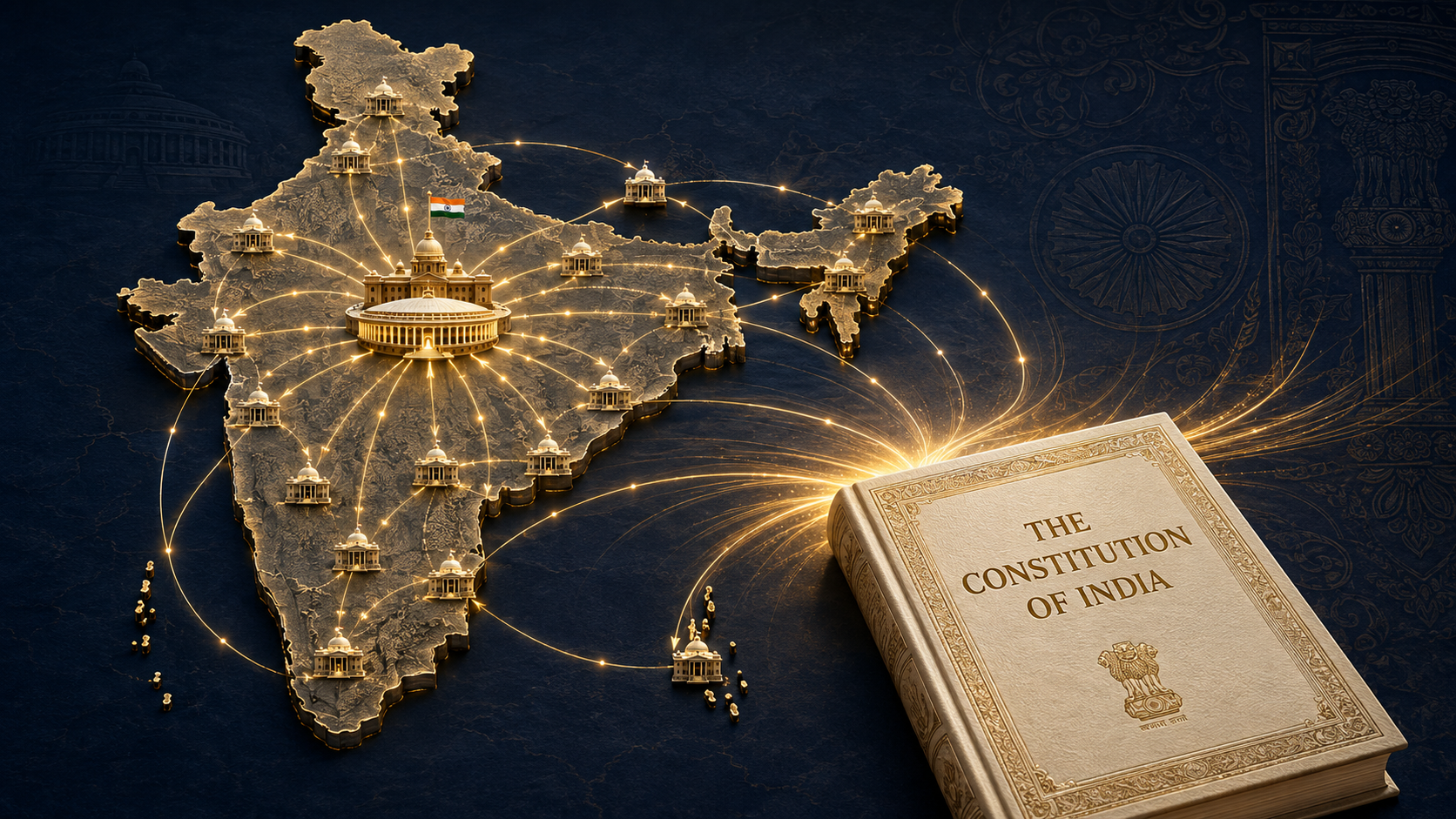
A. Basic Framework | सामान्य जानकारी
- Centre–State Relations का मुख्य constitutional framework Part XI में है।
- Part XI में Articles 245 से 263 आते हैं।
- Part XI के Chapter I में Legislative Relations दिए गए हैं।
- Part XI के Chapter II में Administrative Relations दिए गए हैं।
- भारत में Union और States दोनों को Constitution से powers मिलती हैं।
- Legislative powers का मुख्य division Seventh Schedule में है।
- Seventh Schedule में Union List, State List और Concurrent List हैं।
- Union List के matters पर सामान्यतः Parliament law बनाती है।
- State List के matters पर सामान्यतः State Legislature law बनाती है।
- Concurrent List के matters पर Parliament और State Legislature दोनों law बना सकते हैं।
B. Articles 245–248 | Legislative Powers
- Article 245 laws के territorial extent से संबंधित है।
- Parliament पूरे India या उसके किसी part के लिए law बना सकती है।
- State Legislature पूरे State या उसके किसी part के लिए law बना सकती है।
- Parliamentary law केवल extra-territorial operation होने के कारण invalid नहीं होता।
- Article 246 legislative subjects के distribution से संबंधित है।
- Union List पर Parliament की exclusive legislative power होती है।
- State List पर सामान्यतः State Legislature की exclusive power होती है।
- Concurrent List पर Centre और State दोनों law बना सकते हैं।
- Union List में defence, foreign affairs और currency जैसे matters आते हैं।
- State List में police, public order और agriculture जैसे matters आते हैं।
- Concurrent List में criminal law, marriage और education जैसे कई shared subjects आते हैं।
- Article 246A GST से संबंधित special legislative power देता है।
- GST पर Parliament और States दोनों को constitutional legislative power मिली है।
- Inter-State supply पर GST law बनाने की exclusive power Parliament को है।
- Article 247 Parliament को Union laws के बेहतर administration के लिए additional courts बनाने की अनुमति देता है।
- Article 248 residuary legislative powers Parliament को देता है।
- जो matter State List या Concurrent List में नहीं है, उस पर Parliament law बना सकती है।
- Residuary taxation power भी Parliament के पास है।
C. Parliament कब State List पर Law बना सकती है?
- सामान्य rule में State List पर State Legislature law बनाती है।
- लेकिन Constitution कुछ situations में Parliament को State List पर भी law बनाने देता है।
- Article 249 national interest में Parliament को State List पर law बनाने की power देता है।
- Article 249 की शुरुआत Rajya Sabha resolution से होती है।
- Resolution को present and voting members की कम-से-कम 2/3 majority चाहिए।
- Resolution में State List का relevant matter specify किया जाता है।
- Article 249 resolution अधिकतम 1 year के लिए effective रहता है।
- इसे फिर एक-एक वर्ष के लिए renew किया जा सकता है।
- Resolution खत्म होने के बाद Parliamentary law सामान्यतः 6 months तक effective रह सकता है।
- Article 249 Rajya Sabha की special federal power है।
- Article 250 National Emergency के दौरान Parliament को State List पर law बनाने देता है।
- Emergency खत्म होने के बाद ऐसा law सामान्यतः 6 months तक effective रहता है।
- Article 249 और Article 250 State Legislature की law-making power पूरी तरह खत्म नहीं करते।
- Conflict होने पर Article 249/250 के तहत बनाया Parliamentary law prevail करता है।
- यह rule Article 251 में दिया गया है।
- Article 252 दो या अधिक States की consent पर Parliament को State subject पर law बनाने देता है।
- इसके लिए संबंधित State Legislatures resolution pass करती हैं।
- बाद में कोई अन्य State भी उस Parliamentary law को adopt कर सकती है।
- Article 252 law को लागू State स्वयं amend या repeal नहीं कर सकता।
- उसे amend या repeal करने की power Parliament के पास रहती है।
- Article 253 international treaties और agreements लागू करने के लिए Parliament को विशेष power देता है।
- Treaty लागू करने के लिए Parliament State List matter पर भी legislation कर सकती है।
D. Article 254 | Repugnancy
- Article 254 Centre और State laws के conflict से संबंधित है।
- Article 254 मुख्य रूप से Concurrent List के matters पर लागू होता है।
- State law और valid Parliamentary law में conflict हो तो सामान्यतः Parliamentary law prevail करता है।
- State law conflict की सीमा तक void हो सकता है।
- इसे Doctrine of Repugnancy कहा जाता है।
- Article 254(2) State law के लिए important exception देता है।
- State law को President के consideration के लिए reserve किया जा सकता है।
- President assent दे दे तो वह State law उस State में prevail कर सकता है।
- लेकिन Parliament बाद में उस State law को override कर सकती है।
- Parliament बाद में उसे amend, vary या repeal करने वाला law भी बना सकती है।
- केवल दो laws अलग होने से repugnancy automatically नहीं बनती।
- वास्तविक legal conflict होना जरूरी है।
- Article 255 कुछ recommendation और previous sanction requirements को procedural nature का मानता है।
E. Administrative Relations | Articles 256–258A
- Article 256 States की obligation से संबंधित है।
- State executive power को Parliamentary laws का पालन सुनिश्चित करना चाहिए।
- Union इस purpose के लिए State को directions दे सकती है।
- Article 257 कहता है कि State executive action Union executive power को obstruct नहीं करना चाहिए।
- Union कुछ situations में State को directions दे सकती है।
- National या military importance की communication facilities पर Union directions दे सकती है।
- Railways की protection के लिए भी Union States को directions दे सकती है।
- ऐसी directions से State को extra cost आए तो Union compensation दे सकती है।
- Cost पर disagreement होने पर arbitrator Chief Justice of India द्वारा appoint किया जा सकता है।
- Article 257A अब omitted है।
- Article 258 Union functions States को सौंपने से संबंधित है।
- President State Government की consent से Union functions State को सौंप सकता है।
- यह entrustment conditional या unconditional हो सकता है।
- Parliament State officers पर Union law से संबंधित duties भी impose कर सकती है।
- Article 258A इसका reverse arrangement देता है।
- Governor, Government of India की consent से State functions Union को सौंप सकता है।
- Article 258 और 258A cooperative administration को आसान बनाते हैं।
F. Articles 260–263
- Article 260 India के बाहर के territories से संबंधित Union jurisdiction का provision देता है।
- Government of India agreement के आधार पर foreign territory के कुछ functions undertake कर सकती है।
- Article 261 public acts, records और judicial proceedings से संबंधित है।
- Union और States के public acts और records को पूरे India में recognition दिया जाता है।
- Civil Court का final judgment law के अनुसार India के दूसरे parts में भी execute किया जा सकता है।
- Article 262 Inter-State river water disputes से संबंधित है।
- Parliament inter-State river या river valley के water disputes के adjudication के लिए law बना सकती है।
- Parliament ऐसे disputes में Supreme Court सहित courts की jurisdiction exclude कर सकती है।
- इसलिए हर inter-State water dispute सीधे Article 131 में Supreme Court के सामने नहीं जाता।
- Inter-State River Water Disputes Act Article 262 से जुड़ी important legislation है।
- Article 263 Inter-State Council से संबंधित है।
- President public interest में Inter-State Council establish कर सकता है।
- Council States के बीच disputes पर inquiry और advice कर सकती है।
- Centre और States के common-interest subjects पर discussion कर सकती है।
- Council policy coordination के लिए recommendations कर सकती है।
- Inter-State Council 28 May 1990 को Presidential Order द्वारा स्थापित किया गया था।
- इसे Sarkaria Commission की recommendation के बाद स्थापित किया गया।
- Inter-State Council के Chairman Prime Minister होते हैं।
G. Federalism – Judiciary Points
- भारत में Centre और States की powers Constitution द्वारा divide की गई हैं।
- Indian federal system में Centre को कई areas में stronger position दी गई है।
- Strong Centre होने के बावजूद States केवल Centre के agents नहीं हैं।
- States का अपना independent constitutional existence है।
- S.R. Bommai v. Union of India (1994) Centre–State relations का landmark case है।
- Supreme Court ने Federalism को Basic Structure का हिस्सा माना है।
- Federalism और democracy एक-दूसरे से closely connected constitutional principles हैं।
- Emergency powers federal character को समाप्त नहीं करतीं; वे exceptional provisions हैं।
- Centre–State disputes में Constitution की distribution of powers सबसे पहले देखी जाती है।
- Legislative competence तय करने में Seventh Schedule बहुत महत्वपूर्ण है।
- State List का existence Indian federal structure का important feature है।
- Centre और States के बीच cooperation को अक्सर Co-operative Federalism कहा जाता है।
Emergency Provisions आपातकालीन उपबंध
A. Basic Framework | सामान्य जानकारी
- Emergency Provisions संविधान के Part XVIII में दिए गए हैं।
- Part XVIII में Articles 352 से 360 आते हैं।
- Constitution मुख्य रूप से तीन प्रकार की Emergency की व्यवस्था करता है।
- Article 352 National Emergency से संबंधित है।
- Article 356 State में constitutional machinery failure से संबंधित है।
- Article 360 Financial Emergency से संबंधित है।
B. Article 352 | National Emergency
- Article 352 को सामान्यतः National Emergency कहा जाता है।
- National Emergency का पहला ground War है।
- दूसरा ground External Aggression है।
- तीसरा ground Armed Rebellion है।
- National Emergency पूरे India में लगाई जा सकती है।
- इसे India के केवल किसी हिस्से में भी लगाया जा सकता है।
- Actual war शुरू होने से पहले भी Emergency घोषित की जा सकती है।
- इसके लिए war, external aggression या armed rebellion का imminent danger होना पर्याप्त हो सकता है।
- पहले Article 352 में “Internal Disturbance” शब्द था।
- 44th Constitutional Amendment ने “Internal Disturbance” की जगह “Armed Rebellion” किया।
- यह बदलाव 20 June 1979 से effective हुआ।
- President National Emergency अपने personal decision से नहीं लगा सकता।
- Union Cabinet का decision President को writing में communicate होना जरूरी है।
- यहाँ Union Cabinet का अर्थ Prime Minister और Cabinet-rank Ministers से है।
- यह written Cabinet advice safeguard 44th Amendment से आया।
- Emergency Proclamation Parliament के दोनों Houses के सामने रखी जाती है।
- इसे 1 month के भीतर Parliament से approval मिलना जरूरी है।
- Approval Lok Sabha और Rajya Sabha दोनों से आवश्यक है।
- National Emergency approval के लिए special majority चाहिए।
- यह majority House की total membership की majority होनी चाहिए।
- साथ ही present and voting members की कम-से-कम 2/3 majority भी चाहिए।
- Parliament से approved Emergency सामान्यतः 6 months तक चलती है।
- इसे हर 6 months पर Parliament की fresh approval से आगे बढ़ाया जा सकता है।
- Article 352 में National Emergency के लिए कोई fixed maximum total period नहीं दिया गया है।
C. Lok Sabha Safeguard
- Lok Sabha Emergency को disapprove कर दे तो President को उसे revoke करना होता है।
- Lok Sabha के कम-से-कम 1/10 members special sitting की मांग कर सकते हैं।
- इसके लिए written notice देना होता है।
- House session में हो तो notice Speaker को दिया जाता है।
- House session में न हो तो notice President को दिया जाता है।
- ऐसी notice मिलने पर special sitting 14 days के भीतर होनी चाहिए।
- ये safeguards भी 44th Amendment के बाद मजबूत किए गए।
D. Effect of National Emergency | Articles 353–354
- Article 353 National Emergency के effects से संबंधित है।
- Emergency में Union की executive power States को directions देने तक बढ़ जाती है।
- Emergency के दौरान Parliament State List के matters पर भी law बना सकती है।
- ऐसी Parliamentary power का संबंध Article 250 से भी है।
- Emergency खत्म होने के बाद State List पर ऐसा Parliamentary law सामान्यतः 6 months बाद ineffective हो जाता है, जहाँ Parliament को केवल Emergency के कारण competence मिली थी।
- Article 354 Centre–State revenue distribution से संबंधित Emergency power देता है।
- President Articles 268–279 के revenue-distribution provisions में temporary modification कर सकता है।
- ऐसी modification Emergency खत्म होने वाले financial year से आगे नहीं चल सकती।
E. Article 355 | Duty of Union
- Article 355 Union पर States की protection का duty डालता है।
- Union को States को external aggression से protect करना है।
- Union को States को internal disturbance से भी protect करना है।
- Article 355 में आज भी “internal disturbance” शब्द मौजूद है।
- Union को यह भी सुनिश्चित करना है कि State Government Constitution के अनुसार चले।
Exam Trap: Article 352 = Armed Rebellion, लेकिन Article 355 = Internal Disturbance.
F. Article 356 | President's Rule
- Article 356 को सामान्यतः President's Rule कहा जाता है।
- Article 356 तब लागू हो सकता है जब State Government Constitution के अनुसार नहीं चल सकती।
- President Governor की report के आधार पर Article 356 लागू कर सकता है।
- President Governor की report के बिना भी Article 356 action ले सकता है।
- Article 356 में Constitution शब्द “or otherwise” इस्तेमाल करता है।
- President State Government के सभी या कुछ functions अपने हाथ में ले सकता है।
- State Legislature की powers Parliament द्वारा या Parliament के authority के तहत exercise की जा सकती हैं।
- President Article 356 के जरिए High Court की powers अपने हाथ में नहीं ले सकता।
- High Court से संबंधित constitutional provisions को Article 356 के तहत suspend नहीं किया जा सकता।
- Article 356 Proclamation दोनों Houses of Parliament के सामने रखी जाती है।
- इसे 2 months के भीतर Parliament से approval मिलना जरूरी है।
- Article 356 approval के लिए Article 352 जैसी special majority नहीं है।
- Approved President's Rule एक बार में 6 months तक चलता है।
- इसे हर 6 months में Parliament approval से आगे बढ़ाया जा सकता है।
- सामान्य constitutional maximum 3 years है।
- President's Rule को 1 year से आगे बढ़ाने के लिए extra conditions पूरी करनी होती हैं।
- पहली condition—National Emergency पूरे India या संबंधित State के पूरे/किसी हिस्से में लागू हो।
- दूसरी condition—Election Commission certify करे कि Assembly election कराने में difficulty है।
- दोनों conditions President's Rule को one year से आगे continue करने के लिए जरूरी हैं।
- Article 356 Proclamation को बाद में revoke या vary किया जा सकता है।
G. Article 357 | Legislative Powers during President's Rule
- Article 357 President's Rule के दौरान State legislative powers से संबंधित है।
- Parliament State Legislature की law-making power President को दे सकती है।
- President इस power को अन्य authority को delegate भी कर सकता है।
- Lok Sabha session में न हो तो President State Consolidated Fund से temporary expenditure authorise कर सकता है।
- President's Rule के दौरान बनाया गया State law Rule समाप्त होते ही अपने-आप खत्म नहीं होता।
- वह law competent Legislature द्वारा alter, repeal या amend किए जाने तक जारी रह सकता है।
H. Article 358 | Article 19 during Emergency
- Article 358 केवल Article 19 से संबंधित है।
- Article 358 हर प्रकार की National Emergency में लागू नहीं होता।
- यह War के आधार पर लगी Emergency में लागू होता है।
- यह External Aggression के आधार पर लगी Emergency में भी लागू होता है।
- Armed Rebellion के आधार पर लगी Emergency में Article 358 लागू नहीं होता।
- War/External Aggression Emergency में Article 19 State action को उसी तरह restrict नहीं करता।
- Emergency खत्म होने पर ऐसे laws future के लिए सामान्य constitutional limitations के अधीन हो जाते हैं।
- Article 358 protection पाने वाले law में Emergency से संबंध का recital होना आवश्यक है।
- Article 358 का operation automatic है; अलग Presidential Order जरूरी नहीं है।
I. Article 359 | Enforcement of Fundamental Rights
- Article 359 Article 358 से अलग है।
- Article 359 में President को अलग order जारी करना होता है।
- President specified Fundamental Rights के enforcement के लिए court जाने का right suspend कर सकता है।
- Article 359 सभी Fundamental Rights को automatically suspend नहीं करता।
- Presidential Order में जिन rights का उल्लेख है, उन्हीं पर उसका effect पड़ता है।
- Article 20 का court-enforcement suspend नहीं किया जा सकता।
- Article 21 का court-enforcement भी suspend नहीं किया जा सकता।
- Articles 20 और 21 को यह protection 44th Amendment से मिली।
- इसलिए Emergency में भी life and personal liberty की constitutional protection को Article 359 से court-enforcement से बाहर नहीं किया जा सकता।
- Article 358 = केवल Article 19, जबकि Article 359 = specified Part III rights के court-enforcement से संबंधित है।
J. Article 360 | Financial Emergency
- Article 360 Financial Emergency से संबंधित है।
- Financial Emergency तब लग सकती है जब India या उसके किसी part की financial stability or credit threatened हो।
- Financial Emergency की Proclamation President जारी करता है।
- इसे Parliament के दोनों Houses के सामने रखना जरूरी है।
- इसे 2 months के भीतर Parliament से approval मिलना चाहिए।
- Financial Emergency में Union States को financial propriety संबंधी directions दे सकती है।
- State employees के salaries और allowances कम करने का direction दिया जा सकता है।
- State Money Bills को President के consideration के लिए reserve करने का direction भी दिया जा सकता है।
- President Union employees के salaries और allowances में reduction का direction दे सकता है।
- इसमें Supreme Court और High Court Judges के salaries और allowances भी शामिल हो सकते हैं।
Panchayats, Municipalities & Co-operative Societies
पंचायतें, नगरपालिकाएँ एवं सहकारी समितियाँ
A. Panchayats | पंचायतें
- Panchayats से संबंधित provisions Constitution के Part IX में हैं।
- Part IX में Articles 243 से 243-O आते हैं।
- Part IX को 73rd Constitutional Amendment Act, 1992 द्वारा जोड़ा गया।
- 73rd Amendment के Panchayat provisions 24 April 1993 से लागू हुए।
- Article 243 Panchayats से संबंधित definitions देता है।
- Article 243A Gram Sabha से संबंधित है।
- Gram Sabha में village की electoral roll में registered persons शामिल होते हैं।
- Gram Sabha की powers State Legislature law द्वारा तय करती है।
- Article 243B Panchayats के constitution से संबंधित है।
- सामान्यतः Panchayati Raj की three-tier system होती है।
- पहला स्तर Village Level है।
- दूसरा स्तर Intermediate Level है।
- तीसरा स्तर District Level है।
- 20 lakh या उससे कम population वाले State में Intermediate Level Panchayat बनाना जरूरी नहीं है।
- Article 243C Panchayats की composition से संबंधित है।
- Panchayat की सभी elected seats territorial constituencies से direct election द्वारा भरी जाती हैं।
- Intermediate और District Panchayat के Chairpersons elected members में से चुने जाते हैं।
- Village Panchayat Chairperson के election का तरीका State Legislature तय करती है।
- Article 243D Panchayats में reservation से संबंधित है।
- Panchayats में SC और ST के लिए seats reserve होती हैं।
- SC/ST reservation सामान्यतः उनकी local population के proportion के अनुसार होता है।
- SC/ST reserved seats में कम-से-कम one-third seats women के लिए होती हैं।
- हर Panchayat में directly elected total seats में कम-से-कम one-third seats women के लिए reserved होती हैं।
- Women reservation में SC/ST women की reserved seats भी शामिल होती हैं।
- Panchayats में women reservation constitutional minimum है; State इससे अधिक reservation दे सकता है।
- Panchayat Chairpersons के offices में भी reservation का provision है।
- प्रत्येक level पर Chairpersons के कम-से-कम one-third offices women के लिए reserved होते हैं।
- State backward classes के लिए भी Panchayat reservation दे सकता है।
B. Term, Powers & Elections of Panchayats
- Article 243E Panchayat की duration से संबंधित है।
- Panchayat की normal term 5 years होती है।
- Election normal term खत्म होने से पहले पूरा किया जाना चाहिए।
- Panchayat dissolve हो जाए तो सामान्यतः 6 months के भीतर election होना चाहिए।
- अगर remaining term 6 months से कम हो तो उस short period के लिए election जरूरी नहीं है।
- Mid-term election से बनी Panchayat केवल पुरानी Panchayat की remaining term तक रहती है।
- Article 243F membership disqualification से संबंधित है।
- Panchayat election के लिए constitutional minimum age 21 years हो सकती है।
- केवल 25 years से कम होने के कारण व्यक्ति disqualified नहीं होगा यदि उसने 21 years पूरे कर लिए हैं।
- Article 243G Panchayats की powers और responsibilities से संबंधित है।
- State Legislature Panchayats को self-government की powers दे सकती है।
- Panchayats economic development और social justice के plans बना सकती हैं।
- Panchayats से जुड़े subjects Eleventh Schedule में दिए गए हैं।
- Eleventh Schedule में कुल 29 subjects हैं।
- Agriculture Eleventh Schedule का subject है।
- Minor irrigation और water management भी इसमें हैं।
- Rural housing और drinking water भी इसमें हैं।
- Primary/secondary education भी इसमें शामिल है।
- Health, sanitation और family welfare भी Eleventh Schedule में हैं।
- Public Distribution System भी इसमें शामिल है।
- Article 243H Panchayats की taxation और funds से संबंधित है।
- State law Panchayat को taxes, duties, tolls और fees लगाने की power दे सकता है।
- Article 243-I State Finance Commission से संबंधित है।
- Governor प्रत्येक 5 years में State Finance Commission constitute करता है।
- State Finance Commission Panchayats की financial position review करता है।
- Article 243J Panchayat accounts और audit से संबंधित है।
- Article 243K Panchayat elections से संबंधित है।
- Panchayat elections का control State Election Commission के पास होता है।
- State Election Commissioner को Governor appoint करता है।
- State Election Commissioner को High Court Judge जैसी manner और grounds पर ही remove किया जा सकता है।
- Article 243-O Panchayat elections में courts के interference को limit करता है।
- Panchayat election सामान्यतः prescribed Election Petition से challenge किया जाता है।
C. Special Areas & PESA
- Article 243M कुछ areas को Part IX से बाहर रखता है।
- Scheduled Areas और certain Tribal Areas पर Part IX automatically लागू नहीं होता।
- Parliament Part IX को Scheduled Areas तक exceptions/modifications के साथ extend कर सकती है।
- इसी constitutional power से PESA Act, 1996 जुड़ा है।
- PESA का पूरा नाम Provisions of the Panchayats (Extension to the Scheduled Areas) Act, 1996 है।
- PESA Fifth Schedule के Scheduled Areas में Panchayati Raj को special tribal safeguards के साथ लागू करता है।
D. Municipalities | नगरपालिकाएँ
- Municipalities से संबंधित provisions Part IXA में हैं।
- Part IXA में Articles 243P से 243ZG आते हैं।
- Part IXA 74th Constitutional Amendment Act, 1992 से जोड़ा गया।
- Municipal provisions 1 June 1993 से effective हुए।
- Article 243Q तीन प्रकार की Municipalities बताता है।
- Rural से Urban transition वाले area के लिए Nagar Panchayat होती है।
- Smaller Urban Area के लिए Municipal Council होती है।
- Larger Urban Area के लिए Municipal Corporation होती है।
- Governor notified Industrial Township में Municipality न बनाने का निर्णय ले सकता है।
- Article 243R Municipality की composition से संबंधित है।
- Municipal area को electoral Wards में divide किया जाता है।
- सामान्यतः Municipality की seats direct election से भरी जाती हैं।
- Municipal administration के special knowledge वाले persons को State law representation दे सकता है।
- ऐसे nominated experts को Municipality meetings में vote करने का right नहीं होता।
- Article 243S Wards Committees से संबंधित है।
- 3 lakh या अधिक population वाली Municipality में Wards Committees बनाई जाती हैं।
E. Reservation, Term & Elections of Municipalities
- Article 243T Municipal reservation से संबंधित है।
- Municipalities में SC और ST के लिए seats reserved होती हैं।
- उनका reservation local SC/ST population के proportion से जुड़ा है।
- Directly elected municipal seats में कम-से-कम one-third seats women के लिए reserved होती हैं।
- इसमें SC/ST women की reserved seats भी शामिल हैं।
- State backward classes के लिए भी Municipal reservation का provision कर सकता है।
- Article 243U Municipality की duration से संबंधित है।
- Municipality की normal term 5 years होती है।
- Dissolution के बाद सामान्यतः 6 months के भीतर election होना चाहिए।
- Municipality membership के लिए भी 21 years की constitutional age protection लागू है।
- Article 243W Municipal powers से संबंधित है।
- Municipal functions से जुड़े subjects Twelfth Schedule में हैं।
- Twelfth Schedule में कुल 18 subjects हैं।
- Urban planning, roads, water supply और sanitation इसके important subjects हैं।
- Fire services और urban forestry भी Twelfth Schedule में हैं।
- Slum improvement और urban poverty alleviation भी इसमें हैं।
- Birth और death registration भी Twelfth Schedule का subject है।
- Municipal elections भी State Election Commission कराता है।
F. Planning Committees
- Article 243ZD District Planning Committee से संबंधित है; यह Panchayats और Municipalities के plans को consolidate करती है और इसके कम-से-कम 4/5 members elected local-body members में से चुने जाते हैं।
- Article 243ZE Metropolitan Planning Committee से संबंधित है; Metropolitan Area के लिए population 10 lakh या अधिक होती है और committee के कम-से-कम 2/3 members elected Municipal members/Panchayat Chairpersons में से चुने जाते हैं।
G. Co-operative Societies | सहकारी समितियाँ
- 97th Constitutional Amendment ने Article 19(1)(c) में co-operative societies को जोड़ा और Article 43B भी insert किया; Article 43B voluntary formation, autonomous functioning, democratic control और professional management को promote करने की बात करता है।
- 97th Amendment ने Part IXB – Articles 243ZH से 243ZT भी जोड़ा, लेकिन Supreme Court ने Union of India v. Rajendra N. Shah (2021) में State co-operative societies के संबंध में Part IXB को required State ratification न होने के कारण invalid माना।
- Current Exam Position: Part IXB केवल Multi-State Co-operative Societies के संबंध में operative है; Article 19(1)(c) में co-operative societies और Article 43B पर Rajendra N. Shah judgment का यह invalidation लागू नहीं हुआ।
Elections & Election Commission
निर्वाचन एवं निर्वाचन आयोग
A. Basic Constitutional Framework
- Elections से संबंधित provisions Constitution के Part XV में दिए गए हैं।
- Part XV में Articles 324 से 329 आते हैं।
- Article 324 Election Commission of India से संबंधित है।
- Election Commission of India एक constitutional body है।
- Election Commission की स्थापना 25 January 1950 को हुई थी।
- Election Commission elections की superintendence, direction और control करता है।
- Electoral rolls की preparation भी Article 324 के control में आती है।
- Election Commission Lok Sabha elections conduct करता है।
- Election Commission Rajya Sabha elections भी conduct करता है।
- Election Commission State Legislatures, President और Vice-President के elections भी conduct करता है।
- Panchayat और Municipal elections Election Commission of India नहीं कराता।
- Local body elections संबंधित State Election Commission कराता है।
B. Composition of Election Commission
- Election Commission में एक Chief Election Commissioner (CEC) होता है।
- President समय-समय पर अन्य Election Commissioners की संख्या तय कर सकता है।
- वर्तमान व्यवस्था में Election Commission एक three-member body है—CEC और दो Election Commissioners।
- CEC और Election Commissioners की formal appointment President करता है।
- Appointment President के warrant under his hand and seal से होती है।
- Article 324 appointments को Parliament द्वारा बनाए गए law के अधीन रखता है।
- वर्तमान appointment framework Chief Election Commissioner and Other Election Commissioners Act, 2023 में दिया गया है।
- यह Act 2 February 2024 से लागू है।
C. Current Appointment Process
- CEC और Election Commissioners के लिए पहले Search Committee panel तैयार करती है।
- Search Committee का head Union Law Minister होता है।
- Search Committee में दो अन्य members कम-से-कम Government of India के Secretary rank के होते हैं।
- Search Committee सामान्यतः 5 persons का panel तैयार करती है।
- इसके बाद Selection Committee recommendation देती है।
- Selection Committee के Chairman Prime Minister होते हैं।
- Lok Sabha के Leader of Opposition Selection Committee के member होते हैं।
- Prime Minister द्वारा nominated एक Union Cabinet Minister भी member होता है।
- यदि recognised Leader of Opposition न हो तो largest opposition party का leader इस purpose के लिए माना जाता है।
- Selection Committee Search Committee के panel के बाहर के योग्य व्यक्ति पर भी विचार कर सकती है।
D. Qualification, Term & Removal
- CEC/EC के लिए व्यक्ति Government of India के Secretary rank के equivalent post पर हो या रह चुका हो।
- उसमें integrity होना जरूरी है।
- उसे election management और conduct का knowledge तथा experience होना चाहिए।
- CEC और Election Commissioner की term 6 years है।
- लेकिन 65 years की age पहले पूरी हो जाए तो office समाप्त हो जाता है।
- इसलिए term है—6 years or 65 years, whichever is earlier।
- CEC और Election Commissioners re-appointment के लिए eligible नहीं होते।
- Election Commissioner बाद में CEC बन सकता है।
- लेकिन EC + CEC मिलाकर total tenure 6 years से अधिक नहीं हो सकता।
- CEC और EC resignation President को देते हैं।
- Chief Election Commissioner को Supreme Court Judge जैसी manner और grounds पर remove किया जाता है।
- अन्य Election Commissioner को CEC की recommendation के बिना remove नहीं किया जा सकता।
- CEC की service conditions appointment के बाद उसके disadvantage में नहीं बदली जा सकतीं।
- Commission में disagreement हो तो matter majority opinion से decide होता है।
E. Article 325 | Electoral Roll
- Article 325 electoral rolls से संबंधित है।
- प्रत्येक territorial constituency के लिए एक general electoral roll होता है।
- Religion के आधार पर किसी व्यक्ति को electoral roll से बाहर नहीं किया जा सकता।
- Race के आधार पर exclusion नहीं किया जा सकता।
- Caste के आधार पर exclusion नहीं किया जा सकता।
- Sex के आधार पर भी exclusion नहीं किया जा सकता।
- Constitution अलग communal electoral rolls की व्यवस्था नहीं करता।
F. Article 326 | Adult Suffrage
- Article 326 adult suffrage से संबंधित है।
- Lok Sabha और State Legislative Assembly elections adult suffrage पर आधारित हैं।
- Voter बनने के लिए व्यक्ति का Indian citizen होना जरूरी है।
- Voting registration की constitutional minimum age 18 years है।
- पहले voting age 21 years थी।
- 61st Constitutional Amendment ने voting age 21 से घटाकर 18 years की।
- Non-residence voter registration की disqualification का आधार हो सकता है।
- Unsoundness of mind भी law के अनुसार disqualification का आधार हो सकता है।
- Crime या corrupt/illegal practice भी law के अनुसार disqualification का आधार हो सकती है।
G. Articles 327–329
- Article 327 Parliament को elections के संबंध में law बनाने की power देता है।
- Parliament electoral rolls और constituencies से जुड़े matters पर law बना सकती है।
- Article 328 State Legislature को State Legislature elections पर law बनाने की limited power देता है।
- State law Constitution और Parliamentary law के अधीन होता है।
- Article 329 election matters में courts के interference को limit करता है।
- Constituency delimitation law की validity को election process के बीच सामान्यतः court में challenge नहीं किया जा सकता।
- किसी election को केवल prescribed Election Petition द्वारा challenge किया जाता है।
- Article 329 का उद्देश्य चल रहे election process को unnecessary interruption से बचाना है।
- Election complete होने के बाद legal challenge का proper statutory remedy उपलब्ध रहता है।
- President और Vice-President के election disputes Article 329 नहीं बल्कि Article 71 के तहत Supreme Court decide करता है।
H. Representation of the People Act, 1950
- Representation of the People Act, 1950 election law का important statute है।
- RPA 1950 mainly electoral rolls से संबंधित है।
- यह voters की qualifications से भी संबंधित है।
- Constituencies और seats के allocation से जुड़े provisions भी इसमें हैं।
- Electoral rolls के preparation का detailed framework RPA 1950 में मिलता है।
- इसलिए याद रखें—RPA 1950 = Seats + Constituencies + Voters + Electoral Rolls।
I. Representation of the People Act, 1951
- Representation of the People Act, 1951 actual conduct of elections का प्रमुख law है।
- यह Parliament और State Legislature membership की qualifications से संबंधित है।
- यह membership की statutory disqualifications भी बताता है।
- Election conduct की detailed procedure RPA 1951 में दी गई है।
- Candidates की nomination भी इस Act के framework में आती है।
- Election expenses भी RPA 1951 में regulated हैं।
- Political parties का registration Section 29A से संबंधित है।
- Voting का statutory provision Section 62 में है।
- Corrupt practices भी RPA 1951 में defined हैं।
- Election offences के provisions भी इसी Act में हैं।
- Election Petition का provision Section 80 में है।
- Lok Sabha/Assembly आदि की Election Petition High Court try करता है।
- इसका provision Section 80A में है।
- याद रखें—RPA 1951 = Conduct + Candidates + Disqualification + Political Parties + Election Disputes।
J. EVM, VVPAT & NOTA
- EVM का full form Electronic Voting Machine है।
- Indian EVM में Ballot Unit और Control Unit मुख्य units हैं।
- EVM का पहली बार election में use 1982 के Parur Assembly by-election, Kerala में हुआ था।
- VVPAT का full form Voter Verifiable Paper Audit Trail है।
- VVPAT का पहली बार use 2013 Noksen Assembly by-election, Nagaland में हुआ।
- VVPAT voter को अपने recorded vote को verify करने की सुविधा देता है।
- VVPAT slip लगभग 7 seconds तक transparent window में दिखाई देती है।
- NOTA का अर्थ None of the Above है।
- Supreme Court के 2013 direction के बाद EVM/ballot में NOTA option दिया गया।
- NOTA Parliamentary और Assembly elections में उपलब्ध है, लेकिन Presidential election में NOTA लागू नहीं होता।
Constitutional Bodies + Public Service Commissions
संवैधानिक निकाय एवं लोक सेवा आयोग
A. Constitutional Bodies | सामान्य जानकारी
- Constitutional Body वह body है जिसका आधार सीधे Constitution of India में मिलता है।
- Constitutional Body और statutory body एक ही चीज नहीं हैं।
- Statutory Body किसी Act of Parliament या State Legislature से बनाई जाती है।
- Election Commission का constitutional आधार Article 324 है।
- CAG का constitutional आधार Article 148 है।
- Finance Commission का constitutional आधार Article 280 है।
- UPSC और State PSCs का constitutional आधार Article 315 है।
- NCSC, NCST और NCBC भी constitutional commissions हैं।
B. Comptroller and Auditor-General of India | CAG
- Article 148 Comptroller and Auditor-General of India से संबंधित है।
- CAG को सामान्यतः भारत की सर्वोच्च public audit authority माना जाता है।
- CAG की appointment President करता है।
- Appointment President के warrant under his hand and seal से होती है।
- CAG पद ग्रहण करने से पहले President या उसके द्वारा appointed person के सामने oath लेता है।
- CAG को हटाने की प्रक्रिया Supreme Court Judge जैसी है।
- CAG को उन्हीं grounds पर remove किया जा सकता है जिन पर Supreme Court Judge को हटाया जाता है।
- इसलिए CAG को सामान्य executive order से remove नहीं किया जा सकता।
- CAG की salary और service conditions appointment के बाद उसके disadvantage में नहीं बदली जा सकतीं।
- CAG office छोड़ने के बाद Union या State Government के किसी दूसरे office के लिए eligible नहीं होता।
- CAG office का administrative expenditure Consolidated Fund of India पर charged होता है।
- CAG की statutory term 6 years या 65 years की age, जो पहले हो, है।
- CAG अपनी resignation President को देता है।
- Article 149 CAG के duties and powers से संबंधित है।
- CAG के detailed duties Parliament द्वारा बनाए गए law में दिए जाते हैं।
- इसके लिए प्रमुख law CAG's Duties, Powers and Conditions of Service Act, 1971 है।
- Article 150 Union और States के accounts के form से संबंधित है।
- Accounts का form President, CAG की advice पर, prescribe करता है।
- Article 151 CAG की audit reports से संबंधित है।
- Union accounts की CAG report President को दी जाती है।
- President उस report को Parliament के दोनों Houses के सामने रखवाता है।
- State accounts की CAG report Governor को दी जाती है।
- Governor उसे State Legislature के सामने रखवाता है।
C. Finance Commission | वित्त आयोग
- Article 280 Finance Commission से संबंधित है।
- Finance Commission एक constitutional body है।
- Finance Commission को President constitute करता है।
- सामान्यतः Finance Commission प्रत्येक 5 years में constitute किया जाता है।
- आवश्यकता होने पर President इसे पाँच वर्ष से पहले भी constitute कर सकता है।
- Finance Commission में एक Chairman और 4 other members होते हैं।
- Members की qualifications Parliament law द्वारा तय करती है।
- Finance Commission Centre और States के बीच tax revenue distribution पर recommendation देता है।
- यह States को grants-in-aid के principles पर भी recommendation देता है।
- Panchayats के resources बढ़ाने के लिए State Consolidated Fund augment करने के measures पर भी recommendation देता है।
- Municipalities के resources बढ़ाने के measures पर भी recommendation देता है।
- President अन्य financial matter भी Finance Commission को refer कर सकता है।
- Finance Commission की recommendations advisory nature की होती हैं।
- Article 281 Finance Commission report से संबंधित है।
- President Finance Commission की recommendations Parliament के सामने रखवाता है।
- इसके साथ Government द्वारा की गई action का explanatory memorandum भी रखा जाता है।
- Current 16th Finance Commission के Chairman Dr. Arvind Panagariya हैं।
- 16th Finance Commission ने 2026–31 period के लिए report दी है।
- इस report को 17 November 2025 को President को submit किया गया था और बाद में Parliament में रखा गया।
D. Public Service Commissions | लोक सेवा आयोग
- Public Service Commissions के provisions Part XIV, Chapter II में हैं।
- इनसे संबंधित Articles 315 से 323 हैं।
- Article 315 Union और States के Public Service Commissions से संबंधित है।
- Union के लिए Union Public Service Commission (UPSC) होती है।
- प्रत्येक State के लिए सामान्यतः State Public Service Commission (SPSC) होती है।
- दो या अधिक States के लिए Joint State Public Service Commission भी बनाई जा सकती है।
- Joint State PSC बनाने के लिए संबंधित State Legislatures को पहले resolution pass करना होता है।
- इसके बाद Joint State PSC बनाने का law Parliament बनाती है।
- UPSC और Joint State PSC के Chairman तथा members की appointment President करता है।
- State PSC के Chairman और members की appointment Governor करता है।
- Article 316 PSC members की appointment और term से संबंधित है।
- जहाँ तक संभव हो, Commission के लगभग आधे members ऐसे होने चाहिए जिन्होंने कम-से-कम 10 years Government service की हो।
- UPSC member की term 6 years या 65 years की age, जो पहले हो, है।
- Joint State PSC member के लिए भी age limit 65 years है।
- State PSC member की term 6 years या 62 years की age, जो पहले हो, है।
- UPSC या Joint PSC member resignation President को देता है।
- State PSC member resignation Governor को देता है।
- Article 317 PSC member के removal और suspension से संबंधित है।
- UPSC, Joint PSC और State PSC के member को constitutional grounds पर remove करने की final power President के पास है।
- Misbehaviour के case में Supreme Court inquiry का constitutional role होता है।
- Insolvency भी PSC member को हटाने का ground हो सकता है।
- अपने office के बाहर paid employment करना भी removal का ground बन सकता है।
- Mental या physical infirmity भी constitutional conditions के अनुसार removal का आधार हो सकती है।
- Article 318 Commission के members और staff की service conditions के regulations से संबंधित है।
- Article 319 office छोड़ने के बाद PSC members के दूसरे Government offices पर restrictions लगाता है।
- UPSC Chairman office छोड़ने के बाद Union या State Government के किसी अन्य employment के लिए eligible नहीं होता।
- State PSC Chairman आगे UPSC का Chairman या member बन सकता है।
- State PSC Chairman किसी दूसरे State PSC का Chairman भी बन सकता है।
E. Functions of UPSC / SPSC
- Article 320 Public Service Commissions के functions से संबंधित है।
- UPSC Union services में appointments के लिए examinations conduct करता है।
- State PSC State services के लिए examinations conduct करता है।
- दो या अधिक States request करें तो UPSC joint recruitment schemes में assistance दे सकता है।
- Recruitment methods से जुड़े matters पर Commission से consultation की जा सकती है।
- Civil services में appointments से जुड़े principles पर PSC advice देता है।
- Promotions से जुड़े principles भी Article 320 के functions में आते हैं।
- Transfer from one service to another से जुड़े matters पर भी consultation हो सकती है।
- Disciplinary matters भी PSC के important constitutional functions में आते हैं।
- Government किसी matter को भी advice के लिए Commission को refer कर सकती है।
- Article 321 Parliament या State Legislature को PSC के functions बढ़ाने की अनुमति देता है।
- Article 322 PSC के expenses से संबंधित है।
- UPSC का expenditure Consolidated Fund of India पर charged होता है।
- State PSC का expenditure संबंधित Consolidated Fund of State पर charged होता है।
- Article 323 PSC की annual reports से संबंधित है।
- UPSC अपनी report President को देता है।
- State PSC अपनी report Governor को देता है।
- Government PSC की advice न माने तो Legislature के सामने कारण बताने वाला memorandum रखना होता है।
F. NCSC, NCST & NCBC
- Article 338 National Commission for Scheduled Castes यानी NCSC से संबंधित है।
- NCSC में Chairperson, Vice-Chairperson और 3 other members होते हैं।
- NCSC Scheduled Castes को मिले constitutional और legal safeguards की जांच करता है।
- NCSC अपनी reports President को देता है।
- Article 338A National Commission for Scheduled Tribes यानी NCST से संबंधित है।
- NCST को अलग constitutional commission का status 89th Constitutional Amendment से मिला।
- NCST भी Chairperson, Vice-Chairperson और 3 other members वाला commission है।
- यह Scheduled Tribes के safeguards और welfare measures को monitor करता है।
- Article 338B National Commission for Backward Classes यानी NCBC से संबंधित है।
- NCBC को constitutional status 102nd Constitutional Amendment Act, 2018 से मिला।
- NCBC socially and educationally backward classes के safeguards की जांच करता है।
- NCBC specific complaints की inquiry भी कर सकता है।
- NCSC, NCST और NCBC को inquiry के दौरान कुछ matters में civil court जैसी powers प्राप्त हैं।
G. Special Officer for Linguistic Minorities
- Article 350B Special Officer for Linguistic Minorities से संबंधित है।
- Special Officer को President appoint करता है।
- उसका काम linguistic minorities के constitutional safeguards की जांच करना है।
- वह अपनी reports President को देता है।
- President इन reports को Parliament के दोनों Houses के सामने रखवाता है।
- Reports संबंधित State Governments को भी भेजी जाती हैं।
Finance, Property, Contracts, Services & Tribunals
वित्त, संपत्ति, संविदाएँ, सेवाएँ एवं अधिकरण
A. Finance | वित्त
- Finance से जुड़े मुख्य provisions Constitution के Part XII में हैं।
- Part XII में Articles 264 से 300A आते हैं।
- Article 265 कहता है कि law की authority के बिना कोई tax न लगाया जा सकता है और न collect किया जा सकता है।
- इसलिए Government केवल executive order से tax नहीं लगा सकती।
- Article 266 Consolidated Fund और Public Account से संबंधित है।
- Union का मुख्य Government fund Consolidated Fund of India है।
- State का मुख्य fund Consolidated Fund of the State होता है।
- Government की revenues, loans और loan repayments जैसी रकम Consolidated Fund में जाती है।
- Consolidated Fund से money निकालने के लिए Constitution के अनुसार legislative authority जरूरी होती है।
- Government द्वारा received other public money सामान्यतः Public Account में credit होती है।
- Article 267 Contingency Fund से संबंधित है।
- Contingency Fund अचानक और unforeseen expenditure के लिए होता है।
- Union Contingency Fund President के disposal में रहता है।
- State Contingency Fund Governor के disposal में रहता है।
- बाद में ऐसे expenditure के लिए Legislature से approval लिया जाता है।
- Article 268 कुछ duties को Union द्वारा levy लेकिन States द्वारा collect/appropriate करने की व्यवस्था करता है।
- Article 269 कुछ taxes को Union द्वारा levy और collect करके States को assign करने से संबंधित है।
- Article 269A inter-State GST से संबंधित है।
- Inter-State GST Government of India collect करती है और Union तथा States में apportion किया जाता है।
- Import of goods/services को GST के लिए inter-State supply माना जाता है।
- Article 270 Union और States के बीच taxes के distribution से संबंधित है।
- Article 271 Parliament को certain Union taxes पर surcharge लगाने की power देता है।
- Surcharge की proceeds Union के purposes के लिए जाती हैं।
- Article 275 कुछ States को Union grants-in-aid से संबंधित है।
- Scheduled Tribes और Scheduled Areas के welfare के लिए भी Article 275 महत्वपूर्ण है।
- Article 276 profession, trade, calling और employment पर tax से संबंधित है।
- Article 276 के तहत profession tax की constitutional maximum limit ₹2,500 per person per year है।
- Article 279 “net proceeds” की calculation से संबंधित है और CAG का certificate final माना जाता है।
B. GST Council & Finance Commission
- Article 279A GST Council से संबंधित है।
- GST Council का Chairman Union Finance Minister होता है।
- Union Minister of State in charge of Revenue/Finance इसका member होता है।
- प्रत्येक State अपना Finance/Taxation Minister या nominated Minister भेजता है।
- GST Council की meeting का quorum total members का one-half है।
- Decision के लिए weighted votes का कम-से-कम three-fourths majority चाहिए।
- Central Government के vote का weight one-third होता है।
- सभी States के votes का combined weight two-thirds होता है।
- Article 280 Finance Commission से संबंधित है।
- Finance Commission की detailed study Chapter 17 में already cover की जा चुकी है।
- Article 281 Finance Commission recommendations को Parliament के सामने रखने से संबंधित है।
C. Other Financial Provisions & Borrowing
- Article 282 Union या State को public purpose के लिए grants देने की अनुमति देता है।
- यह power ऐसे purpose पर भी use हो सकती है जो उस Government के normal legislative field में न हो।
- Article 283 Consolidated Funds, Contingency Funds और Public Accounts की custody से संबंधित है।
- Article 285 Union property को सामान्यतः State taxation से exemption देता है।
- Parliament law द्वारा इस exemption में बदलाव कर सकती है।
- Article 289 State की property और income को सामान्यतः Union taxation से protection देता है।
- State के commercial trade/business पर Parliament law द्वारा taxation की व्यवस्था कर सकती है।
- Article 292 Government of India की borrowing से संबंधित है।
- Union borrowing Consolidated Fund of India की security पर की जा सकती है।
- Article 293 States की borrowing से संबंधित है।
- State Government केवल India के भीतर borrowing कर सकती है।
- State borrowing Consolidated Fund of State की security पर हो सकती है।
- यदि State पर Union का loan या guarantee outstanding है, तो further borrowing के लिए Government of India की consent जरूरी हो सकती है।
D. Property of Union & States
- Articles 294–295 Government property, assets, rights और liabilities के succession से संबंधित हैं।
- Article 296 escheat, lapse और bona vacantia से संबंधित है।
- Ownerless property किस Government में vest होगी, यह property की location और nature पर depend कर सकता है।
- Article 297 territorial waters, continental shelf और Exclusive Economic Zone के certain resources से संबंधित है।
- ऐसे valuable resources Union में vest होते हैं।
- Article 298 Union और States को trade या business carry on करने की executive power देता है।
- Government property acquire, hold और dispose भी कर सकती है।
- Government contracts भी Article 298 की executive power में आते हैं।
E. Government Contracts | Article 299
- Article 299 Government contracts के लिए special constitutional formalities देता है।
- Union Government contract को President के name में expressed होना चाहिए।
- State Government contract को Governor के name में expressed होना चाहिए।
- Contract authorised person द्वारा execute किया जाना चाहिए।
- Article 299 का purpose unauthorised Government contracts से public money को protect करना है।
- Required constitutional form follow न करने वाला contract Government पर enforceable न हो सकता है।
- President या Governor Government contract के लिए personally liable नहीं होते।
- उनके behalf पर contract execute करने वाला authorised person भी केवल उस कारण personal liability नहीं लेता।
F. Suits & Right to Property
- Article 300 Government के against suits और legal proceedings से संबंधित है।
- Union के विरुद्ध proceedings Union of India के name में हो सकती हैं।
- State के विरुद्ध proceedings संबंधित State के name में हो सकती हैं।
- Article 300A Right to Property से संबंधित है।
- Right to Property अब Fundamental Right नहीं है।
- यह एक constitutional right है।
- 44th Constitutional Amendment ने Right to Property को Fundamental Rights से हटाया।
- Article 300A कहता है—किसी व्यक्ति को उसकी property से केवल authority of law द्वारा ही deprive किया जा सकता है।
- केवल executive order से property छीनना Article 300A के अनुरूप नहीं है।
- Property लेने की action में public purpose महत्वपूर्ण constitutional requirement है।
- Supreme Court ने Kolkata Municipal Corporation v. Bimal Kumar Shah (2024) में Article 300A के important safeguards बताए।
- इनमें notice, hearing, reasoned decision, public purpose और fair compensation जैसे safeguards शामिल हैं।
- Court ने efficient acquisition process और final conclusion को भी important protection माना।
G. Services under Union & States
- Services से संबंधित provisions Part XIV में हैं।
- Part XIV के Chapter I में मुख्यतः Articles 308–314 आते हैं।
- Article 309 Government services की recruitment और service conditions से संबंधित है।
- Parliament Union services और State Legislature State services के लिए laws बना सकती है।
- Law बनने तक President या Governor service rules बना सकते हैं।
- Article 310 को Doctrine of Pleasure से जोड़ा जाता है।
- Union civil servants सामान्यतः President के pleasure पर office hold करते हैं।
- State civil servants सामान्यतः Governor के pleasure पर office hold करते हैं।
- लेकिन Doctrine of Pleasure absolute नहीं है; यह Constitution, खासकर Article 311, के अधीन है।
- Article 311 civil servants को dismissal, removal और reduction in rank के against safeguards देता है।
- कर्मचारी को उस authority से subordinate authority द्वारा dismiss/remove नहीं किया जा सकता जिसने उसे appoint किया था।
- सामान्यतः punishment से पहले charges बताना और reasonable opportunity of hearing देना जरूरी है।
- Inquiry के बाद proposed punishment पर अलग second opportunity देना constitutionally जरूरी नहीं है।
- Criminal conviction, inquiry करना practically impossible होना, या State security जैसे cases में Article 311(2) के exceptions लागू हो सकते हैं।
H. All India Services | Article 312
- Article 312 All India Services से संबंधित है।
- नई All India Service बनाने के लिए पहले Rajya Sabha resolution pass करती है।
- Resolution को present and voting members की कम-से-कम 2/3 majority चाहिए।
- Resolution में national interest में नई All India Service जरूरी होना बताया जाता है।
- उसके बाद Parliament law बनाकर नई All India Service create कर सकती है।
- IAS और IPS को Constitution Article 312 के तहत existing All India Services मानता है।
- आज All India Services में IAS, IPS और Indian Forest Service (IFoS) शामिल हैं।
- Article 312 में All India Judicial Service बनाने की भी constitutional power है।
- All India Judicial Service में District Judge से नीचे की judicial post शामिल नहीं की जा सकती।
- Article 312 के तहत AIJS बनाने वाला law आवश्यक होने पर Part VI के subordinate judiciary chapter में consequential changes कर सकता है; ऐसा law Article 368 amendment नहीं माना जाएगा।
I. Tribunals | अधिकरण
- Tribunals से संबंधित provisions Constitution के Part XIVA में हैं।
- Part XIVA 42nd Constitutional Amendment द्वारा जोड़ा गया।
- Part XIVA में केवल Articles 323A और 323B हैं।
- Article 323A Administrative Tribunals से संबंधित है।
- Article 323A के तहत law बनाने की power केवल Parliament के पास है।
- Administrative Tribunals Government service की recruitment और service-condition disputes सुन सकते हैं।
- Administrative Tribunals Act, 1985 Article 323A के तहत बनाया गया प्रमुख law है।
- इसी Act के तहत Central Administrative Tribunal (CAT) स्थापित किया गया।
- Article 323B other specified matters के tribunals से संबंधित है।
- Article 323B के तहत appropriate Legislature tribunal बना सकती है।
- Taxation Article 323B के specified matters में शामिल है।
- Foreign exchange और import-export matters भी इसमें शामिल हैं।
- Industrial और labour disputes भी Article 323B में आते हैं।
- Land reforms और urban property ceiling भी specified matters हैं।
- Parliament/State Legislature elections से जुड़े certain matters भी Article 323B में शामिल हैं।
- L. Chandra Kumar v. Union of India (1997) Tribunals पर landmark case है।
- Supreme Court ने High Courts की Articles 226/227 judicial review power को Basic Structure का हिस्सा माना।
- Tribunal का decision concerned High Court की judicial review से पूरी तरह बाहर नहीं किया जा सकता।
- Tribunals High Courts का complete substitute नहीं हैं।
- इसलिए tribunal decisions constitutional judicial scrutiny के अधीन रहते हैं।
Trade & Commerce + Official Language + Special Provisions
व्यापार एवं वाणिज्य + राजभाषा + विशेष प्रावधान
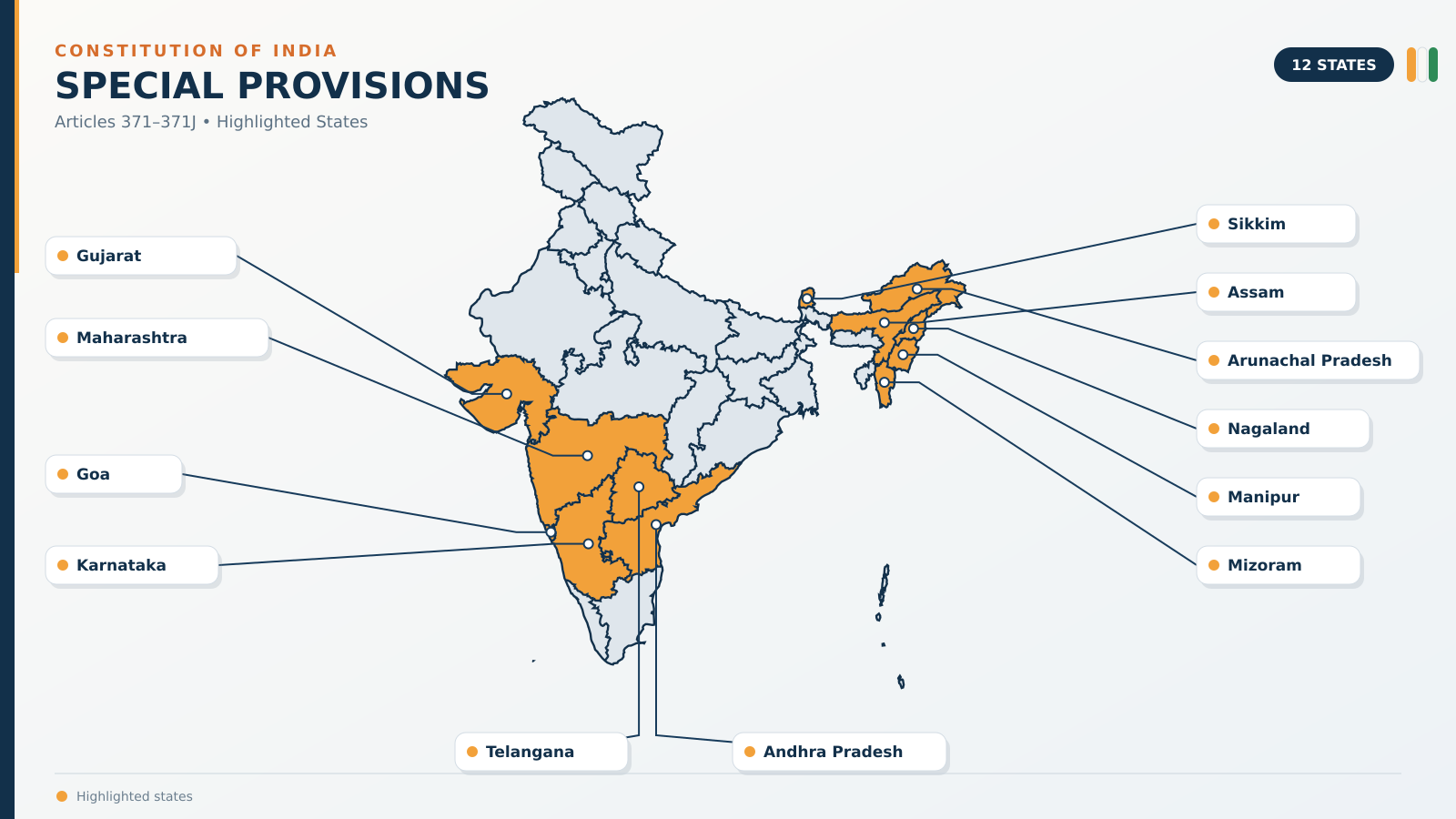
A. Trade, Commerce & Intercourse
- Trade and Commerce से संबंधित provisions Constitution के Part XIII में हैं।
- Part XIII में Articles 301 से 307 आते हैं।
- Article 301 पूरे India में trade, commerce और intercourse की freedom देता है।
- Article 301 की freedom absolute नहीं है; यह Part XIII के अन्य provisions के अधीन है।
- Article 302 Parliament को public interest में trade पर restrictions लगाने की power देता है।
- Parliament एक State से दूसरे State के trade पर भी reasonable restriction लगा सकती है।
- Article 303 Centre और States को सामान्यतः एक State को दूसरे पर preference देने से रोकता है।
- इसी तरह States के बीच discrimination भी सामान्यतः prohibited है।
- Goods की scarcity जैसी स्थिति में Parliament Article 303 के exception का use कर सकती है।
- यह scarcity exception केवल Parliament को दिया गया है, State Legislature को नहीं।
- Article 304(a) State को बाहर से आने वाले goods पर tax लगाने देता है।
- लेकिन imported goods और State में बने similar goods के बीच tax discrimination नहीं होना चाहिए।
- Article 304(b) public interest में reasonable restrictions की अनुमति देता है।
- Article 304(b) वाला Bill State Legislature में लाने से पहले President की previous sanction जरूरी है।
- Article 305 existing laws और State monopoly से जुड़े laws को protection देता है।
- Article 306 अब omitted है।
- Article 307 Parliament को Articles 301–304 लागू करने के लिए authority बनाने की power देता है।
- Jindal Stainless v. State of Haryana (2016) में Supreme Court ने कहा कि केवल tax लगना अपने-आप Article 301 का violation नहीं है।
- Article 304(a) मुख्य रूप से discriminatory taxation को रोकता है।
- Jindal Stainless में पुरानी Compensatory Tax Theory को reject कर दिया गया।
B. Official Language | राजभाषा
- Official Language से संबंधित provisions Constitution के Part XVII में हैं।
- Part XVII में Articles 343 से 351 आते हैं।
- Part XVII चार Chapters में divided है।
- Article 343 Union की Official Language से संबंधित है।
- Union की Official Language Hindi in Devanagari Script है।
- Union के official purposes के लिए numerals का form International Form of Indian Numerals है।
- Constitution ने शुरुआत में English के continued use के लिए 15 years का period रखा था।
- Parliament को 15 years के बाद भी English के use को continue करने की power दी गई थी।
- Official Languages Act, 1963 के कारण Hindi के साथ English आज भी Union के official purposes में use होती है।
- Important Trap: Constitution Hindi को Union की Official Language कहता है, “National Language” नहीं।
- Constitution में किसी language को National Language घोषित नहीं किया गया है।
C. Article 344 | Official Language Commission
- Article 344 Official Language Commission और Parliamentary Committee से संबंधित है।
- Constitution commencement के 5 years बाद पहला Official Language Commission बनना था।
- दूसरा Commission commencement के 10 years बाद बनना था।
- Commission को President constitute करता है।
- इसमें Eighth Schedule की अलग-अलग languages का representation होता है।
- Commission Hindi के progressive official use पर recommendation देता है।
- English के official use से जुड़े matters पर भी recommendation दे सकता है।
- Article 344 के तहत Parliamentary Committee में कुल 30 members होते हैं।
- इसमें 20 Lok Sabha members होते हैं।
- इसमें 10 Rajya Sabha members होते हैं।
- Members का election proportional representation द्वारा Single Transferable Vote से होता है।
D. State & Regional Languages
- Article 345 State की Official Language से संबंधित है।
- State Legislature State में use होने वाली एक या अधिक languages को official language बना सकती है।
- State Hindi को भी official language के रूप में adopt कर सकता है।
- Article 346 State-to-State और State-to-Union official communication से संबंधित है।
- दो या अधिक States आपसी agreement से अपने communication में Hindi use कर सकते हैं।
- Article 347 किसी State की population के substantial section की language से संबंधित है।
- ऐसी demand पर President किसी language को State या उसके किसी part में official recognition देने का direction दे सकता है।
E. Language of Courts
- Article 348 Supreme Court और High Courts की language से संबंधित है।
- सामान्य constitutional rule के अनुसार Supreme Court proceedings की language English है।
- High Court proceedings के लिए भी सामान्य rule English है।
- Parliament law बनाकर इस position में change कर सकती है।
- Governor, President की previous consent से High Court proceedings में Hindi या State की official language को authorise कर सकता है।
- Article 348(2) की यह permission अपने-आप High Court के judgment, decree या order पर लागू नहीं होती।
- Official Languages Act, 1963 की Section 7 कुछ conditions के साथ High Court judgments आदि में Hindi/State language के use की अनुमति देती है।
- ऐसी judgment/decree/order के साथ authorised English translation देना होता है।
F. Linguistic Safeguards
- Article 350 व्यक्ति को grievance representation किसी ऐसी language में देने देता है जो Union या State में use होती है।
- Article 350A linguistic minority children के लिए primary stage पर mother tongue education facilities से संबंधित है।
- State और local authorities को ऐसी facilities देने का प्रयास करना चाहिए।
- President इस संबंध में State को directions दे सकता है।
- Article 350B Special Officer for Linguistic Minorities से संबंधित है।
- Special Officer को President appoint करता है।
- वह linguistic minorities के constitutional safeguards की जांच करता है।
- उसकी reports President को दी जाती हैं और Parliament के सामने रखी जाती हैं।
- Article 351 Hindi language के development के लिए Union को directive देता है।
- Hindi के development में Hindustani और Eighth Schedule languages के forms और expressions से enrichment की बात कही गई है।
- Hindi vocabulary के लिए Constitution ने primarily Sanskrit और secondarily other languages का reference दिया है।
- Eighth Schedule में वर्तमान में 22 languages हैं।
- Eighth Schedule की 22 languages का अर्थ यह नहीं है कि Union की 22 official languages हैं।
G. Temporary, Transitional & Special Provisions
- Special provisions का मुख्य framework Constitution के Part XXI में है।
- Part XXI का title है—Temporary, Transitional and Special Provisions।
- Article 369 Parliament को कुछ State List matters पर temporary law-making power देता था।
- Article 369 की यह special power Constitution commencement से केवल 5 years के लिए थी।
- इसलिए Article 369 अब मुख्यतः historical importance रखता है।
H. Article 370 | Jammu & Kashmir
- Article 370 originally Jammu and Kashmir के लिए temporary special constitutional arrangement था।
- 6 August 2019 से Presidential Declaration के जरिए Article 370 के पुराने clauses को largely inoperative कर दिया गया।
- Current constitutional text के अनुसार Constitution of India के सभी provisions Jammu and Kashmir पर बिना पुराने special modifications के लागू होते हैं।
- In Re: Article 370 (2023) में Supreme Court ने 2019 के उस constitutional outcome को uphold किया जिससे Article 370 की special arrangement समाप्त हुई।
- Supreme Court ने माना कि Article 370 एक temporary provision था।
I. Articles 371–371J | State-wise Special Provisions
- Article 371 Maharashtra और Gujarat से संबंधित है।
- इसमें Vidarbha, Marathwada तथा Gujarat के कुछ regions के development के लिए special arrangements किए जा सकते हैं।
- Governor के लिए separate development boards और equitable allocation of development funds की responsibility दी जा सकती है।
- Article 371A – Nagaland: Naga religious/social practices, customary law, customary justice और land/resources पर Parliamentary law सामान्यतः तभी लागू होता है जब Nagaland Assembly resolution से ऐसा decide करे।
- Article 371A को 13th Constitutional Amendment से जोड़ा गया।
- Article 371B – Assam: Tribal Areas के elected MLAs की special Assembly Committee से संबंधित है।
- Article 371B को 22nd Constitutional Amendment से जोड़ा गया।
- Article 371C – Manipur: Hill Areas के लिए Legislative Assembly Committee और Governor की special responsibility से संबंधित है।
- Article 371C को 27th Constitutional Amendment से जोड़ा गया।
- Article 371D – Andhra Pradesh & Telangana: public employment और education में अलग regions के लोगों के लिए equitable opportunities से संबंधित है।
- Article 371E Parliament को Andhra Pradesh में Central University establish करने की power देता है।
- Articles 371D और 371E मुख्य रूप से 32nd Constitutional Amendment से जुड़े हैं।
- Article 371F – Sikkim: Sikkim के लिए special constitutional arrangements देता है।
- Sikkim Legislative Assembly में कम-से-कम 30 members होने चाहिए।
- Article 371F को 36th Constitutional Amendment, 1975 से जोड़ा गया।
- Article 371G – Mizoram: Mizo religious/social practices, customary law, customary justice और land ownership से जुड़े Parliamentary laws को special protection देता है।
- Mizoram Legislative Assembly में कम-से-कम 40 members होने चाहिए।
- Article 371G 53rd Constitutional Amendment से जुड़ा है।
- Article 371H – Arunachal Pradesh: Governor को law and order के संबंध में special responsibility देता है।
- Arunachal Pradesh Assembly में कम-से-कम 30 members होने चाहिए।
- Article 371H 55th Constitutional Amendment से जुड़ा है।
- Article 371-I – Goa: Goa Legislative Assembly में कम-से-कम 30 members होने चाहिए।
- Article 371-I 56th Constitutional Amendment से जुड़ा है।
- Article 371J – Karnataka: Constitution में Hyderabad-Karnataka region के लिए special development provisions दिए गए हैं।
- इसमें separate Development Board, equitable development funds और education/public employment opportunities के provisions हैं।
- Article 371J 98th Constitutional Amendment से जोड़ा गया।
J. Other Transitional Provisions
- Article 372 Constitution लागू होने से पहले के existing laws को continue करने से संबंधित है।
- Existing law केवल Constitution लागू होने से automatically समाप्त नहीं हुआ।
- लेकिन ऐसा law Constitution के अन्य provisions के अधीन है।
- Article 372A President की adaptation of laws power से संबंधित है।
- Articles 374–378 Federal Court, High Court Judges, CAG और Public Service Commissions की constitutional transition से जुड़े provisions हैं।
- Articles 379 से 391 अब omitted हैं।
- Article 392 President की power to remove difficulties से संबंधित transitional provision है।
Schedules + Important Amendments + Landmark Cases + Miscellaneous Articles
अनुसूचियाँ + महत्वपूर्ण संशोधन + ऐतिहासिक निर्णय + विविध अनुच्छेद
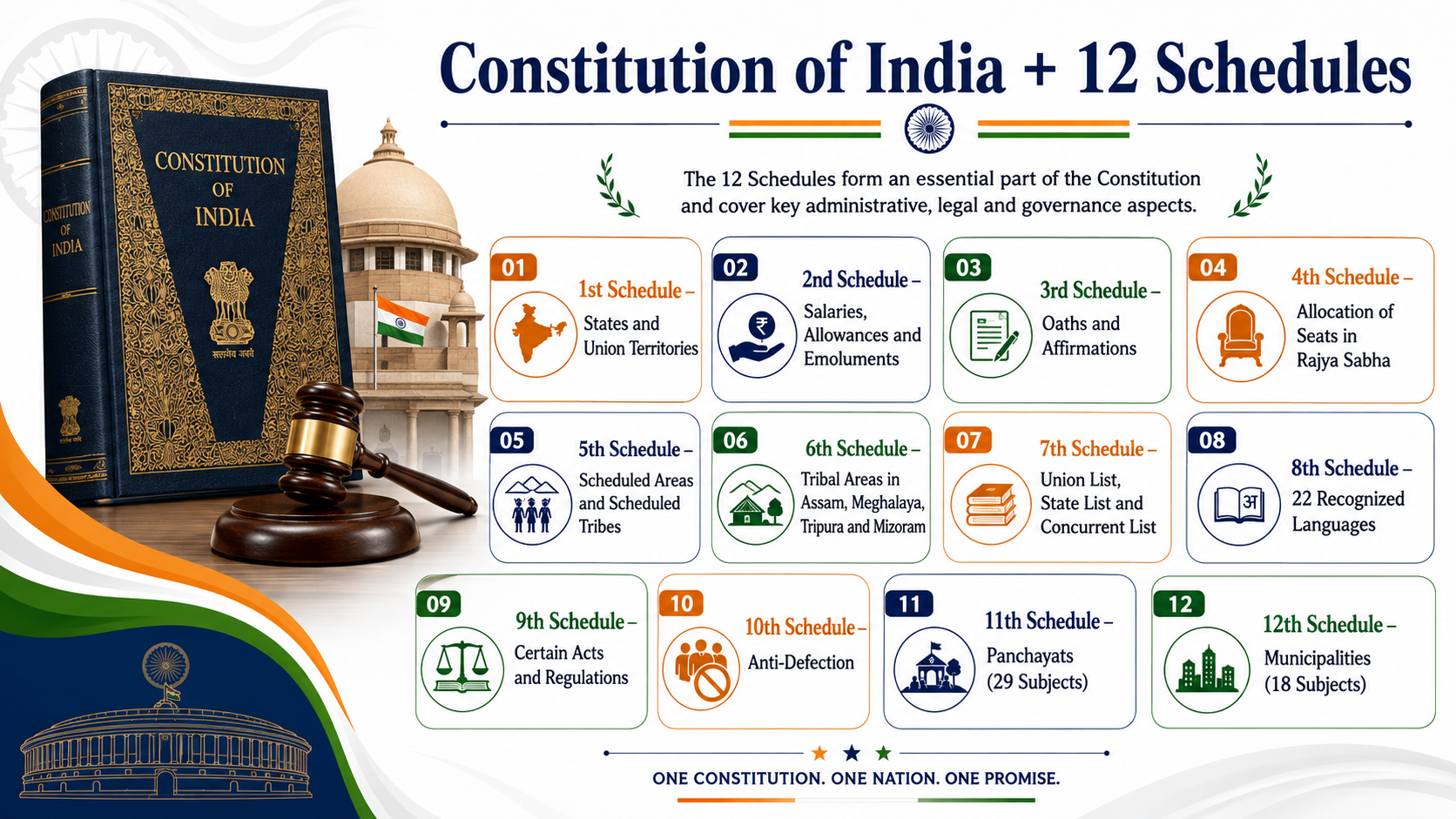
A. Schedules of the Constitution | संविधान की अनुसूचियाँ
- भारतीय संविधान में वर्तमान में कुल 12 Schedules हैं।
- First Schedule States और Union Territories से संबंधित है।
- First Schedule में States के territories का constitutional description मिलता है।
- Union Territories भी First Schedule में listed हैं।
- Second Schedule कुछ constitutional authorities के salary, allowances और privileges से संबंधित है।
- इसमें President और Governors से जुड़े provisions हैं।
- Parliament तथा State Legislature के presiding officers भी Second Schedule में आते हैं।
- Supreme Court और High Court Judges से जुड़े provisions भी इसमें हैं।
- CAG से संबंधित provisions भी Second Schedule में हैं।
- Third Schedule constitutional offices के Oaths and Affirmations के forms देता है।
- Union Ministers और State Ministers की oath Third Schedule में है।
- MPs और MLAs की oath भी Third Schedule में दी गई है।
- Supreme Court और High Court Judges की oath भी Third Schedule में है।
- Fourth Schedule Rajya Sabha में seats के allocation से संबंधित है।
- Rajya Sabha में States और Union Territories की seat allocation Fourth Schedule में दी गई है।
- Fifth Schedule Scheduled Areas और Scheduled Tribes के administration से संबंधित है।
- Fifth Schedule मुख्य रूप से Scheduled Areas की administration और control से जुड़ी है।
- Sixth Schedule Assam, Meghalaya, Tripura और Mizoram के Tribal Areas से संबंधित है।
- Sixth Schedule में Autonomous District Councils और Regional Councils का framework मिलता है।
- Seventh Schedule Centre और States की legislative powers divide करती है।
- Seventh Schedule में Union List, State List और Concurrent List हैं।
- Eighth Schedule recognised constitutional languages से संबंधित है।
- Eighth Schedule में वर्तमान में 22 languages हैं।
- Ninth Schedule certain Acts और Regulations से संबंधित है।
- Ninth Schedule को 1st Constitutional Amendment, 1951 द्वारा जोड़ा गया था।
- Ninth Schedule के laws को आज complete judicial-review immunity नहीं है।
- I.R. Coelho case के अनुसार 24 April 1973 के बाद Ninth Schedule में डाले गए laws Basic Structure review face कर सकते हैं।
- Tenth Schedule Anti-Defection Law से संबंधित है।
- Tenth Schedule को 52nd Constitutional Amendment, 1985 द्वारा जोड़ा गया।
- Party voluntarily छोड़ना defection का ground हो सकता है।
- Party whip के विरुद्ध vote/abstain करना भी prescribed conditions में disqualification ला सकता है।
- Independent elected member election के बाद political party join करे तो disqualified हो सकता है।
- Nominated member को seat लेने के 6 months के भीतर party join करने की freedom मिलती है।
- Merger exception के लिए legislative party के कम-से-कम 2/3 members जरूरी होते हैं।
- पुराना one-third split exception 91st Amendment द्वारा समाप्त कर दिया गया।
- Defection का decision Speaker या Chairman करता है।
- Speaker/Chairman का Tenth Schedule decision judicial review से पूरी तरह बाहर नहीं है।
- Eleventh Schedule Panchayats से संबंधित है।
- Eleventh Schedule में 29 subjects हैं।
- Twelfth Schedule Municipalities से संबंधित है।
- Twelfth Schedule में 18 subjects हैं।
B. Most Important Constitutional Amendments
- 1st Amendment, 1951 ने Article 15(4), Articles 31A–31B और Ninth Schedule जैसे important changes किए।
- 7th Amendment, 1956 States Reorganisation से closely जुड़ा है।
- 24th Amendment, 1971 ने Parliament की constitutional amendment power को expressly strengthen किया।
- 25th Amendment, 1971 Article 31C से संबंधित है।
- 26th Amendment, 1971 ने Privy Purses और former rulers की recognition समाप्त की।
- 36th Amendment, 1975 ने Sikkim को State बनाया।
- 42nd Amendment, 1976 को अक्सर Mini Constitution कहा जाता है।
- 42nd Amendment ने Preamble में Socialist, Secular और Integrity से जुड़े changes किए।
- 42nd Amendment ने Fundamental Duties भी जोड़ीं।
- 44th Amendment, 1978 ने Right to Property को Fundamental Right से हटाया।
- 44th Amendment ने Emergency safeguards को भी मजबूत किया।
- 52nd Amendment, 1985 ने Anti-Defection Law और Tenth Schedule जोड़ी।
- 61st Amendment ने voting age 21 से 18 years की।
- 69th Amendment National Capital Territory of Delhi और Article 239AA से संबंधित है।
- 73rd Amendment Panchayats को constitutional status देता है।
- 74th Amendment Municipalities को constitutional status देता है।
- 86th Amendment ने Article 21A के तहत Right to Education जोड़ा।
- 91st Amendment ने Ministries के size पर 15% ceiling और anti-defection safeguards मजबूत किए।
- 97th Amendment Co-operative Societies से संबंधित है।
- 99th Amendment ने NJAC बनाया, लेकिन Supreme Court ने इसे unconstitutional घोषित कर दिया।
- 101st Amendment GST से संबंधित है।
- 102nd Amendment ने NCBC को constitutional status दिया।
- 103rd Amendment EWS reservation से संबंधित है।
- 104th Amendment ने SC/ST legislative reservation की अवधि बढ़ाई और Anglo-Indian nomination arrangement समाप्त होने दिया।
- 105th Amendment States की SEBC identification power से संबंधित है।
- 106th Amendment, 2023 Lok Sabha और State Assemblies में women reservation से संबंधित है।
- Current official 2026 Constitution amendments को 106th Amendment तक incorporate करता है।
C. Landmark Constitutional Cases
- Shankari Prasad v. Union of India (1951) — Parliament की Fundamental Rights amend करने की power को initially uphold किया गया।
- Golaknath v. State of Punjab (1967) — Parliament की Fundamental Rights amendment power पर restriction लगाया गया।
- Kesavananda Bharati v. State of Kerala (1973) — Basic Structure Doctrine स्थापित हुआ।
- Kesavananda Bharati judgment की important date 24 April 1973 है।
- Kesavananda Bharati case 13-Judge Bench ने decide किया था।
- Indira Nehru Gandhi v. Raj Narain (1975) — Free and fair elections तथा Rule of Law को constitutional importance मिली।
- Maneka Gandhi v. Union of India (1978) — Article 21 की interpretation को बहुत व्यापक बनाया गया।
- Minerva Mills v. Union of India (1980) — Limited amending power और FR-DPSP balance को protect किया गया।
- Waman Rao v. Union of India (1981) — Ninth Schedule के लिए 24 April 1973 महत्वपूर्ण cut-off बना।
- Indra Sawhney v. Union of India (1992) — OBC reservation jurisprudence का landmark case है।
- Kihoto Hollohan v. Zachillhu (1992) — Speaker के anti-defection decision को judicial review के अधीन माना गया।
- S.R. Bommai v. Union of India (1994) — Federalism, secularism और Article 356 के लिए landmark case है।
- S.R. Bommai ने President's Rule को judicial review के अधीन माना।
- Vishaka v. State of Rajasthan (1997) — workplace sexual harassment के खिलाफ guidelines दी गईं।
- L. Chandra Kumar v. Union of India (1997) — Articles 32 और 226/227 की judicial review power को Basic Structure से जोड़ा गया।
- I.R. Coelho v. State of Tamil Nadu (2007) — Ninth Schedule की immunity को Basic Structure के अधीन रखा गया।
- NJAC Case (2015) — 99th Amendment और NJAC को struck down किया गया।
- K.S. Puttaswamy v. Union of India (2017) — Right to Privacy को Fundamental Right माना गया।
- Navtej Singh Johar v. Union of India (2018) — consensual same-sex relations के criminalisation को constitutional rights के विरुद्ध माना गया।
- Joseph Shine v. Union of India (2018) — adultery offence को unconstitutional घोषित किया गया।
- Janhit Abhiyan v. Union of India (2022) — 103rd Amendment/EWS reservation को uphold किया गया।
- In Re: Article 370 (2023) — Supreme Court ने 2019 की Article 370-related constitutional action को uphold किया।
- Property Owners Association v. State of Maharashtra (2024) — हर privately owned property अपने-आप Article 39(b) का “material resource of the community” नहीं है।
D. Miscellaneous Articles | विविध अनुच्छेद
- Constitution का Part XIX Miscellaneous provisions से संबंधित है।
- Part XIX में मुख्यतः Articles 361 से 367 आते हैं।
- Article 361 President और Governors को office के दौरान कुछ constitutional immunities देता है।
- President या Governor अपने official powers के exercise के लिए किसी court के प्रति personally answerable नहीं होते।
- उनके term के दौरान उनके खिलाफ criminal proceedings institute या continue नहीं की जा सकतीं।
- President या Governor की arrest या imprisonment के लिए court process उनके term के दौरान issue नहीं की जा सकती।
- Article 361A Parliament और State Legislature proceedings की substantially true publication को protection देता है, subject to constitutional conditions।
- Article 361B defection से disqualified member को certain remunerative political posts से भी temporarily disqualify करता है।
- Article 363 certain pre-Constitution treaties और agreements से जुड़े disputes में courts की jurisdiction को bar करता है।

Frequently Asked Questions (FAQs)
Q1. इन Constitution One-Liners में क्या-क्या cover किया गया है?
भारतीय संविधान के महत्वपूर्ण Articles, Parts, Schedules, Amendments, Constitutional Bodies, Landmark Cases और प्रमुख Doctrines को chapter-wise cover किया गया है।
Q2. ये notes किन exams के लिए useful हैं?
Judiciary, APO, UPSC, State PCS, SSC, Law Entrance, UGC NET Law और अन्य competitive exams के लिए उपयोगी हैं।
Q3. क्या ये notes latest Constitution के अनुसार हैं?
हाँ, content को उपलब्ध नवीनतम constitutional provisions और official sources के आधार पर तैयार किया गया है।
Q4. इन notes का मुख्य source क्या है?
मुख्य रूप से Constitution of India, Legislative Department, Supreme Court judgments तथा संबंधित official government sources।
Q5. क्या इसमें सभी महत्वपूर्ण Articles शामिल हैं?
Exam point of view से महत्वपूर्ण Articles और frequently asked provisions को priority दी गई है।
Q6. क्या Landmark Supreme Court Cases भी दिए गए हैं?
हाँ, Kesavananda Bharati, Maneka Gandhi, S.R. Bommai, Minerva Mills, Puttaswamy जैसे महत्वपूर्ण constitutional cases शामिल हैं।
Q7. क्या Constitutional Amendments भी cover किए गए हैं?
हाँ, परीक्षा के लिए महत्वपूर्ण Constitutional Amendments और उनसे हुए प्रमुख बदलाव शामिल हैं।
Q8. Constitution में वर्तमान में कितने Schedules हैं?
भारतीय संविधान में वर्तमान में 12 Schedules हैं।
Q9. Constitution में कितने Parts हैं?
वर्तमान Constitution में 25 operative Parts माने जाते हैं।
Q10. क्या केवल One-Liners पढ़ना पर्याप्त है?
One-Liners revision और Prelims के लिए बहुत उपयोगी हैं, लेकिन Judiciary Mains के लिए Bare Act, case laws और detailed concepts भी पढ़ने चाहिए।
Q11. इन One-Liners को कैसे revise करें?
रोज 1–2 Chapters पढ़ें, महत्वपूर्ण Articles mark करें और सप्ताह के अंत में Quick Revision करें।
Q12. कठिन Articles कैसे याद करें?
Articles को topic-wise groups में याद करें, जैसे FR: 12–35, DPSP: 36–51, Duties: 51A, President: 52–78, Parliament: 79–122।
Q13. क्या Constitution की भाषा पूरी तरह सरल रखी गई है?
हाँ, technical constitutional terms को रखते हुए explanation को आसान और exam-oriented बनाया गया है।
Q14. अगर Constitution में नया Amendment या Supreme Court judgment आता है तो?
ऐसे important changes को समय-समय पर notes में update किया जाना चाहिए।
Q15. सबसे पहले कौन से Chapters revise करें?
Fundamental Rights, DPSP, President, Parliament, Supreme Court, Centre-State Relations, Emergency, Constitutional Bodies और Amendments को priority दें।